房地产

Search documents
麻烦你,尊重一下王石
虎嗅APP· 2026-01-22 10:18
以下文章来源于纪中展讲决策 ,作者纪中展 纪中展讲决策 . 纪中展|伟事达 095 组教练|随行灯塔创始人产品社群发起人|亿级创始人的决策力教练|被企业家们称 为"黄油刀教练",温柔锋利,专切创始人的关键决策难题。 本文来自微信公众号: 纪中展讲决策 ,作者:纪中展,题图来自:视觉中国 每次王石被推上热搜,我都觉得荒诞。荒诞的不是他的人生有起伏,那谁的人生没有呢。荒诞的是一 个在中国企业发展史上写下浓重一笔的人,正在被当成段子消费。 你可以不喜欢他的婚姻,你可以看不惯他的太太,你甚至可以不同意他的很多选择,包括他讲的很多 话。 但,也请你别把一个有历史定位的符号级别的企业家,降格成八卦素材。麻烦你,尊重一下王石。 王石不是"普通名人",他是有历 史定位的 王石之所以值得被尊重,不是因为他"没错",而是因为他确实给过中国企业家一个重要的启发:企业 家可以不只是一种活法。 他之所以是符号:因为他"开过 路" 真正值得尊重的企业家,往往不只是"赚钱的人",而是"开过路的人"。王石的意义在于:他在多个关 键问题上,给了中国企业家"另一条路"的想象空间。 他代表的,不只是"做成一家大公司",更是一种更稀缺的尝试:把企业 ...


华人置业(00127.HK):金得诚获授80亿港元有期贷款融资
Ge Long Hui· 2026-01-22 09:49
Group 1 - The company, China Overseas Land & Investment Limited (00127.HK), announced that its joint venture, Goldrich, successfully acquired a plot of land in Kai Tak, Kowloon, Hong Kong, known as New Kowloon Inland Lot No. 6590 [1] - The joint venture is fully owned by Fengwei Limited, with the company holding a 10% stake and other partners holding the remaining 90% [1] - As of the announcement date, the group has provided multiple loans to Goldrich for partial payment of the land price and development costs, with a total outstanding loan balance of HKD 414,585,743.93, which is unsecured and bears an annual interest rate of 2% [1] Group 2 - On January 22, 2026, Goldrich will enter into a term loan financing agreement with a syndicate of lenders, involving a total principal amount of HKD 8 billion [1] - The financing aims to refinance an existing loan of HKD 2.14 billion owed to an external bank and to finance or refinance construction costs and related professional fees for the development of the land [1] - The total amount drawn from the syndicate loan financing, along with all accrued interest and other payable amounts, will be repaid in a lump sum on the final maturity date [1]
融创中国(01918)根据强制可转换债券发行9.59亿股
智通财经网· 2026-01-22 09:35
智通财经APP讯,融创中国(01918)发布公告,于2026年1月22日,该公司根据于2025年12月23日发行 2026年到期的零票息强制可转换债券 ("强制可转换债券1") 配发及发行9.59亿股新股。 ...
樊纲:市场是最稀缺的资源,要将消费作为战略基点丨财金先生
Sou Hu Cai Jing· 2026-01-22 09:05
Core Viewpoint - The current global economic landscape is characterized by multiple interwoven factors, with China's economic resilience being a focal point amidst external pressures and internal structural challenges [2][4]. Group 1: Global Economic Dynamics - The West's attempts to contain China focus on hindering its latecomer advantages, misinterpreting the learning and technology diffusion process as "theft" [2]. - China's traditional comparative advantages are shifting as labor-intensive industries lose cost advantages to lower-income countries like India and Southeast Asia [2]. - Despite a 30% year-on-year decline in exports to the U.S., China's exports to ASEAN and the EU grew by 14.6% and 8.9% respectively in the first 11 months of 2025, indicating strong resilience and the vitality of global cooperation [3]. Group 2: Domestic Economic Challenges - The real estate bubble is a significant challenge, with historical precedents suggesting that adjustments can take 5 to 20 years [4]. - The current economic downturn is exacerbated by a "liquidity trap," where businesses are reluctant to invest despite increased money supply, leading to limited effectiveness of monetary policy [4]. - Consumer spending is a critical shortfall, with household consumption accounting for only 40% of GDP, significantly below the global average [4]. Group 3: Paths to Economic Resilience - The first path is to continuously activate latecomer advantages by balancing learning and independent research in key technology sectors [5]. - The second path involves promoting industrial restructuring and upgrading through mergers and acquisitions in overcapacity industries, drawing on historical experiences from market economies [5]. - The third path emphasizes accelerating the globalization of Chinese enterprises, leveraging foreign investments to assist industrialization in developing countries, which can alleviate international pressure from trade surpluses [5]. Group 4: Policy Recommendations and Growth Potential - The market is identified as the most scarce resource, with a call to prioritize consumption as a strategic foundation by improving social security systems and increasing incomes for low-income groups [5]. - China's urbanization rate of 64% still lags behind developed countries, presenting opportunities for growth, alongside a strong talent pool and a complete industrial chain [5]. - The transformative potential of artificial intelligence is highlighted as a crucial driver for future economic growth, with China positioned in the leading tier of AI development [5][6].
尝高美集团(08371)通过附属与丰树产业私人有限公司签订了新租赁协议开设四间新餐厅
智通财经网· 2026-01-22 08:55
Core Viewpoint - The company, Chao Mei Group, has signed a new lease agreement to open four new restaurants, which aligns with its strategic growth plan and is expected to enhance shareholder value [1] Group 1: New Restaurant Openings - The new lease agreement was signed with a wholly-owned subsidiary of the owner, Fengshu Industry Private Limited, and is set to open four new restaurants by the third quarter of 2026 [1] - The new restaurants include: (1) Niuqi, (2) Jinlong, (3) Majizao, and (4) Social Korean, with Social Korean being the first casual Korean fusion restaurant under the group [1] - The new openings will bring the total number of restaurants under the group to 13 for Niuqi, 3 for Jinlong, 4 for Majizao, and the first for Social Korean [1] Group 2: Strategic Location - The new restaurants will be located in another city, which is a high-end shopping center and a significant transit hub with over 200 shops and restaurants, as well as 229,000 square feet of office space [1] - The owner of the shopping center is a leading global real estate developer and high-end shopping center operator, managing 938 properties across 13 markets including Singapore, the USA, France, Germany, and Japan [1] - The board believes that opening new restaurants in high-traffic shopping centers like another city aligns with the company's operational strategy and serves the best interests of the company and its shareholders [1]
辽宁发布推动城市高质量发展的实施意见
Zhong Guo Fa Zhan Wang· 2026-01-22 08:29
中国发展网讯 记者施文郁报道 为深入贯彻落实中央城市工作会议精神和《中共中央、国务院关于推动 城市高质量发展的意见》,结合辽宁实际,辽宁省委、省政府提出如下实施意见。 优化城市体系,提升综合承载能力 建设现代化都市圈和城市群。持续推进规划统筹、设施互通、产业协作、服务共享、生态共保、文旅共 建、社会共治,着力构建双核引领、多点支撑、全域协同的现代化城市体系。完善沈阳都市圈协同推进 机制,加速同城化进程。提升辽宁沿海经济带融合开放水平,优化港口群功能布局,加强与腹地互动。 联动建设沈大经济走廊,提升辽中南城市群发展能级。深化辽西地区与京津冀要素双向流动。支持辽东 地区发展绿色经济。 增强沈大双核发展能级和辐射带动作用。支持沈阳立足全国先进制造业基地、东北现代服务业中心、区 域性科技创新高地等核心功能,建设东北亚国际化中心城市、国家历史文化名城、国际性综合交通枢纽 城市。支持大连"两先区"、"三个中心"建设,建设现代海洋城市,在体制机制创新、新旧动能转换、高 水平对外开放等方面发挥示范引领作用。 促进大中小城市和小城镇协调发展。坚持特色差异发展,增强鞍山、丹东、锦州、营口辐射带动作用, 提升抚顺、阜新转型发展能力 ...
越来越多日企视加息为不利因素 日本央行面临政策挑战
Xin Hua Cai Jing· 2026-01-22 06:51
Core Viewpoint - An increasing number of Japanese companies perceive that rising interest rates negatively impact their business, highlighting the challenges faced by the Bank of Japan in normalizing its long-standing ultra-low interest rate policy [1] Group 1: Business Sentiment - Approximately 44% of Japanese companies believe that the downside risks of rising interest rates outweigh the upside risks, a figure that has increased by nearly 7 percentage points compared to expectations in April 2024 [1] - Companies expressing concern include real estate firms worried that rising mortgage rates will suppress housing demand, as well as businesses indicating they may need to delay loans [1] - Only 2.8% of companies feel that rising interest rates will benefit them, with some believing that a stronger yen will reduce import costs [1] Group 2: Currency Impact - The announcement by Prime Minister Fumio Kishida regarding the early election has led to a further decline in the yen this month [1]
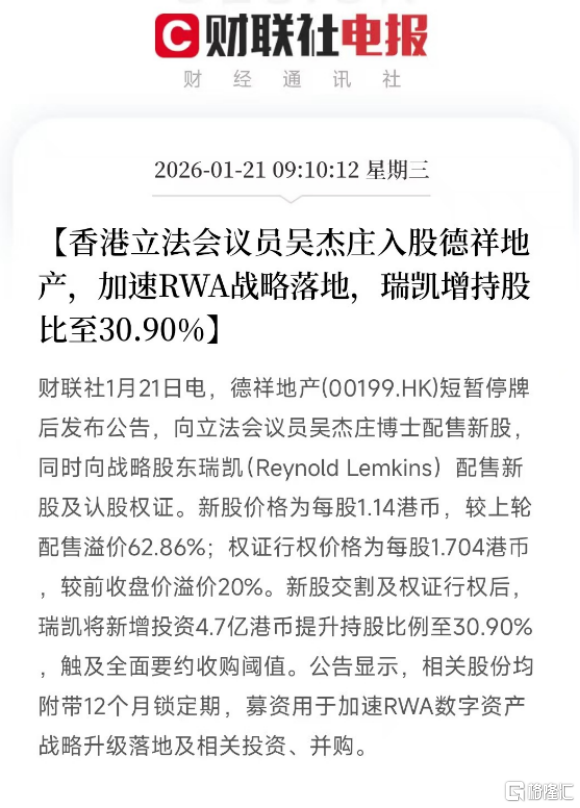
30.9% 持股锁定!壳王陈国强交棒,德祥地产的 RWA 估值革命来了
Ge Long Hui· 2026-01-22 06:33
Core Viewpoint - The article discusses the strategic maneuvers of Chen Guoqiang, a prominent figure in Hong Kong's capital market, particularly focusing on the transformation of Deshang Real Estate and the aggressive tactics employed by Ruikai Group to gain control over it [1][3][4]. Group 1: Strategic Moves - Ruikai Group's operation is characterized as a "textbook-level control battle," where it initially acquired a 10% stake and subsequently increased its holding to 30.90% through a secondary issuance and structured warrants, investing HKD 470 million at a 68% premium [3]. - The details of a HKD 1.70 exercise price and a one-year lock-up commitment reveal Ruikai's long-term ambitions, aiming for absolute control rather than short-term gains [3][4]. Group 2: Transformation of Deshang Real Estate - Chen Guoqiang's strategy involves selling off nearly HKD 1 billion in overseas and local properties, which appears to be asset reallocation but is actually a move to dismantle his real estate foundation for the next generation [4]. - The collaboration between Chen Guoqiang and Ruikai is framed as a "cross-generational dialogue," combining Chen's clean shell and market credibility with Ruikai's RWA technology and capital allocation system to pivot Deshang Real Estate into the digital asset infrastructure sector [4][5]. Group 3: Competitive Advantages - Ruikai's strength lies not only in financial resources but also in its ability to inject social resources and operational capabilities into the target company, providing long-term liquidity and connecting with high-quality resources in the new capital cycle [4]. - The involvement of Wu Jiezhuang, a legislative council member, adds a significant policy endorsement, reinforcing Deshang's compliance as an RWA vehicle and signaling strong market confidence in its long-term prospects [4]. Group 4: Valuation Perspective - Deshang Real Estate's valuation should no longer be based on traditional real estate logic, as Chen Guoqiang is transitioning the company from physical asset sales to digital asset issuance through RWA technology [5]. - The article emphasizes the need for investors to reconsider the potential valuation ceiling of a company that shifts its foundational logic from "selling land" to "issuing digital assets," highlighting the significance of this capital game in the Hong Kong market [5].
内外需增长斜率分化,关注出口和科技共振方向
China Post Securities· 2026-01-22 05:41
Economic Growth - China's GDP growth for 2025 is projected at 5%, achieving the annual economic growth target[2] - Quarterly GDP growth rates show a trend of high to low, with rates of 5.4%, 5.2%, 4.8%, and 4.5% respectively[9] Demand and Consumption - Retail sales growth in December was 0.9%, continuing a trend of marginal decline for seven consecutive months[14] - Consumer confidence remains low, with household short-term loans decreasing by CNY 1,023 billion in December 2025, a drop of CNY 16,113 billion compared to 2024[15] Investment Trends - Fixed asset investment growth fell to -3.8% for the year, a decline of 1.2 percentage points from the previous value[21] - Real estate investment saw a significant drop of 17.2% year-on-year, indicating a deep adjustment in the market[21] Export and Production - Industrial added value in December grew by 5.2%, with a notable increase in high-tech industries[27] - Export delivery value increased by 3.2% in December, correlating with the rise in industrial output[27] Policy and Future Outlook - The government aims to stabilize investment, with significant policy tools already deployed to support infrastructure projects[23] - The export momentum is expected to continue into 2026, remaining a key driver of economic growth[30]
特斯拉将终止FSD免费转移|首席资讯日报
首席商业评论· 2026-01-22 04:52
Group 1 - Tesla has announced the termination of its free FSD transfer plan, effective March 31, 2026, aiming to increase the usage rate of FSD features [2] - The minimum down payment ratio for commercial housing loans in 20 cities in Guangdong Province will be adjusted to no less than 30%, effective January 21, 2026 [3] - The 2026 Spring Festival travel period is expected to see record-high inter-regional mobility and passenger volumes in rail and civil aviation, with self-driving remaining the primary mode of travel [4] Group 2 - The State Administration for Market Regulation reported that 1.3977 million problematic power banks were recalled in 2025, with ongoing efforts to strengthen product recall supervision [5] - In 2025, real estate development investment in Henan Province is projected to decline by 8.6%, with residential investment down by 9.6% [6] - Pinduoduo was fined 100,000 yuan for failing to report tax information as required, highlighting the importance of compliance in business operations [7] Group 3 - Great Wall Motors' new vehicle sales reached 1.3237 million in 2025, with over 500,000 units sold in overseas markets, reflecting a year-on-year growth of 11.68% [8] - Xibei Catering Group has secured Series A financing, increasing its registered capital by approximately 13.1% [9] - Douyin reported a 90% decrease in rumor exposure in 2025, thanks to improved rumor detection and management systems [10] Group 4 - Douyin's e-commerce division denied the development of a product called "Dou Sheng Sheng," clarifying that it is part of a local service exploration [11] - New Media Co., Ltd. announced that its co-invested dramas are being released as planned, with revenues to be recognized according to the broadcasting schedule [12] - Taobao and Tmall are upgrading their real experience score system and launching a "Good Service" leaderboard for over 1,000 stores [12]