
智能手机

Search documents
实力破圈!华为Mate 80系列持续引领行业跨越发展
Jing Ji Guan Cha Wang· 2025-11-26 10:09
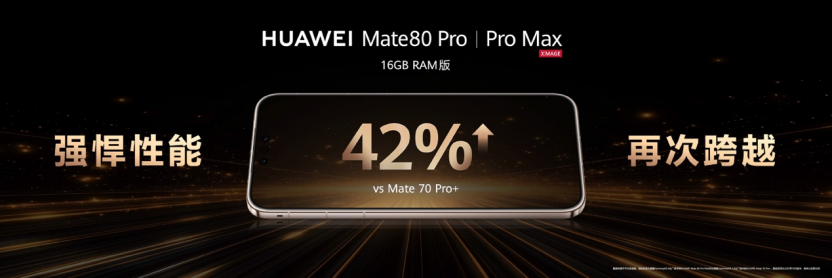
Core Insights - Huawei's Mate 80 series has achieved significant advancements in design, display, performance, and imaging experience, marking a comprehensive breakthrough in product capabilities [1] - The starting price for the Mate 80 series is set at 4699 yuan, with the digital version being highlighted as particularly attractive [1] - The launch event emphasized a theme of collaboration and exploration, symbolizing a new phase for the Chinese electronic information industry and the importance of partnerships within the Harmony ecosystem [1] Market Position and Performance - Over the past four years, Huawei's high-end market share significantly declined, a period referred to as the "darkest moment" for Huawei smartphones [2] - In 2023, Huawei began a strong comeback, with the Mate 60 series leading to a notable recovery in high-end market share, reaching 38% by Q1 2025, just 5 percentage points behind Apple [2] Technological Advancements - The Mate 80 Pro Max has seen a 42% performance improvement compared to its predecessor, providing consumers with a new level of experience [4] - Huawei's HarmonyOS has achieved over 27 million terminal devices, with an adaptation rate exceeding 98%, showcasing significant progress in the ecosystem [4] - A breakthrough in materials science allows for a full metal design without signal interference, enhancing the device's performance [6] Future Prospects - Huawei's introduction of a 700MHz emergency communication feature in the Mate 80 series represents a significant innovation in communication standards, potentially increasing Huawei's influence in future telecommunications [6] - Market predictions indicate that Huawei's market share in China will continue to expand, posing a stronger challenge to Apple's dominance in the high-end segment [8] - In Q3 of this year, Huawei's domestic smartphone shipments reached 10.4 million units, capturing 15.2% of the market, with approximately one-third of the high-end smartphone market priced above $600 [8]

京东方A:小米是公司客户
Mei Ri Jing Ji Xin Wen· 2025-11-26 10:05
Core Viewpoint - BOE Technology Group (京东方A) confirmed that Xiaomi is one of its clients, indicating a business relationship between the two companies [1]. Group 1 - BOE Technology Group responded to an investor inquiry on an interactive platform regarding its relationship with Xiaomi [1]. - The company clarified that it supplies products to Xiaomi, which includes both Xiaomi's automotive and smartphone divisions [1].


机构:今年年底将有13亿部iPhone 二手机占一多半
Xin Lang Ke Ji· 2025-11-26 09:19
Core Insights - By the end of 2023, there will be 1.3 billion iPhones in use, with over 50% being second-hand devices, indicating an increasing lifespan for Apple's flagship smartphone [1] - Starting in 2024, the average lifespan of an iPhone is projected to reach 8 years, reflecting a trend towards longer usage [1] - The second-hand smartphone market is predominantly dominated by Apple, with a significant rise in consumer interest in refurbished iPhones due to minimal upgrades between generations [2] Group 1 - CCS Insight reports that the iPhone is the most reused smartphone, with a notable increase in interest for second-hand models [1] - Analyst Leo Gebbie highlights that the lack of significant upgrades between iPhone generations contributes to the growing preference for refurbished devices [1] - Consumers are increasingly opting for refurbished iPhones not only for cost savings but also for environmental benefits [1] Group 2 - The current second-hand smartphone market is almost entirely controlled by Apple, which may impact the company's future revenue [2] - Gebbie suggests that Apple may need to consider the implications of this trend on its business strategy in the future [2]

小米获雷军超1亿港元增持 业绩增长股价半年跌幅却超35%
Chang Jiang Shang Bao· 2025-11-26 08:51
近期小米集团股价持续承压。截至11月24日收盘,小米集团报收38.66港元/股,相较于6月27日创下的年 内高点61.45港元/股,累计跌幅已超过35%。 不过,在回购公告发出后,11月25日,小米集团股价上涨,收盘报40.34港元/股,市值超过万亿。 长江商报奔腾新闻记者注意到,近日,小米集团披露2025年第三季度财报,集团第三季度实现总营收 1131.21亿元,连续4个季度超千亿元,同比增长22.3%;经调整净利润113.11亿元,同比增长80.9%。 11月24日晚间,小米集团在港交所发布公告称,公司创始人、董事长兼CEO雷军通过其全资拥有的 Team Guide Limited购入260万股小米B类普通股,平均每股价格约38.58港元,总计斥资超过1亿港元。 增持完成后,雷军共持有小米40.63亿股A类普通股及19.94亿股B类普通股,总计相当于公司已发行股份 的约23.26%。 据悉,此前在11月20日和21日,小米集团分别回购1350万股和800万股,总金额约8亿港元。 长江商报奔腾新闻记者 汪静 2025年第三季度,小米集团的智能手机出货量为4330万台,同比增长0.5%,连续9个季度实现同比增 ...
蔚来手机NIOPhone发布:实现车机应用跨端融合 售价6499元起
Xin Lang Ke Ji· 2025-11-26 08:46
Core Insights - NIO officially launched its flagship smartphone, NIOPhone, during the NIO IN 2023 Innovation Day, positioning it as a premium device tailored for NIO car owners [1] Product Specifications - NIOPhone is powered by Qualcomm Snapdragon 8 Gen 2 and offers memory configurations up to 16GB RAM and 1TB storage [1] - The device features a 6.81-inch display with a variable refresh rate ranging from 1 to 120Hz, a rear camera setup including a 50MP wide, ultra-wide, and periscope telephoto lens, and a 5200mAh battery supporting 66W wired and 50W wireless fast charging [1] Variants and Pricing - NIOPhone comes in four performance versions and two flagship versions, with colors matching NIO vehicles' exteriors and interiors, along with a special EPedition version [1] - The pricing for NIOPhone is set at 6499 yuan for performance versions, 6899 yuan for flagship versions, and 7499 yuan for the EPedition version [1] Unique Features - The smartphone is designed to replace car keys, allowing control of multiple vehicles from one device, and can unlock the car even 48 hours after the phone is powered off [1] - It includes a dedicated car control button for quick access to 30 functions and enables cross-platform integration with the vehicle's system for applications like gaming and meetings [1]


荣耀赵明:折叠屏不是小众市场 预计2027年折叠屏出货将超1亿部
Xin Lang Ke Ji· 2025-11-26 08:45
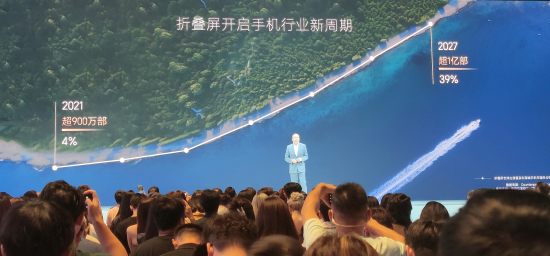
Core Viewpoint - Honor has launched the stylish wallet foldable screen Honor V Purse, indicating a significant shift in the foldable smartphone market towards mainstream adoption [1] Industry Insights - In 2021, global shipments of foldable smartphones exceeded 9 million units, capturing 4% of the high-end market [1] - It is projected that by 2027, foldable smartphone shipments will surpass 100 million units, with a high-end market share reaching 39% [1] Company Strategy - Honor's CEO Zhao Ming emphasizes that the lightweight design is the primary technological strength of foldable screens, which can blur the lines between foldable and traditional flat-screen devices [1] - The company believes that foldable screens are not a niche market and have the potential to replace existing flagship flat-screen smartphones [1]
超越三星,苹果今年有望成全球最大手机制造商
3 6 Ke· 2025-11-26 08:13
Core Insights - Apple is expected to surpass Samsung this year to become the world's largest smartphone manufacturer, driven by strong sales of the iPhone 17 series, with an estimated shipment of 255 million units, a year-on-year increase of approximately 10%, and a market share projected to rise to 19.4% [1][2] Group 1: Sales Performance - The iPhone 17 series saw a sales increase of up to 22% in some markets during its first month, while the global smartphone market declined by 2.7% during the same period [1] - In October, Apple's iPhone sales grew by 37% year-on-year, significantly outpacing the overall market growth of 8% [1] - In China, the iPhone accounted for one-quarter of total smartphone sales in October, with 80% of those sales coming from the new iPhone 17 series [1] Group 2: Product Features and Pricing - The iPhone 17 standard model features a 120Hz ProMotion adaptive refresh rate screen and a peak brightness of 3000 nits, enhancing outdoor visibility and smoothness [2] - Storage for the entire series has been upgraded from 128GB to 256GB without a price increase, addressing consumer storage concerns [2] - The A19 chip, built on TSMC's 3nm process, offers over 30% GPU performance improvement, catering to high-load gaming [2] - The battery capacity has increased to 3692mAh, extending video playback time from 22 hours to 30 hours, improving overall battery life [2] - The starting price for the iPhone 17 standard model remains at 5999 yuan, the same as the previous generation, while the iPhone 17 Pro series 256GB version is priced at 9999 yuan, unchanged from its predecessor [2] Group 3: Market Position and Competition - Over the past three years, Apple and Samsung have been in close competition for global smartphone shipments, with projections indicating that Apple may surpass Samsung in Q4 due to strong iPhone 17 sales [3] - According to Counterpoint, the global smartphone shipment rankings for 2024 are expected to be Samsung, Apple, Xiaomi, OPPO, and vivo, with Apple projected to lead in shipments at 230 million units and a market share of 18.7% [3] - Xiaomi is anticipated to maintain strong competitiveness, with a projected shipment of 168.5 million units in 2024, securing the third position globally [3]
原极氪CBO关海涛重回荣耀,或将负责全球市场营销业务
Nan Fang Du Shi Bao· 2025-11-26 08:08
Core Insights - Guan Haitao, former Chief Brand Officer of Zeekr, has returned to Honor and is expected to lead the marketing department, indicating a strategic move for global marketing and brand enhancement during a critical IPO preparation phase [2][3] - Guan's dual reporting structure to both the Marketing and Sales Service Department and the Brand Marketing Department highlights the urgency for Honor to consolidate its global marketing system [2] - His return aligns with Honor's ongoing globalization strategy, focusing on overseas market marketing and organizational marketing capabilities [2][4] Company Background - Guan Haitao previously served as CMO and Head of E-commerce at Honor, where he significantly contributed to the brand's e-commerce system, which accounted for up to 80% of Honor's profits during his tenure [3] - During his two years at Zeekr, he oversaw the launch of high-end models, achieving a sales milestone of 222,000 vehicles in 2024, a year-on-year increase of 87% [3] Strategic Context - Honor is currently in the process of preparing for an IPO, having filed for listing guidance with the Shenzhen Securities Regulatory Bureau, with expectations to complete this by Q1 2026 [3] - The company is undergoing significant transformation, having appointed a new CEO and established an "Alpha Strategy" centered around AI terminal ecosystems [3] - The overseas market is becoming a new growth engine for Honor, and Guan's experience in global brand management at Zeekr is seen as a strategic asset for Honor's capital market ambitions [4]
iPhone 15系列据称续航时间提升至多15%
Xin Lang Ke Ji· 2025-11-26 07:52
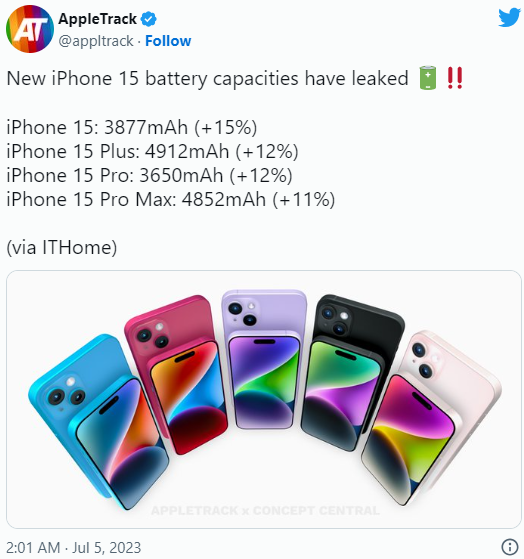
Group 1 - The core point of the articles is that the battery life of the iPhone 15 series will be extended by 11% to 15% across different models [1] - The basic iPhone 15 model is expected to have a 15% increase in battery life, while the iPhone 15 Plus/Pro will see a 12% increase, and the iPhone 15 Pro Max will have an 11% increase [1] - The battery capacities for the four models are reported as 3877mAh for the iPhone 15, 4912mAh for the iPhone 15 Plus, 3650mAh for the iPhone 15 Pro, and 4852mAh for the iPhone 15 Pro Max [3] Group 2 - A technology video blogger, Jacklyn Dallas, noted that while hardware improvements in smartphones are not very significant compared to software development, the increase in battery capacity is a positive development [3] - Dallas mentioned that despite improvements in screen and camera quality, smartphones still typically last only a day, making the increase in battery capacity beneficial [3] - She believes that the updates will only slightly enhance battery life and will not significantly impact Apple's pricing strategy [3]
股票市场概览:资讯日报:凯文·哈西特或执掌联储-20251126
Guoxin Securities Hongkong· 2025-11-26 07:31
Market Overview - Hong Kong stock market indices continued to rebound, driven by easing geopolitical tensions and expectations of a Federal Reserve rate cut[9] - The Hang Seng Index closed at 25,895, up 0.69% for the day and 29.09% year-to-date[3] - Major tech stocks performed well, with Baidu Group rising 4.56% and Xiaomi Group increasing by 4.35%[9] Sector Performance - New consumption concept stocks saw overall gains, with Cha Bai Dao up over 3% and Gu Ming up over 2%[9] - Battery and lithium mining stocks were strong, with Tianqi Lithium up 4.81% and Ganfeng Lithium up 3.46%[9] - Precious and non-ferrous metal stocks generally rose, supported by increased expectations for a Fed rate cut, with Chifeng Jilong Gold up 4.86%[9] U.S. Market Insights - U.S. stock indices closed higher, with the market assessing the Fed's rate cut prospects and developments in the AI sector[9] - The probability of a 25 basis point rate cut at the December meeting is approximately 82% according to the CME FedWatch Tool[9] - Kevin Hassett is viewed as a leading candidate for the next Fed chair, which could lead to a more aggressive rate cut policy[9] Japanese Market Dynamics - The Nikkei 225 index saw minimal movement, closing up 0.07%, with SoftBank Group dropping nearly 10%[13] - Concerns over foreign investment risks and competition in the AI sector are impacting market sentiment[13] Chinese Concept Stocks - The Nasdaq Golden Dragon China Index rose 0.35%, with notable gains in stocks like Hesai up 10.98% and Bawang Tea up 6.69%[10]