玩具

Search documents
财经观察:从消费到科技,中企靠创新“突围”
Huan Qiu Wang· 2025-07-02 22:48
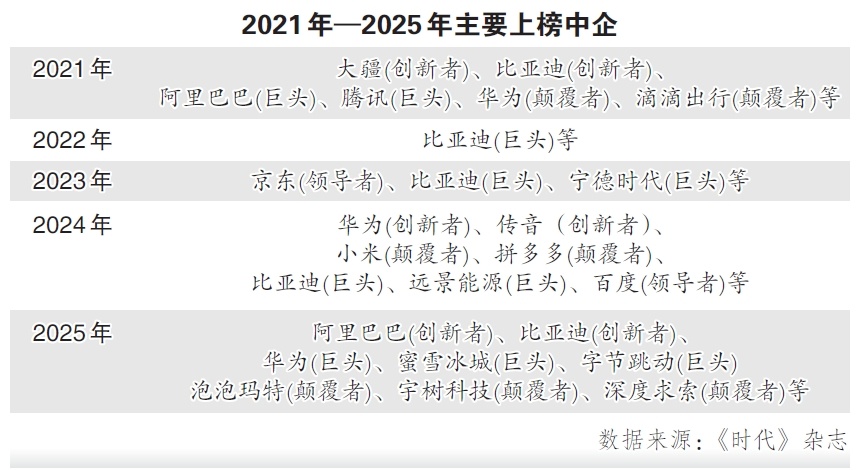
Core Insights - The "Global 100 Most Influential Companies" list for 2025 by Time magazine highlights several Chinese companies, indicating their significant impact across various sectors including consumption, AI, and robotics [1][2] - The selection criteria for the list emphasize a multi-dimensional evaluation of companies based on influence, innovation, strategic foresight, and business achievements rather than solely on financial metrics [1] Group 1: Company Highlights - Notable Chinese companies on the list include Alibaba, Huawei, ByteDance, BYD, and emerging tech firms like DeepSeek and Yushutech, showcasing a diverse representation across industries [2][3] - DeepSeek's AI model is noted for its competitive performance against OpenAI's latest products while significantly reducing costs, marking a pivotal moment in the global AI landscape [2][6] - Pop Mart, recognized as a "disruptor," has gained popularity with its IP "Labubu," leading to a surge in collectible toy sales and establishing 530 themed stores globally [3][6] - The tea brand Mixue Ice City, categorized as a "giant," has rapidly expanded to over 45,000 stores, becoming one of the largest restaurant chains worldwide [3][6] Group 2: Industry Trends - The list reflects a shift in the global business landscape, with Chinese companies transitioning from followers to innovators and leaders in various sectors, particularly in new consumption and AI [6][9] - The automotive sector, exemplified by BYD, is highlighted for its advancements in electric vehicle technology and solid-state battery development, positioning it as a key player in the global market [6][10] - The rise of companies from global South countries, such as those from China and the UAE, indicates a growing influence in the global market, particularly in AI and new energy sectors [9][11] Group 3: Future Outlook - The next 5 to 10 years may see a continued rise of companies from global South nations, especially in emerging fields like AI and renewable energy, while Western firms may face challenges in adapting to these changes [11] - The potential for innovation in consumption, AI applications, and the pharmaceutical sector is significant, with Chinese companies expected to lead in creating new business models and applications [10][11]




时尚消费 | 年轻人都在为什么而买单?品牌该如何应对?
Sou Hu Cai Jing· 2025-07-02 15:47
Core Insights - The article discusses the evolving consumer psychology of young people, particularly those born in the 90s and 00s, highlighting their unique purchasing behaviors and preferences for emotional value over practicality [3][5][11] - It emphasizes the importance of brands establishing emotional connections with consumers, moving beyond traditional marketing strategies to engage with the emotional needs of the younger demographic [4][8][9] Group 1: Young Consumer Behavior - Young consumers are increasingly drawn to personalized and niche products, with trends like Lolita fashion becoming mainstream, reflecting a shift towards the acceptance of subcultures [3][5] - Emotional consumption is on the rise, with brands like Nike and Adidas adapting their marketing strategies to create deeper emotional connections with consumers [4][11] - The difference in consumer logic between generations is evident, with older consumers prioritizing practicality and brand reliability, while younger consumers focus on emotional value and identity representation [5][11] Group 2: Brand Strategies - Brands are encouraged to redefine their identity and marketing strategies to resonate with the emotional needs of consumers, moving from a fixed image to a more flexible and open approach [8][9] - Successful brands like Pop Mart and Jellycat have capitalized on emotional branding by creating products with personality and stories, allowing them to maintain consumer loyalty despite higher price points [5][11] - The need for brands to adapt to rapidly changing consumer preferences is critical, requiring a balance between maintaining core values and being responsive to market trends [9][12]

上海市商务委:7月4日 2025“上海之夏”国际消费季将在上海启动
news flash· 2025-07-02 07:01
上海市政府今日举行新闻发布会,介绍2025"上海之夏"国际消费季总体安排。上海市商务委副主任刘敏 表示,7月4日,2025"上海之夏"国际消费季将在上海盛大启动,届时西岸滨江将推出汇集品牌全球大 展、品牌体验空间和品牌体育赛事的消费新场景。例如,梵克雅宝带来高级制表展"时间的诗篇"的全球 首发,品牌标志性的传奇"天象仪"自动机械装置也将在国内首秀。乐高"世界玩乐节"在上海西岸梦中心 奇幻启幕,正式开启上海玩乐模式,推出超大城市沙盘、音乐街区、乐高武康大楼等网红点位,备受瞩 目的"乐高建筑上海天际线"套装也将限时回归。李宁3V3篮球联赛全国决赛在西岸举办,为市民游客带 来纯粹街头篮球竞技体验。(东方网) ...
基于LMDI因子分解与美日经验的政策启示:从生产国到消费国的跨越:中国内需扩张路径
NORTHEAST SECURITIES· 2025-07-02 01:03
1. Report Industry Investment Rating No relevant content provided. 2. Core Views of the Report - China's past economic growth model relying on investment and exports is unstable, and it is necessary to switch to a consumption - driven model for sustainable development. The current actual consumption rate is at least 15% lower than the optimal level, and there is a large room for improvement [3][11][14][114]. - Since 2010, China's household consumption rate has shown an upward trend after hitting the bottom. Currently, the household consumption propensity dominates the trend of the household consumption rate. How to improve the household consumption propensity is the core focus of subsequent policies [3][25][44]. - The United States and Japan have successfully transformed into consumer - driven economies through different paths, providing valuable references for China. However, China faces problems such as premature population aging, relatively lagging urbanization, and relatively insufficient income growth, so the consumption transformation may be more difficult. It is estimated that China needs about 15 years to become a consumer - driven country [4][46][114][115]. - The core constraints on China's household consumption rate are the systematic pressure on the consumption propensity on the demand side and the structural imbalance between supply and demand of service consumption on the supply side. Policies should focus on multiple dimensions such as increasing property income, improving the social security system, optimizing the population structure, building a consumption culture, and increasing the supply of high - quality service consumption [5][75][116]. 3. Summary According to the Table of Contents 3.1.大国发展引擎转变:消费转型是中国持续发展的必经之路 - The structure of investment, exports, and consumption determines the medium - and long - term development quality of the economy. China's export - oriented and investment - driven models have limitations, while the consumption - driven model is more stable, long - lasting, and sustainable [11]. - China's final consumption expenditure as a percentage of GDP is lower than the global average, and the capital formation as a percentage of GDP is significantly higher than that of international mainstream economies, showing an obvious investment - driven characteristic [14][15]. - By constructing a dynamic analysis framework of the optimal and actual consumption rates, it is found that China's actual household consumption rate has been lower than the optimal level since 1990. After 2010, the consumption gap began to narrow, and there is still at least a 15% room for improvement [21]. - An increase in interest rates leads to a decrease in the optimal household consumption rate, indicating that the substitution effect dominates the consumption - savings decision in China, and a lower interest rate is conducive to the recovery of consumption [21]. 3.2.消费率演变三阶段:基于LMDI因子分解探寻低消费原因 - Since the reform and opening - up, China's household consumption rate has gone through three stages: an initial up - and - down stage from 1978 - 2000, a continuous decline stage from 2000 - 2010, and a recovery stage since 2010 [25]. - Using the LMDI model to decompose the change in the household consumption rate, it is found that the consumption propensity and primary distribution mainly dominate the long - term trend of China's household consumption rate. After 2005, the consumption propensity became the core variable explaining household consumption [32]. - In different stages, different factors affected the consumption rate. From 1978 - 2000, inflation risks and government policies led to a decline in the consumption rate; from 2000 - 2010, the substitution of external demand for domestic demand and the imbalance in primary distribution led to a continuous decline in the consumption rate; since 2010, the household consumption propensity has dominated the trend of the household consumption rate, and the COVID - 19 pandemic has had an impact on the consumption rate [35][41][44]. 3.3.美日转型启示录 3.3.1.美国经验:人口红利+消费信贷创新 - After World War II, the United States achieved an economic transformation from a production - and - export - driven model to a consumption - oriented society. This transformation required government intervention in multiple aspects [47]. - The release of the population dividend, the improvement of urbanization, and the continuous growth of disposable income provided a foundation for the expansion of domestic demand in the United States. The government also promoted the development of consumption through credit innovation and the improvement of the social security system [47][51]. 3.3.2.日本经验:国民收入倍增计划 - In the 1970s, Japan transformed from a production - oriented economy to a consumption - oriented economy under the pressure of external environment deterioration. Although Japan faced problems such as premature population aging, the "National Income Doubling Plan" increased residents' purchasing power, and the improvement of the social security system and financial services promoted consumption [53][57][66]. 3.3.3.中国启示:城镇化、收入增收仍有空间 - China faces problems such as premature population aging, relatively lagging urbanization, and relatively insufficient income growth compared with the United States and Japan during their transformation periods. There is still potential for urbanization and income growth in China [71]. 3.4.政策工具箱:多维消费驱动战略 3.4.1.提升财产性收入:从利息依赖到权益赋能 - China's labor compensation ratio is comparable to that of major global economies, but the property income structure shows an extreme differentiation of "interest dependence and equity absence", which suppresses the consumption propensity. Policies should focus on capital market reform to increase the proportion of equity dividends and activate property income [76][78]. 3.4.2.社保制度迭代:从普惠性覆盖到质量提升 - China's social security system has problems such as incomplete coverage and significant differences in pension levels between urban and rural areas, which restrict the release of consumption momentum. Future policies should focus on improving the inclusiveness and quality of the social security system [80][89]. 3.4.3.人口结构优化:释放短中长期消费潜力 - China's low fertility rate and increasing dependency ratio put pressure on consumption. Fertility support policies can directly increase consumption in the short term and release the consumption potential of the youth group in the long term. The silver economy also has great potential [95][100]. 3.4.4.观念革新:消费文化构建 - The formation of a consumption - oriented society requires the construction of a consumption culture. Currently, Chinese residents' consumption concepts are still relatively conservative, and policies should balance the traditional thrift concept and the demand for consumption - driven transformation [103][107]. 3.4.5.增加优质服务消费供给 - China's service consumption has problems such as a low proportion of service industry added value in GDP and a low proportion of service - related expenditures in total consumption. Policies should focus on expanding the opening - up of the service industry, building a cross - border service trade promotion system, and increasing the supply of high - quality service consumption [109][112]. 3.5.总结与展望 - China needs to switch to a consumption - driven growth model. The consumption transformation may be more difficult than that of the United States and Japan, and it is estimated to take about 15 years. - Future policies should focus on improving the household consumption propensity from four dimensions: income, population structure, social security, and cultural construction, and increase the supply of high - quality service consumption on the supply side [114][115][116].
完美世界内部反腐,多个工作室核心人员被查;中国游戏开发者大会定档8月|游戏早参
Mei Ri Jing Ji Xin Wen· 2025-07-01 23:04
Group 1: Perfect World Corruption Investigation - Perfect World announced an internal notice regarding a corruption investigation, revealing that multiple core personnel violated company policies and labor contracts, with some actions potentially constituting criminal offenses [1] - The implicated employees include heads of major studios and project teams, as well as HR managers, with four suppliers blacklisted by the company [1] - The announcement raises concerns about internal management issues and may affect the performance of the related business lines, increasing market uncertainty regarding the company's operations and project progress [1] Group 2: Bandai Namco Tax Reassessment - Bandai Namco reported receiving a tax reassessment notice from the Tokyo National Tax Agency, requiring the company to pay approximately 69.97 billion yen (around 3.47 million RMB) in back taxes for the fiscal years 2021 to 2023 [2] - The tax reassessment highlights flaws in the company's handling of tax deductions related to digital business R&D expenses and transactions in the toy and model business [2] - Although the company stated that the impact on its financial performance for the fiscal year ending March 2026 would be limited, the incident may prompt investors to scrutinize the company's financial compliance, affecting its perceived investment value [2] Group 3: China Game Developers Conference Announcement - The ChinaJoy official WeChat account announced the 2025 China Game Developers Conference (CGDC) scheduled for August 1-2, coinciding with ChinaJoy, featuring eight sessions and over 60 discussions on cutting-edge technologies and industry insights [3] - The focus on strategy games and technology at CGDC signals the industry's emphasis on innovation in specific segments, potentially attracting investor interest in related technology and game development companies [3] - Such industry events may enhance overall market perception of the gaming sector's future development trends, leading to increased attention from investors [3]

每天摸过1500个Labubu脸蛋的家庭女工,日薪50元
Hu Xiu· 2025-07-01 10:27
Group 1 - The article highlights the life of a family worker, Hu Meiyu, who earns a daily wage of around 50 yuan by trimming excess plastic from Labubu doll faces, a popular product from Pop Mart [7][10][28] - Labubu dolls have gained immense popularity globally, with initial products fetching prices as high as 1.08 million yuan at auctions, leading to long queues at Pop Mart stores and even violent competition among scalpers [6][28] - The production process involves multiple steps and workers, with Hu Meiyu's role being just one of many in the supply chain, reflecting the low wages and labor-intensive nature of the work [15][20] Group 2 - The article discusses the broader context of the toy manufacturing industry in Dongguan, which is home to over 4,000 toy production companies, making it the largest toy export base in China [15][22] - The article mentions that the price for a single Labubu doll face in a factory setting is around 5 yuan, while the retail price can exceed 1000 yuan, indicating a significant markup in the supply chain [15][28] - The article also touches on the related market for doll clothing, which has seen a resurgence due to the popularity of Labubu, with wholesale prices for doll outfits ranging from 15 to 30 yuan [26][27]

海关大战盗版labubu,忙坏泡泡玛特法务部?
Hu Xiu· 2025-07-01 08:37
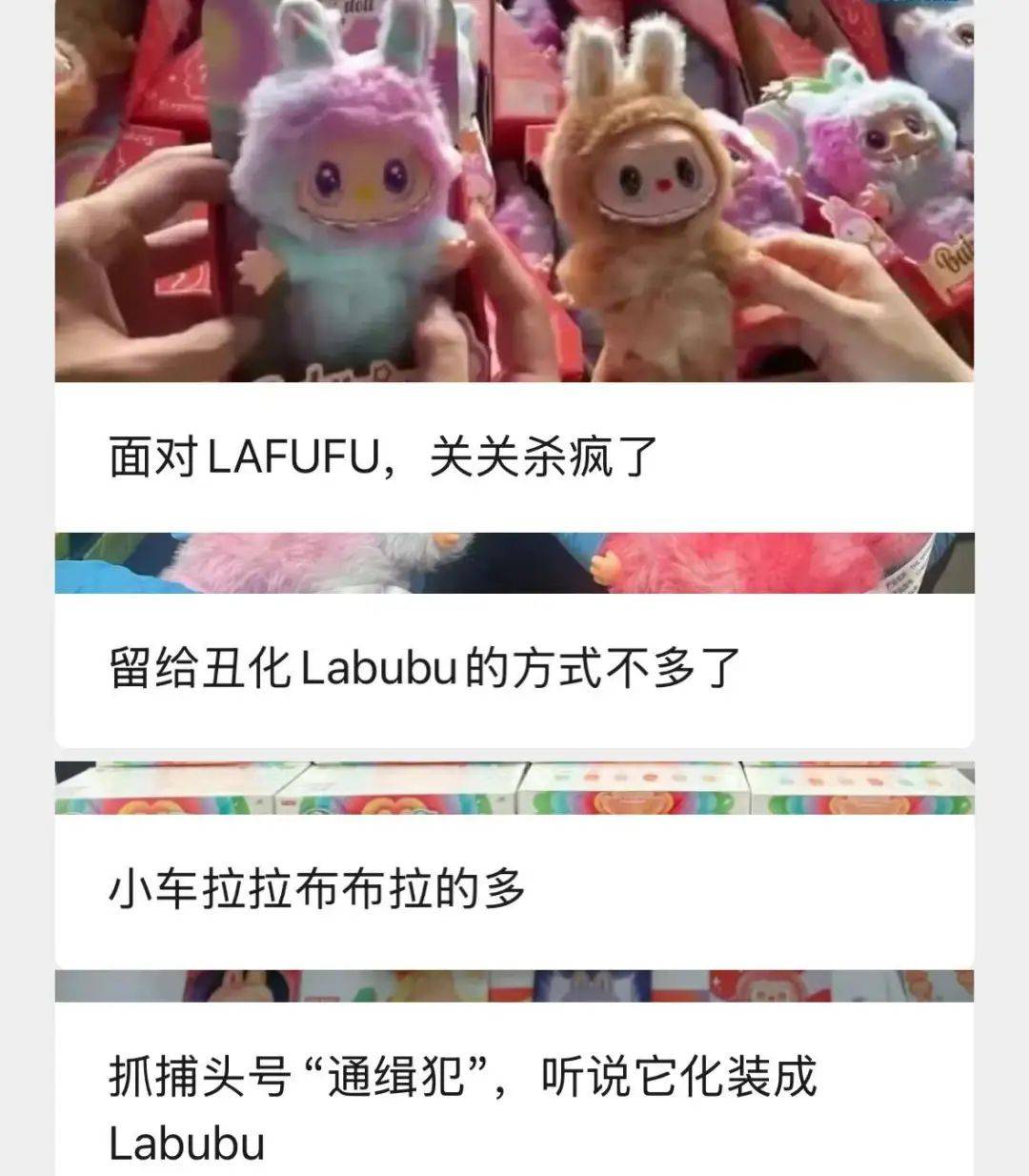
Core Viewpoint - The article discusses the rise of counterfeit "lafufu" toys, which are imitations of the popular "labubu" figures, and the ongoing efforts by customs authorities in China to combat their importation and distribution. The phenomenon has gained significant attention, leading to a cultural trend among workers who follow customs updates on the seizures of these counterfeit goods. Group 1: Customs and Enforcement - Customs authorities have intensified their focus on counterfeit "lafufu" toys, with daily updates on seizures becoming a popular topic among workers [4][11][15] - The customs department has reported large-scale confiscations, with examples including 10,000 units in Hangzhou and 30,000 in Ningbo [14] - The article highlights the role of customs as a key player in the fight against counterfeit goods, transforming it into a central figure in the "lafufu" saga [10][39] Group 2: Market Dynamics - The counterfeit "lafufu" market has seen a surge in production, with some factories adding multiple production lines to meet demand [22] - Prices for high-quality imitations can reach up to 180 yuan per unit, indicating a lucrative market for counterfeit goods [21] - The article notes that the "lafufu" phenomenon has created a unique market segment, with various forms and styles being produced and sold [24][35] Group 3: Cultural Impact - The ongoing customs operations against "lafufu" have become a source of entertainment and engagement for workers, who eagerly await updates on the latest seizures [15][17] - The customs updates have turned into a daily ritual for many, reflecting a blend of humor and interest in the absurdity of the counterfeit market [15][18] - The article mentions that even international audiences are engaging with the "lafufu" trend, showcasing its global reach [9][10] Group 4: Legal and Intellectual Property Issues - The customs actions against "lafufu" are primarily focused on intellectual property infringement rather than smuggling, as the goods do not typically involve tax evasion [39][40] - The article discusses the complexities of determining whether a counterfeit item constitutes an infringement, highlighting the legal gray areas involved [44][45] - Customs has the authority to enforce intellectual property protections, which has led to increased scrutiny of counterfeit goods at borders [40][43]
枢纽经济走弱,“京九第一镇”如何打赢经济翻身仗
Nan Fang Du Shi Bao· 2025-07-01 04:26
Core Viewpoint - Dongguan Changping, once known as the "First Town of Jingjiu," is facing challenges in reclaiming its economic prominence amidst rising competition and aging infrastructure. The town is exploring the transformation of its railway stations into high-speed train (动车) starting points to revitalize its economy and enhance its transportation hub status [1][2][3]. Group 1: Current Economic Status - Changping has seen a decline in its economic ranking from first to seventh in Dongguan over the past three decades, with surrounding towns like Songshan Lake and Chang'an entering the 100 billion GDP club [1][2]. - The town's reliance on its two major railway stations (Dongguan East Station and Changping Station) is being challenged by the improved rail networks of neighboring towns, which have weakened Changping's logistical advantages [2][4]. Group 2: Infrastructure and Development Plans - Changping Station and Dongguan East Station are proposed to be upgraded to high-speed train starting stations, which could significantly impact local economic activity and attract more visitors [2][3]. - The current facilities at Changping Station are outdated and do not meet modern urban development needs, necessitating comprehensive renovations [3][11]. Group 3: Historical Context and Challenges - Historically, Changping's economy thrived due to its railway advantages, but the rise of highways and logistics diversification has diminished its railway significance [4][5]. - The decline in passenger traffic at both railway stations is evident, with significant drops in traveler numbers from 2019 to 2023, indicating a pressing need for revitalization efforts [7][8]. Group 4: Future Prospects and Recommendations - Experts suggest that transforming the railway stations into high-speed train hubs could enhance Changping's connectivity with major cities like Shenzhen and Guangzhou, fostering economic growth and attracting high-tech industries [12][14]. - The development of the TOD "Hong Kong City" project is seen as crucial for integrating Changping into the Greater Bay Area's economic framework, although progress has been slow [9][10].
轻工制造行业专题研究-普通-:乐自天成招股书梳理:多品类IP玩具标杆,全
Sou Hu Cai Jing· 2025-07-01 02:15
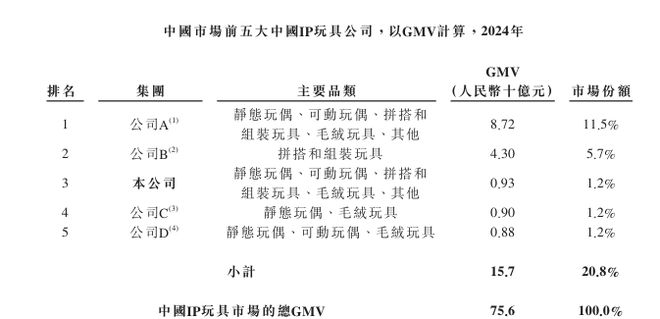
Core Viewpoint - 52TOYS is positioned as a leading IP toy company in China, leveraging its "IP Central" strategy to drive business expansion and enhance its market presence through a diverse range of IP toys and a comprehensive industry chain layout [1][6]. Group 1: Company Overview - 52TOYS, established in 2012 and launching its brand in 2015, has developed over 100 proprietary and licensed IPs by 2024, making it the second-largest multi-category toy company and the third-largest IP toy company in China by GMV [1][13]. - The company's revenue is projected to grow from 463 million RMB in 2022 to 630 million RMB in 2024, reflecting a CAGR of 16.7%, with adjusted net profit reaching 32.01 million RMB in 2024 [1][21]. - The company operates a dual-driven model with proprietary and licensed IPs, covering various categories such as trendy, sci-fi, and cultural toys, and collaborates with renowned brands like Disney and Warner [2][3]. Group 2: Market Dynamics - The global IP derivative market is substantial, expected to reach 1.4056 trillion RMB by 2024, with China's market growing at a CAGR of 15.1% during the same period [1][46]. - The IP toy segment is the largest within the IP derivative market, projected to reach 525.1 billion RMB globally by 2024, accounting for 37.4% of the total market [1][51]. - China's per capita spending on IP toys is significantly lower than in mature markets, indicating substantial growth potential, with 2024 figures at 53.6 RMB compared to 387.0 RMB in the US and 244.7 RMB in Japan [3][56]. Group 3: Competitive Landscape - The Chinese IP toy market is fragmented, with the top three companies holding only 33.1% of the market share, allowing 52TOYS to leverage its multi-category capabilities to gain a competitive edge [3][56]. - The company ranks third in the overall IP toy market and second among multi-category IP toy companies in China by GMV in 2024 [56][58]. - The increasing influence of adult consumers and the expansion of product categories into various fields are expected to enhance market dynamics and competition [3][56]. Group 4: Business Model and Operations - 52TOYS employs a comprehensive business model that integrates IP operation, product design, production logistics, and channel sales, ensuring a seamless connection across the entire value chain [2][3]. - The company introduces over 500 new SKUs annually, with a product range that includes static and movable toys, catering to both mass and premium markets [2][3]. - The distribution strategy primarily relies on a network of over 400 dealers, covering 20,000 retail points, with significant growth in overseas markets, contributing 1.47 billion RMB in revenue by 2024 [2][3].

乐自天成收入向好仍持续亏损:负债率高企现金流转负,市场份额偏弱
Xin Lang Cai Jing· 2025-07-01 00:57
Core Viewpoint - Beijing Lezitiancheng Cultural Development Co., Ltd. (also known as "52TOYS") is seeking to list on the Hong Kong Stock Exchange, with rapid revenue growth but still facing challenges in profitability and IP licensing risks [1]. Financial Performance - Lezitiancheng's revenue from product sales has increased from 457 million yuan in 2022 to 629 million yuan in 2024, accounting for over 98% of total revenue during this period [2][4]. - The company reported revenues of 463 million yuan, 482 million yuan, and 630 million yuan for the years 2022, 2023, and 2024, respectively, with gross profits of 134 million yuan, 195 million yuan, and 252 million yuan, leading to gross margins of 28.9%, 40.5%, and 39.9% [4][5]. - Despite revenue growth, the company recorded net losses of 1.71 million yuan, 71.93 million yuan, and 122 million yuan for the same years, with adjusted net profits showing a similar trend [5][6]. Revenue Sources - Over 50% of Lezitiancheng's revenue comes from licensed IP products, with sales from licensed IP increasing from 233 million yuan in 2022 to 406 million yuan in 2024 [9][10]. - The company has diversified its sales channels, with significant contributions from distributors and direct sales, accounting for over 90% of total revenue [3][4]. Market Position - Lezitiancheng ranks second among multi-category IP toy companies in China by GMV, with a market share of 1.2% in the overall IP toy market, significantly lower than the leading competitors [6][13]. - The Chinese IP toy market is expected to grow at a compound annual growth rate of 17% over the next five years, indicating potential for future expansion [6]. Operational Challenges - The company faces high operational costs, with total expenses for sales, marketing, and administration accounting for approximately 34.17% of total revenue in 2024 [6][7]. - Inventory and accounts receivable management pose risks, as the company has seen an increase in inventory and trade receivables, leading to negative cash flow in 2024 [7][8]. Future Plans - The IPO proceeds will be allocated to diversifying and strengthening the IP matrix (20%), expanding domestic and international direct sales channels (25%), improving marketing activities (15%), potential investments or acquisitions (10%), and general corporate purposes (10%) [15].