家电

Search documents
拓销路展形象,“广货行天下”不止于卖货
Nan Fang Du Shi Bao· 2026-01-14 15:41
Group 1 - The "Guanghuo Xing Tianxia" spring action launch ceremony and home appliance promotion event will start on January 15 at the Tanzhou Convention Center in Foshan, with over 1,300 local home appliance companies participating [1] - Guangdong is a core region for China's home appliance industry, having achieved over 10 national firsts in various categories since the reform and opening up, including production volume of air conditioners and rice cookers [1] - The focus of Guangdong's manufacturing has shifted from "mass production" to "intelligent manufacturing" due to challenges such as rising costs and global supply chain changes [1] Group 2 - Guangdong home appliance companies are integrating IoT, AI, and big data into R&D and production, with the smart home appliance industry in the Guangdong-Hong Kong-Macao Greater Bay Area expected to account for nearly 30% of the global market by November 2025 [2] - Gree Electric has been recognized as a national "leading-level" smart factory, while Midea showcased its innovative technology at the Berlin International Consumer Electronics Show [2] - The event will feature a dual marketing strategy of "online + offline," utilizing major e-commerce platforms and live streaming to effectively reach consumers and enhance brand influence [2] Group 3 - The first quarter will see 18 supporting activities under the "Guanghuo Xing Tianxia" initiative, aimed at integrating resources from leading enterprises, research institutions, and industry associations to create a precise resource matching hub [3] - These supporting activities are crucial for building a healthy industrial ecosystem, transforming the event into a platform for technology exchange, industry connection, and cultural promotion [3] - The initiative aims to enhance the image of Guangdong manufacturing, showcasing not only production capacity but also innovation and advanced technology [3]
“广货行天下”春季行动明日启动,珠海5家企业携新品亮相
Nan Fang Du Shi Bao· 2026-01-14 15:33
Group 1 - The "Guanghuo Hang Tianxia" Spring Action will be launched on January 15 in Foshan, featuring a special promotion for home appliances with participation from five key companies from Zhuhai, showcasing innovative products such as smart air conditioners and audio equipment [2] - The event aims to boost market expansion and sales, gathering over 1,300 home appliance companies from the province, including major brands like Midea, Gree, and Hisense, to display high-quality products and conduct live-stream sales [2] - Gree Electric will promote its air conditioning products, emphasizing core technologies such as smart energy-saving and variable frequency control, while HiVi Technology will showcase its audio products, highlighting acoustic design and craftsmanship [2] Group 2 - The Spring Action is organized by various provincial departments to enhance the visibility and market influence of high-quality Guangdong products, aiming for breakthroughs in online sales and generating a sales surge [3] - Over 6,000 companies from various sectors, including home appliances, clothing, and agriculture, will participate, supported by more than ten major commercial platforms like Alibaba and JD.com [3] - The initiative will select key industries and outstanding brand companies to conduct weekly online and offline sales activities, facilitating the connection between production and sales, and promoting Guangdong products nationwide and globally [3]


“死了么”App估值上亿,照见“孤独经济”万亿新蓝海
Sou Hu Cai Jing· 2026-01-14 14:50
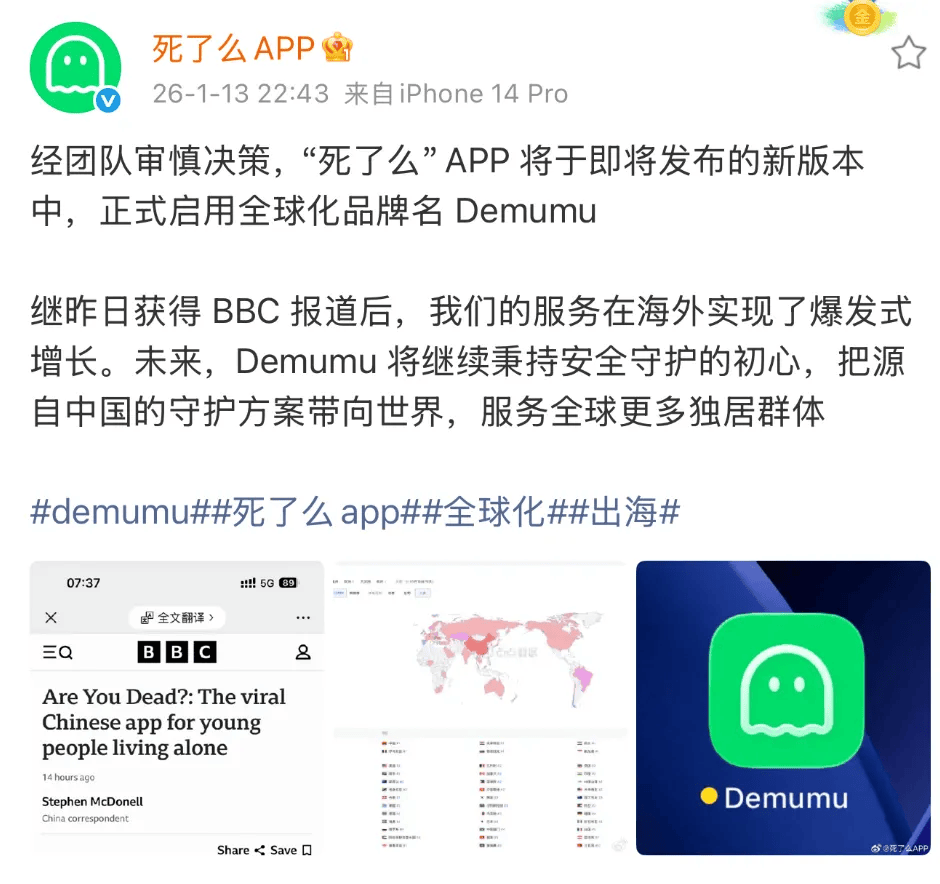
Group 1: App and Company Overview - The "Are You Dead?" app has gained significant popularity, with a rapid increase in downloads by 100 times since its launch, which had an initial investment of just over 1,000 yuan and was developed in less than a month [1] - The app's daily new user count has surged by 500-800 times compared to its initial phase, leading to a company valuation increase to approximately 100 million yuan from 10 million yuan within two days [1] - The app's founder plans to sell 10% of the company's equity for a financing amount in the tens of millions, despite the name "Are You Dead?" being criticized for its negative connotation, prompting a rebranding to "Demumu" for the upcoming version [1] Group 2: Societal Trends and Market Potential - The emergence of the "Are You Dead?" app reflects a growing trend in the "loneliness economy," which is a response to the increasing number of individuals living alone, particularly among urban youth [2][3] - By 2030, it is projected that the number of people living alone in China could reach 150-200 million, with the solo living rate exceeding 30%, driven by factors such as urban migration and changing marriage views [3] - The "loneliness economy" is expected to grow rapidly, with a focus on products that provide emotional value and cater to the needs of individuals living alone, indicating a significant market opportunity [3][5] Group 3: Emotional and Material Needs - The loneliness economy encompasses both emotional and material needs, with young individuals seeking emotional release and social interaction while feeling fatigued by interpersonal relationships [5][7] - The market for companionship services is expanding, with offerings ranging from online companionship to in-person activities, reflecting a growing demand for emotional fulfillment [7] - The rise of AI products and pets as alternatives for companionship is notable, with AI companionship market revenues projected to soar from $30 million to between $70 billion and $150 billion by 2030 [12][16] Group 4: Industry Developments and Consumer Behavior - Major companies are entering the AI companionship and pet markets, with significant investments and product launches aimed at meeting the emotional needs of consumers [15][16] - The pet industry is also experiencing rapid growth, with a projected market size of 312.6 billion yuan by 2025, driven by younger generations who view pets as family members [16][19] - The food and beverage industry is adapting to the needs of solo diners, with businesses like Haidilao innovating their offerings to cater to individual consumption patterns [20][22]
理响中国·聚焦2026中国经济丨吃、穿、用、行……开局之年,绿色消费增长点如何培育?
Yang Guang Wang· 2026-01-14 12:57
Group 1 - The core viewpoint of the article emphasizes the importance of domestic demand and green consumption as key drivers for economic growth during the "14th Five-Year Plan" period, highlighting the need for a strong domestic market and comprehensive green transformation [1][33] - The article outlines the achievements in promoting green consumption, including the implementation of policies such as the old-for-new program, which aims to replace 18.3 million vehicles and 192 million home appliances by 2025, with nearly 60% being new energy vehicles and 90% being energy-efficient appliances [3][9] - The green supply chain construction is highlighted, with a standardized pallet rate of 37.8% and an estimated saving of 250 million disposable pallets, which contributes to the protection of 50 million trees and a reduction of over 2 million tons of carbon emissions [3][4] Group 2 - The article discusses the establishment of a comprehensive recycling system to promote resource recycling, with an expected total recovery of approximately 380 million tons of renewable resources by 2025 [5] - It mentions the cultivation of green circulation enterprises, with 1,161 green shopping malls and 3,500 green hotels established to promote a green lifestyle and create a favorable social atmosphere [6][9] - The article outlines various initiatives to encourage green consumption, including the promotion of green food, organic products, and environmentally friendly household items, as well as the implementation of regulations to reduce single-use plastics [11][15][25]

尺素金声|3.92万亿元销售、惠及4.94亿人次,以旧换新一举多赢
Sou Hu Cai Jing· 2026-01-14 12:46
Group 1 - The core viewpoint of the news is that the "old-for-new" policy has become a significant driver of consumer demand and economic growth, particularly in the appliance and automotive sectors [1][4][5] - From January 1 to 2, 2024, Hebei Province recorded 133,600 sales transactions in home appliances and digital products, totaling 590 million yuan, indicating a strong market response to the policy [1] - The "old-for-new" policy has led to a total sales volume of 3.92 trillion yuan, benefiting 494 million people, with over 18.3 million vehicles and 192 million home appliances exchanged [4] Group 2 - The policy has contributed to a growth of over 1 percentage point in total retail sales, with home appliance retail sales exceeding 1 trillion yuan, marking a historical high [5] - In the automotive sector, nearly 60% of the old-for-new exchanges involved new energy vehicles, with the retail market share of new energy passenger cars exceeding 50% for nine consecutive months [6] - The policy adjustments for 2026 aim to enhance quality and innovation, with a focus on energy-efficient products and expanding subsidies to new smart devices, thus supporting high-quality development [8]

澳柯玛:目前主要从事智慧家电、智慧冷链等业务
Zheng Quan Ri Bao Wang· 2026-01-14 12:44
Group 1 - The core viewpoint of the article is that Aucma (600336) is primarily engaged in smart home appliances and smart cold chain businesses, and does not involve in the research, production, or application of snow-related products [1] Group 2 - The company indicated that detailed information about its main business activities can be found in the 2025 semi-annual report under the section "Company Main Business Situation" [1]

海尔智家:公司已围绕最新补贴方向进行全面布局
Zheng Quan Ri Bao Zhi Sheng· 2026-01-14 12:37
Core Viewpoint - The company is actively aligning with national policy directions and has made comprehensive arrangements around the latest subsidy initiatives, focusing on technological leadership in core product categories like refrigerators and washing machines [1] Group 1: Company Strategy - The company is enhancing its technological advantages in key categories, ensuring a rich lineup of first-level energy-efficient products that meet subsidy policy requirements and promote green consumption upgrades [1] - The company is leveraging its "Three Wings Bird" scenario brand to accelerate the development of whole-home smart solutions, integrating smart appliances into a broader smart consumption ecosystem [1] Group 2: Policy Alignment - The company is committed to continuous technological innovation and scenario upgrades to seize policy opportunities, aiming to create value for consumers and drive high-quality business development [1]

“以前哪能想到,都是中国的…”
Xin Lang Cai Jing· 2026-01-14 12:36
Core Insights - Chinese brands are increasingly establishing a presence in global markets, with a focus on building local operations and brand recognition rather than merely exporting cheap products or making large-scale acquisitions [1][2] - The global expansion of Chinese companies is marked by a significant increase in overseas sales, with projections indicating that overseas sales for Chinese listed companies will reach 15 trillion RMB in 2024, up from 11.6 trillion RMB in 2021 [2] - The shift in Chinese companies' strategies is driven by rising domestic labor costs and geopolitical tensions, prompting a move towards establishing manufacturing bases abroad, particularly in developing countries [5][7] Group 1 - Chinese electric vehicle manufacturer BYD surpassed Tesla in sales, with over 20% of its sales coming from overseas, doubling from 10% in 2024 [2] - The transformation of Chinese enterprises from imitation to innovation is evident, as they now produce high-end products and are sought after by Western companies for their expertise [4] - The establishment of local distribution and supply chain systems is becoming a priority, with companies like Mengniu successfully launching products in local markets [7] Group 2 - The historical context of Chinese companies' global expansion reveals a journey marked by challenges, including initial perceptions of low-quality products and failed acquisitions due to increasing Western scrutiny [3][4] - A shift in human resource strategies is occurring, with Chinese companies increasingly hiring local employees to reduce cultural friction and enhance local engagement [7] - Professional service firms are now actively supporting Chinese companies in their global expansion efforts, reflecting a change in focus from assisting Western firms entering China [8] Group 3 - Despite the strong momentum of expansion, Chinese multinational companies face complex pressures, including Western regulatory challenges and geopolitical risks [8] - The Chinese government is expected to relax strict overseas investment approval processes, which may lead to a greater presence of vibrant Chinese brands in the global market [9]


驶入阿拉木图:满街的中国品牌,与一场正在发生的认知变革
2 1 Shi Ji Jing Ji Bao Dao· 2026-01-14 12:15
Core Insights - Chinese brands have established a strong presence in Kazakhstan, becoming a significant part of the local market with a wide range of products from automobiles to electronics [1][2][3] - The trade relationship between China and Central Asia has seen substantial growth, with trade volume expected to reach $60.7 billion from 2017 to 2024, marking a 150% increase [1] - Kazakhstan is emerging as a key hub for Chinese companies looking to expand overseas, with over 9,000 Chinese enterprises operating in the region [1][3] Trade and Investment - By 2024, China's direct investment and loans to Central Asia are projected to exceed $24 billion, with bilateral trade between China and Kazakhstan reaching a historic high of $43.8 billion [3][4] - The market share of Chinese automotive manufacturers in Kazakhstan has surged from approximately 2% in 2020 to 38% in 2024, indicating a rapid acceptance of Chinese vehicles [3][4] Market Dynamics - The local market in Kazakhstan is characterized by a young population, with 95% owning smartphones, making it an attractive target for internet and technology companies [1][2] - The presence of Chinese brands is evident in various sectors, including home appliances, automobiles, and mobile phones, with local production of Chinese vehicles already underway [4][5] Consumer Behavior - There is a notable shift in consumer perception of Chinese products, moving from low-cost options to recognizing their reliability and technological advancements [5][6] - The acceptance of new technologies and experiences by the young population in Kazakhstan provides fertile ground for the introduction of innovative products [5][6] E-commerce and Marketing Strategies - The e-commerce market in Central Asia is projected to reach $14.7 billion by 2024, with Kazakhstan's market alone estimated at $6 billion [6][7] - Companies are advised to adopt a dual approach in marketing: utilizing mainstream e-commerce platforms for quick consumer access while also developing direct-to-consumer (D2C) channels to build brand identity [7][8] Localization Challenges - Entering the Central Asian market requires a nuanced understanding of local languages and consumer habits, as each country has distinct preferences and regulatory environments [8][9] - Companies often underestimate the complexity of the market, leading to potential pitfalls if they do not conduct thorough market research and engage local partners [9]
驶入阿拉木图:满街的中国品牌 与一场正在发生的认知变革
2 1 Shi Ji Jing Ji Bao Dao· 2026-01-14 12:13
Core Insights - Chinese brands have established a strong presence in Kazakhstan, becoming a significant part of the local market with a wide range of products from automobiles to electronics [1][5] - The trade relationship between China and Central Asia has rapidly expanded, with trade volume expected to reach $60.7 billion from 2017 to 2024, marking a 150% increase [1] - Kazakhstan is emerging as a key hub for Chinese companies looking to expand overseas, with over 9,000 Chinese enterprises operating in the region [1] Market Dynamics - The market in Kazakhstan is characterized by a young population, with 95% owning smartphones, making it attractive for internet and technology companies [1][6] - The bilateral trade between China and Kazakhstan is projected to reach $43.8 billion in 2024, setting a historical record [5] - Chinese automotive brands have seen significant growth, with market share increasing from 2% in 2020 to 38% in 2024 [5][6] Brand Penetration - Chinese brands like Haier, Hisense, and Xiaomi have been expanding their presence in Central Asia since the early 2000s, with a notable increase in brand visibility and local partnerships [5][6] - The automotive sector has become a major growth area, with local production of Chinese brands like Geely and Hongqi starting in Almaty [6] - The perception of Chinese products has shifted from low-cost to reliable technology, driven by rapid technological advancements [6] E-commerce and Advertising Trends - The e-commerce market in Central Asia is projected to reach $14.7 billion in 2024, with Kazakhstan's market alone estimated at $6 billion [8] - The number of Chinese advertisers using Yandex Ads in Kazakhstan has increased by 76% year-on-year, with advertising spending surging by 192% [8] - A dual approach for brands is recommended: utilizing mainstream e-commerce platforms for market testing and developing direct-to-consumer channels for brand building [9] Localization Challenges - Companies entering the Central Asian market must navigate complex local languages and cultural differences, as many countries have both Russian and local languages [10][11] - Each country in the region has unique consumer behaviors and regulatory environments, necessitating tailored marketing strategies [11][12] - Conducting thorough market research and partnering with local experts is crucial for successful market entry and operation [12]