外卖

Search documents
美团市值一度跌破5000亿港元,行业竞争格局逐渐清晰
Di Yi Cai Jing· 2026-02-13 10:04
Core Viewpoint - Meituan's stock price is influenced by industry competition, acquisition integration, and profit expectations, with significant pressure from competitive dynamics and market sentiment [1] Group 1: Stock Performance - On February 13, Meituan's stock price fell over 4.5%, with a market value dropping below HKD 500 billion, closing at HKD 82.5 [1] - Since January 13, when the stock was at HKD 106.5, it has declined by 22.5% [1] Group 2: Competitive Landscape - The competition in the food delivery sector has intensified, with promotional activities increasing costs and pressuring short-term profits [1] - Taobao Shanguo issued free meal cards in February, leading to a surge in orders for milk tea shops [2] - Regulatory challenges have emerged, with local authorities emphasizing the need for platforms to balance the interests of consumers, merchants, delivery personnel, and themselves [2] Group 3: Regulatory Environment - In January, the State Council's Anti-Monopoly and Anti-Unfair Competition Committee began investigating the competitive status of the food delivery service industry [3] Group 4: Future Outlook - Analysts suggest that while Meituan's stock may remain volatile in the short term, significant further declines are unlikely, as the competitive landscape is becoming clearer and business integration is progressing [3] - Meituan is expected to maintain a leading position in the local lifestyle sector due to strong operational barriers, although short-term competition will continue to pressure profits [6] - By 2026, profitability in the food delivery sector is anticipated to improve compared to the losses in the second half of 2025 [6] - Meituan's core advantages include a nationwide delivery network, a vast user and merchant ecosystem, and synergies across various services, which are difficult to replicate [6]



烧光800亿后,外卖佣金开始上涨
3 6 Ke· 2026-02-13 08:50
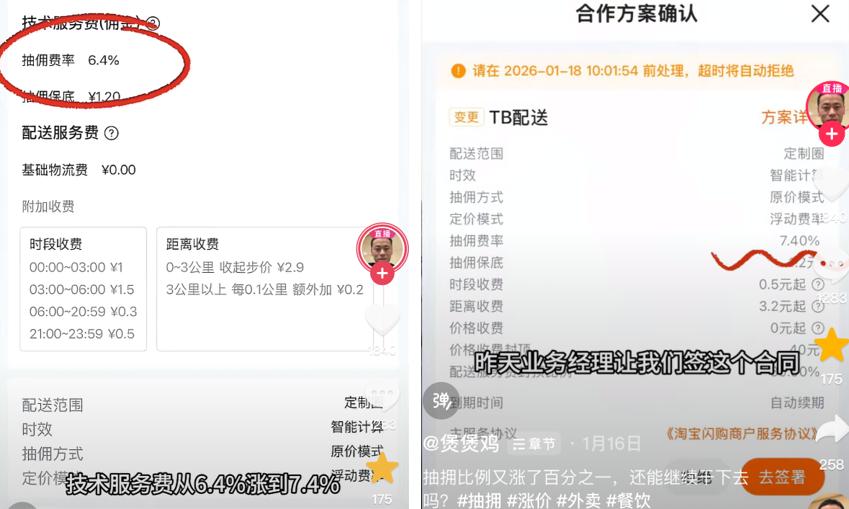
Core Viewpoint - The ongoing competition in the food delivery industry is intensifying, with platforms increasing commission rates and imposing new fees on merchants, leading to rising operational pressures for businesses [1][9][10]. Summary by Sections Commission Increases - Many merchants across various regions, including Hebei and Guangdong, have reported an increase in commission rates, with some rates rising from 6.4% to 7.4% [1]. - In areas like Jiangsu and Anhui, commission rates for self-delivery are nearing 20% [5]. - Merchants are facing pressure to sign new contracts quickly, with non-compliance resulting in store delisting [1]. Market Dynamics - The food delivery market has seen significant financial losses, with major platforms collectively spending over 800 billion in the past year [11]. - Companies like JD and Meituan have reported substantial losses, with JD's new business segment losing 157 billion and Meituan's local business shifting from profit to a loss of 141 billion [11]. - Alibaba's food delivery segment is estimated to have losses between 350 billion to 400 billion [11]. Merchant Challenges - Merchants are increasingly burdened by rising costs, with many reporting that marketing investments do not translate into profits, leading to a cycle of increased spending without corresponding revenue [12][18]. - A report indicated that 63% of merchants are experiencing growth in orders without an increase in revenue, with an average revenue drop of 4% and total profit declining by 8.9% [18]. Strategic Shifts - Platforms are shifting their strategies from aggressive subsidies to optimizing user structures and improving subsidy efficiency [9][23]. - The recent increase in commission rates is seen as a method to reduce losses and may lead to a broader trend of rising fees across the industry [24]. - The focus is shifting towards retaining high-value customers rather than attracting low-value ones, indicating a strategic pivot in the competitive landscape [23]. Future Predictions - The food delivery market is expected to see continued financial investment to secure market share, but with a more calculated approach to spending [23]. - A potential wave of commission increases may occur as platforms test merchants' willingness to accept higher costs in exchange for customer flow [24]. - Price increases in food delivery services may lead to a decrease in overall orders, potentially returning the market to pre-competitive levels [25].


【2026春节特别报道】这一年的暖心事
Xin Lang Cai Jing· 2026-02-12 21:36
Group 1 - The core viewpoint of the articles highlights significant policy changes aimed at improving labor rights and social security for flexible and elderly workers in China [1][2][4][5][6][7] Group 2 - The cancellation of household registration restrictions for social insurance participation is expected to facilitate the free flow of labor resources and protect the rights of flexible employment groups [1] - The introduction of basic rights protection for elderly workers provides a legal basis for their rights, focusing on labor remuneration, rest, safety, and dispute resolution [2] - New tax regulations for internet platform workers indicate that those engaged in delivery and other services will not face additional tax burdens, thus supporting their financial stability [3] - Major companies like JD and Taobao are actively integrating gig economy workers into traditional social security systems, with significant coverage and subsidy plans for insurance [4] - The expansion of pilot programs for occupational injury protection for new employment forms is set to include more provinces and industries over the next three years, enhancing worker safety [5] - The age limit for applying for large passenger and freight vehicle licenses has been extended to 63 years, aligning with gradual retirement policies and supporting driver employment rights [6][7]
【2026春节特别报道】“暖”政策协力托举 劳动者奔赴“新”程
Xin Lang Cai Jing· 2026-02-12 21:36
Core Viewpoint - The article highlights the significant transformation in the rights protection and service scenarios for new employment groups, emphasizing collaborative efforts from various sectors to enhance support and services for these workers. Group 1: Rights Protection and Service Improvements - The rights service work for new employment groups has transitioned from "single-point breakthroughs" to "comprehensive coverage," and from "passive responses" to "proactive services" [1] - Key sectors such as express delivery, food delivery, live streaming, and ride-hailing have seen targeted efforts to address wage arrears, fostering a social consensus that discourages unpaid wages [1] - The removal of household registration restrictions for social insurance coverage has improved the social insurance system for flexible workers and migrant workers [1] Group 2: Collaborative Efforts and Support Mechanisms - The All-China Federation of Trade Unions has taken the lead in creating a supportive environment for new employment groups, with nearly 180,000 union stations providing essential services [2] - Various government departments are enhancing the employment chain, making social security transfers more convenient, and implementing supportive policies like entrepreneurial loans and tax reductions [3] - Platform companies are actively participating in occupational injury protection trials and are working to standardize algorithm rules and commission rates to ensure fair treatment of workers [3] Group 3: Social Integration and Community Support - Services for urban integration of new employment groups are being optimized, addressing issues such as children's education, housing security, and legal aid [1] - The collaborative governance model is gaining traction, with a growing recognition of the labor value of new employment groups and a societal atmosphere of care and support [4] - The ongoing efforts in rights protection for new employment groups reflect a commitment to ensuring that the benefits of development are equitably shared among all workers [4]
【光明论坛】关心新就业群体 探索更适配的劳动权益保障
Xin Lang Cai Jing· 2026-02-12 20:34
Core Viewpoint - The new employment group, particularly in the express delivery and takeaway sectors, has become a significant part of China's labor market, with over 84 million new employment workers, highlighting the need for improved labor rights and social security systems to support this group [1][2]. Group 1: Current Situation and Government Initiatives - The express delivery and takeaway industries employ over 10 million workers, serving as a crucial "employment reservoir" in urban labor markets [1]. - Various regions have initiated New Year welfare activities for new employment groups, such as social security subsidies and recognition for good deeds [2]. - The government is exploring effective labor protection systems tailored to the unique characteristics of new employment relationships, which differ from traditional employer-employee dynamics [2][3]. Group 2: Policy Recommendations and Innovations - The "14th Five-Year Plan" suggests improving social security transfer policies and increasing participation rates among flexible workers and new employment groups [3]. - Proposed measures include enhancing occupational injury protection, innovating social security systems with low-cost entry options, and providing financial support for platforms to stabilize protections [3][4]. - The pilot program for occupational injury protection has seen over 22 million participants, adapting to new employment characteristics by decoupling protection from traditional labor relationships [4]. Group 3: Future Directions and Support Mechanisms - Platforms are encouraged to create a tiered employment system based on service duration and stability of work, providing identity recognition and benefits for long-term workers [4][5]. - Opportunities for professional development, such as skill training and educational advancement programs, are being offered to enhance career prospects for new employment workers [5].
反垄断措施密集出台,《金融时报》发文称正重塑中国竞争逻辑
Huan Qiu Wang· 2026-02-12 01:01
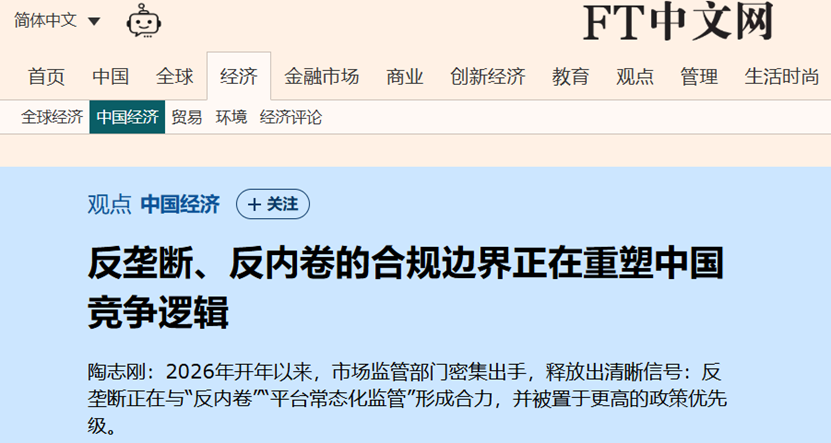
Group 1 - The State Council's Anti-Monopoly and Anti-Unfair Competition Committee has issued guidelines for the public utility sector to prevent and curb monopolistic behaviors in water, electricity, gas, and heating services, aiming to maintain fair market competition and protect consumer and public interests [1] - The upcoming national market supervision work meeting in 2025 has prioritized "strengthening anti-monopoly and anti-unfair competition" as a key task, indicating that anti-monopoly efforts are now a crucial part of China's competitive order adjustment [1] Group 2 - In 2026, market regulatory authorities have intensified anti-monopoly enforcement actions targeting food delivery platforms, the polysilicon industry alliance, and online travel platforms, signaling a clear message that anti-monopoly is being integrated with "anti-involution" and "platform normalization regulation" at a higher policy priority [3] - The primary goal of anti-monopoly measures is to prevent monopolistic behaviors from causing systemic harm to consumers and suppliers, as monopolies can raise prices for consumers and lower earnings for upstream suppliers [3] - Unlike the reliance on judicial litigation in Europe and the U.S., China's anti-monopoly approach is primarily administrative, characterized by high efficiency, short cycles, and quick corrections, allowing early intervention to prevent long-term damage to consumers and suppliers [3]
永辉超市CEO发全员信反思;山姆、奥乐齐等多平台春节调价
Sou Hu Cai Jing· 2026-02-11 14:17
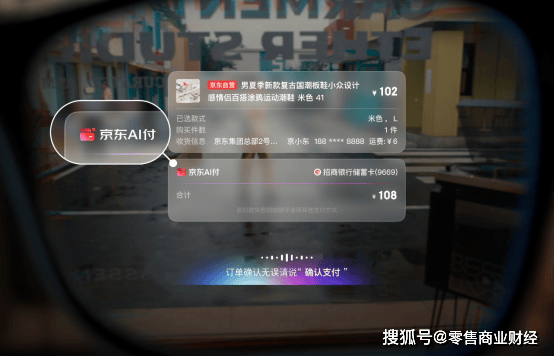
Group 1 - Yonghui Supermarket's CEO Wang Shoucheng announced plans to distribute nearly 50 million yuan in profit sharing to employees by 2025, while also admitting past mistakes in prioritizing scale over core values [1] - The company plans to close nearly 400 low-quality stores and focus on systematically renovating over 300 existing stores, expecting to see growth in both customer traffic and sales by 2025 [1] Group 2 - JD Technology launched a new payment method called "JD AI Pay," allowing users to make payments conveniently and securely using voice commands, integrated with the JD JoyAI model [2] - The service is currently available on the JoyAI App and through smart glasses, enhancing the shopping experience [2] Group 3 - Meituan is distributing New Year gift packages to stable and law-abiding delivery riders, with tens of thousands of riders receiving gifts and cash rewards, including a 10,000 yuan "Dream Cash Voucher" [3] Group 4 - Multiple platforms, including Aldi and Xiaoxiang Supermarket, announced adjustments to service arrangements and delivery fees during the Spring Festival, with additional charges for orders placed during specific dates [6][14] - Sam's Club, Hema, and Dingdong Maicai also confirmed similar adjustments to their delivery fees during the holiday period [14] Group 5 - Coca-Cola reported a revenue of $47.941 billion for the fiscal year 2025, a year-on-year increase of 1.87%, with a net profit of $13.107 billion, up 23.29% [11] - The fourth quarter revenue was $11.8 billion, below the expected $12.03 billion, and the company anticipates a 4% to 5% organic revenue growth for 2026 [11] Group 6 - Shanghai Xiaonan Guo clarified that all its restaurants are temporarily closed for strategic restructuring, ensuring that deposits and prepaid cards can be refunded [12] - The closure aims to streamline operations and allocate resources to core markets to reduce financial losses [12] Group 7 - Sam's Club officially signed a contract to establish a new location in Guangzhou Huangpu Science City, expected to open in 2028 [13] Group 8 - Taobao Flash Sales reported a 347% year-on-year increase in sales related to New Year goods, with orders from third- and fourth-tier cities rising over 580% [15] - The platform introduced a "New Year not closing" service, ensuring high operational rates for partner stores during the holiday [15] Group 9 - Haidilao received over 50,000 reservations for New Year's Eve dining, with more than 1,000 locations operating on that day and over 1,300 returning to normal operations shortly after [16] - The company is also trialing its first pet-friendly themed restaurant in Jiangsu, enhancing dining experiences for pet owners [16]

新春走基层|“我们给总书记拜年!”——我们的奔跑真的被看见了!
Zhong Guo Qing Nian Bao· 2026-02-11 13:52
Core Insights - The article highlights the increasing recognition and support for delivery workers in China, particularly during the Lunar New Year, as evidenced by President Xi Jinping's visit to a community service center for these workers [1][3]. Group 1: Government and Social Support - The government and various social organizations are enhancing support for new employment forms, with nearly 180,000 union service stations established nationwide to provide essential services for delivery workers [3]. - The "14th Five-Year Plan" emphasizes improving social security policies for flexible employment workers, aiming to increase their insurance coverage [5][8]. - Major platforms like Meituan and Taobao are implementing pension and medical insurance subsidies for delivery workers, with plans for nationwide coverage by the end of 2025 [5][8]. Group 2: Personal Experiences of Delivery Workers - Delivery worker Jia Yazhan expressed gratitude for the government's recognition of their hard work, noting the positive changes in working conditions and support over the years [3][6]. - Zhang Ruiqiang, another delivery worker, shared his commitment to his job, highlighting the sense of responsibility he feels as the family's economic provider [7]. - Wu Jing, a long-time courier, reflected on the industry's growth and the stable income it provides, reinforcing her dedication to her work and community involvement [8].

被总书记慰问的快递员:很激动,体会到在家的温馨感
Bei Ke Cai Jing· 2026-02-11 07:26
张瑞强是河北邢台人,之前做过厨师,后来感觉北京机会多、发展好就来到了北京,因为工作自由、收 入也不错,稳定有保障,加入外卖队伍,成为一名外卖骑手。过去5年多来,他一直在月坛街道车公庄 附近跑单,现在每天能送60多单,一个月收入1万多元。 "当时感觉挺激动,也很感谢政府对我们新就业群体的关心关照,让我们在这个北京首都有了一种家的 感觉,体会到了在家那种温馨感。"张瑞强说,在政府、平台等多方合力下,外卖骑手的保障越来越 好,他在老家参加了新型农村合作医疗,也了解到平台面向全部骑手推出了养老保险和医疗保险,为大 家提供至少50%补贴,荣誉骑士和骑士队长100%补贴,接下来他会积极参与。 "很激动,总书记特别关心我们新就业群体,问候了我们吃穿住行生活的各个方面。"另外一位在场并与 总书记交流的圆通快递员吴静告诉新京报记者,下午平复心情以后,她第一时间把这个消息告诉了自己 的父亲,与家人分享了这份喜悦。 新街口街道父母食堂是吴静常去吃饭的地方,这里不仅会为快递人员提供8折优惠,也会提供免费的雨 衣雨伞,吴静告诉新京报记者,这些年社会和政府对于快递员群体的关心和关爱越来越多,也让她感受 到支持与鼓励。 2月10日上午,习 ...
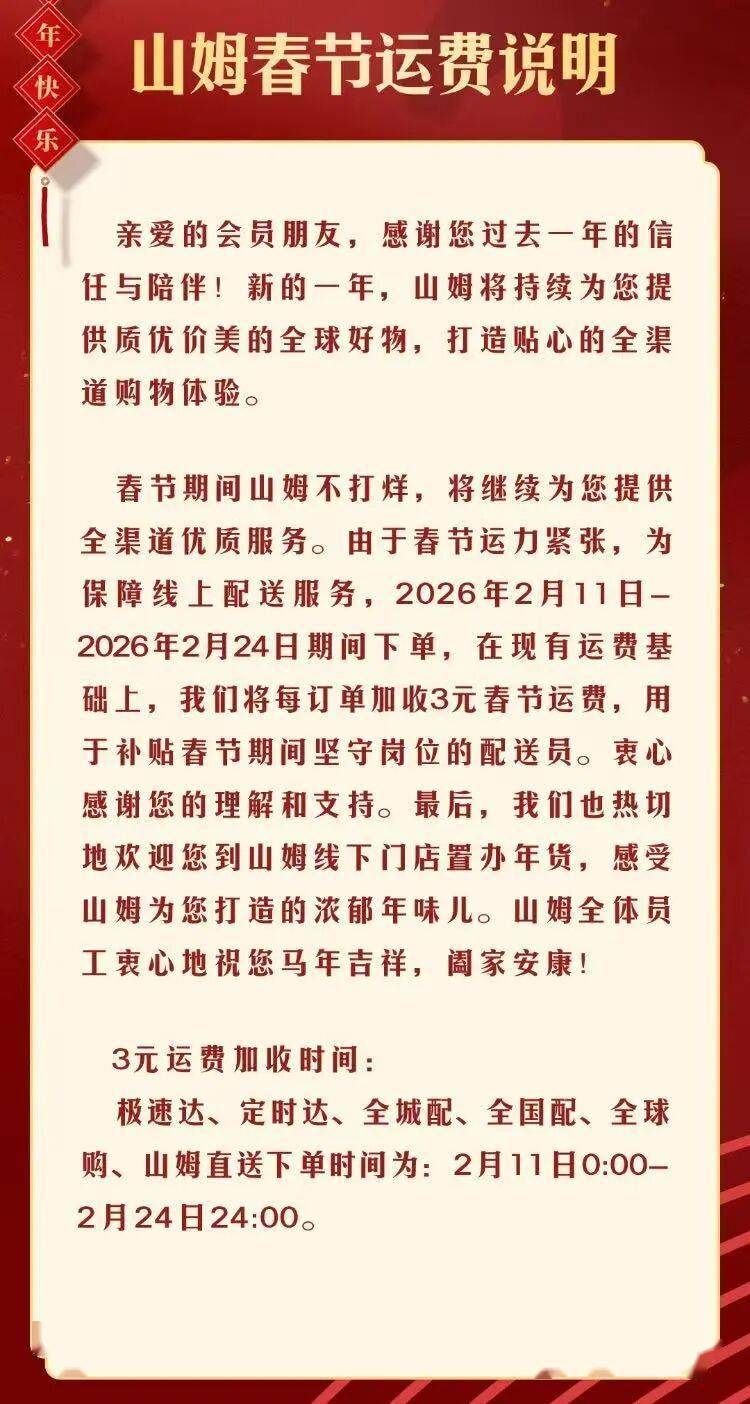
山姆、盒马、叮咚集体通知,最多一次+6元
Sou Hu Cai Jing· 2026-02-11 06:50
Core Viewpoint - The article discusses the adjustments made by various online platforms regarding delivery fees during the upcoming Chinese New Year holiday, highlighting the balance between maintaining service and compensating delivery personnel. Group 1: Delivery Fee Adjustments - Sam's Club announced an additional charge of 3 yuan per order for online deliveries from February 11 to February 24, 2026, due to tight delivery capacity during the holiday [1] - Hema stated that from February 14 to February 21, 2026, all online orders would incur a basic delivery fee of 6 yuan per order, with additional charges for overweight items [3] - Dingdong Maicai will also charge an extra 3 yuan service fee per order from February 15 to February 21, 2026, due to similar capacity constraints [6] Group 2: Alternative Approaches by Other Platforms - Meituan will not increase delivery fees during the holiday, focusing instead on subsidizing riders through cash incentives and other benefits [7] - Taobao Shanguo plans to invest nearly 2 billion yuan in rider incentives from February 4 to March 3, 2026, while keeping consumer fees unchanged [8] - JD.com announced a commitment of over 1.3 billion yuan for employee welfare during the nine-day holiday period starting February 3, 2026 [9]