
纺织品

Search documents
大摩闭门会:关税与贸易协议,尘埃落定了吗?如何应对香港稳定币政策的转变
2025-08-05 03:20
Summary of Key Points from Conference Call Records Industry Overview - The conference call discusses the impact of tariffs and trade agreements on various Asian economies, particularly focusing on South Korea and India, as well as the implications for the cross-border payment industry and stablecoin developments in Hong Kong. Key Points on Tariffs and Trade Agreements - Asian exporters have shifted some tariff costs to U.S. consumers, with China's tariffs reaching 30% and overall tariffs in the region expected to average 24% this year, up from 5% at the beginning of the year [1][3] - The U.S. will bear approximately $450 billion in tariff changes, while Asia will face a burden of about $260 billion due to these tariffs [3] - South Korea's trade agreement with the U.S. has reduced automotive tariffs from 25% to 15%, and South Korea has committed to invest $100 billion in various sectors, including semiconductors [5][6] - The trade agreement has alleviated some economic uncertainties for South Korea, leading to a growth forecast that is 1.1% above consensus for 2025, driven by fiscal stimulus and moderate domestic consumption [6][7] Impact on Specific Industries - The U.S. has imposed a 25% tariff on Indian exports, which has a limited direct impact on India's GDP (approximately 2%), but the indirect effects due to global economic slowdown are concerning [8][10] - Key sectors in India that are sensitive to U.S. tariffs include electronics, textiles, and pharmaceuticals, with textiles having a 40% share of the U.S. export market [9][10] - The Gift Nifty index is expected to be impacted by around 70 basis points due to the tariff changes, with agricultural tariffs being a significant negotiation point [11] Developments in Stablecoins and Cross-Border Payments - Hong Kong is positioning itself as a testing ground for stablecoins, with the Financial Authority planning to ban cryptocurrency trading while exploring stable digital currencies [13][14] - The acceptance of stablecoins in e-commerce will take time due to the maturity of existing cross-border payment tools like Visa and PayPal, and regulatory uncertainties may increase risks [15] - Stablecoin issuers and fintech companies are expected to be the primary beneficiaries of this emerging market, although traditional banking may also be affected [17] Regulatory and Market Considerations - The Hong Kong Monetary Authority will begin accepting applications for stablecoin issuance, with a limited number of licenses expected to be granted initially [14] - The development of stablecoins linked to the Hong Kong dollar may be easier due to its peg to the U.S. dollar, while the growth of RMB-linked stablecoins may be slower due to the smaller offshore RMB pool [16] - The transition to new payment systems will require significant capital investment and time to gain market acceptance, as evidenced by challenges faced in domestic payment systems in China [19] Conclusion - The overall economic outlook for South Korea appears cautiously optimistic due to the trade agreement with the U.S., while India faces challenges from tariff increases. The stablecoin market in Hong Kong is poised for growth, but acceptance in e-commerce will require time and investment.
纺织商会召开欧盟尼龙纱线反倾销调查应诉协调会
news flash· 2025-08-04 07:36
智通财经8月4日电,2025年8月1日下午,中国纺织品进出口商会召开欧盟尼龙纱线反倾销调查应诉协调 会。商务部贸易救济调查局、福建、浙江、江苏、广东、四川、河南省商务厅以及厦门市商务局领导, 四川省贸易摩擦工作站负责人,涉案企业代表和律师参加会议。 纺织商会召开欧盟尼龙纱线反倾销调查应诉协调会 ...
招商宏观:从库存和关税因素看美铜价格波动
智通财经网· 2025-08-03 03:23
Core Viewpoint - The data from May 2025 indicates that the U.S. is entering an active destocking phase, with total inventory increasing by 2.62% year-on-year and total sales increasing by 3.30% year-on-year, both showing a decline from previous values [1][2]. Overall Inventory Cycle - In May, total U.S. inventory increased by 2.62% year-on-year, down from 3.15% previously, while total sales increased by 3.30% year-on-year, down from 3.68% [2]. - The U.S. is confirmed to be in an active destocking phase, with a significant import surge occurring from November 2024 to March 2025, and imports returning to normal levels in April and May 2025 [2]. - A short-term replenishment demand is expected in June and July 2025, but active destocking is anticipated to continue thereafter, with excess imports expected to be depleted by November 2025 [2]. U.S. Industry Inventory Cycle - Among 14 major industries in May, six are in active destocking, including upstream oil, natural gas, and consumer fuels, chemical products, midstream transportation, and downstream automotive and automotive parts, textiles, clothing, luxury goods, and food, beverages, and tobacco [3]. - Historical inventory levels show that construction materials, chemical products, metals and mining, paper and forestry products, and technology hardware and equipment have higher inventory levels compared to historical percentiles [3]. Upstream Inventory Trends - Oil, natural gas, and consumer fuels have been in active replenishment from July 2023 to May 2024, transitioning to active destocking by June 2024 and remaining in that phase until May 2025 [4]. - Chemical products are expected to transition from passive replenishment to active destocking by May 2025 [5]. - Construction materials and metals and mining are currently in passive replenishment, with a high likelihood of transitioning to active destocking in the future [6]. Midstream Inventory Trends - The transportation sector is likely in active destocking, while paper and forestry products, as well as electrical equipment and appliances, are in passive replenishment [7]. - Mechanical manufacturing has transitioned to active replenishment as of March 2025 [7]. Downstream Inventory Trends - The automotive and automotive parts sector is in active replenishment as of December 2024 [8]. - Household durable goods, textiles, clothing, luxury goods, food, beverages, and tobacco are in passive replenishment, with some expected to transition to active replenishment in April and May 2025 [8].
2025年5月美国行业库存数据点评:从库存和关税因素看美铜价格波动
CMS· 2025-08-01 06:43
Overall Inventory Cycle - In May, the total inventory in the U.S. increased by 2.62% year-on-year, down from 3.15% in the previous period[12] - Sales in May rose by 3.30% year-on-year, compared to 3.68% previously[12] - The U.S. is confirmed to be entering an active destocking phase, with a significant import surge occurring from November 2024 to March 2025[12] - A brief replenishment demand is expected in June and July, after which active destocking will continue[12] Industry Inventory Cycle - Six out of fourteen major industries are in active destocking as of May, including oil, gas, chemicals, transportation, automotive parts, textiles, and food[19] - The historical percentile for overall inventory in May is 32.4%, with construction materials at 83.6% and chemicals at 69.3%[19] - The first round of excess imports is estimated at $180 billion and the second at $100 billion, totaling $280 billion, which may be exhausted by November[12] - Recent rapid declines in copper prices are attributed to a 50% tariff on copper products while exempting raw materials, disrupting supply and demand dynamics[13] Risk Factors - The potential for U.S. economic fundamentals and policies to exceed expectations poses a risk to inventory and pricing stability[8]
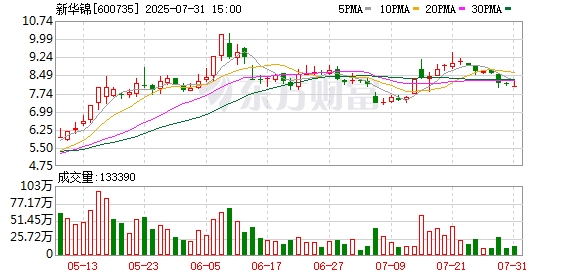
新华锦:7月31日召开董事会会议
Mei Ri Jing Ji Xin Wen· 2025-07-31 09:53
Group 1 - The core point of the article is that Xinhua Jin (SH 600735) held its 17th meeting of the 13th Board of Directors on July 31, 2025, to discuss the proposal for the board's re-election and other documents [2] - In the fiscal year 2024, Xinhua Jin's revenue composition is as follows: hair products accounted for 54.75%, e-commerce for 22.77%, textiles for 11.89%, used cars for 8.17%, and others for 1.54% [2]


稀缺,“小而美”股票出炉,低市值+低PE+高增长,18股上榜
Zheng Quan Shi Bao Wang· 2025-07-30 11:11
Core Viewpoint - The article highlights the emergence of "small and beautiful" stocks characterized by low market capitalization, low PE ratios, and high growth, with 18 stocks identified as potential investment opportunities [1][5]. Group 1: Market Performance - The small-cap and low-market-cap stocks have outperformed the market in 2025, with the Wind Small Cap and Wind Small Market Cap indices showing year-to-date gains exceeding 30% as of July 30 [2]. - In contrast, large-cap indices have shown minimal growth, with gains of less than 5% [2]. Group 2: Earnings Reports - During the peak of semi-annual earnings disclosures, over 170 stocks with market capitalizations below 5 billion yuan reported net profit growth of over 50% year-on-year for the first half of 2025 [3]. - Notable performers include Xianda Co., which expects a net profit of 130 to 150 million yuan, reflecting a year-on-year increase of 24.43 to 28.35 times, driven by rising product prices and new market entries [3]. - Rongzhi Rixin anticipates a net profit of 14 to 15 million yuan, marking a year-on-year increase of 20.28 to 21.8 times, benefiting from digital transformation trends across industries [3]. Group 3: Investment Characteristics - The identified low market cap high-growth stocks have shown strong performance, averaging a 30.79% increase this year, outperforming the Shanghai Composite Index by approximately 23 percentage points [5]. - Among these stocks, 18 have rolling PE ratios below 30, indicating potential undervaluation, with some stocks like Lutai A and Lianfa Co. having PE ratios below 20 [5]. - Additionally, 12 stocks have PB ratios below 2, with Lutai A, Lianfa Co., and Xinhuangpu having PB ratios below 1, suggesting strong investment value [5].
美国司法部重拳出击,准备动用刑事手段打击逃避特朗普关税的企业和个人
Hua Er Jie Jian Wen· 2025-07-24 00:06
Core Viewpoint - The U.S. Department of Justice is preparing to file criminal charges against companies and individuals attempting to evade U.S. tariffs, indicating a significant shift towards stricter enforcement of trade regulations [1][2]. Group 1: Enforcement Actions - The DOJ is increasing personnel for a new division focused on trade fraud, with federal prosecutors collecting evidence related to foreign goods transactions during the Biden administration [1]. - The enforcement will target multiple industries, including steel, aluminum, textiles, and consumer goods, aiming to maintain a fair trade environment and ensure tax revenue [1][2]. - Criminal prosecution will be prioritized for serious violations, moving away from traditional civil penalties for customs evasion [2]. Group 2: Financial Implications - Evasion of tariffs reportedly costs the government billions of dollars annually, impacting funding for essential government services [2]. - The Trump administration's tariffs, including a minimum 10% on nearly all imports and 50% on steel and aluminum, have created strong incentives for companies to evade taxes, potentially leading to civil and criminal liabilities [2][3]. Group 3: Investigative Preparations - U.S. law enforcement agencies are actively preparing for future lawsuits by reviewing potential violations from the Trump administration and earlier [3]. - Federal prosecutors are requesting shipping records and communications from companies to investigate potential tariff evasion [3][4]. - The Customs and Border Protection (CBP) agency has intensified scrutiny of high-tariff items, indicating a proactive approach to identifying potential fraud [3][4].
嘉麟杰: 北京市盈科律师事务所关于上海嘉麟杰纺织品股份有限公司2025年第一次临时股东会的法律意见书
Zheng Quan Zhi Xing· 2025-07-21 10:35
Core Viewpoint - The legal opinion letter confirms the legality and validity of the procedures and results of the Shanghai Jialinjie Textile Co., Ltd. 2025 First Extraordinary General Meeting of Shareholders, ensuring compliance with relevant Chinese laws and regulations [4][9]. Group 1: Meeting Procedures - The meeting was convened by the company's board of directors, and the notice was published on July 5, 2025, meeting the 15-day notice requirement [4][5]. - The meeting was held on July 21, 2025, using a combination of on-site and online voting, with the on-site meeting taking place at 2:00 PM in Shanghai [4][5]. Group 2: Attendance and Voting - A total of 13 shareholders attended the meeting in person, while 213 participated via online voting, representing 5,705,101 shares, which is 0.6921% of the total voting shares [5][6]. - The qualifications of all attendees, including directors and legal representatives, were verified and deemed valid [6]. Group 3: Resolutions and Voting Results - The meeting reviewed several resolutions, including the resignation and election of non-independent directors, changes to registered capital, and amendments to the company's articles of association [6][8]. - The voting results indicated that all resolutions were passed, with ordinary resolutions requiring a simple majority and special resolutions needing two-thirds majority [9].

嘉麟杰: 关于回购股份注销完成暨股份变动的公告
Zheng Quan Zhi Xing· 2025-07-18 10:18
Core Viewpoint - The company has completed the repurchase and cancellation of shares, resulting in a reduction of total share capital from 828,127,200 shares to 824,283,100 shares [1][5][6] Summary by Sections Share Repurchase Approval - The company approved a share repurchase plan on June 24, 2024, allowing for the use of between RMB 20 million and RMB 40 million to repurchase shares at a price not exceeding RMB 2.61 per share within 12 months [1][2] Share Repurchase Implementation - A total of 3,872,800 shares were repurchased, accounting for 0.47% of the total shares before cancellation, with a total expenditure of RMB 9,987,924.00 [2][4] Share Cancellation Arrangement - The cancellation of 3,844,100 shares was completed on July 17, 2025, resulting in a new total share capital of 824,283,100 shares [5][6] Impact of Share Cancellation - The cancellation is expected to enhance earnings per share and improve shareholder returns without significantly affecting the company's financial status or future development [5][6] Follow-up Arrangements - The company will proceed with necessary changes in business registration and documentation following the completion of the share repurchase plan [6]
印尼获美国较低关税 交易式外交达成“不良先例”?
Yang Shi Wang· 2025-07-18 03:22
Core Points - Indonesia has reached a trade agreement with the United States, which includes a 19% tariff on all imported Indonesian goods, while Indonesian purchases of $15 billion in U.S. energy, $4.5 billion in agricultural products, and 50 Boeing aircraft are promised [1][3] - The agreement is seen as a diplomatic victory for Indonesia, with President Prabowo emphasizing its mutual benefits and potential to enhance local industries [3][7] - The deal may set a concerning precedent for Indonesia's future negotiations with other economic partners, as it could lead to similar demands from other countries [2][10] Trade Impact - The U.S. trade deficit with Indonesia was $17.9 billion in 2024, with bilateral trade amounting to $38.3 billion [4] - Key Indonesian exports to the U.S. include palm oil, coffee, cocoa, textiles, and semiconductors, which may benefit from the tariff reduction [4] - Indonesia's textile and footwear sectors may face challenges due to the new tariffs, while the energy and agricultural sectors could see gains [1][4] Economic Concerns - The agreement's energy procurement commitment of $15 billion raises questions about Indonesia's goals to reduce fossil fuel dependency and promote renewable energy [6] - The removal of localization production requirements may negatively impact local manufacturing, leading to dissatisfaction among companies that have invested significantly to comply with these regulations [6][10] - The deal is perceived to offer more political than economic benefits, as the U.S. remains a less significant trading partner compared to Indonesia's Asian counterparts [7][10] Regional Reactions - Other Asian countries are closely monitoring the U.S.-Indonesia agreement to strategize their own trade negotiations [2][8] - The agreement may influence Indonesia's ongoing trade talks with the EU, as both parties have been at odds over localization policies and environmental regulations [8][9] - Concerns arise that Indonesia's concessions to the U.S. could weaken its negotiating position with other trade partners, including the Eurasian Economic Union and the Southern Common Market [10][12]