纺织服装

Search documents
特 力A(000025)8月25日主力资金净流入1558.77万元
Sou Hu Cai Jing· 2025-08-25 09:38
Group 1 - The core viewpoint of the news is that Shenzhen Teli (Group) Co., Ltd. has shown a significant decrease in total revenue while maintaining a positive growth in net profit for the latest reporting period [1] - As of August 25, 2025, Teli A's stock price closed at 18.21 yuan, with a 2.07% increase and a trading volume of 190,000 hands, amounting to a transaction value of 343 million yuan [1] - The company's total revenue for the first half of 2025 was 878 million yuan, a year-on-year decrease of 44.41%, while the net profit attributable to shareholders was 84.01 million yuan, a year-on-year increase of 9.59% [1] Group 2 - The company has a current ratio of 1.294 and a quick ratio of 1.198, indicating a stable liquidity position [1] - The debt-to-asset ratio stands at 28.96%, reflecting a relatively low level of financial leverage [1] - Shenzhen Teli has made investments in 41 companies and participated in 647 bidding projects, showcasing its active engagement in business expansion [2]


国泰海通:关注后续估值有望修复标的中报发布 行业短期关注安踏体育等
Zhi Tong Cai Jing· 2025-08-25 08:46
Group 1 - The textile and apparel sector in Hong Kong has shown strong stock performance following the release of interim reports, with a recommendation to focus on quality stocks with cautious or clear interim expectations and stable full-year performance, such as Shenzhou International, Jiangnan Buyi, and Anta Sports [1] - Notable stock price increases post-interim report include: Yue Yuen (+10.25%), Samsonite (+0.18%), Crystal International (+13.49%), Xtep International (+16.75%), and Li Ning (+8.78%), attributed to results meeting or slightly exceeding market expectations and stable full-year performance forecasts for 2025 [2] - The low valuation and dividend attributes of these companies are highlighted, with projected P/E ratios and dividend yields for 2025/26 as follows: Yue Yuen (7.3X/6.5X, 10%/11%), Samsonite (11X/10X, 4%/5%), Crystal International (10X/9X, 5.8%/6.4%), Xtep International (12X/11X, 4.0%/4.4%), and Li Ning (18.6X/17.8X, 2.7%/2.8%) [2] Group 2 - In July, Swiss watch exports (excluding the US) improved on a month-on-month basis, with Singapore and Hong Kong leading the growth, while overall global exports showed a year-on-year increase of 6.9% [3] - The export figures for July indicate a significant increase in the US due to tariff disruptions, with global exports (excluding the US) showing a year-on-year decline of 0.9% but an improvement from June's -3.2% [3] - Cumulative export data from January to July shows a year-on-year increase of 1.0% for global exports, while specific regions like China and Hong Kong experienced declines [3]


国泰海通:关注后续估值有望修复标的中报发布 行业短期关注安踏体育(02020)等
智通财经网· 2025-08-25 08:41
Group 1: Textile and Apparel Industry Insights - Cathay Pacific Haitong's report highlights strong stock performance in the Hong Kong textile and apparel sector during the interim report disclosure period, suggesting a focus on quality stocks with cautious or clear interim expectations and stable full-year performance [1] - Notable stock price increases post-interim report include: Yue Yuen Industrial (+10.25%), Samsonite (+0.18%), Crystal International (+13.49%), Xtep International (+16.75%), and Li Ning (+8.78%), attributed to meeting or slightly exceeding market expectations and stable performance forecasts for 2025 [1] - Valuation metrics indicate potential for recovery, with projected P/E ratios and dividend yields for 2025/26 as follows: Yue Yuen (7.3X/6.5X, 10%/11%), Samsonite (11X/10X, 4%/5%), Crystal International (10X/9X, 5.8%/6.4%), Xtep International (12X/11X, 4.0%/4.4%), and Li Ning (18.6X/17.8X, 2.7%/2.8%) [1] Group 2: Swiss Watch Export Trends - In July, Swiss watch exports (excluding the U.S.) showed a month-on-month improvement, with Singapore and Hong Kong leading the growth [2] - Year-on-year export figures for July indicate a global increase of 6.9%, with specific changes for China (-6.5%), the U.S. (+45.0%), Japan (-10.1%), Europe (-2.8%), Hong Kong (+4.6%), and Singapore (+14.8%) [2] - Cumulative export data from January to July shows a year-on-year increase of 1.0% globally, while China experienced a decline of 17.0% [2]
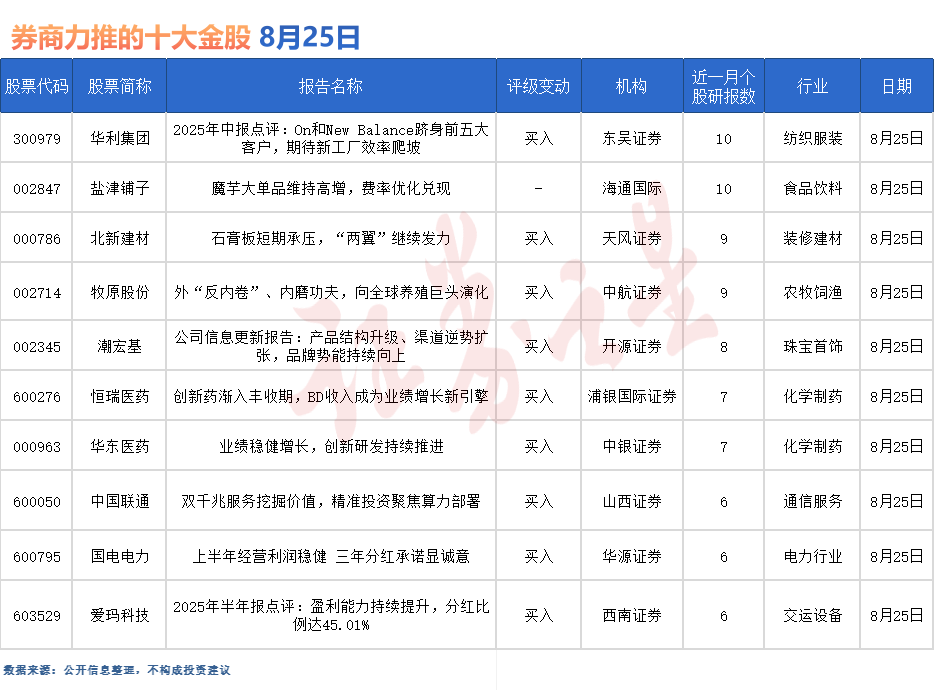
8月25日券商今日金股:10份研报力推一股(名单)
Zheng Quan Zhi Xing· 2025-08-25 08:27
Core Viewpoint - Securities firms have given "buy" ratings to nearly 100 A-share listed companies on August 25, focusing on various industries such as textiles, food and beverage, construction materials, agriculture, jewelry, pharmaceuticals, telecommunications, electricity, and transportation equipment [1] Group 1: Company Ratings and Reports - Huayi Group received significant attention from securities firms, with 10 reports in the past month, ranking first among stocks promoted by brokers on August 25 [2] - Salted Fish Company was also highlighted, receiving 10 reports from various securities firms, with a focus on maintaining high growth in its core product, konjac [3] - Beixin Building Materials was noted for its strategic development and received 9 reports, with a revised profit forecast for 2025-2027 [3] - Other companies such as Muyuan Foods, Chaohongji, Hengrui Medicine, Huadong Medicine, China Unicom, Guodian Power, and Aima Technology also garnered attention from multiple securities firms in the past month [4] Group 2: Industry Focus - The industries attracting broker attention include textiles and apparel, food and beverage, construction materials, agriculture, jewelry, pharmaceuticals, telecommunications, electricity, and transportation equipment [1] - The reports indicate a trend of focusing on companies with strong growth potential and innovative strategies within these industries [3]



慕尚集团(01817.HK)利润大幅增长,释放可持续发展的新信号
Ge Long Hui· 2025-08-25 07:48
Group 1: Market Overview - The A-share market has shown strong performance, with the Hong Kong stock market also improving, as evidenced by the Hang Seng Index breaking the 25,000-point mark multiple times, indicating the potential start of a comprehensive bull market [1] - Institutions are optimistic about technology and consumer sectors in the Hong Kong market, noting that these assets are more closely related to current trends in AI applications and new consumption, and have better fundamentals compared to A-shares [1] Group 2: Company Focus - Moshang Group - Moshang Group has demonstrated strong operational resilience, with a significant profit increase, achieving a revenue of 969 million yuan and a net profit growth of 30.9% to 8.872 million yuan in the first half of the year, maintaining profitability since 2022 [4][5] - The company's gross margin remains high at 53.4%, with its main brand GXG generating 897 million yuan in revenue and a gross margin of 54.2%, while its other brand Mode Commuter achieved 191 million yuan in revenue with a gross margin of 58.4% [5] - Moshang Group has effectively managed its offline self-operated channel revenue, which totaled 449 million yuan, and has focused on channel transformation by closing inefficient stores and enhancing single-store performance [6] Group 3: Strategic Potential - Moshang Group's strategic direction is centered on meeting the needs of young consumers, with GXG being recognized as a brand that understands young people's preferences, particularly through its "commuting menswear" strategy [7][8] - The changing consumption patterns among young males, especially the Z generation, present a long-term market opportunity, with predictions indicating that 73% of this demographic will enter the workforce in the next decade [9] - GXG's innovative product offerings, such as the Zero Pressure series, cater to the evolving demands of young professionals, blending functionality with aesthetics [10] Group 4: Innovation and Digital Transformation - Moshang Group is exploring AI applications and private domain marketing to enhance operational innovation and long-term development quality, with AI sampling significantly reducing development time and costs [12] - The company has established a comprehensive digital transformation strategy, integrating data insights with intelligent design to improve product strategy flexibility and competitiveness [13] - A recent exclusive strategic partnership with Dreamxiang Technology aims to address inventory issues while enhancing user engagement and achieving sales growth [13] Group 5: Future Outlook - Moshang Group's strong profitability, clear strategic direction, and alignment with new consumption trends position it well for future growth, with the potential to capitalize on the emerging consumer demands [14] - The company is expected to benefit from the ongoing new consumption wave, which will help unlock its previously established momentum and accelerate its performance recovery [14]
美国媒体质疑川普欺软怕硬,对待中方和对待印度不一样,美财长的回答亮了
Sou Hu Cai Jing· 2025-08-25 06:58
Group 1 - The U.S. Treasury Secretary Scott Bessen defended the decision to impose tariffs on India while not sanctioning China, highlighting India's significant increase in oil imports from Russia, which rose from less than 1% before 2022 to 42% [2] - Bessen pointed out that India has profited $16 billion from reselling Russian oil, labeling it as "unacceptable opportunistic arbitrage" [2] - In 2024, India imported $53 billion worth of oil and crude from Russia, while China's imports were higher at $62.6 billion, but this aligns with China's larger economic scale [2] Group 2 - China is currently the largest buyer of Russian crude oil, importing 57.71 million tons valued at $29.48 billion from January to July 2024, which constitutes only 13.5% of China's total imports [2] - The trade volume between the U.S. and China far exceeds that of the U.S. and India, with U.S.-India trade estimated at $128.8 billion in 2024 compared to several hundred billion for U.S.-China trade, leading to a cautious approach from the U.S. regarding sanctions on China [4] - India's government temporarily exempted cotton import tariffs to support its textile industry against U.S. tariffs, while Chinese refineries increased their Russian oil purchases, with Urals crude imports nearly doubling to 75,000 barrels per day in August [4] Group 3 - Bessen's remarks indicate that in the balance of geopolitical economics, power remains the most significant leverage, suggesting that China's strength influenced the U.S. decision-making process [5]

省纺织服装行业“问计”数字化转型
Liao Ning Ri Bao· 2025-08-25 01:27
Core Viewpoint - The event held in Huludao, Liaoning Province, focuses on the integration of cross-border e-commerce channel reconstruction and digital transformation in the textile and apparel industry, aiming to enhance the industry's development opportunities [1] Group 1: Event Overview - The event is organized by the Provincial Department of Industry and Information Technology and the Provincial Textile and Apparel Association, themed "Breaking the Deadlock and New Birth" [1] - The main objectives include constructing a composite channel matrix of "platform + independent site + social e-commerce" [1] - The event serves as a bridge for connections among government, enterprises, academia, and research institutions [1] Group 2: Industry Goals - The initiative aims to improve order response speed and inventory turnover through digital tools [1] - It seeks to create a closed loop of "channel reconstruction - data accumulation - transformation landing" by collaborating with ecological partners [1] - The focus is on transitioning from "scale advantages" to "intelligent advantages" within the industry [1] Group 3: Industry Opportunities - Current trends in cross-border e-commerce channel reconstruction and digital transformation present significant development opportunities for the textile industry [1] - The event clarifies the development direction of "digital intelligence empowering cross-border e-commerce" for the Liaoning textile and apparel sector [1]
申万宏源证券晨会报告-20250825
Shenwan Hongyuan Securities· 2025-08-25 01:12
Group 1: North Exchange Specialized and Innovative Index - The North Exchange Specialized and Innovative Index focuses on innovative small and medium-sized enterprises, emphasizing "specialized, refined, unique, and innovative" small giants, providing differentiated value as a rare high-quality small-cap growth index in the market [11][12] - The index consists of high-quality underlying assets, with a market capitalization median of 3.74 billion yuan, lower than other indices, indicating a focus on smaller companies [11] - The index has shown high growth potential, with a revenue compound annual growth rate (CAGR) of 40.4% over the past three years, and a high research and development investment ratio of 6.2% [11] Group 2: Saint Bella (2508HK) - Saint Bella is a well-known company in the high-end confinement service sector, aiming to provide comprehensive family care services from pregnancy to elderly care, with a projected adjusted net profit of 117 million, 191 million, and 287 million yuan for 2025-2027 [3][14] - The company has established four core advantages: strong brand recognition in high-end confinement services, a light asset model with standardized training, vertical and horizontal expansion in family services, and international market penetration targeting overseas Chinese [17] - The family care industry in China is expected to grow from 392.8 billion yuan in 2019 to 711.3 billion yuan in 2024, with a CAGR of 12.6%, indicating a favorable market environment for Saint Bella [17]


山西证券研究早观点-20250825
Shanxi Securities· 2025-08-25 00:57
Core Insights - The report highlights a significant growth in the AI sector, driven by macroeconomic factors such as the expectation of interest rate cuts in the US and supportive policies for AI investments from the Trump administration. This has led to increased investor interest in AI-related technologies and companies [5][6] - The liquid cooling industry is experiencing heightened attention due to accelerated deployments by overseas cloud service providers (CSPs) and positive performance indicators from key players in the sector. The report suggests that the liquid cooling market is transitioning from a conceptual phase to one of actual performance delivery [5][6] - The report emphasizes the importance of domestic supernodes and the expected growth in high-speed copper connections and optical modules, particularly following the recent Open Compute Project (OCP) conference [6][9] Industry Commentary - The communication sector is witnessing a rotation towards AI-related investments, with a focus on liquid cooling, optical circuit switching (OCS), and domestic supernodes. The report suggests that these areas are poised for growth due to technological advancements and market demand [5][6] - The report notes that the OCS market is expected to see significant commercial deployment in North America by 2026, with potential total addressable market (TAM) reaching $2 billion. This technology is becoming increasingly relevant for large CSP data center networks [9][10] Company Analysis - The report discusses the performance of China Mobile, which reported a slight decline in revenue but an increase in net profit for the first half of 2025. The company is focusing on transitioning its business model towards value-based operations, leveraging its extensive customer base [18][19] - The report highlights the strong performance of a specific company, which achieved a revenue of 12.354 billion yuan in the first half of 2025, marking a 251% year-on-year increase. The company is expanding its market presence both domestically and internationally [10][12] - Another company mentioned in the report experienced a revenue growth of 10.36% in the first half of 2025, despite facing challenges in profitability due to operational pressures from older factories and the ramp-up of new facilities [15][16]

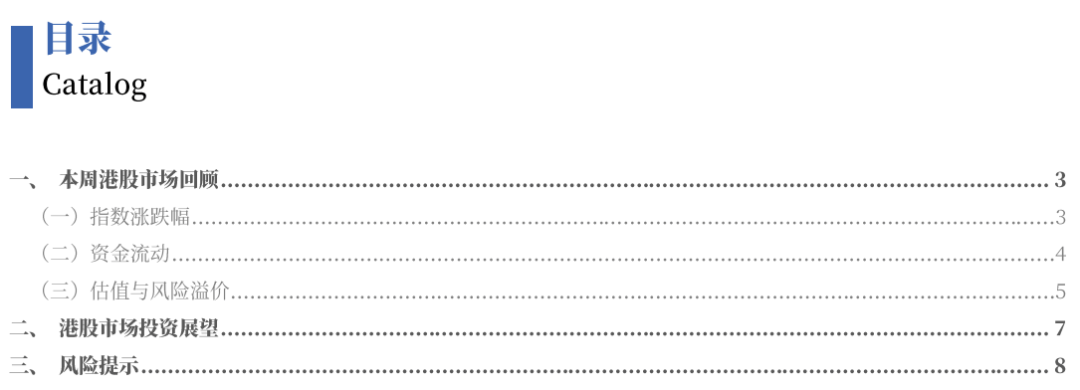
中国银河策略:港股三大指数涨幅分化明显,场内热点快速轮动
Sou Hu Cai Jing· 2025-08-25 00:55
Market Performance - The Hong Kong stock market showed mixed performance from August 18 to August 22, with the Hang Seng Index rising by 0.27% to close at 25,339.14 points, the Hang Seng Tech Index increasing by 1.89% to 5,647.68 points, and the Hang Seng China Enterprises Index up by 0.45% to 9,079.93 points [5][3][1] - Among the sectors, six industries saw gains while five experienced declines. Consumer discretionary, information technology, and consumer staples led the gains with increases of 2.46%, 2.10%, and 0.96% respectively, while materials, energy, and utilities faced the largest declines, dropping by 2.42%, 1.96%, and 1.50% respectively [7][1] Liquidity and Trading Volume - The average daily trading volume on the Hong Kong Stock Exchange was HKD 280.46 billion, an increase of HKD 23.61 billion from the previous week. The average daily short-selling amount was HKD 32.34 billion, up by HKD 3.21 billion, with short-selling accounting for 11.61% of total trading volume, an increase of 0.35 percentage points [11][1] - Southbound capital recorded a net inflow of HKD 17.90 billion, a decrease of HKD 20.22 billion from the previous week [11][1] Valuation and Risk Premium - As of August 22, the Hang Seng Index had a PE ratio of 11.54 and a PB ratio of 1.2, reflecting a 0.2% increase in PE and a 0.01% decrease in PB from the previous week, both at the 85th percentile since 2019. The Hang Seng Tech Index had a PE of 21.77 and a PB of 3.13, at the 22nd and 67th percentiles respectively [14][22] - The risk premium for the Hang Seng Index was calculated at 4.4% based on the 10-year US Treasury yield of 4.26%, and 6.88% based on the 10-year Chinese Treasury yield of 1.7818% [20][18] Investment Outlook - The US Department of Commerce announced the inclusion of 407 product categories in the steel and aluminum tariff list with a 50% tax rate, which may affect market sentiment [27][29] - Federal Reserve Chairman Jerome Powell indicated a shift in risk balance, suggesting potential adjustments in policy stance, which could lead to increased foreign capital inflow into the Hong Kong market [29][27] - Domestic fiscal data showed a 2.6% year-on-year increase in public budget revenue for July, the highest growth rate of the year, indicating a positive economic outlook [29][27] - Investment recommendations include focusing on sectors with better-than-expected interim results, those benefiting from favorable policies such as AI and "anti-involution" industries, and high-dividend stocks for stable returns amid uncertainties [29][27]