债券

Search documents
The Fed cutting rates is positive for fixed income, says Nuveen's Saira Malik
Youtube· 2025-10-03 12:27
Market Overview - The Dow is experiencing a triple-digit gain, with the S&P up by 15 points and the NASDAQ increasing by 52 points [1] Fixed Income Strategy - The current environment is favorable for fixed income, particularly with the Federal Reserve potentially cutting rates, making yields attractive [2] - Focus is on higher quality credit, with a preference for municipal bonds due to strong fundamentals, including robust rainy day funds and high savings rates [3][4] - Senior loans and emerging market debt are also being considered, especially as tariff-related issues have stabilized [5] Economic Concerns - There are concerns about a slowing economy, particularly in the employment market, which could be impacted by a government shutdown [6] - The upcoming Federal Open Market Committee (FOMC) meeting on October 28th may see the Fed lacking sufficient data to make informed rate cut decisions [7] Earnings Outlook - Third quarter earnings are expected to show strong year-over-year growth, with a consensus forecast of 8.8%, primarily driven by technology stocks [8] Valuation Insights - U.S. markets are trading at a premium compared to historical averages, largely due to the influence of technology and artificial intelligence [9] AI and Market Trends - The current landscape of AI investments is seen as different from the late 1990s bubble, with companies being larger and more profitable [15] - The structural trend of AI is expected to drive U.S. stocks higher, despite potential short-term volatility [16] - Historical data suggests that when the S&P is up significantly year-to-date, markets tend to end higher by year-end [17]


信心一日还魂记
虎嗅APP· 2025-10-03 11:48
Core Viewpoint - The article discusses the importance of "confidence" in the Chinese economy, likening it to a theatrical play titled "Waiting for Confidence," where confidence is a crucial yet elusive element for economic recovery [4][6]. Group 1: Importance of Confidence - Confidence is described as a "metaphysical" element that drives economic actions and decisions, transforming uncertainty into actionable expectations [6][8]. - The article emphasizes that confidence cannot be artificially created through policies or data alone; it exists in the collective consciousness of individuals [8][22]. Group 2: Case Study of Argentina - Argentina serves as a case study where confidence was temporarily restored through external intervention, specifically a $200 billion currency swap line from the U.S. Treasury, which provided a significant credit backing to the Argentine central bank [12][14]. - Historical parallels are drawn to past crises, such as the 1994-1995 Mexican Tequila Crisis, where similar confidence-boosting measures were effective [14][15]. Group 3: Challenges in Restoring Confidence - Despite temporary boosts in confidence, the article questions whether it can be sustained, highlighting that market participants remain skeptical and risk premiums are still high [21][22]. - The political landscape in Argentina poses a significant challenge, as any signs of failure in reforms can lead to a rapid loss of confidence among investors [21][22].

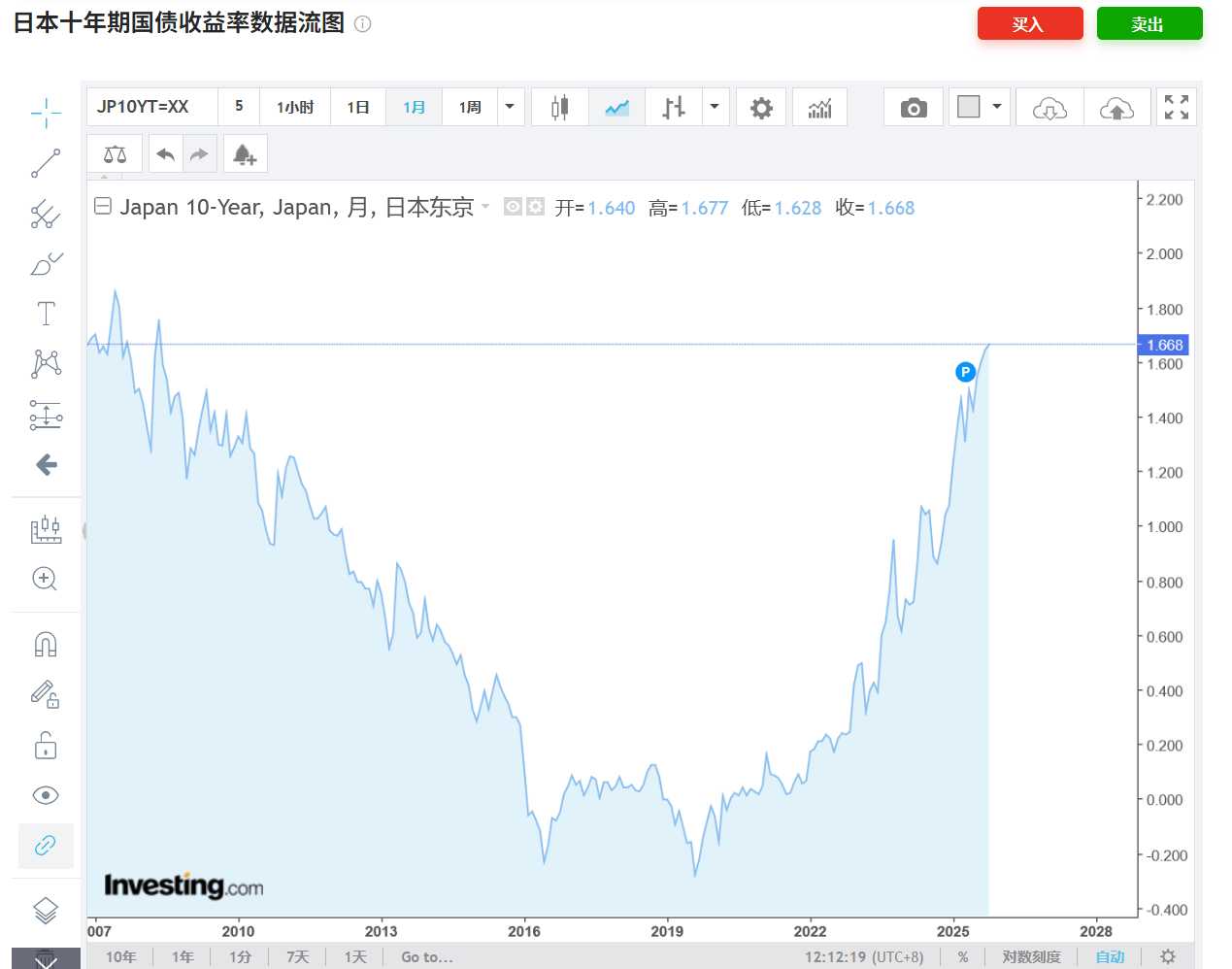
日本10年期国债收益率升至1.67%,2008年7月以来最高
Sou Hu Cai Jing· 2025-10-03 04:56
Core Points - Japan's 10-year government bond yield has risen to 1.67%, the highest level since July 2008 [1] - The Ministry of Finance set the coupon rate for the upcoming 10-year bonds at 1.7%, an increase from 1.5% in the previous quarter, marking a 17-year high [4] - The rise in long-term interest rates is driven by expectations of an early interest rate hike by the Bank of Japan [4] Summary by Category Government Bonds - The coupon rate for the 10-year government bonds has been adjusted to 1.7%, reflecting a significant increase from the previous rate of 1.5% [4] - The increase in interest rates may lead to higher debt servicing costs for the government, raising concerns about fiscal pressure [4] Monetary Policy - Two policy committee members of the Bank of Japan proposed raising the policy rate to around 0.75% during the September monetary policy meeting, contributing to market expectations of a rate hike in October [4] - The ruling party's minority status in both houses of parliament has heightened vigilance regarding fiscal expansion, which is also a factor contributing to the rise in long-term interest rates [4]
科技创新债券发行加速
Xin Lang Cai Jing· 2025-10-03 03:53
Core Insights - The announcement by the People's Bank of China and the China Securities Regulatory Commission on May 7 has led to active participation in the issuance of technology innovation bonds [1] - A total of 530 institutions issued technology innovation bonds amounting to 1,165.847 billion yuan from May 7 to September 28 [1] - Financial institutions issued 319.67 billion yuan, while non-financial enterprises issued 846.177 billion yuan, indicating a significant contribution from non-financial sectors [1] Summary by Category - **Market Participation** - 530 institutions participated in the issuance of technology innovation bonds [1] - The total issuance reached 1,165.847 billion yuan from May 7 to September 28 [1] - **Institutional Breakdown** - 88 financial institutions issued bonds totaling 319.67 billion yuan [1] - 442 non-financial enterprises issued bonds amounting to 846.177 billion yuan [1] - **Market Structure** - Non-financial enterprises issued 403.88 billion yuan in the interbank market and 442.297 billion yuan in exchanges [1] - The establishment of the "technology board" in the bond market aims to enhance financing support for technological innovation and diversify the bond market [1]
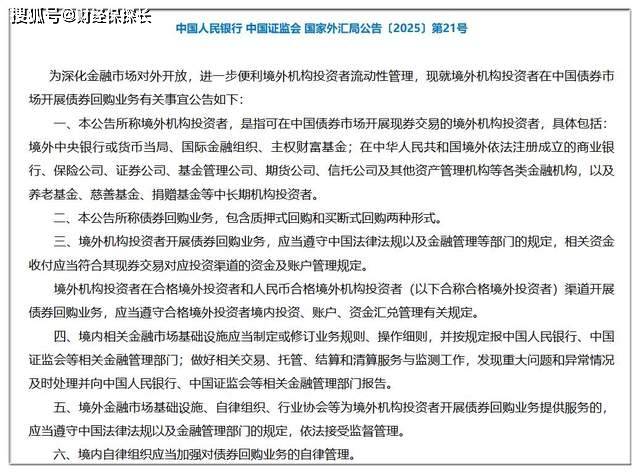
三部门联合发文!涉及1170家境外机构,4万亿债券市场迎来巨变!
Sou Hu Cai Jing· 2025-10-02 09:03
Core Viewpoint - The recent announcement by the central bank, the China Securities Regulatory Commission, and the State Administration of Foreign Exchange allows foreign institutional investors to fully participate in the bond repurchase market, marking a significant policy shift in China's financial landscape [1][8]. Group 1: Impact on Foreign Investors - The new policy effectively provides foreign investors with a "liquidity button" for their RMB-denominated bonds, enhancing their ability to manage cash flow [2]. - Historically, foreign investors faced challenges during market volatility, often forced to sell Chinese government bonds to meet margin calls, disrupting their investment strategies [3]. - The inability to efficiently manage liquidity led to increased trading costs and amplified investment risks, with estimates suggesting that transaction costs could consume 30%-50% of investment returns [4]. Group 2: Historical Context and Policy Evolution - The bond repurchase business for foreign institutions has been a decade-long journey, with initial participation limited to sovereign institutions and certain clearing entities, excluding major investment players [8]. - The recent policy change opens the door for a broader range of foreign investment institutions, allowing them to engage in repurchase agreements, which are essential for liquidity management [8]. Group 3: Operational Differences and Future Prospects - The new repurchase framework introduces a buyout-style repurchase model, aligning more closely with international practices, while the existing pledge-style repurchase remains in place for the time being [11]. - The policy is expected to enhance the attractiveness of Chinese bonds, with foreign institutions likely to increase their holdings significantly, as evidenced by a net increase of over 300 billion RMB in the first eight months of the year [13]. - The central bank's efforts to position Chinese bonds as widely accepted collateral in global markets could further boost their appeal and liquidity [13].
中方连抛500亿美债,特朗普为何不敢施压?美国关门危机真相曝光
Sou Hu Cai Jing· 2025-10-02 05:08
Core Points - The U.S. government experienced a shutdown on October 1, leading to a freeze in the financial system and significant market volatility [1][3] - The shutdown resulted from failed negotiations between the White House and Congress over budget allocations, particularly concerning aid to Ukraine and immigration policies [22][24] - The shutdown has broader implications for the U.S. debt market, with a notable reduction in foreign holdings of U.S. Treasuries, particularly by China, which sold off over $50 billion in six months [13][14][20] Group 1: Government Shutdown Impact - The government shutdown led to the suspension of various federal operations, including the closure of national parks and the halting of new drug approvals by the FDA [5][7] - Over 60% of government employees were placed on unpaid leave, significantly affecting public services and operations [7][9] - The military entered a minimum readiness state, with non-essential projects frozen and potential salary disruptions for military personnel [7][9] Group 2: Market Reactions - The stock market reacted sharply, with the Dow Jones futures dropping over 450 points and significant fluctuations in the U.S. Treasury yields [9][26] - Gold prices surged by 3% in Tokyo, marking the highest single-day increase of the year, as investors sought safe-haven assets [9][14] - Rating agencies issued warnings regarding the U.S. credit outlook, prompting some institutional investors to reduce their holdings in U.S. Treasuries [18][30] Group 3: Debt Market Dynamics - The U.S. Treasury market was already under pressure, with a record high fiscal deficit in Q2 2025 and declining foreign participation in Treasury auctions [26][28] - The reduction in Treasury holdings by China and other foreign investors has raised concerns about the stability of the U.S. debt market [16][20] - The Federal Reserve has adjusted its market operations in response to the changing dynamics, including delaying the planned reduction of its balance sheet [20][30]
日本5年期国债收益率下跌1个基点至1.220%
Mei Ri Jing Ji Xin Wen· 2025-10-02 02:00
Core Viewpoint - The yield on Japan's 5-year government bonds has decreased by 1 basis point to 1.220% [1] Group 1 - The decline in the 5-year government bond yield indicates a potential shift in investor sentiment towards safer assets [1]
中国抛售美债引发关注,巴菲特持债超3000亿,民间持仓占比超半数
Sou Hu Cai Jing· 2025-10-01 22:39
Core Viewpoint - The ongoing narrative surrounding U.S. Treasury bonds in 2025 reflects a complex interplay of global trust and the credibility of the U.S. dollar, with China being a focal point of discussion [1][5]. Group 1: U.S. Treasury Bonds Market Dynamics - U.S. Treasury bond prices remain strong and liquid, countering the narrative that selling U.S. debt equates to a financial catastrophe [1]. - The U.S. Treasury's data release in March sparked speculation about China's potential liquidation of U.S. bonds, igniting discussions on social media [1][2]. - The majority of U.S. Treasury bonds are held by domestic entities, including households, pension funds, and insurance companies, rather than foreign investors [2][3]. Group 2: China's Role in the U.S. Treasury Market - China ranks third globally in U.S. Treasury holdings, below Japan and the UK, holding less than one-tenth of the total [3]. - The perception of China as a "disruptor" in the U.S. Treasury market is misleading; it is more accurately described as a significant "player" rather than a dominant force [3][5]. - Speculation about China "dumping" U.S. bonds often overlooks the market's inherent liquidity and depth, which would require substantial domestic investor panic to trigger a significant downturn [3][5]. Group 3: Middle Eastern Investment Behavior - Middle Eastern investors prefer equity, real estate, and technology ventures over U.S. Treasury bonds due to religious prohibitions against fixed interest products [4]. - The notion that Middle Eastern funds are abandoning U.S. bonds is inaccurate; their investment strategies are guided by specific financial principles rather than market trends [4]. Group 4: Market Sentiment and Reactions - The fear surrounding U.S. Treasury bonds is not easily swayed by any single investor's actions, including potential large-scale sell-offs by China [5]. - The complexity of global capital flows and the underlying trust in the U.S. dollar play a crucial role in the stability of the U.S. Treasury market [5]. - The narrative of a potential "financial bomb" due to China's actions is oversimplified; a deeper understanding of the market's structure and the U.S.'s own financial mechanisms is necessary [5].
Treasury rates fall on weak ADP jobs report
Youtube· 2025-10-01 19:00
Group 1 - The bond market is accustomed to fluctuations, but the significance of these changes is uncertain and may depend on the duration of the trends observed [1][2] - Recent weak ADP employment report, the weakest since March 2023, along with a negative revision to the previous month, has led to market reactions [2] - Two-year yields have dropped more significantly than ten-year yields, indicating a notable shift in the yield curve dynamics [3][6] Group 2 - The decline in two-year yields highlights concerns regarding labor market weakness, which is a critical factor for the Federal Reserve's inflation strategy [4] - Market expectations for Federal Reserve easing have increased, with probabilities exceeding 100% for the next meeting, suggesting a pricing in of more than 25 basis points [5] - The yield curve is steepening as short-term rates have decreased more sharply, indicating a significant market adjustment [6]

美国损失惨重,中国清空3000亿美债,最大接盘侠诞生
Sou Hu Cai Jing· 2025-10-01 09:44
Group 1 - The core issue is the unprecedented shock to the US financial system triggered by China's significant reduction of US Treasury holdings, totaling $300 billion over three months, which has shaken market confidence [2][5] - China has strategically reduced its US Treasury holdings to $767.4 billion after selling $7.6 billion in March, marking a clear shift in its investment strategy and signaling a decrease in reliance on the US economy [2][4] - The US government has attempted to mitigate the situation by sending officials to persuade China to maintain its Treasury holdings, but China has decisively moved away from US debt, indicating a decline in trust in US financial dominance [2][5] Group 2 - In contrast to China's withdrawal, Japan has increased its US Treasury holdings by $19.9 billion in March, bringing its total to over $1.18 trillion, positioning itself as the largest holder of US debt [4] - The US faces worsening fiscal conditions, with rising inflation and a growing deficit, leading to a decline in market confidence in US Treasuries, raising questions about the wisdom of Japan's investment [4][7] - The ongoing financial turmoil reflects the broader context of US-China tensions, with China's actions seen as a direct response to US pressures, including tariffs on Chinese products and geopolitical tensions in the South China Sea [5][6] Group 3 - Despite Japan's short-term role in absorbing some of the US Treasury market's losses, it cannot restore confidence in the market, as other countries are now considering reducing their own US Treasury holdings [7] - The US economy is experiencing slow growth and market volatility, compounded by ineffective Federal Reserve interest rate policies that have failed to alleviate inflationary pressures [7] - The financial crisis is just beginning, with the potential for a more severe crisis looming on the horizon if the US government cannot find new buyers for its debt [7]