智能手机

Search documents
小米法务:“雷军不懂结构,发的微博不算数”
Sou Hu Cai Jing· 2025-11-20 08:14
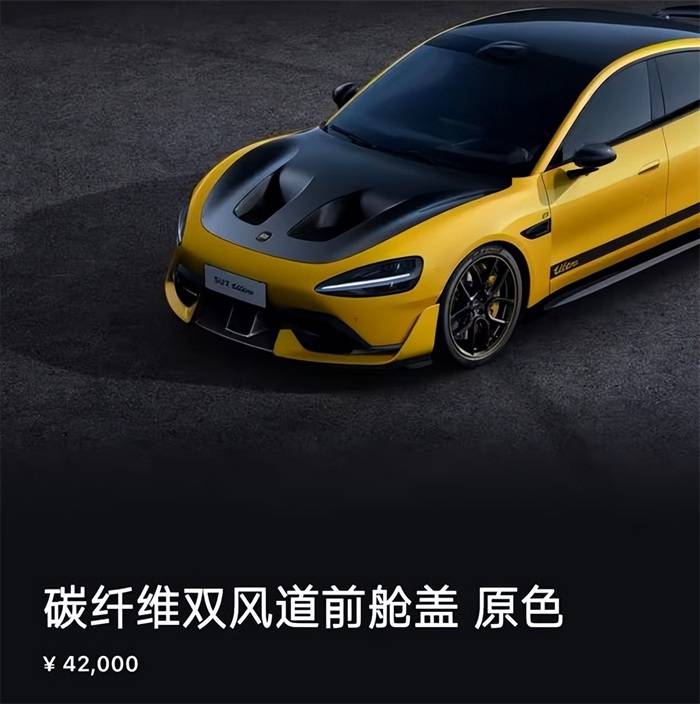
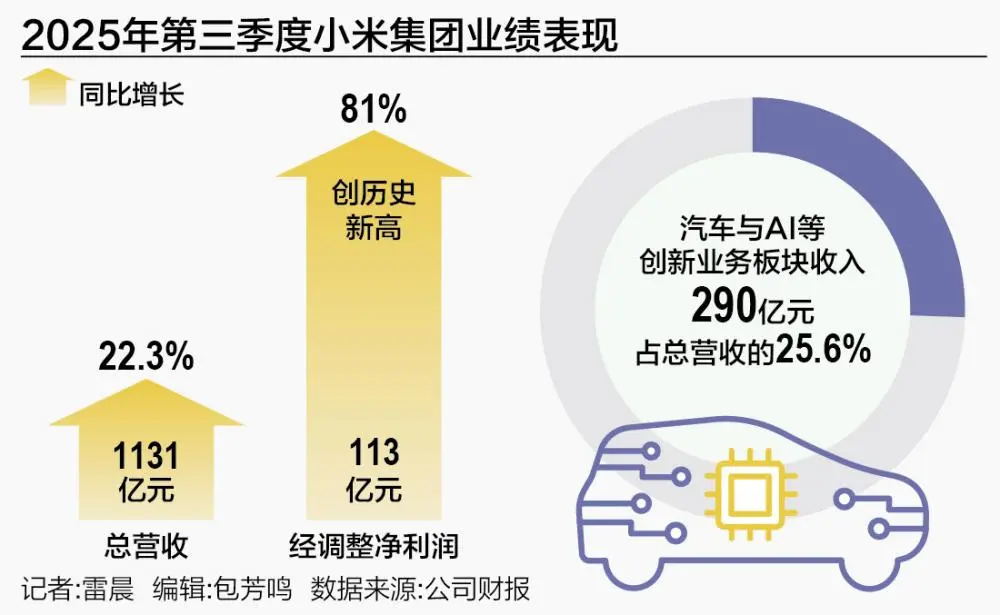
Core Insights - Xiaomi's automotive division achieved significant revenue growth and profitability in Q3 2025, reporting total revenue of 113.12 billion yuan, a year-on-year increase of 22.3%, and an adjusted net profit of 11.31 billion yuan, up 81% [10][11] - However, the company faces a public relations crisis due to a lawsuit regarding false advertising related to its carbon fiber hood, which has led to a loss of consumer trust [1][5] Financial Performance - In Q3 2025, Xiaomi's automotive business delivered 108,796 vehicles, a year-on-year increase of 173.4%, generating revenue of 28.3 billion yuan, which is a 197.9% increase compared to the previous year [10][11] - The gross margin for the automotive segment reached 25.5%, an increase of 8.4 percentage points from the same period last year [10][11] - Xiaomi's R&D investment for the first three quarters of 2025 was 23.5 billion yuan, with a workforce of 24,871 in R&D [14] Legal and Brand Challenges - The controversy began with the launch of the SU7 Ultra, which was marketed with exaggerated claims about its carbon fiber hood's performance, leading to customer dissatisfaction and a lawsuit from over 100 car owners [3][4] - Xiaomi's legal defense strategy, which included statements undermining the credibility of CEO Lei Jun's endorsements, has further damaged the brand's reputation [10][12] - The market reacted negatively to the news of the lawsuit, with Xiaomi's stock price dropping to 38.82 HKD, a decline of 4.81% in a single day, reflecting investor concerns about brand management and consumer trust [11][12] Market Position and Future Outlook - The current situation highlights a common challenge for emerging automotive companies: transitioning from reliance on the founder's personal brand to establishing trust based on product quality and performance [12][14] - To restore consumer confidence, Xiaomi must provide credible product testing data or offer more substantial compensation to affected customers [14] - The company needs to gradually separate its brand identity from Lei Jun's personal image, focusing on product quality, technological strength, and customer service as the foundation for long-term growth [14]


小米发11亿港元股权奖励,股价仍未止跌
Guan Cha Zhe Wang· 2025-11-20 07:38
Core Viewpoint - Xiaomi Group announced a large-scale share award and stock option grant to selected participants as part of its 2023 and 2024 share plans, aiming to align interests and retain talent amid ongoing stock price pressure [1][2]. Group 1: Share Awards and Stock Options - On November 19, Xiaomi granted a total of 29,366,734 shares to 3,334 selected participants, including employees and service providers, valued at approximately HKD 1.14 billion (around RMB 1.04 billion) based on a closing price of HKD 38.82 per share [1]. - The majority of the awarded shares, totaling 29,102,866 shares, were given to employees, while 263,868 shares were allocated to service providers, with no purchase cost for the awarded shares [1]. - Xiaomi H.K. Limited also granted 496,300 stock options to three selected participants, all employees, allowing them to purchase shares at USD 0.1 each [1]. Group 2: Future Grant Capacity and Performance Metrics - As of the announcement date, Xiaomi has 527,087,611 shares and 50,000,000 shares available for future grants under the Xiaomi Hong Kong plan and service provider limits, respectively [2]. - The rationale for the share awards is to align the interests of the recipients with the company's goals and to recognize their contributions, while also aiming to attract and retain talent for ongoing operations and development [2]. - The vesting of awarded shares will be based on performance targets, with the number of shares tied to individual and departmental performance rankings [2]. Group 3: Financial Performance and Market Reaction - Xiaomi reported Q3 revenue of RMB 113.1 billion, a year-on-year increase of 22.3%, marking the fourth consecutive quarter of revenue exceeding RMB 100 billion, with a net profit of RMB 11.3 billion, up 80.9% year-on-year, achieving a historical high [3]. - Despite strong financial results, Xiaomi's stock price faced significant pressure, dropping 4.81% on November 19, falling below HKD 40, and continuing to decline on November 20 [3].

小米发10亿股权奖励,股价仍未止跌
Guan Cha Zhe Wang· 2025-11-20 07:33
Core Viewpoint - Xiaomi Group announced a large-scale share award and stock option grant to selected participants as part of its 2023 and 2024 share plans, aiming to align interests and retain talent [1][2]. Group 1: Share Awards - On November 19, Xiaomi granted a total of 29,366,734 shares to 3,334 selected participants, including employees and service providers, with a total market value of approximately HKD 1.14 billion (around RMB 1.04 billion) based on the closing price of HKD 38.82 per share [1]. - The majority of the awarded shares, totaling 29,102,866 shares, were granted to employees, while 263,868 shares were awarded to service providers [1]. - The awarded shares were granted at zero cost, meaning recipients do not need to pay for the shares [1]. Group 2: Stock Options - Xiaomi H.K. Limited granted a total of 496,300 stock options to three selected participants, all of whom are employees, allowing them to purchase shares at USD 0.1 each [1]. - As of the announcement date, there are 527,087,611 shares and 50,000,000 shares available for future grants under the Xiaomi Hong Kong plan and service provider limits, respectively [2]. Group 3: Performance and Conditions - The vesting of the awarded shares will be based on performance targets, with the number of shares tied to individual and departmental performance rankings [2]. - The board may decide to invalidate unexercised awards or require the return of shares or equivalent cash if participants engage in serious misconduct or are deemed unsuitable for the awards [2]. Group 4: Financial Performance - Xiaomi reported Q3 revenue of RMB 113.1 billion, a year-on-year increase of 22.3%, marking the fourth consecutive quarter of revenue exceeding RMB 100 billion [3]. - The adjusted net profit reached RMB 11.3 billion, a year-on-year increase of 80.9%, achieving a historical high [3]. - Despite strong financial results, Xiaomi's stock price fell by 4.81% on November 19, dropping below HKD 40, and continued to decline on November 20 [3].

小米新征途:智能汽车、出海和高端化造想象空间
Feng Huang Wang· 2025-11-20 07:08
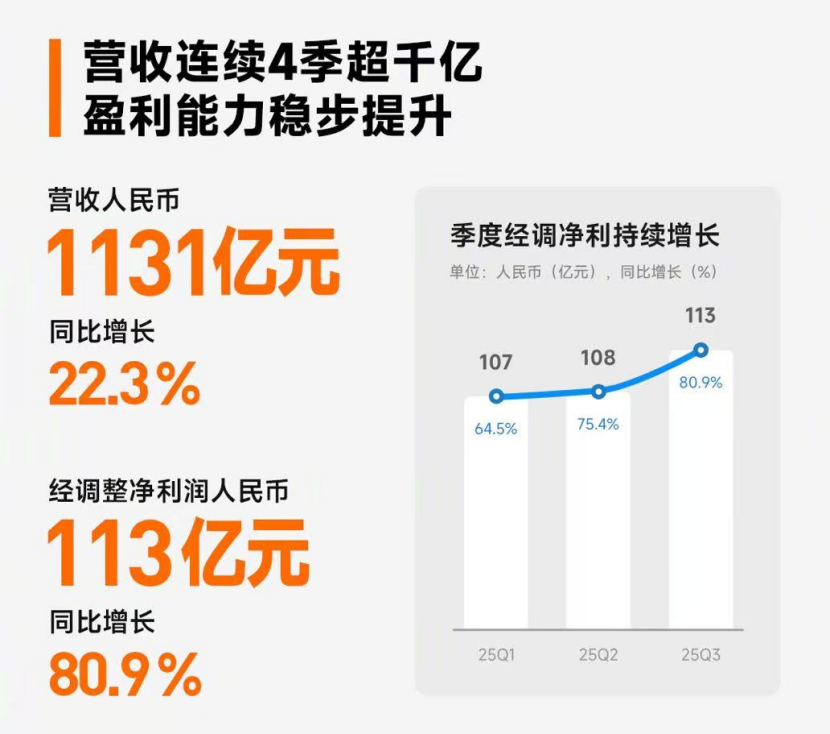
Core Insights - Xiaomi's revenue reached 113.1 billion yuan in Q3, marking a 22.3% year-on-year increase, with adjusted net profit soaring by 80.9% to 11.3 billion yuan, a historical high [1][2] - The company is experiencing robust growth in its core business while its innovative sectors, particularly electric vehicles and AI, are rapidly gaining traction [2][8] - Xiaomi's R&D investment has reached 23.5 billion yuan in the first three quarters, with expectations to exceed 30 billion yuan for the entire year, laying a solid foundation for future growth [1][17][19] Revenue Breakdown - In Q3, revenue from the smartphone and AIoT segments was 84.1 billion yuan, with smartphone revenue at 46 billion yuan and IoT and lifestyle products at 27.6 billion yuan, reflecting a 5.6% year-on-year growth [4] - Internet services revenue reached 9.4 billion yuan, up 10.8% year-on-year, with overseas internet service revenue hitting a record 3.3 billion yuan, contributing significantly to growth [5] Smartphone Performance - Xiaomi's global smartphone shipments reached 43.3 million units in Q3, marking nine consecutive quarters of year-on-year growth, maintaining a top-three position globally for 21 quarters [4] - The Xiaomi 17 series has gained significant traction in the high-end market, achieving over 1 million sales within five days of launch [9][10] Innovative Business Growth - Revenue from the electric vehicle and AI segments surged to 29 billion yuan, with a year-on-year increase exceeding 199%, and the automotive division achieving profitability [5][12] - The contribution of innovative business to overall revenue growth has increased from 15.32% to 25.64% in Q3, indicating a shift towards self-sustaining growth [5] R&D and Future Outlook - Xiaomi plans to invest 200 billion yuan in R&D over the next five years, focusing on core technologies to transition from an internet company to a hard-tech company [19][20] - The company has launched new self-developed chips and operating systems, enhancing its ecosystem and user experience across devices [19][20] International Expansion - Xiaomi aims to increase the number of its retail stores overseas to 10,000 in the next five years, focusing on markets in Southeast Asia, Hong Kong, Taiwan, Japan, South Korea, and Europe [14][16] - The company has successfully established a presence in international markets, with significant interest in its electric vehicles and smart home products [13][14]
用实力回应质疑:小米Q3汽车业务首次盈利、手机/大家电成业绩强劲新引擎
Sou Hu Cai Jing· 2025-11-20 07:00
Core Insights - Xiaomi Group reported a strong Q3 2025 financial performance with revenue of 113.1 billion yuan, a year-on-year increase of 22.3%, and an adjusted net profit of 11.3 billion yuan, up over 80% year-on-year [1][5] - The company has achieved over 100 billion yuan in net profit for three consecutive quarters, indicating a solid transition into a phase of normalized high profitability [5] Revenue and Profit Growth - For the first three quarters of 2025, Xiaomi achieved total revenue of 340.37 billion yuan, a 32.5% increase year-on-year, and an adjusted net profit of 32.817 billion yuan, up 73.5% year-on-year [6] - The growth is attributed to the strong performance of its smartphone, automotive, and smart home appliance sectors, with innovative businesses like electric vehicles and AI contributing 29 billion yuan in revenue [6] Business Performance - In Q3, Xiaomi's smartphone shipments reached 43.3 million units, marking nine consecutive quarters of year-on-year growth, with a global market share of 13.6% [8] - The AIoT platform connected devices surpassed 1 billion, reaching 1.036 billion, with monthly active users at 742 million [8] - Internet services revenue hit a record high of 9.4 billion yuan, growing 10.8% year-on-year [8] Strategic Positioning - Xiaomi's unique business model integrates hardware, software, and services, creating a comprehensive smart living experience that is difficult for competitors to replicate [11] - The company has established a clear ecosystem synergy among its three growth curves: smartphones as the primary user interface, automotive as the second revenue engine, and smart appliances enhancing the overall ecosystem [11][20] Automotive Business - The automotive sector reported revenue of 28.3 billion yuan in Q3, a staggering 197.9% increase year-on-year, with a delivery volume of 108,800 units, marking a 33.8% increase from Q2 [15] - Xiaomi's first electric vehicle achieved profitability within a year and a half of its launch, a unique feat among new automotive entrants in China [15] Smart Home Appliances - Xiaomi's high-end smart appliance segment is gaining traction, with new product launches and the opening of a smart appliance factory in Wuhan, which will support large-scale production [17] - The company is positioned as a key player in driving the upgrade of home appliance products, leading trends in smart and scenario-based consumption [17] Research and Development - Xiaomi's R&D investment reached 23.5 billion yuan in the first three quarters of 2025, with a record high of 9.1 billion yuan in Q3, reflecting a 52.1% year-on-year increase [20][21] - The company is transitioning from an internet company to a hard-tech leader, with significant advancements in AI and self-developed chips [21] Market Outlook - Analysts view Xiaomi's long-term value positively, citing its robust balance sheet, strong ecosystem integration, and competitive advantages in the electric vehicle sector [23][24] - The synergy between smartphones, electric vehicles, and AIoT is expected to unlock substantial growth potential, bringing Xiaomi closer to its goal of reaching a trillion-dollar market valuation [24]

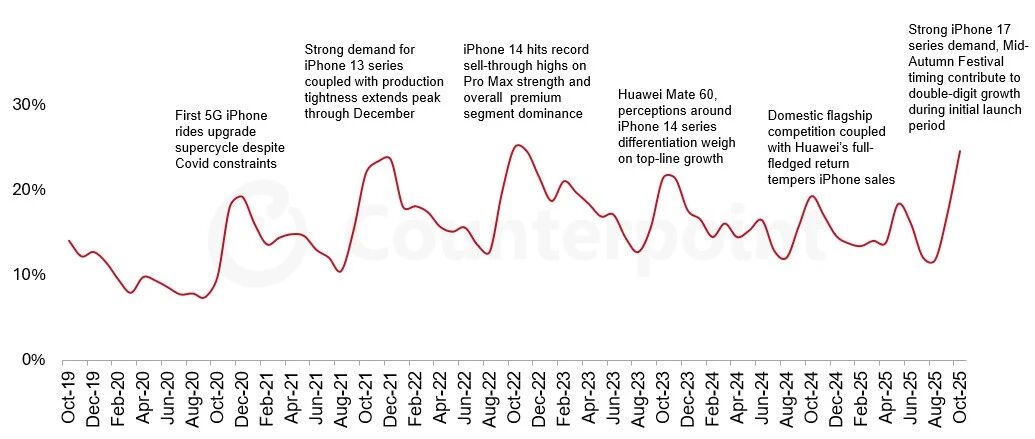
Counterpoint Research:中国10月智能手机销量同比增长8% iPhone Q4销量持续攀升
智通财经网· 2025-11-20 05:52
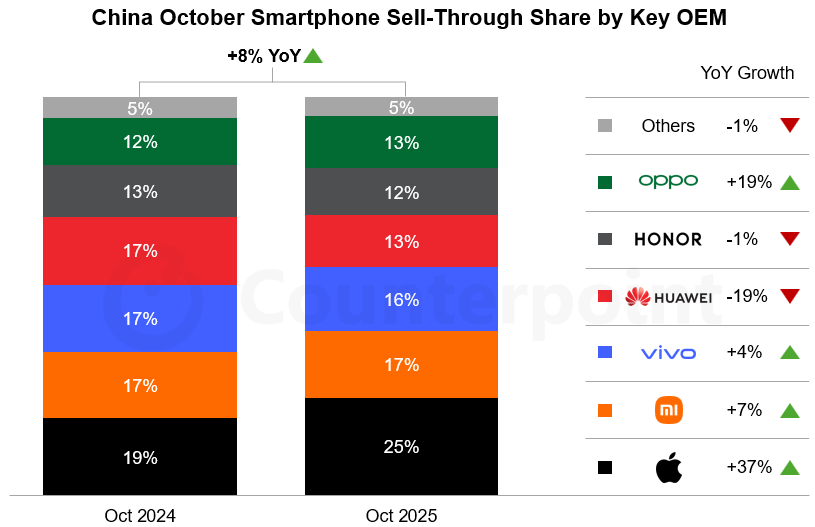
Core Insights - Apple's smartphone sales in October increased by 8% year-on-year, driven by a 37% growth in iPhone sales, particularly the iPhone 17 series [1][6] - The iPhone 17 series has achieved significant sales, with over 80% of new iPhone sales coming from this model, leading to an expected rise in overall sales due to increased average selling prices [1][6] - October marked Apple's best-ever Q4 start, with iPhones accounting for one in four smartphones sold in China, a feat only previously achieved in 2022 [4][6] Company Performance - OPPO emerged as the second-largest growth driver in the domestic smartphone market, thanks to its flagship Find X9 series and the youth-oriented Reno 14 series, exceeding expectations [6] - Xiaomi launched its Xiaomi 17 series early, along with a diverse product lineup, allowing it to reclaim the second position in the domestic market for the first time in over a decade [6] - Apple's sales momentum remains strong entering November, with expectations of achieving the best quarterly performance in December, despite potential competition from Huawei's upcoming Mate 80 series [6]

小米汽车开始挣钱 卖一台车净赚6434元 雷军最新发声
2 1 Shi Ji Jing Ji Bao Dao· 2025-11-20 04:53
Core Insights - Xiaomi Group reported a total revenue of 113.1 billion yuan for Q3 2025, representing a year-on-year growth of 22.3%, with adjusted net profit reaching 11.3 billion yuan, up 81%, marking a historical high [1][4] - The company successfully transitioned between old and new growth engines, with innovative businesses like smart electric vehicles and AI achieving profitability for the first time in a single quarter, while the traditional smartphone business faced pressure due to rising memory costs [1][4] Financial Performance - The automotive business delivered 108,796 vehicles in Q3, with a total of 265,967 vehicles delivered in the first three quarters, and a monthly delivery of over 40,000 units in October, achieving profitability with a net profit of 6,434 yuan per vehicle sold [4][6] - The smartphone business faced challenges, with global shipments of 43.3 million units and revenue of 45.969 billion yuan, leading to a decline in gross margin to 11.1% due to rising costs of core components [6][5] Business Segmentation - Internet services generated revenue of 9.4 billion yuan in Q3, a 10.8% increase, primarily driven by strong advertising performance [7] - IoT business revenue reached 27.6 billion yuan, maintaining year-on-year growth for seven consecutive quarters, with a gross margin of 23.9% [9][8] R&D and Long-term Strategy - R&D expenditure in Q3 amounted to 9.1 billion yuan, a 52.1% increase, with total R&D investment for the first three quarters nearing last year's total, expected to exceed 30 billion yuan for the year [11][12] - The company is focusing on core technologies and frontier fields, with capital expenditure for the first three quarters at 13 billion yuan, reflecting long-term strategic investments [12][10] Market Outlook and Challenges - Despite achieving profitability in the automotive sector, the company anticipates challenges in 2026 due to reduced purchase tax subsidies and intensified competition [12] - The smartphone business continues to face long-term pressure from rising memory costs, while the IoT sector is experiencing a transitional phase in the domestic appliance market [12][6]
小米汽车开始挣钱,卖一台车净赚6434元,雷军最新发声
2 1 Shi Ji Jing Ji Bao Dao· 2025-11-20 04:53
Core Insights - Xiaomi Group reported a total revenue of 113.1 billion yuan for Q3 2025, representing a year-on-year growth of 22.3%, with adjusted net profit reaching 11.3 billion yuan, a significant increase of 81%, marking a historical high [1] - The financial report indicates a successful transition between old and new growth engines, with innovative businesses like smart electric vehicles and AI achieving profitability for the first time in a single quarter, while the traditional smartphone business faces pressure due to rising memory costs [1][3] - Xiaomi's partner and president, Lu Weibing, emphasized the importance of continuous capability building to enhance resilience against uncontrollable environmental factors [1] Innovative Business Performance - The smart electric vehicle and AI sectors became the core growth drivers, with Xiaomi delivering 108,796 vehicles in Q3 and a total of 265,967 vehicles in the first three quarters, achieving profitability for the first time with an operating profit of 700 million yuan [3] - The average profit per vehicle sold was 6,434 yuan, exceeding expectations and validating the product strength and business model of Xiaomi's automotive division [3] Smartphone Business Challenges - Xiaomi's global smartphone shipments reached 43.3 million units in Q3, generating revenue of 45.969 billion yuan, but the smartphone business faced a decline in gross margin to 11.1% due to rising costs of core components [5] - Lu Weibing noted that the current memory price increase is driven by strong demand for HBM (High Bandwidth Memory) from AI, leading to a long-term cost pressure on the smartphone segment [5] Internet Services Contribution - The internet services segment generated revenue of 9.4 billion yuan in Q3, reflecting a year-on-year growth of 10.8%, primarily driven by strong performance in advertising [6] IoT Business Growth - Xiaomi's IoT and lifestyle product revenue reached 27.6 billion yuan in Q3, maintaining year-on-year growth for seven consecutive quarters, with a gross margin of 23.9% [8] - The overseas market has become a significant growth driver for IoT, with record revenue achieved in Q3, and plans for further expansion in Southeast Asia and Europe [8] R&D Investment and Long-term Strategy - Xiaomi's R&D expenditure in Q3 amounted to 9.1 billion yuan, a 52.1% increase year-on-year, with total R&D investment for the first three quarters nearing last year's total [10] - The company aims to become a global leader in core technology through substantial investments in foundational technologies, particularly in AI [10] Future Challenges and Strategic Focus - Despite achieving profitability in the automotive sector, challenges are anticipated in 2026 due to reduced purchase tax subsidies and intensified competition [11] - The smartphone business continues to face long-term cost pressures, while the IoT sector is navigating a transitional phase in the domestic appliance market [11] - Xiaomi plans to focus on consolidating automotive profitability, advancing smartphone premiumization, and leveraging opportunities in AI to achieve high-quality growth [11]

小米汽车开始挣钱,卖一台车净赚6434元,雷军最新发声
21世纪经济报道· 2025-11-20 04:49
Core Insights - Xiaomi Group reported a total revenue of 113.1 billion yuan for Q3 2025, a year-on-year increase of 22.3%, with adjusted net profit reaching 11.3 billion yuan, up 81%, marking a historical high [1] - The company successfully transitioned between old and new growth engines, with innovative businesses like smart electric vehicles and AI achieving profitability for the first time in a single quarter, while the traditional smartphone business faced pressure due to rising memory costs [1][4] - Xiaomi's President Lu Weibing emphasized the importance of resilience through continuous capability building in response to uncontrollable environmental factors [1] Revenue and Profitability - The innovative business segment, including smart electric vehicles, delivered a significant turnaround, achieving a profit of 700 million yuan in Q3 after a loss of 300 million yuan in Q2, with an average profit of 6,434 yuan per vehicle sold [4] - The smartphone business faced challenges, with global shipments of 43.3 million units and revenue of 45.969 billion yuan, leading to a decline in gross margin to 11.1% due to prolonged cost pressures from core components [6] Business Segmentation - Internet services generated revenue of 9.4 billion yuan in Q3, reflecting a 10.8% year-on-year growth, primarily driven by strong performance in advertising [7] - The IoT business reported revenue of 27.6 billion yuan, maintaining a growth streak for seven consecutive quarters, with a gross margin of 23.9% [9] Strategic Initiatives - Xiaomi is increasing its R&D investment, with Q3 spending reaching 9.1 billion yuan, a 52.1% increase year-on-year, and total R&D expenditure expected to exceed 30 billion yuan for the year [11] - The company is focusing on high-end product strategies to counteract cost pressures, achieving a market share increase in the 4,000-6,000 yuan price segment by 5.6 percentage points to 18.9% [6] Future Outlook - Despite achieving profitability in the automotive sector, challenges remain, including reduced purchase tax subsidies and intensified competition expected in 2026 [12] - Xiaomi aims to solidify its automotive profitability, further penetrate the high-end smartphone market, and leverage opportunities in AI and physical world integration for long-term strategic goals [12]

中国 10 月智能手机销量同比增长 8%;iPhone Q4 销量持续攀升,有望创历史新高
Counterpoint Research· 2025-11-20 04:14
Core Insights - In October, China's smartphone sales increased by 8% year-on-year, driven by Apple's 37% growth in sales [4][5][7] - The iPhone 17 series has significantly contributed to Apple's performance, with over 80% of sales coming from this new lineup, leading to an expected increase in overall sales due to rising average selling prices [5][7] - October marked Apple's best-ever Q4 start, with one in four smartphones sold in China being an iPhone, a feat only previously achieved once in 2022 [7] Market Performance - The iPhone 17 series, including the base, Pro, and Pro Max models, achieved double-digit growth rates in October, with the base model showing the fastest growth [7][9] - OPPO's flagship Find X9 series has performed well, driven by its strong imaging capabilities and large battery capacity, making it the second-largest growth driver in the domestic smartphone market [9] - Xiaomi reached the second position in the domestic market for the first time in over a decade, aided by its strong product lineup, including the Xiaomi 17 series launched during the Mid-Autumn Festival sales peak [9] Future Outlook - Apple's strong sales momentum is expected to continue into November, with the potential for record quarterly performance in December [9] - The upcoming launch of Huawei's Mate 80 series on November 25 poses a potential challenge, but current trends suggest that Apple's growth is robust and unlikely to see significant declines [9]