
制造

Search documents
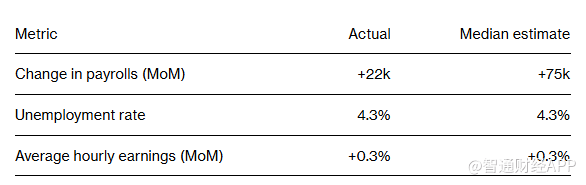
美国8月非农“大爆冷” 巩固美联储9月降息预期
Zhi Tong Cai Jing· 2025-09-05 13:37
Group 1 - The core viewpoint of the articles indicates a significant slowdown in U.S. job growth, with the unemployment rate rising to its highest level since 2021, raising concerns about a potential worsening labor market [1][2][3] - In August, non-farm payrolls increased by only 22,000, far below the expected 75,000, while the unemployment rate rose to 4.3% [2][3] - Job growth has been concentrated in healthcare, leisure, and hospitality, while sectors such as information, finance, manufacturing, federal government, and business services saw substantial job losses [2][3] Group 2 - The average job growth over the past three months is only 29,000, marking the weakest employment growth phase since the pandemic began, with job additions consistently below 100,000 for four consecutive months [3] - The disappointing employment report has increased expectations for a Federal Reserve interest rate cut in September, with a 98% probability of a 25 basis point cut anticipated [4] - The yield on the two-year U.S. Treasury note fell to 3.5%, and the ten-year note yield dropped to 4.1%, both reaching five-month lows, indicating a market reaction to the employment data [3]

内蒙古自治区政府采购合同融资规模突破20亿大关
Sou Hu Cai Jing· 2025-09-05 10:09
Core Insights - The Inner Mongolia Autonomous Region has successfully surpassed a financing scale of 2 billion yuan through government procurement contract financing, marking significant progress in supporting small and medium-sized enterprises (SMEs) [1][2] - The financing model leverages the credit value of government procurement contracts, providing SMEs with a streamlined and efficient financing pathway [1] Financing Model - The government procurement contract financing allows winning bidders to apply for financing directly from cooperating financial institutions using their government procurement contracts as collateral [1] - This model simplifies the approval process and lowers financing thresholds, effectively addressing the challenges of "difficult and expensive financing" faced by SMEs [1] Impact on SMEs - Over 700 SMEs have received financing support through this platform, with a cumulative financing amount reaching 2.08 billion yuan, covering various sectors including manufacturing, services, and construction [1] - The funds are primarily utilized for expanding production, upgrading equipment, and enhancing technological research and development, thereby improving market competitiveness [1] Regional Participation - The participation rates of enterprises from different regions are notable, with Ordos, Baotou, and Hohhot contributing 19%, 15%, and 12% of the financing respectively [1] Efficiency Improvements - The Inner Mongolia Finance Department has initiated a "financing express" pilot program to enhance financing efficiency, optimizing various processes such as credit assessment, loan limits, approval speed, and account management [2] - The time from application to disbursement has been significantly reduced, with funds potentially available within 1 hour after the government procurement contract is issued, and the maximum credit limit can reach 10 million yuan [2] Future Plans - The Finance Department aims to expand financial service coverage, diversify financing product types, and promote policy application to support more SMEs in achieving healthy growth [2]
筑牢合规根基、激活重组动能 江苏证监局指导开展上市公司高质量发展系列培训
Zheng Quan Shi Bao Wang· 2025-08-29 05:21
Group 1: Core Insights - The Jiangsu Securities Regulatory Bureau is promoting high-quality development of listed companies through a series of training sessions aimed at enhancing compliance and operational standards [1][2][3] - The training sessions have seen participation from nearly 700 listed companies and 900 executives, emphasizing the importance of compliance and governance in maintaining market integrity [1][2] Group 2: Compliance and Risk Management - The regulatory body has intensified its enforcement actions against financial fraud, insider trading, and other violations, establishing a robust accountability framework that raises the cost of non-compliance [2] - Listed companies are urged to adopt a compliance-first mindset, recognizing that proper governance is essential for sustainable growth and maintaining investor confidence [2] Group 3: Policy Utilization and Company Quality - Jiangsu is leveraging national policies to enhance the quality of listed companies, encouraging mergers and acquisitions that align with strategic goals and market demands [3] - Companies are advised to learn from past failures in M&A to avoid high-risk ventures and ensure successful integration of new assets [3] Group 4: Shareholder Value and Market Confidence - In response to regulatory encouragement, listed companies in Jiangsu have increased their cash dividend payouts, with a total of 1,056.99 billion yuan projected for 2024, reflecting a 5% increase in payout ratio [4][5] - The region has seen a significant rise in private equity investments, with 1,038 cases amounting to 406.83 billion yuan, marking an 18.1% increase year-on-year [5]
飞达控股(01100)发布中期业绩,股东应占溢利5991.8万港元,同比增长69.9%
Zhi Tong Cai Jing· 2025-08-26 09:13
Core Insights - The company reported a revenue of HKD 846 million for the six months ending June 30, 2025, representing a year-on-year growth of 23.1% [1] - The profit attributable to shareholders was HKD 59.918 million, showing a significant increase of 69.9% compared to the previous year [1] - Basic earnings per share were HKD 0.13962, with an interim dividend proposed at HKD 0.03 per share [1] Revenue Breakdown - The manufacturing segment experienced a revenue growth of 20.6%, reaching HKD 537.7 million, which accounted for 63.6% of the total revenue [1] - Segment operating profit saw a substantial increase of 28.9%, amounting to HKD 120 million [1]
为什么问题总是“发现太晚、解决太慢”?
3 6 Ke· 2025-08-26 03:05
Core Insights - The article emphasizes the importance of Quick Response Quality Control (QRQC) as a solution to common manufacturing issues, particularly slow information flow and delayed decision-making during production problems [1][2][8] - QRQC aims to enable real-time problem-solving on the production floor, thereby minimizing waste and improving quality [2][9] QRQC Overview - QRQC is a structured real-time problem-solving method that originated in the automotive industry and is now widely adopted across various manufacturing sectors [2][9] - The method focuses on quickly identifying issues, analyzing root causes, and implementing immediate corrective actions to prevent recurrence [2][3] Key Principles of QRQC - Speed: Immediate response to issues, ideally within minutes, to minimize downtime and losses [5] - Structure: Clear, replicable processes guide teams in problem resolution, ensuring consistency across all levels [5] - Standardization: Uniform recording and sharing of information to facilitate experience reuse and track recurring issues [5] Steps for Implementing QRQC - The QRQC process includes five key steps: exposing problems, communicating swiftly, analyzing root causes, taking action, and verifying solutions [6][7] - The focus is on resolving issues at their source quickly, rather than relying on meetings and reports [7] Adoption of QRQC - Many manufacturing companies face similar challenges, such as delayed information and unclear responsibilities, which QRQC effectively addresses [8][9] - QRQC is favored for its simplicity, efficiency, and quick results, allowing frontline employees to take immediate action [9] Digital Empowerment of QRQC - Digital tools enhance QRQC by enabling real-time problem reporting, cross-shift communication, and automated tracking of corrective actions [15][16] - The integration of digital systems allows for better visibility, accountability, and speed in problem resolution [16] Practical Implementation of QRQC - Successful QRQC implementation involves gaining leadership support, starting with pilot projects, training teams, and establishing clear communication channels [13][14] - Continuous practice and experience sharing are essential for QRQC to take root and expand within the organization [14] Conclusion - QRQC, especially when combined with digital tools, can significantly improve problem-solving speed and quality in manufacturing environments, turning real-time issue resolution into a competitive advantage [11][18]
商务部研究院的培训,涉及出口管制、跨境AML
制裁名单· 2025-08-20 01:56
Core Viewpoint - The article announces a specialized training program on export control and cross-border anti-money laundering compliance, aimed at helping enterprises enhance their risk identification and prevention capabilities in a complex global regulatory environment [2][3]. Training Content - **Export Control and Economic Sanctions** - Review of global export control and economic sanctions hotspots, analysis of the current situation, and future trends [2] - Overview of China's Export Control Law, including its jurisdiction, measures, and legal responsibilities [2] - Introduction to international export control mechanisms such as the Wassenaar Arrangement and Nuclear Suppliers Group [3] - Study of export control policies from the US and EU, including EAR, ITAR, and OFAC sanctions, and their impact on China [3] - Analysis of secondary sanctions case studies and response strategies [3] - Practical construction of export control compliance systems, including risk assessment, internal controls, training, and auditing mechanisms [3] - **Cross-Border Anti-Money Laundering and Counter-Terrorism Financing** - Analysis of the new Anti-Money Laundering Law and FATF's fifth round of international evaluation standards, focusing on the obligations of financial institutions and enterprises [3] - Practical operations for customer due diligence and transaction monitoring, including identity verification and reporting of large and suspicious transactions [3] - Screening for sanction risks and list management through compliance tools, establishing monitoring and updating mechanisms [3] - Case studies on cross-border transaction risks related to anti-money laundering and sanctions [3] - **Coordinated Compliance for Export Control and Anti-Money Laundering** - Building collaborative mechanisms and policy linkages, including regulatory agency cooperation models and dual-track compliance frameworks for enterprises [4] - Information sharing and technological integration for tracking cross-border funds and logistics, and upgrading list management systems [4] - Practical collaborative models and experiences, such as cooperation modes at the China-Vietnam border and high-risk country management in the EU [4] Target Audience - The training is aimed at personnel from local commerce bureaus, economic cooperation bureaus, financial regulatory bureaus, the People's Bank, foreign exchange administration, and related staff from free trade zones and border cooperation zones [5] - It also targets compliance, legal, risk management, international business, and card center staff from financial institutions, as well as relevant personnel from manufacturing and trading enterprises, trade associations, law firms, accounting firms, and consulting companies [5] Fees and Other Information - The training fee is set at 5,980 yuan per person, which includes teaching, materials, and venue costs [5] - Accommodation is arranged according to the Ministry of Finance's standards, with costs borne by participants [5] - Registration details and payment instructions are provided, with a deadline for registration [6]

各地工商联助力民营企业融入全国统一大市场建设——当好桥梁纽带 赋能民企发展
Xin Hua Wang· 2025-08-18 23:24
Group 1 - The establishment of a unified national market is essential for constructing a new development pattern and promoting high-quality development [1] - The private economy is a vital force in advancing Chinese-style modernization and serves as an important foundation for high-quality development, with 4.6% year-on-year growth in newly established private enterprises in the first half of the year, totaling 4.346 million [1] - Local industry and commerce federations are enhancing the sense of gain for private enterprises by promoting policies, building communication platforms, and optimizing the business environment [1] Group 2 - Various local industry and commerce federations are actively promoting the implementation of policies to support enterprises, conducting activities to understand enterprise needs, and ensuring the effective delivery of benefits [2] - In Hebei Province, 1,456 enterprises and chambers of commerce were visited, resolving 387 issues for private enterprises and conducting 240 policy training sessions [2] - Guangdong Province's initiative "Spring Rain Nurturing Seedlings" aims to provide tailored tax incentives for small and micro enterprises [2] Group 3 - Local federations are organizing supply-demand matching platforms to facilitate cooperation among enterprises, enhancing the integration of industrial chains [3] - In Hunan Province, a "production and sales matching exchange salon" was held to foster collaboration among enterprises, resulting in over 50 procurement agreements [3] - The initiative in Qinhuangdao City promotes efficient flow of production factors through resource integration and service optimization [3] Group 4 - Wuhan City has launched the "Golden Bridge Plan" to connect technology-based small and micro enterprises with incubators, venture capital, research institutions, and government departments [4] - The "National Federation of Industry and Commerce Innovation Growth Empowerment Matching Activity" in Guangzhou provided a platform for innovative enterprises to showcase their latest research achievements [5] Group 5 - A multi-faceted dispute resolution mechanism has been established, combining courts and industry associations to efficiently resolve business disputes [6] - The establishment of over 6,900 mediation organizations within the industry and commerce federation system has significantly enhanced the capacity for dispute resolution [7] - Innovative models like "customized mediation" in Yibin City have improved the quality and efficiency of mediation services [7]
被误读的“社保新规”和担心的中小企业
经济观察报· 2025-08-16 08:17
Core Viewpoint - The recent legal interpretation emphasizes the enforcement of existing social insurance regulations rather than introducing new rules, and it should not be over-interpreted [3][12][27] Group 1: Concerns of Business Owners - Business owners are primarily worried about the impact of compliance costs for employee social insurance on their profits [3][15] - Many small and micro enterprises have previously operated under informal agreements not to pay social insurance, leading to potential legal disputes as employees can now claim compensation for non-payment [7][15] - The implementation of the new interpretation may lead some businesses to reduce staff, cut salaries, or even shut down due to increased costs [7][16] Group 2: Implications of the New Interpretation - The new interpretation clarifies that employees can demand compensation if their employer fails to pay social insurance, even if there was a prior agreement not to do so [5][8] - The interpretation is expected to push some businesses to comply with social insurance obligations, as it strengthens employees' rights [7][12] - The legal framework for social insurance has existed for years, but enforcement has been lax, particularly for small businesses facing economic difficulties [6][12] Group 3: Challenges in Achieving Universal Social Insurance - Despite the goal of universal social insurance, significant gaps remain, particularly among small and micro enterprises, which often struggle to comply due to financial constraints [21][27] - The willingness of employees to contribute to social insurance is influenced by their immediate financial needs versus long-term benefits [22][23] - The current economic environment, including pressures from the pandemic, has led to a more lenient approach from authorities regarding compliance with social insurance payments [27][26] Group 4: Future Considerations - The potential for increased legal disputes over social insurance compliance may lead to a more cautious approach from businesses, particularly small and micro enterprises [10][14] - There is a concern that the new interpretation could lead to a rise in operational costs, prompting businesses to pass these costs onto consumers or reduce their workforce [16][17] - The long-term sustainability of the social insurance system relies on a broader base of compliant contributors, necessitating careful consideration of the balance between enforcement and economic viability for businesses [28][27]

被误读的“社保新规”和焦虑的中小企业
Jing Ji Guan Cha Wang· 2025-08-16 05:18
Core Viewpoint - The recent "social security new regulations" have raised concerns among small and medium-sized enterprises (SMEs) regarding compliance costs and potential legal risks associated with employee social security contributions [2][6][19]. Group 1: Impact of New Regulations - The Supreme Court's "Interpretation No. 2" allows employees to claim economic compensation if their employer fails to pay social security, even if there was a prior agreement not to do so [2][4]. - Many SMEs have historically not paid social security, and the new regulations may lead to a loss of trust between employers and employees, potentially resulting in layoffs or business closures [6][19]. - The average additional cost for a factory to comply with social security payments can significantly impact profitability, with estimates suggesting an increase of 2.1 million yuan per employee annually [8][17]. Group 2: Misinterpretation of "Universal Social Security" - Experts argue that the term "universal social security" is misleading, as the requirement for social security contributions has existed but was not strictly enforced [4][13]. - The implementation of "Interpretation No. 2" is not a signal for immediate universal social security but rather a reinforcement of existing laws that have not been adequately enforced [4][15]. - The actual compliance rates for social security contributions among SMEs remain low, with many still not participating in the system [23][24]. Group 3: Long-term Considerations - The long-term sustainability of the social security system relies on broader compliance, which is essential for providing basic living guarantees for retirees [29][31]. - There is a need for a balanced approach that considers both the financial burdens on businesses and the willingness of employees to contribute to social security [24][27]. - The gradual push towards universal social security is seen as necessary for the overall stability of the pension system, despite current challenges [30][31].

2025年第一季度迪拜GDP达1197亿迪拉姆,同比增长4%
Shang Wu Bu Wang Zhan· 2025-08-15 16:08
Economic Performance - In the first quarter of 2025, Dubai's GDP reached 119.7 billion dirhams, reflecting a year-on-year growth of 4% [2] - The growth demonstrates the resilience and vitality of Dubai's economy [2] Sector Contributions - The real estate sector experienced a significant growth of 7.8% [2] - The financial and insurance sector grew by 5.9% [2] - The wholesale and retail trade sector saw an increase of 4.5% [2] - The information and telecommunications sector grew by 3.2% [2] - The accommodation and food services sector increased by 3.4% [2] - The manufacturing sector grew by 3.3% [2] - The transportation and warehousing sector experienced a growth of 2% [2]