
建筑材料

Search documents
粤开市场日报-20250701
Yuekai Securities· 2025-07-01 08:41
Market Overview - The A-share market showed mixed performance today, with the Shanghai Composite Index rising by 0.39% to close at 3457.75 points, while the Shenzhen Component Index increased by 0.11% to 10476.29 points. However, the Sci-Tech Innovation 50 Index fell by 0.86% to 994.80 points, and the ChiNext Index decreased by 0.24% to 2147.92 points. Overall, 2628 stocks rose, 2542 fell, and 247 remained unchanged across the market [1]. - The total trading volume in the Shanghai and Shenzhen markets was 14660 billion, a decrease of 208.42 billion compared to the previous trading day [1]. Industry Performance - Among the Shenwan first-level industries, sectors such as comprehensive, pharmaceutical biology, banking, non-ferrous metals, public utilities, and building materials led the gains, while computer, retail, telecommunications, media, power equipment, and real estate sectors experienced declines [1]. Sector Highlights - The top-performing concept sectors today included China Shipbuilding System, innovative drugs, antibiotics, vitamins, generic drugs, low-priced stocks in the ChiNext, hydropower, biotechnology, advanced packaging, superhard materials, pet economy, CRO, medical material exports, selected banks, and brain-computer interfaces [1].
从微观出发的五维行业轮动月度跟踪-20250701
Soochow Securities· 2025-07-01 04:04
Quantitative Models and Construction Methods 1. Model Name: Five-Dimensional Industry Rotation Model - **Model Construction Idea**: The model is based on the Dongwu Securities multi-factor stock selection system, categorizing micro factors into five dimensions: volatility, fundamentals, trading volume, sentiment, and momentum. It leverages style indicators to classify stocks within industries and constructs final industry factors by combining intra-industry dispersion and traction indicators [6][7] - **Model Construction Process**: 1. Micro factors are categorized into five dimensions using the Dongwu Securities multi-factor classification standard [6] 2. Style indicators are used to classify stocks within industries, creating intra-industry dispersion and traction indicators [6] 3. The final industry factors are synthesized into five categories: volatility, fundamentals, trading volume, sentiment, and momentum [6] - **Model Evaluation**: The model effectively captures intra-industry style differences and integrates multiple dimensions to enhance industry rotation strategies [6] 2. Model Name: Five-Dimensional Industry Rotation Model for CSI 300 Index Enhancement - **Model Construction Idea**: This model applies the five-dimensional industry rotation framework to enhance the CSI 300 Index by overweighting high-scoring industries and underweighting low-scoring ones [22] - **Model Construction Process**: 1. At the end of each month, the top five industries (highest scores) are selected as enhancement industries, and the bottom five industries (lowest scores) are excluded [22] 2. Stocks in excluded industries are removed from the portfolio, and their weights are proportionally redistributed to stocks in enhancement industries [22] 3. The portfolio is rebalanced monthly [22] --- Model Backtesting Results 1. Five-Dimensional Industry Rotation Model - **Annualized Return**: 21.59% - **Annualized Volatility**: 10.77% - **IR**: 2.00 - **Monthly Win Rate**: 73.33% - **Maximum Drawdown**: 13.30% [10][14] 2. Five-Dimensional Industry Rotation Model (Long-Only, Market-Neutral) - **Annualized Return**: 10.52% - **Annualized Volatility**: 6.59% - **IR**: 1.60 - **Monthly Win Rate**: 70.83% - **Maximum Drawdown**: 9.36% [14][15] 3. Five-Dimensional Industry Rotation Model for CSI 300 Index Enhancement - **Annualized Excess Return**: 8.90% - **Annualized Excess Volatility**: 7.50% - **IR**: 1.19 - **Monthly Win Rate**: 69.42% - **Maximum Drawdown**: 12.74% [23] --- Quantitative Factors and Construction Methods 1. Factor Name: Volatility Factor - **Factor Construction Idea**: Measures the dispersion of stock returns within an industry to capture risk-adjusted opportunities [6] - **Factor Construction Process**: 1. Calculate the standard deviation of stock returns within each industry 2. Normalize the values to ensure comparability across industries [6] 2. Factor Name: Fundamentals Factor - **Factor Construction Idea**: Evaluates the financial health and valuation metrics of stocks within an industry [6] - **Factor Construction Process**: 1. Aggregate financial ratios such as ROE, P/E, and P/B for stocks within each industry 2. Normalize and rank the aggregated values [6] 3. Factor Name: Trading Volume Factor - **Factor Construction Idea**: Tracks liquidity and trading activity within industries to identify momentum-driven opportunities [6] - **Factor Construction Process**: 1. Calculate the average trading volume for stocks within each industry 2. Normalize and rank the values [6] 4. Factor Name: Sentiment Factor - **Factor Construction Idea**: Captures market sentiment through price trends and investor behavior within industries [6] - **Factor Construction Process**: 1. Analyze price momentum and news sentiment data for stocks within each industry 2. Aggregate and normalize the sentiment scores [6] 5. Factor Name: Momentum Factor - **Factor Construction Idea**: Identifies industries with strong upward price trends [6] - **Factor Construction Process**: 1. Calculate the relative strength index (RSI) and moving average convergence divergence (MACD) for stocks within each industry 2. Aggregate and normalize the momentum scores [6] --- Factor Backtesting Results 1. Volatility Factor - **Annualized Return**: 11.62% - **Annualized Volatility**: 10.16% - **IR**: 1.14 - **Monthly Win Rate**: 60.00% - **Maximum Drawdown**: 14.27% [14] 2. Fundamentals Factor - **Annualized Return**: 5.66% - **Annualized Volatility**: 9.93% - **IR**: 0.57 - **Monthly Win Rate**: 56.00% - **Maximum Drawdown**: 21.50% [14] 3. Trading Volume Factor - **Annualized Return**: 7.65% - **Annualized Volatility**: 12.11% - **IR**: 0.63 - **Monthly Win Rate**: 58.40% - **Maximum Drawdown**: 18.51% [14] 4. Sentiment Factor - **Annualized Return**: 7.87% - **Annualized Volatility**: 12.91% - **IR**: 0.61 - **Monthly Win Rate**: 64.00% - **Maximum Drawdown**: 14.79% [14] 5. Momentum Factor - **Annualized Return**: 11.69% - **Annualized Volatility**: 10.71% - **IR**: 1.09 - **Monthly Win Rate**: 61.29% - **Maximum Drawdown**: 13.52% [14] 6. Composite Factor - **Annualized Return**: 21.59% - **Annualized Volatility**: 10.77% - **IR**: 2.00 - **Monthly Win Rate**: 73.33% - **Maximum Drawdown**: 13.30% [14]
ESG一周丨财政部发布企业可持续披露准则“应用指南”征求意见稿;《中国气候变化蓝皮书(2025)》发布
Mei Ri Jing Ji Xin Wen· 2025-06-29 15:44
ESG Policies - The Ministry of Finance released a draft application guide for the "Corporate Sustainable Disclosure Standards," detailing nine key areas for corporate sustainability information disclosure [1] - The guide aims to enhance the quality of sustainability disclosures and promote high-quality corporate development [1] Climate Change Reports - The China Meteorological Administration published the "China Climate Change Blue Book (2025)," highlighting ongoing global warming trends and significant climate changes in China [2] - The report indicates that China is experiencing a higher warming rate than the global average, with extreme weather events becoming more frequent and severe [2] - Monitoring indicators for 2024 are expected to reach new highs, emphasizing the urgency of climate change response measures [2] Global Energy Standards - The Global Energy Interconnection Development and Cooperation Organization announced the release of the first seven global energy interconnection standards, developed by nearly 160 experts from nine countries [3] - These standards cover various areas, including new power system planning and clean energy resource assessment, filling international standard gaps [3] ESG Events - The second China-Europe Enterprise ESG Best Practices Conference was held in Stuttgart, Germany, focusing on enhancing cooperation in the ESG field [4] - The conference highlighted the strategic consensus and practical alignment between China and Europe in ESG, aiming to reshape sustainable economic and trade paradigms [4] ESG Initiatives - The China Building Materials Federation released a report promoting sustainable development in the building materials industry and launched a public service platform for ESG practices [5] - This initiative aims to integrate key aspects such as information disclosure and financial support, establishing a closed-loop management system [5] Carbon Footprint Management - The Ministry of Ecology and Environment published China's first "Product Carbon Footprint Management System Progress Report 2025," indicating a strong start in carbon footprint management system construction [6] - The report states that over 70 national standards for carbon footprint accounting are in development, showcasing China's commitment to standardized carbon management [6] Green Energy Initiatives - The State Grid announced that the 2025 Summer Davos Forum will achieve 100% green energy supply, reducing carbon emissions significantly [7] - This initiative demonstrates a market-driven approach to clean energy consumption and provides a replicable model for green energy use in large events [7]
销量增加,好房子、节能新标激活建筑行业绿色赛道
Qi Lu Wan Bao· 2025-06-29 01:57
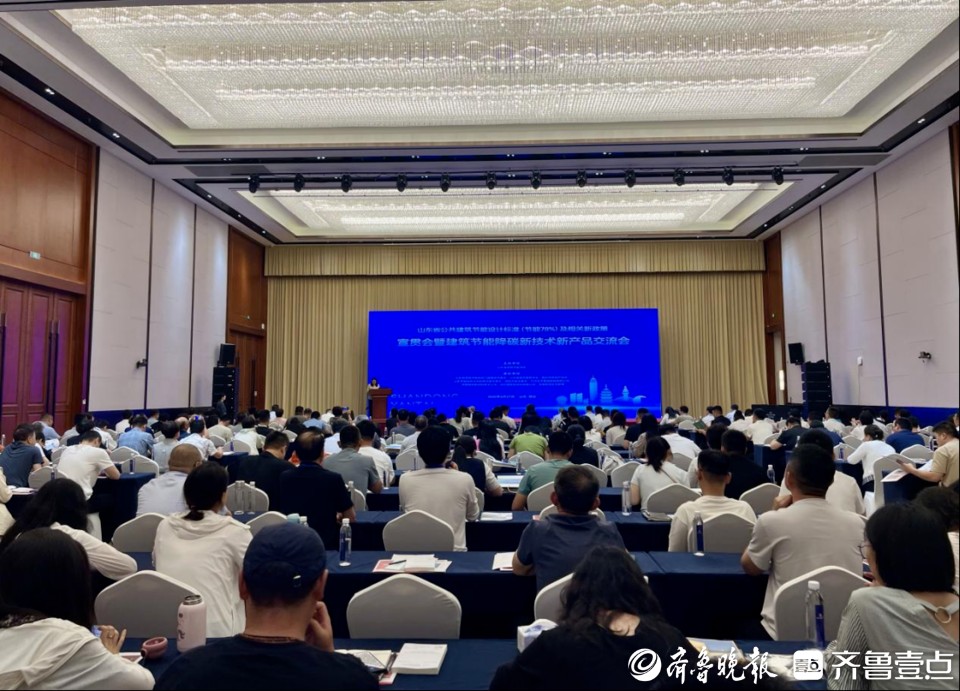
Core Viewpoint - The event highlighted the implementation of new energy-saving standards for public buildings in Shandong, aiming for a 78% energy efficiency improvement, alongside the existing 83% standard for residential buildings, reflecting a significant push towards energy conservation and carbon reduction in the construction industry [3][4]. Group 1: Energy Efficiency Standards - Shandong is set to implement a new public building energy-saving standard of 78%, which is the first of its kind in the country, effective from August 1, 2023 [4]. - The residential building energy-saving standard of 83% was already implemented on May 1, 2023, marking a significant advancement in energy efficiency requirements [4]. - The new standards emphasize the use of all-electric designs for energy systems, excluding centralized heating, and aim to enhance the thermal performance of building envelopes [4][5]. Group 2: Green Building Promotion - The promotion of green buildings is a key focus, with requirements for new urban residential buildings to comply with green building standards, and public buildings funded by government or state-owned investments to meet at least two-star green building standards [3][4]. - The application of green building materials is mandated, with specific percentages required for different star ratings of green buildings: 10% for one-star, 20% for two-star, and 30% for three-star buildings [3][4]. Group 3: Market Opportunities and Innovations - The new energy-saving standards are expected to drive the adoption of high-efficiency insulation materials and innovative construction methods, creating new market opportunities for the construction industry [5][7]. - The introduction of advanced materials, such as composite insulation boards, is gaining traction, with benefits including reduced thickness and improved thermal performance, leading to cost reductions for developers and buyers [7][9]. - The event showcased new technologies and products, including integrated photovoltaic materials that serve both decorative and energy-generating purposes, indicating a trend towards multifunctional building materials [9].

湖北国创高新材料股份有限公司关于对外担保的进展公告
Shang Hai Zheng Quan Bao· 2025-06-27 21:32
Group 1 - The company, Hubei Guochuang High-tech Materials Co., Ltd., has provided a guarantee for its wholly-owned subsidiary, Guangxi Guochuang Road Materials Co., Ltd., for a credit limit of 80 million RMB from Guangxi Beibu Gulf Bank [2][3] - The board of directors approved a guarantee limit of up to 240 million RMB for the year 2025, which is valid for 12 months from the date of the shareholders' meeting [3] - The company has a total external guarantee balance of 90 million RMB, which accounts for 19.19% of its latest audited net assets, with no overdue guarantees or litigation related to guarantees [8][9] Group 2 - Guangxi Guochuang Road Materials Co., Ltd. was established on October 8, 2005, with a registered capital of 90 million RMB and is fully owned by the company [5] - The company specializes in the research, production, and sales of modified asphalt and related materials, as well as road construction services [5] - The guarantee provided by the company includes coverage for principal, interest, penalties, and various costs associated with enforcing the guarantee [7][12]

413股获杠杆资金大手笔加仓
Zheng Quan Shi Bao Wang· 2025-06-27 01:42
Market Overview - On June 26, the Shanghai Composite Index fell by 0.22%, while the total margin balance in the market reached 1.838493 trillion yuan, an increase of 9.259 billion yuan compared to the previous trading day [1] Margin Balance by Market - As of June 26, the margin balance in the Shanghai market was 928.631 billion yuan, up by 3.383 billion yuan; in the Shenzhen market, it was 904.095 billion yuan, up by 5.695 billion yuan; and in the Beijing Stock Exchange, it was 5.767 billion yuan, up by 0.181 billion yuan [1] Industry Analysis - Among the industries tracked by Shenwan, 27 industries saw an increase in margin balance, with the electronics sector leading with an increase of 1.703 billion yuan, followed by the computer and communication sectors with increases of 1.339 billion yuan and 1.260 billion yuan, respectively [1] Individual Stock Performance - A total of 2,094 stocks experienced an increase in margin balance, accounting for 56.90% of the total. Among these, 413 stocks had a margin balance increase of over 5% [1] - The stock with the largest increase in margin balance was Tonghui Information, with a latest margin balance of 7.3965 million yuan, reflecting an increase of 87.58% from the previous trading day, and its stock price rose by 13.79% [1] - Other notable stocks with significant margin balance increases included Keshine New Materials and Honghai Technology, with increases of 60.29% and 52.59%, respectively [1] Top 20 Stocks by Margin Balance Increase - The average increase in stock prices among the top 20 stocks by margin balance increase was 4.94%, with notable gainers including Patel and Youji Co., with increases of 30.00% and 28.96%, respectively [2][3] Stocks with Decreased Margin Balance - In contrast, 1,586 stocks saw a decrease in margin balance, with 188 stocks experiencing a decline of over 5%. The stock with the largest decrease was Ruixing Co., with a margin balance of 1.5274 million yuan, down by 34.44% [4][5]
国内经济周报:国内高频:集运价格连续上涨-20250625
Shenwan Hongyuan Securities· 2025-06-25 09:38
Group 1: Industrial Production - Industrial production shows signs of seasonal weakness, with blast furnace operating rates slightly down by 0.3 percentage points year-on-year to 1%[4] - Midstream production is mixed, with soda ash operating rates up by 0.4 percentage points to -3% and polyester filament operating rates up by 0.4 percentage points to 3.8%[4] - Cement grinding rates decreased by 3.6 percentage points year-on-year to 4.6%, indicating weak construction activity[4] Group 2: Downstream Demand - Port cargo throughput increased by 5.7 percentage points year-on-year to 3.6%, while container throughput rose by 4.1 percentage points to 5.3%[5] - Daily average transaction area of new homes in 30 major cities fell significantly, down by 38.3 percentage points year-on-year to 14.2%[5] - Shipping prices saw a substantial increase, with the CCFI composite index rising by 8% week-on-week, particularly on the US West Coast where rates surged by 14.8%[5] Group 3: Price Trends - Agricultural product prices declined, with egg prices down by 1.5%, fruit prices down by 1.3%, and pork prices down by 0.4%[5] - Industrial product prices showed a rebound, with the Nanhua Industrial Price Index increasing by 3.1% week-on-week, and the energy chemical price index rising by 5.6%[5] - The metal price index decreased slightly by 0.2% week-on-week, indicating mixed trends in industrial commodities[5] Group 4: Risks - Potential risks include unexpected changes in trade conditions, uncertainties in policy responses, and the effectiveness of policy transmission mechanisms[6]
朝闻国盛:中观数据与盈利预测指向哪些行业景气?
GOLDEN SUN SECURITIES· 2025-06-24 00:21
Group 1: Core Insights - The report highlights the industries showing signs of economic prosperity based on medium-term data and profit forecasts, indicating potential investment opportunities [3][6]. - The report emphasizes the importance of monitoring macroeconomic indicators and sector performance to identify favorable investment sectors [3][6]. Group 2: Industry Performance - The top-performing industries in January, March, and over the past year include Communication (7.9%, 0.3%, 28.0%), Banking (6.0%, 11.2%, 33.4%), and Media (4.6%, 0.2%, 42.6%) [1]. - Conversely, the bottom-performing industries include Food & Beverage (-7.3%, -7.6%, -1.7%), Automotive (-6.9%, -6.7%, 27.4%), and Household Appliances (-6.6%, -8.0%, 9.0%) [1]. Group 3: Environmental Sector Insights - The environmental sector is experiencing stricter monitoring standards, with leading companies positioned to benefit from these changes, particularly in waste management and recycling [5][7]. - The report identifies specific companies such as Huaneng Environment and Huicheng Environmental as key players benefiting from carbon neutrality initiatives and significant project wins [5].
“好房子” 和新科技相互成就 带动房地产供应链品质升级
Shang Hai Zheng Quan Bao· 2025-06-23 19:18
Core Viewpoint - The implementation of the new national standard "Residential Project Specifications" is expected to drive the development of new residential buildings towards safety, comfort, sustainability, and intelligence, while also providing opportunities for quality upgrades in the real estate supply chain [1][6]. Group 1: Impact on High-Performance Building Materials - The new regulations have led to a significant increase in demand for high-performance building materials due to mandatory requirements for insulation and soundproofing [2][3]. - Real estate companies are shifting their focus from price to quality, actively seeking new materials and technologies that enhance housing quality [2][3]. - The new regulations are seen as a milestone for the building materials industry, promoting a shift from low-quality price competition to a focus on performance, quality, durability, and user experience [2][3]. Group 2: Technological Advancements and Innovations - The promotion of prefabricated construction is expected to enhance market acceptance and improve construction efficiency [4]. - Companies are investing in research and development for prefabricated decoration technologies, achieving significant reductions in construction time and improving quality [4][5]. - The integration of smart home systems is expanding, with companies developing customized and innovative functional scenarios for their projects [5][6]. Group 3: Transformation of the Real Estate Supply Chain - The new regulations are reshaping the supply and procurement systems in the building materials industry, emphasizing transparency and quality control [6][7]. - The cost of green building materials has become comparable to traditional materials due to technological advancements and policy support, leading to higher project implementation rates [6][7]. - The entire real estate industry is moving towards high-quality and sustainable development, with expectations for further maturity in the supply chain over the next few years [8].
“首届建筑材料行业ESG可持续发展论坛”举办
Zhong Zheng Wang· 2025-06-20 13:41
张东壮提到,ESG建设是一项系统性、长期性工程,绝非一蹴而就。ESG发展已经从企业"加分项"转变 为高质量发展的"必修课",希望行业企业进一步提高站位,深刻认识发展ESG的重要性,精准把握ESG 发展的新要求,凝聚合力,携手开创建材行业ESG工作新局面。 中证报中证网讯(记者董添)6月20日,由中国建筑(601668)材料联合会主办的"首届建筑材料行业ESG 可持续发展论坛"在北京举办。论坛以"绿色转型共建可持续未来"为主题,旨在共同研讨ESG理念在建 材行业的实践路径。 中国建筑材料联合会驻会副会长张东壮表示,ESG已经融入国家整体发展战略,联合会始终把加强ESG 建设工作作为推动建材行业绿色低碳安全高质量发展的一项重要的工作来抓。联合会推动引导行业上市 公司积极响应、非上市企业高度关注的建材行业ESG实践正在加速推进。 本次论坛成功搭建了建材行业首个ESG交流高端平台,联合会表示,将以此为契机,进一步完善工作举 措,加快建设行业ESG生态圈,引导并推动ESG实践不断走深走实,共同谱写好建材行业绿色低碳安全 高质量发展新篇章。 论坛正式启动了建筑材料行业ESG公共服务平台,发布了《深化建材行业ESG实践共创 ...