汽车

Search documents
在海外过年的中国车商:不做“一锤子买卖”,在最前沿扎根|新春走基层
Di Yi Cai Jing· 2026-02-23 04:43
Group 1 - The core viewpoint of the article highlights the growing trend of Chinese automotive companies expanding overseas, driven by both market opportunities and competitive pressures [1][2] - The Chinese automotive industry has transitioned from a focus on low-cost vehicles to enhancing product quality and brand recognition in international markets, particularly in the electric vehicle sector [2] - Major Chinese automotive brands such as BYD, Chery, Geely, and Great Wall have seen increased market share and improved reputation abroad, as consumer perceptions shift away from the low-quality stereotype [2] Group 2 - The competition in overseas automotive markets has intensified, moving from a phase where customers sought suppliers to a scenario where traders compete fiercely for clients [3] - Many traders who lack a deep understanding of the market and rely on low-price strategies are exiting the industry, while savvy overseas customers are increasingly informed and selective [3] - The company emphasizes the importance of establishing long-term relationships with clients and adapting to local market conditions, moving away from short-term profit strategies [3][4] Group 3 - The company is actively engaging with overseas clients, particularly during domestic auto shows, to foster long-term partnerships and ensure successful collaboration [4] - A significant new partnership involves the establishment of a KD factory in the Middle East, which is set to begin operations, necessitating thorough preparation for after-sales services [4][5] - The path for Chinese automotive exports is becoming more crowded and challenging, but the company is committed to long-term strategies for success [5]
港股午评:恒指涨2.29%重返27000点 科指涨3.32% 科网股、黄金股普涨 光通讯概念走...
Xin Lang Cai Jing· 2026-02-23 04:15
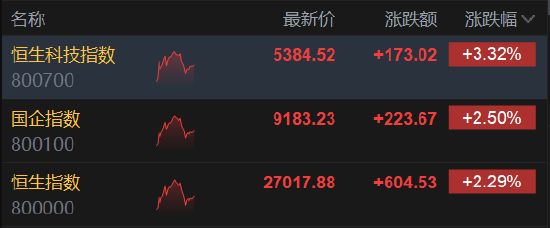
Market Overview - The Hong Kong stock market indices collectively rose, with the Hang Seng Index increasing by 2.29% to 27,017.88 points, the Hang Seng Tech Index up by 3.32%, and the National Enterprises Index rising by 2.50% [1][2]. Technology Sector - Tech stocks experienced a broad rally, with Meituan rising over 6%, JD.com up more than 4%, and Alibaba, Tencent, Kuaishou, and Baidu each increasing by over 3% [1]. Gold Sector - Gold stocks surged, with Tongguan Gold rising over 11%. The increase in gold prices is attributed to uncertainties surrounding trade agreements with the U.S. following a Supreme Court ruling limiting President Trump's tariff powers [2][3]. Automotive Sector - The automotive sector was active, with NIO rising over 3%. According to data from the China Passenger Car Association, the total export of complete vehicles from mainland China reached 8.32 million units last year, with overseas sales of domestic brands exceeding 9 million units [3][4]. Optical Communication Sector - The optical communication sector saw significant gains, with Yangtze Optical Fibre and Cable rising over 15%. The company reported full operational capacity at its production bases during the Spring Festival, ensuring the delivery of high-speed optical modules [4][5].





反转再反转,美国这次加征全球关税,如同舞台剧一样
Sou Hu Cai Jing· 2026-02-23 03:42
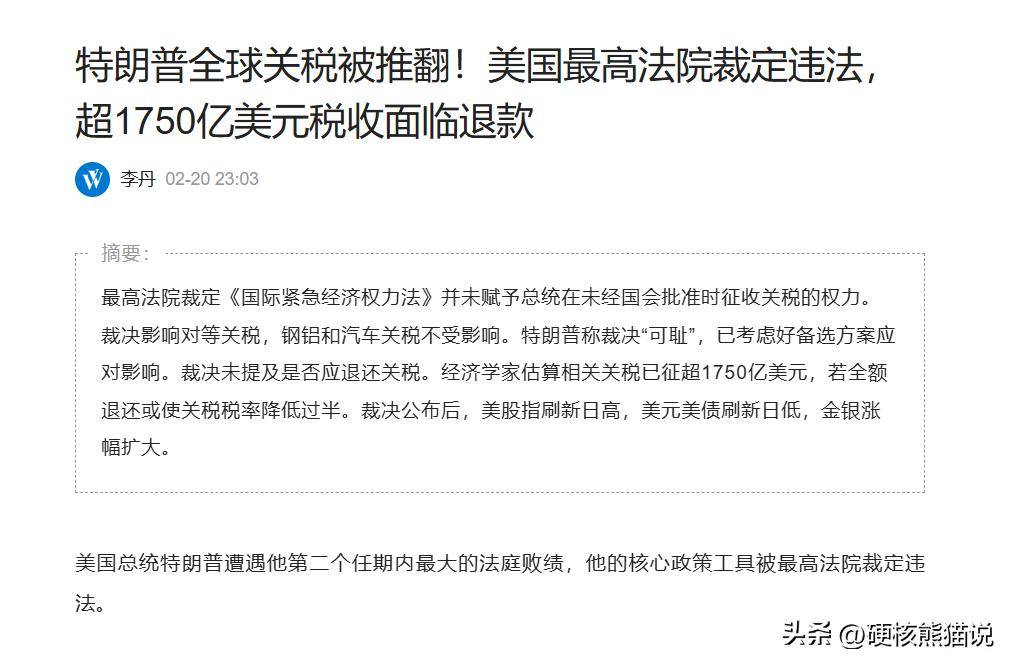
Group 1 - The Supreme Court ruling has significant implications for the U.S. domestic economy, despite having little effect on Trump's international relations [3][5] - Trump quickly adjusted his strategy by invoking the Trade Act of 1974, increasing global tariffs from 10% to 15%, which is higher than initially planned [5] - The increase in tariffs is expected to burden American consumers, with an estimated additional cost of $1,700 per household annually due to rising import costs [7][9] Group 2 - High tariffs are putting pressure on U.S. manufacturing, with overall costs rising by 2% to 4.5%, and specific industries like automotive facing increased costs of $1,200 to $2,500 per vehicle [9] - The manufacturing sector is experiencing job losses, with over 80,000 layoffs in the past year, contradicting Trump's goal of bringing manufacturing back to the U.S. [9][11] - The share of manufacturing in the U.S. economy is declining, projected to drop from 10.8% in 2024 to 10.5% in 2025, indicating a lag in advanced technology sectors [11] Group 3 - The semiconductor industry is facing significant losses due to increased tariffs, with over $10 billion in damages and a reduction in global market share from 37% in 1990 to 12% today [11] - If tariffs persist, consumer electronics prices are projected to rise significantly, with smartphones potentially increasing by 31% and gaming consoles by 69% [11] - The U.S. is losing competitive ground to China in high-tech sectors, with China making substantial advancements in electric vehicles, artificial intelligence, and semiconductor production [13]
港股大幅走高!恒指涨近3%,恒生科技指数飙升4%,科技、黄金、有色全线爆发
Jin Rong Jie· 2026-02-23 03:21
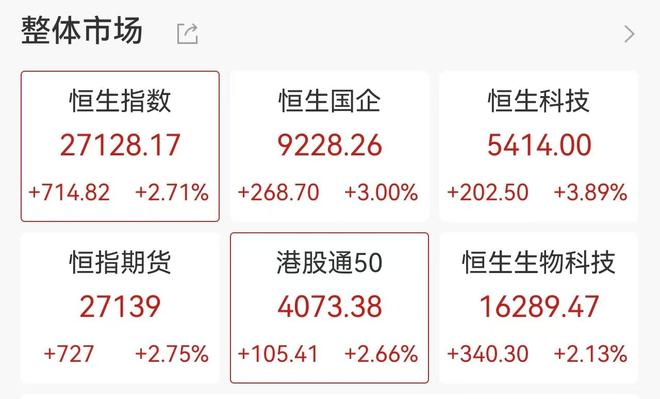
Market Overview - The Hong Kong stock market opened strong and continued to rise, with the Hang Seng Index up nearly 3%, the Hang Seng Tech Index up nearly 4%, and the Hang Seng China Enterprises Index up over 3% [1] - The A50 futures also saw an increase, expanding to over 1.5% [1] Sector Performance - Technology stocks led the market rally, with Meituan rising over 7%, JD Group and BYD up over 5%, and SMIC up nearly 5% [2][3] - Other notable gainers included Huahong Semiconductor, Li Auto, Sunny Optical Technology, and Leap Motor, all rising over 4% [2][3] Individual Stock Highlights - Meituan-W: Current price 86.750, up 7.43% [4] - JD Group-SW: Current price 109.100, up 5.11% [4] - BYD: Current price 100.300, up 5.08% [4] - SMIC: Current price 70.950, up 4.80% [4] - Huahong Semiconductor: Current price 98.350, up 4.46% [4] - Li Auto-W: Current price 73.150, up 4.35% [4] - Alibaba-W: Current price 152.700, up 3.81% [4] Precious Metals and Commodities - The precious metals sector saw significant gains, with spot gold surpassing $5160 per ounce, up over 1%, and spot silver rising over 3% [5] - Chinese gold stocks also surged, with China Gold International up over 7% and Zijin Mining up over 4% [5] Other Sector Movements - The non-ferrous metals sector performed strongly, with China Daye Non-Ferrous Metals up over 9% and Jiangxi Copper up over 6% [5] - The optical communication sector saw collective gains, with Yangtze Optical Fibre up over 18% [5] Investment Insights - Galaxy Securities indicated that the technology sector remains a long-term investment focus, with reduced valuation pressure and potential for rebound due to advancements in AI [6] - Huatai Securities suggested monitoring three key areas: semiconductor hardware, consumer sectors like dining and innovative pharmaceuticals, and electrical equipment benefiting from system upgrades [6] - Significant stock buybacks by industry leaders have instilled confidence in the Hong Kong market, with total buyback amounts exceeding 25.4 billion HKD since 2026 [6]
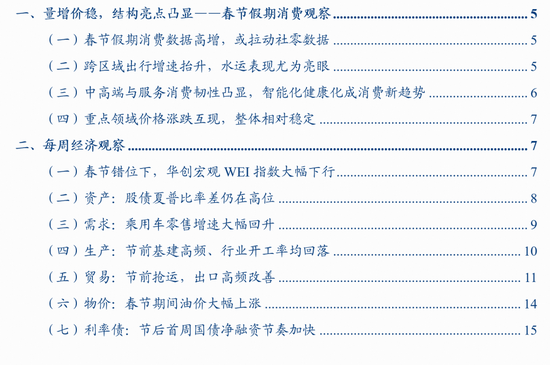
张瑜:量增价稳,结构亮点凸显——春节假期消费观察
Xin Lang Cai Jing· 2026-02-23 02:54
Group 1 - The core viewpoint of the article highlights a significant increase in retail and catering data during the Spring Festival holiday, with a year-on-year growth of 8.6% in the first four days, which is expected to boost the social retail data for the first two months of the year [1][2][52] - The increase in cross-regional travel during the holiday period saw an 8.7% rise compared to the previous year, with water transport showing remarkable growth of 28.5%, influenced by tourism demand and the reopening of Hainan [3][12][54] - Price stability was observed in key sectors, with high-end liquor and hotel prices in popular small cities increasing, while prices in first-tier cities and movie ticket prices saw declines [4][16][55] Group 2 - Structural highlights in consumption include a strong performance in mid-to-high-end products like gold and duty-free items, with gold consumption remaining robust and duty-free sales in Hainan increasing by 20.9% [5][14][56] - Domestic and cross-border travel maintained momentum, with hotel accommodation transaction values rising by 32.7% and a predicted double-digit growth in daily inbound and outbound travelers at national ports [5][14][57] - The trend towards smart and health-oriented consumption was evident, with significant sales growth in smart wearable devices and organic foods during the holiday period [5][14][57] Group 3 - Weekly economic observations indicate a rebound in durable goods consumption, with passenger car retail sales increasing by 54% year-on-year in early February, contrasting with a decline of 13.9% in January [6][24] - Real estate sales showed improvement, with a 5% year-on-year increase in residential sales area in 27 cities as of mid-February, compared to a decline of 16% in January [6][25] - Export activities showed signs of recovery, with a 32.3% increase in the number of outbound port calls compared to the previous year, indicating a positive trend in trade [6][30]
量增价稳,结构亮点凸显——春节假期消费观察
一瑜中的· 2026-02-23 02:49
Group 1 - The core viewpoint of the article highlights a significant increase in retail and catering data during the Spring Festival holiday, with a year-on-year growth of 8.6% in the first four days, which is expected to positively impact the social retail data for the first two months of the year [2][3][15] - The increase in travel volume is notable, with cross-regional travel rising by 8.7% compared to the same period last year, particularly driven by improvements in civil aviation and rail travel, as well as a remarkable 28.5% increase in water transport [4][16] - Price stability is observed in key sectors, with high-end liquor and hotel prices in popular small cities showing increases, while prices in first-tier cities for hotels and movie tickets have decreased [5][22][23] Group 2 - Structural highlights in consumption include a strong performance in mid-to-high-end products such as gold and duty-free items, with gold consumption remaining robust and duty-free sales in Hainan increasing by 20.9% [6][19][21] - Domestic and cross-border travel continue to thrive, with hotel accommodation transaction values increasing by 32.7% and domestic flight bookings rising by approximately 9% [19][20] - The trend towards smart and health-oriented consumption is evident, with significant sales growth in smart wearable devices and organic foods, indicating a shift in consumer behavior towards immediate purchasing [20][21] Group 3 - Weekly economic observations indicate a rebound in durable goods consumption, with passenger car retail sales increasing by 54% year-on-year, contrasting with a decline of 13.9% in January [29] - Real estate sales show improvement, with a 5% year-on-year increase in residential sales area as of mid-February, compared to a decline of 16% in January [29] - Export activities have shown signs of recovery, with a 32.3% increase in the number of outbound port calls compared to the previous year, indicating a positive trend in trade [37][38]
中国拯救世界?美媒感慨:要不是中国反抗特朗普,全球已经大萧条
Sou Hu Cai Jing· 2026-02-23 02:44
Core Viewpoint - The U.S. Supreme Court ruled that the large-scale tariff policy implemented by the Trump administration was illegal, effectively pausing the ongoing trade war. This decision has led to significant market reactions and fears among U.S. farmers and investors regarding the future of U.S. agricultural exports, particularly soybeans, to China [1][3]. Group 1: Impact on U.S. Agriculture - The U.S. soybean industry is heavily affected, with exports to China previously accounting for up to 60% of total production. Following the Supreme Court ruling, fears arose that China would shift to purchasing cheaper soybeans from Brazil, which has established a stable supply chain [1][3]. - U.S. farmers are struggling with low profits and high costs for imported agricultural machinery and fertilizers due to tariffs, leading to a cycle of increased production but greater losses [3]. - The agricultural sector is facing its fourth consecutive year of low profits, despite high production levels, exacerbated by the tariff-induced price increases of essential farming inputs [3]. Group 2: Consumer Impact - U.S. consumers are beginning to realize that they are bearing the costs of the tariffs, with prices for everyday goods, appliances, and vehicles rising significantly. Research indicates that the costs of tariffs are primarily shouldered by U.S. importers and consumers rather than foreign suppliers [6]. - The dissatisfaction among consumers and farmers could translate into political consequences in the upcoming midterm elections, particularly in the Midwest, where soybean farmers have traditionally supported the Republican Party [8]. Group 3: International Relations and Responses - The unilateral tariff policies have strained relationships between the U.S. and its allies, with many countries reconsidering their economic ties with the U.S. and seeking closer cooperation with China [10]. - Japan has shown a submissive stance, continuing to pursue investment in the U.S. despite the Supreme Court ruling against the tariff agreement, indicating a willingness to compromise for potential tariff relief [12]. - The EU has publicly criticized Trump's unilateralism but has not taken substantial retaliatory actions, instead opting to appease the U.S. for tariff exemptions due to its deep economic reliance on the U.S. market [14][20]. Group 4: Responses from Developing Countries - Developing countries, particularly in Southeast Asia and Latin America, have shown a tendency to acquiesce to U.S. tariff demands due to their economic vulnerabilities and reliance on the U.S. dollar for trade [18][21]. - India initially adopted a strong stance but ultimately succumbed to U.S. pressure, reflecting the broader trend of developing nations lacking the capacity to resist U.S. tariffs [22]. Group 5: China's Countermeasures - In contrast to other nations, China has taken a firm stand against U.S. tariffs, implementing retaliatory measures that directly target U.S. interests, including imposing equivalent tariffs on U.S. imports and controlling rare earth exports critical to U.S. military applications [24][26]. - China's strategy includes diversifying its export markets away from the U.S., resulting in a significant reduction in the trade deficit with the U.S. and record-high overall exports [28][35]. - The comprehensive industrial system in China allows it to maintain stability and independence from U.S. pressures, making it less vulnerable to tariff impacts compared to countries heavily reliant on the U.S. market [37][38].
港股汽车股今日普涨 赛力斯涨近5%
Mei Ri Jing Ji Xin Wen· 2026-02-23 02:18
Core Viewpoint - The Hong Kong automotive stocks experienced a broad increase today, indicating positive market sentiment in the sector [1] Group 1: Stock Performance - Seres (09927.HK) rose by 4.87%, trading at HKD 96.85 [1] - BYD Company (01211.HK) increased by 4.56%, with shares priced at HKD 99.8 [1] - Xpeng Motors-W (09868.HK) saw a rise of 3.83%, reaching HKD 70.45 [1] - Li Auto-W (02015.HK) gained 3.57%, trading at HKD 72.6 [1]

视频丨为节日幸福感加码 多地出台一系列消费利好政策
Xin Lang Cai Jing· 2026-02-23 02:12
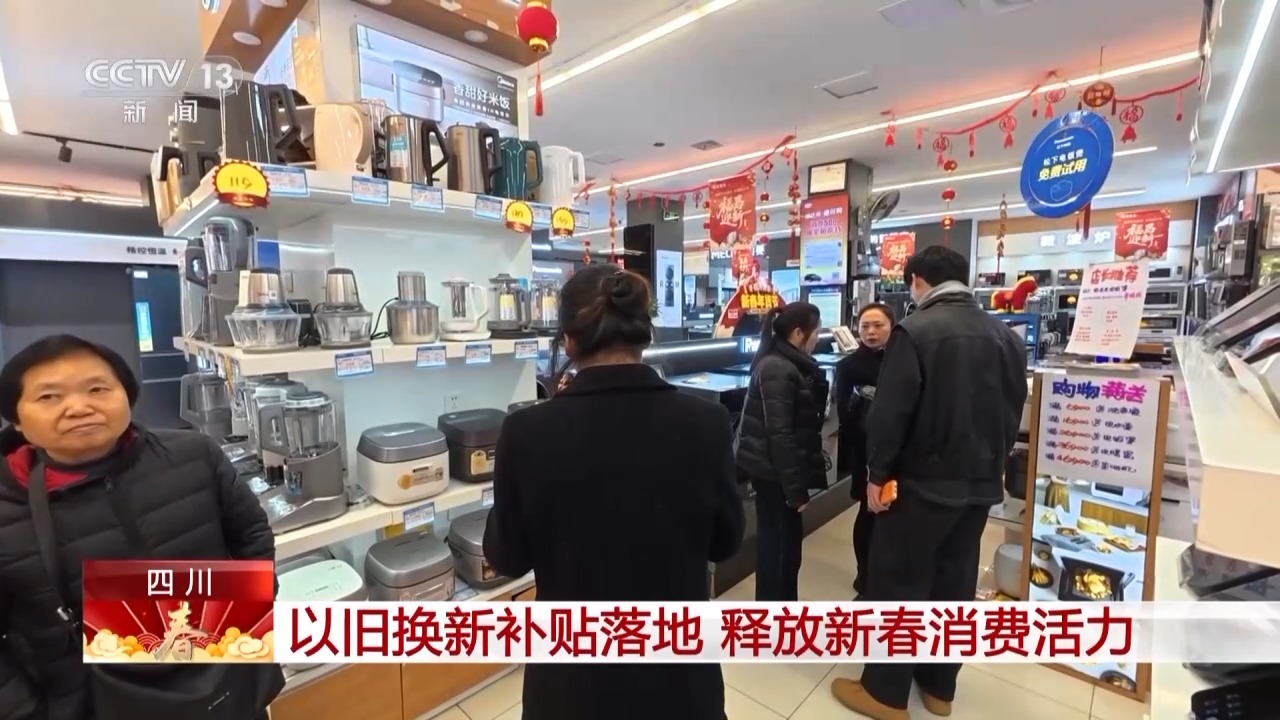
Group 1 - The article highlights the introduction of various consumer-friendly policies across the country, enhancing the festive happiness of citizens during the Spring Festival [1] - In Sichuan, the "old for new" policy has led to significant consumer engagement, with 1.124 million applications for home appliance exchanges, generating a consumption boost of 4.344 billion yuan [4] - The "old for new" initiative not only provides financial benefits to consumers but also promotes consumption upgrades and green transformation, becoming a key growth point in the Spring Festival market [4] Group 2 - Jiangsu's "Lego New Year" special event offers consumers substantial financial incentives, with mobile phones remaining a popular item, alongside emerging tech products like smart glasses and small appliances [5] - The inclusion of smart glasses in national subsidy policies has attracted considerable consumer interest, showcasing the evolving preferences in technology [5][7] - In Anhui, the expansion of the "Two New" policy has invigorated the automotive market, with local subsidies expected to drive monthly consumption by 150 million yuan [9]
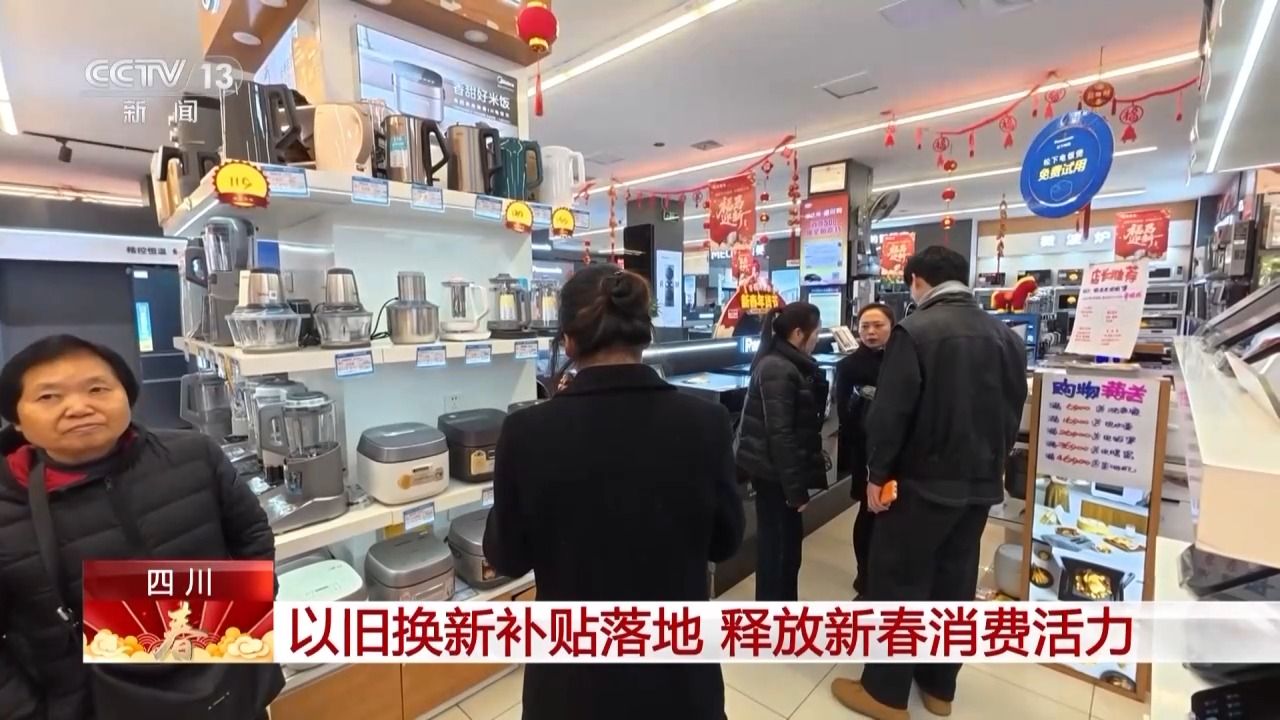
为节日幸福感加码 多地出台一系列消费利好政策
Xin Lang Cai Jing· 2026-02-23 02:12
Group 1 - The core viewpoint of the article highlights the positive impact of various consumer-friendly policies implemented across the country, enhancing the festive experience for citizens during the Spring Festival [1] - In Sichuan, the "old for new" policy has led to significant consumer engagement, with 1.124 million applications for home appliance exchanges, generating a consumption boost of 4.344 billion yuan [3] - The demand for digital and smart products is also notable, with 1.618 million applications resulting in a consumption increase of 4.878 billion yuan, indicating a trend towards consumption upgrades and green transformation [3] Group 2 - Jiangsu province organized a special "Happy Shopping Spring Festival" event, providing consumers with substantial incentives, and highlighting the popularity of smartphones and smart gadgets among consumers [4] - The introduction of smart glasses into the national subsidy policy has attracted considerable consumer interest, showcasing the growing trend of technology integration in daily life [4][6] - In Anhui's Chuzhou, the automotive market has been revitalized through combined subsidies and streamlined processes, with expectations of generating 150 million yuan in monthly consumption from automotive purchases [8]