公用事业

Search documents
国防军工行业资金流出榜:中航沈飞等11股净流出资金超5000万元
Zheng Quan Shi Bao Wang· 2025-07-08 09:40
沪指7月8日上涨0.70%,申万所属行业中,今日上涨的有29个,涨幅居前的行业为通信、电力设备,涨 幅分别为2.89%、2.30%。国防军工行业今日上涨0.64%。跌幅居前的行业为公用事业、银行,跌幅分别 为0.37%、0.24%。 国防军工行业资金流出榜 资金面上看,两市主力资金全天净流入154.50亿元,今日有14个行业主力资金净流入,电子行业主力资 金净流入规模居首,该行业今日上涨2.27%,全天净流入资金74.37亿元,其次是电力设备行业,日涨幅 为2.30%,净流入资金为36.78亿元。 主力资金净流出的行业有17个,公用事业行业主力资金净流出规模居首,全天净流出资金22.97亿元, 其次是医药生物行业,净流出资金为22.85亿元,净流出资金较多的还有国防军工、银行、商贸零售等 行业。 国防军工行业今日上涨0.64%,全天主力资金净流出11.63亿元,该行业所属的个股共139只,今日上涨 的有100只,涨停的有1只;下跌的有38只。以资金流向数据进行统计,该行业资金净流入的个股有50 只,其中,净流入资金超千万元的有19只,净流入资金居首的是菲利华,今日净流入资金1.40亿元,紧 随其后的是中国海防 ...

顺风清洁能源(01165.HK)7月8日收盘上涨30.43%,成交255.18万港元
Jin Rong Jie· 2025-07-08 08:37
Group 1 - The core viewpoint of the news highlights the recent performance of Shunfeng Clean Energy, which saw a significant stock price increase of 30.43% on July 8, closing at HKD 0.03 per share, despite a year-to-date decline of 11.54% [1] - Shunfeng Clean Energy's cumulative increase over the past month is reported at 53.33%, while it has underperformed the Hang Seng Index by 19.08% [1] - Financial data indicates that for the fiscal year ending December 31, 2024, Shunfeng Clean Energy achieved total revenue of HKD 160 million, a decrease of 33% year-on-year, and a net profit attributable to shareholders of -HKD 435 million, reflecting a year-on-year increase of 3.11% [1] Group 2 - Currently, there are no institutional investment ratings for Shunfeng Clean Energy [2] - The average price-to-earnings (P/E) ratio for the utility sector is reported at 6.36 times, with a median of 6.24 times, while Shunfeng Clean Energy has a P/E ratio of -0.25 times, ranking 77th in the industry [2] - Shunfeng International Clean Energy Co., Ltd. is positioned as a leading provider of low-carbon energy solutions, focusing on solar power generation, product manufacturing, and integrated solar energy storage [2]
【盘中播报】沪指涨0.69% 建筑材料行业涨幅最大
Zheng Quan Shi Bao Wang· 2025-07-08 06:21
| 农林牧渔 | | | | 国投中鲁 | | | --- | --- | --- | --- | --- | --- | | 交通运输 | 0.03 | 156.13 | 19.29 | 物产中大 | 5.32 | | 银行 | -0.03 | 238.08 | -1.71 | 浦发银行 | -2.74 | | 公用事业 | -0.49 | 394.04 | 2.86 | 迪森股份 | -5.50 | 今日各行业表现(截至下午13:58) | 申万行业 | 行业涨跌(%) | 成交额(亿元) | 比上日(%) | 领涨(跌)股 | 涨跌幅(%) | | --- | --- | --- | --- | --- | --- | | 建筑材料 | 2.66 | 153.70 | 22.59 | 国际复材 | 20.00 | | 电子 | 2.64 | 1560.52 | 35.42 | N屹唐 | 144.38 | | 电力设备 | 2.33 | 1155.48 | 50.93 | 欣灵电气 | 20.01 | | 通信 | 2.18 | 570.91 | 21.02 | 天孚通信 | 12.19 | | 传媒 ...
超3900只个股上涨
第一财经· 2025-07-08 04:23
Market Performance - As of midday, the Shanghai Composite Index rose by 0.58%, the Shenzhen Component Index increased by 1.27%, and the ChiNext Index climbed by 2.25%, with over 3,900 stocks in the market experiencing gains [1]. Sector Performance - The photovoltaic equipment, BC battery, PCB, and energy metal sectors showed the highest gains, while the insurance and agriculture sectors weakened [2]. Capital Flow - Major funds saw a net inflow into the electronics, power equipment, and computer sectors, while there was a net outflow from the banking, public utilities, and transportation sectors [3]. Individual Stock Performance - Specific stocks such as Industrial Fulian, Sungrow Power Supply, and Shenghong Technology experienced net inflows of 2.785 billion, 1.495 billion, and 1.036 billion respectively [4]. - Conversely, stocks like Changjiang Electric Power, Hanyu Pharmaceutical, and Jingbeifang faced net outflows of 393 million, 228 million, and 223 million respectively [5]. Institutional Insights - According to Jin Jun, Investment Director at Qianhai Bourbon Fund, the market has shown resilience since the rally began on June 23, with expectations for the index to challenge 3,674 points in the second half of the year despite facing resistance at the previous high of 3,496 [7]. - Dong Tian from Zhongtai Securities noted that the index is facing significant pressure and suggested focusing on industries with longer cycles and those that have released earnings forecasts to gauge overall industry conditions [7].








美股投资风险怎么评估?
Sou Hu Cai Jing· 2025-07-08 03:20
Macro Economic Risk Assessment - The macroeconomic situation significantly impacts the US stock market, with GDP growth being a key indicator of economic performance. Strong economic growth typically leads to increased corporate profits and rising stock prices, while a slowdown can pressure stock prices [2] - Inflation is a critical factor; moderate inflation reflects economic activity, but high inflation can increase corporate costs, compress profit margins, and potentially lead to interest rate hikes by the Federal Reserve, negatively affecting the stock market [2] - Interest rate policies are crucial, as rate hikes can make fixed-income products more attractive, leading to capital outflows from the stock market, while rate cuts can stimulate stock market investment enthusiasm [2] Industry Risk Analysis - Different industries face varying risks in the US stock market. Cyclical industries like automotive and real estate are sensitive to economic cycles, thriving in prosperous times but facing downturns during recessions [3] - Defensive industries such as healthcare and utilities are less affected by economic fluctuations and often show stronger resilience during economic instability [3] - The technology sector, while having high growth potential, faces rapid technological changes and intense competition, which can lead to crises for companies that fall behind [3] - Emerging industries, such as renewable energy, encounter policy risks and technological maturity risks, where changes in government support or delays in technological breakthroughs can impact company performance and stock prices [3] Company Fundamental Risk Consideration - Company-level risk assessment requires a focus on financial health, including analysis of balance sheets, income statements, and cash flow statements. High debt ratios indicate increased financial pressure and risk of distress [4] - Unstable profitability, characterized by frequent losses or significant fluctuations, raises concerns about a company's future [4] - Management quality is vital; effective leadership can navigate market changes, while poor decision-making and internal management issues can hinder company growth and negatively affect stock prices [4] - Market competitiveness is also crucial, encompassing market share, brand influence, and comparative advantages or disadvantages against competitors, all of which impact future profitability and market value [4] Market Liquidity and Trading Risk Assessment - The US stock market is vast, but liquidity varies among stocks. Low-priced and small-cap stocks may have insufficient trading volume, leading to larger spreads and higher transaction costs, making it difficult to find buyers or sellers quickly [5] - Special trading mechanisms in the US market, such as margin trading and short selling, can amplify risks. Margin trading can lead to margin calls if stock prices drop significantly, potentially resulting in forced liquidation if additional funds are not provided [5] - Short selling carries risks as well; if stock prices rise instead of falling, short sellers can incur substantial losses [5]
20个行业获融资净买入,医药生物行业净买入金额最多
Zheng Quan Shi Bao Wang· 2025-07-08 02:38
Core Insights - As of July 7, the latest market financing balance reached 1,846.406 billion yuan, an increase of 6.359 billion yuan compared to the previous trading day [1] - The pharmaceutical and biological industry saw the largest increase in financing balance, rising by 1.340 billion yuan [1] - The public utilities sector had the highest percentage increase in financing balance at 1.83% [1] Industry Summary - **Pharmaceutical and Biological**: Latest financing balance is 132.411 billion yuan, increased by 1.340 billion yuan, with a growth rate of 1.02% [1] - **Electronics**: Latest financing balance is 213.330 billion yuan, increased by 0.994 billion yuan, with a growth rate of 0.47% [1] - **Computer**: Latest financing balance is 142.101 billion yuan, increased by 0.912 billion yuan, with a growth rate of 0.65% [1] - **Public Utilities**: Latest financing balance is 43.242 billion yuan, increased by 0.776 billion yuan, with a growth rate of 1.83% [1] - **Coal**: Latest financing balance is 15.418 billion yuan, increased by 0.219 billion yuan, with a growth rate of 1.44% [1] - **Real Estate**: Latest financing balance is 29.696 billion yuan, decreased by 0.189 billion yuan, with a decline rate of 0.63% [2] - **Steel**: Latest financing balance is 14.214 billion yuan, decreased by 0.099 billion yuan, with a decline rate of 0.69% [2] - **Environmental Protection**: Latest financing balance is 14.923 billion yuan, decreased by 0.073 billion yuan, with a decline rate of 0.49% [2]
浙商证券浙商早知道-20250708
ZHESHANG SECURITIES· 2025-07-07 23:40
Market Overview - On July 7, the Shanghai Composite Index rose by 0.02%, while the CSI 300 fell by 0.43%, the STAR Market 50 dropped by 0.66%, the CSI 1000 increased by 0.24%, and the ChiNext Index decreased by 1.21%. The Hang Seng Index also fell by 0.12% [4]. - The best-performing industries on July 7 were comprehensive (+2.57%), utilities (+1.87%), real estate (+1.68%), light industry manufacturing (+1.52%), and environmental protection (+1.1%). The worst-performing industries included coal (-2.04%), pharmaceuticals and biology (-0.97%), telecommunications (-0.77%), home appliances (-0.7%), and electronics (-0.67%) [4]. - The total trading volume for the entire A-share market on July 7 was 1,227.1 billion yuan, with net inflow from southbound funds amounting to 12.067 billion Hong Kong dollars [4]. Key Insights Light Industry Manufacturing - The report emphasizes a trend in consumer growth industries, advocating for a balanced investment in value stocks [5]. - The market outlook indicates that the first half of 2025 saw insufficient national subsidies and weak overall consumption, leading to a structural growth in "new" consumption [5]. - The underlying logic of "new" consumption is attributed to generational shifts and changes in consumer attitudes during the economic transition period. Despite full pricing, mid-term performance growth is expected to digest valuations, making the second half of the year a clear investment focus for the sector [5]. - Key drivers include the sustained prosperity of new consumption and the performance turning point for traditional consumption [5]. - Recommendations include focusing on growth in consumer experience and prioritizing quality manufacturing stocks that have solidified their bottom lines [5]. Strategy Insights - The report projects that in Q3 2025, the domestic equity market may be dominated by local factors, suggesting banks as a stable investment while recommending balanced allocations in brokerage, military industry, and TMT sectors [6]. - The report notes a potential slowdown in the global trend of "de-dollarization" and emphasizes the need for rebalancing in dollar asset allocations. It suggests that U.S. stocks may show resilience beyond expectations, although caution is advised regarding potential inflationary pressures [6]. - Key factors to monitor include the expiration of the 90-day tariff exemption on China by the U.S. in mid-August and the earnings reports of U.S. stocks for Q2 2025 [7]. - The report highlights that the current dollar is likely entering a prolonged downtrend, with U.S. Treasury rates expected to remain high and volatile in Q3 2025 [7].
中山公用: 关于2025年度第一期超短期融资券发行情况公告
Zheng Quan Zhi Xing· 2025-07-07 16:13
Core Viewpoint - Zhongshan Public Utility Group Co., Ltd. has successfully issued its first ultra-short-term financing bond for 2025, with a total issuance amount of 500 million RMB at an interest rate of 1.66% [2]. Group 1: Financing Bond Issuance - The company held board and shareholder meetings on September 23 and October 24, 2024, to approve the registration for issuing ultra-short-term financing bonds and medium-term notes, with a total registration amount not exceeding 2 billion RMB for ultra-short-term bonds and 3 billion RMB for medium-term notes [1]. - The company received approval for the registration of ultra-short-term financing bonds with a registered amount of 2 billion RMB, valid for two years from the date of the notice [1]. - The first ultra-short-term financing bond, named "25 Zhongshan Public SCP001," has a term of 270 days, with an interest start date of July 4, 2025, and a maturity date of March 31, 2026 [2]. Group 2: Subscription Details - The planned issuance amount for the bond was 500 million RMB, which was fully subscribed at the same amount [2]. - There were 19 compliant subscription applications totaling 2.28 billion RMB, with the highest subscription rate at 2.20% and the lowest at 1.55% [2]. - The lead underwriter for this bond issuance was China Merchants Bank Co., Ltd., with CITIC Bank Co., Ltd. as the co-lead underwriter [2].

本周北证50小幅回调、锦华新材上会,下周北矿检测上会
Guohai Securities· 2025-07-07 14:56
Investment Rating - The industry investment rating is positive, indicating a favorable outlook for the sector, with a focus on companies with stable performance and reasonable valuations [35]. Core Insights - The report highlights that the North Exchange 50 Index experienced a slight decline of 1.71% this week, closing at 1415.04 points, while the average market capitalization of A-share constituent stocks is 3.083 billion [5][11]. - The report emphasizes the importance of focusing on quality stocks with stable growth and reasonable valuations in the North Exchange, particularly in the context of the 2025 investment landscape [5]. Summary by Sections Overall Market Overview - As of July 4, 2025, the North Exchange A-share market consists of 268 stocks, with an average market capitalization of 3.083 billion. The North Exchange 50 Index saw a decline of 1.71% this week, while the Shanghai and Shenzhen 300 Index increased by 1.54% [5][11]. - The average daily trading volume for the North Exchange 50 was 27.983 billion, down 17.81% from the previous week, with a turnover rate of 3.18% [5][24]. Stock and Industry Performance - In the past week, 50 stocks increased in value, while 217 stocks decreased, resulting in an increase ratio of 18.66%, which is a decrease of 74.63 percentage points week-on-week [17]. - The top five performing industries were Beauty Care (8.60%), Light Industry Manufacturing (1.9%), Pharmaceutical Biology (1.57%), Transportation (0.60%), and Environmental Protection (0.47%). Conversely, the bottom five industries included Electronics (-4.86%), Automotive (-4.58%), Communications (-3.92%), Media (-3.88%), and Public Utilities (-3.22%) [19][22]. New Stock Updates - No new stocks were listed on the North Exchange this week, but one company, Jinhua New Materials, passed the review for listing, while another, Beikang Testing, is scheduled for review next week [28][29]. Key Companies and Earnings Forecast - The report identifies key companies to watch, including: - Tongli Co., Ltd. (stock code: 834599.BJ) with a buy rating and an expected EPS of 1.99 for 2025 [6]. - Wuxin Tunnel Equipment (stock code: 835174.BJ) also rated as buy with an expected EPS of 1.64 for 2025 [6]. - Kaide Quartz (stock code: 835179.BJ) rated as hold with an expected EPS of 1.03 for 2025 [6]. - Hualing Co., Ltd. (stock code: 430139.BJ) rated as hold with an expected EPS of 0.34 for 2025 [6]. - Hengtou Open Source (stock code: 834415.BJ) rated as hold with an expected EPS of 0.22 for 2025 [6]. - Tianli Composite (stock code: 873576.BJ) rated as buy with an expected EPS of 1.03 for 2025 [6].


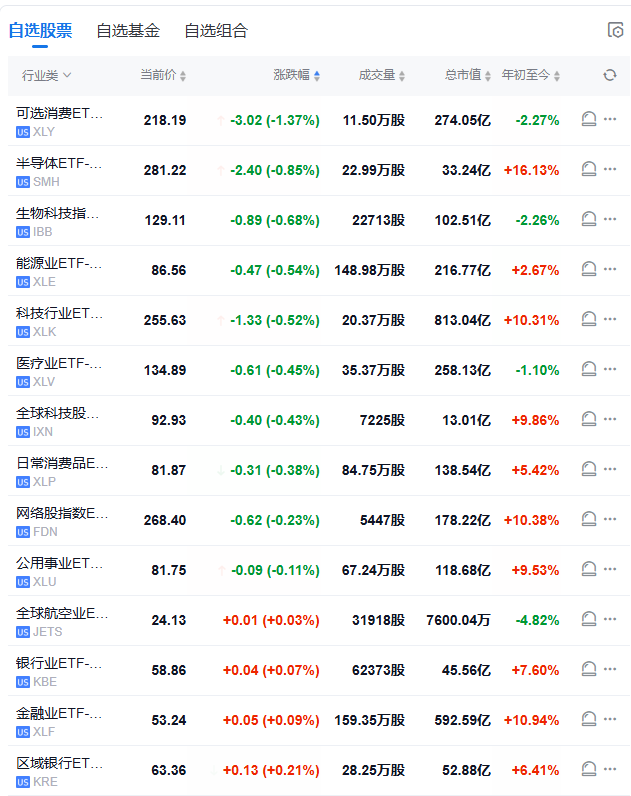
美股盘初,主要行业ETF多数下跌,可选消费ETF跌超1%,半导体ETF跌近1%,生物科技指数ETF跌0.7%。
news flash· 2025-07-07 13:37
Market Overview - Major industry ETFs in the US stock market mostly declined, with the Consumer Discretionary ETF dropping over 1%, the Semiconductor ETF falling nearly 1%, and the Biotechnology Index ETF decreasing by 0.7% [1] ETF Performance - Consumer Discretionary ETF (US XLY) current price: $218.19, down by $3.02 (-1.37%), with a trading volume of 115,000 shares and a total market value of $27.405 billion, year-to-date performance down by 2.27% [2] - Semiconductor ETF (US SMH) current price: $281.22, down by $2.40 (-0.85%), with a trading volume of 229,900 shares and a total market value of $3.324 billion, year-to-date performance up by 16.13% [2] - Biotechnology Index ETF (US IBB) current price: $129.11, down by $0.89 (-0.68%), with a trading volume of 22,713 shares and a total market value of $10.251 billion, year-to-date performance down by 2.26% [2] - Energy ETF (US XLE) current price: $86.56, down by $0.47 (-0.54%), with a trading volume of 1.4898 million shares and a total market value of $21.677 billion, year-to-date performance up by 2.67% [2] - Technology Sector ETF (US XLK) current price: $255.63, down by $1.33 (-0.52%), with a trading volume of 203,700 shares and a total market value of $81.304 billion, year-to-date performance up by 10.31% [2] - Healthcare ETF (US XLV) current price: $134.89, down by $0.61 (-0.45%), with a trading volume of 353,700 shares and a total market value of $25.813 billion, year-to-date performance down by 1.10% [2] - Global Technology ETF (US IXN) current price: $92.93, down by $0.40 (-0.43%), with a trading volume of 7,225 shares and a total market value of $1.301 billion, year-to-date performance up by 9.86% [2] - Consumer Staples ETF (US XLP) current price: $81.87, down by $0.31 (-0.38%), with a trading volume of 847,500 shares and a total market value of $13.854 billion, year-to-date performance up by 5.42% [2] - Internet ETF (US FDN) current price: $268.40, down by $0.62 (-0.23%), with a trading volume of 5,447 shares and a total market value of $178.22 billion, year-to-date performance up by 10.38% [2] - Utilities ETF (US XLU) current price: $81.75, down by $0.09 (-0.11%), with a trading volume of 672,400 shares and a total market value of $11.868 billion, year-to-date performance up by 9.53% [2] - Global Airlines ETF (US JETS) current price: $24.13, up by $0.01 (+0.03%), with a trading volume of 31,918 shares and a total market value of $76.0004 million, year-to-date performance down by 4.82% [2] - Banking ETF (US KBE) current price: $58.86, up by $0.04 (+0.07%), with a trading volume of 62,373 shares and a total market value of $4.556 billion, year-to-date performance up by 7.60% [2] - Financials ETF (US XLF) current price: $53.24, up by $0.05 (+0.09%), with a trading volume of 1.5935 million shares and a total market value of $59.259 billion, year-to-date performance up by 10.94% [2] - Regional Banks ETF (US KRE) current price: $63.36, up by $0.13 (+0.21%), with a trading volume of 282,500 shares and a total market value of $5.288 billion, year-to-date performance up by 6.41% [2]