交通运输

Search documents
异动盘点0813| 阅文集团涨超15%,北海康成-B再涨超31%;柯达夜盘跌超19%,小牛电动涨超11%
贝塔投资智库· 2025-08-13 04:00
Group 1 - Kangji Medical (09997) resumed trading with a nearly 1% increase, announcing a privatization agreement with Knight Bidco Limited, which will make Kangji a wholly-owned subsidiary and delist from the Hong Kong Stock Exchange after completion [1] - Tencent Music (01698) opened high with over a 15% increase, reporting a 30% year-on-year increase in adjusted net profit for Q2 ending June 30, 2025, driven by high-quality growth in its online music business [1] - Mingyuan Cloud (00909) opened over 2% higher, announcing a cash acquisition of 100% equity in ASIOT Co., Ltd. for 700 million yen by its subsidiary MytePro Japan [1] Group 2 - Yuedu Group (00772) surged over 15%, reporting a 68.5% year-on-year increase in net profit for the first half of the year, with strong performance in IP for premium films and animations, and significant growth in the emerging short drama sector [2] - Minmetals Resources (01208) rose over 9%, with net profit increasing 15 times year-on-year, attributed to higher copper production and rising prices of copper, gold, silver, and zinc [2] - Beihai Kangcheng-B (01228) increased over 31%, announcing a strategic cooperation agreement with Baiyang Pharmaceutical for exclusive commercial services in promoting several products in mainland China, Hong Kong, and Macau [2] Group 3 - Zhonghui Biotech-B (02627) surged over 25%, as its vaccine product was included in the preliminary review list of the national commercial health insurance innovative drug catalog [2] - Gilead Sciences-B (01672) rose over 5%, announcing promising efficacy results for its candidate drug ASC47 in combination with teriparatide for obesity treatment in diet-induced obesity mouse studies [3] - Dongying Travel (06882) fell over 9%, issuing a profit warning with expected net profit of approximately 6 million HKD for the first half of 2025, down about 82% from 34 million HKD in the same period last year [3] Group 4 - Kodak (KODK.US) dropped 19.91% after reporting a shift from profit to loss in Q2, raising concerns about its ability to execute critical financing measures [4] - Niu Technologies (NIU.US) rose 11.69%, reporting a turnaround to profitability in Q2 and projecting Q3 revenue between 1.433 billion to 1.638 billion CNY, a year-on-year increase of 40% to 60% [4] - Huya (HUYA.US) increased by 4.53%, preparing to release its financial report, with a strong growth trajectory in gaming-related services [4] Group 5 - ON Running (ONON.US) rose 8.95%, reporting a 32% year-on-year increase in Q2 sales and projecting annual net sales of at least 2.91 billion Swiss francs, exceeding previous expectations [6] - Micron Technology (MU.US) increased by 3.26%, significantly raising its Q4 fiscal year 2025 revenue guidance to between 11.1 billion to 11.3 billion USD, with gross margin guidance improved to 44% to 45% [6]



港股红利低波ETF(159569)近7日6天上涨,高股息标的持续吸引资金流入!
Jin Rong Jie· 2025-08-13 03:22
Core Viewpoint - The Hong Kong stock market is experiencing a collective rise, with significant inflows of capital and an increase in dividend payouts from state-owned enterprises, indicating a favorable investment environment for high-dividend sectors [1][2]. Group 1: Market Performance - As of 11:00 AM on Wednesday, the Hong Kong stock market showed collective gains, with the Hong Kong Dividend Low Volatility ETF (159569) remaining stable, having risen over 23% year-to-date [1]. - Popular stocks such as China Hongqiao, Far East Horizon, and major banks and oil companies are witnessing gains, reflecting positive market sentiment [1]. Group 2: Capital Inflows - According to Wind data, southbound capital inflows have exceeded 910 billion HKD this year, significantly surpassing the total inflow for the entire previous year [1]. - The Hong Kong Dividend Low Volatility ETF (159569) has seen a net inflow of approximately 10 million HKD over the past three months, indicating accelerated capital allocation [1]. Group 3: Policy and Dividend Increases - The Ministry of Finance has announced plans to improve the salary management system for state-owned financial enterprises, while the State-owned Assets Supervision and Administration Commission (SASAC) is pushing for increased dividend payouts from central enterprises [1]. - Several Hong Kong-listed central enterprises, including China Mobile and China National Offshore Oil Corporation, have announced increases in their interim dividend ratios, reflecting a positive response to the supportive policy environment [1]. Group 4: Investment Outlook - Western Securities suggests that high-dividend sectors in the Hong Kong stock market hold long-term investment value in the current liquidity-friendly environment, attracting low-cost capital [1]. - The stable profitability of sectors like banking, along with improved supply-demand dynamics in midstream material industries, is expected to enhance corporate earnings recovery [1].
银河证券北交所日报-20250812
Yin He Zheng Quan· 2025-08-12 12:42
- The report does not contain any quantitative models or factors for analysis[1][3][4]
北交所日报-20250812
Yin He Zheng Quan· 2025-08-12 12:36
- The report includes market data for the top ten gainers and losers in the stock market on August 12, 2025, with details such as market value, revenue, net profit, and P/E ratio [9][10] - The report provides a comparison of the average daily price changes between the Beijing Stock Exchange (BSE) and the A-share market across various industries [6][7] - The report includes a chart showing the turnover rate and transaction amount for the Beijing Stock Exchange as of August 12, 2025 [8] - The report contains a chart comparing the valuation changes (P/E and P/B ratios) of the BSE with the STAR Market and ChiNext Market as of August 12, 2025 [12][13]
红利港股ETF(159331)收红,中长期资金偏好低波高红利特性
Mei Ri Jing Ji Xin Wen· 2025-08-12 09:07
Group 1 - The core viewpoint is that the Hong Kong stock market, particularly high dividend stocks, presents long-term investment value in the current liquidity easing environment [1] - The banking sector is expected to maintain stable earnings and continue existing dividend levels, which will attract low-cost funds [1] - High dividend assets are becoming an important allocation direction amid declining non-standard investment returns [1] Group 2 - The Hong Kong Dividend ETF (159331) tracks the Hong Kong Stock Connect High Dividend Index (930914), which selects 30 high dividend yield securities from companies that meet Stock Connect criteria [1] - The index focuses on large and mid-cap companies with significant dividend yield advantages and stable cash flows, covering various sectors including transportation and resources [1] - Investors without stock accounts can consider related ETFs such as the Cathay CSI Hong Kong Stock Connect High Dividend Investment ETF Initiated Link A (022274) and Link C (022275) [1]
新增专项债发行节奏明显加快
Xin Hua Wang· 2025-08-12 06:30
Core Viewpoint - The issuance of new special bonds has accelerated significantly in early 2023, with a focus on early issuance and utilization to stimulate effective investment [1][2][3] Group 1: Issuance Data - On February 28, the single-day issuance of new special bonds reached 88 billion yuan, accounting for over 20% of the total issuance for the month [1][2] - In the first two months of 2023, a total of 877.5 billion yuan in new special bonds was issued, representing 60.1% of the early allocated quota of 1.46 trillion yuan [2] - The provinces with the highest issuance of new special bonds include Shandong, Guangdong, and Sichuan [2] Group 2: Investment Focus - The primary focus of the issued funds is on infrastructure projects, particularly in transportation and municipal industrial park construction, with significant allocations also directed towards agriculture, forestry, water conservancy, and ecological protection [2] - Nearly 29% of the funds allocated to infrastructure in the first two months were directed towards transportation infrastructure, 39% towards municipal and park infrastructure, and 25% towards agriculture, forestry, water conservancy, and ecological protection [2] Group 3: Future Outlook - The pace of special bond issuance is expected to continue accelerating, with projections indicating that over 90% of the early allocated quota will be issued in the first quarter of 2023 [3] - The Ministry of Finance emphasizes the importance of supporting key project construction through the reasonable arrangement of local government special bonds [3]
全力稳大盘 投资如何多方开源 一批重大项目抓紧上马,PPP担重任激活民间投资
Xin Hua Wang· 2025-08-12 06:26
Group 1 - The central government and local authorities are implementing a series of policies to stabilize and expand investment, focusing on public-private partnerships (PPP) as a key strategy [1][3][5] - A significant number of major projects are being launched, with Hebei province starting 336 projects with a total investment of 104.6 billion yuan, reflecting a 10.1% year-on-year increase in planned investment for major projects across 20 provinces [2][3] - The government aims to accelerate the issuance and utilization of special bonds, with a target of 3.45 trillion yuan in special bonds to be issued by the end of June, which is expected to enhance local government financial capacity [4][5] Group 2 - There is a notable increase in private investment, with Hunan province reporting a 12.6% year-on-year growth in private investment from January to April, outpacing overall investment growth [4][5] - The government is encouraging private investment in urban infrastructure through various incentives, including investment subsidies and capital injections [5][6] - The PPP model is being emphasized to leverage government funds to attract more social capital, with 178 new projects added to the national PPP database this year, amounting to an investment of 328.1 billion yuan [6][8] Group 3 - The focus on enhancing the "pulling power" of PPP projects is crucial, especially in the current economic environment, with calls for more flexible financing solutions to attract private capital [7][8] - Local governments, such as Zhejiang and Guangdong, are promoting the PPP model for railway construction and other infrastructure projects, highlighting the advantages of existing projects over new ones in terms of quality and cash flow [8] - The need for a more competitive market environment and relaxed entry barriers for private investment in infrastructure is emphasized to stimulate economic growth [8]
“招商系”7家上市公司:坚定信心 提速回购
Xin Hua Wang· 2025-08-12 05:57
Core Viewpoint - Seven listed companies under China Merchants Group, including China Merchants Shekou, China Merchants Port, China Merchants Energy, China Merchants Highway, China Merchants Jinling, Liao Port Co., and China Merchants Industry, announced a collective plan to accelerate their share repurchase programs, reflecting strong confidence in their future development prospects and intrinsic value [1] Group 1 - The companies aim to enhance shareholder rights and maintain market confidence in their listed entities [1] - The share repurchase initiative is intended to boost the investment value of the listed companies [1]
A股市场“回购热”仍在继续,自由现金流稳定的公司适合实施回购
Mei Ri Jing Ji Xin Wen· 2025-08-12 02:13
Group 1 - The A-share market shows mixed performance with the free cash flow strategy leading, as evidenced by the Guozheng Free Cash Flow Index rising by 0.66% [1] - Nearly 400 A-share companies have disclosed share buyback progress since July, involving over 60 billion yuan, indicating a continued trend of "buyback heat" in the market [1] - Companies suitable for buybacks include those with surplus cash beyond operational needs and stable free cash flow, particularly leading consumer goods companies [1] Group 2 - The Cash Flow 500 ETF focuses on sectors such as non-ferrous metals, basic chemicals, transportation, machinery, and pharmaceuticals, combining growth and quality with a small and mid-cap style [2] - The Cash Flow 500 ETF conducts quarterly evaluations and profit distributions, allowing for potential profit sharing if conditions are met [2]
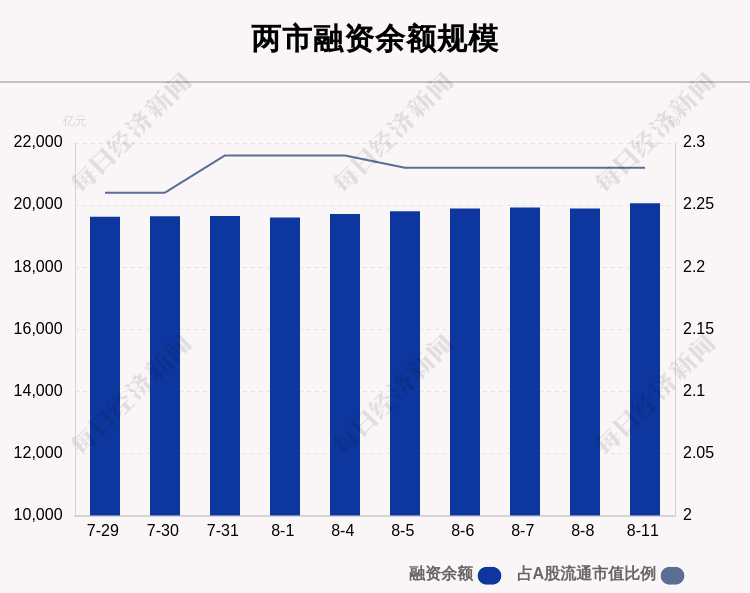
8月11日融资余额20056.9亿元,相较上个交易日增加167.37亿元
Sou Hu Cai Jing· 2025-08-12 00:56
Summary of Key Points Group 1: Market Overview - As of August 11, the margin trading balance in the Shanghai and Shenzhen markets reached 2019.687 billion yuan, an increase of 16.578 billion yuan compared to the previous trading day [1] - The financing balance was 2005.69 billion yuan, up by 16.737 billion yuan from the previous day [1] - The Shanghai market's margin trading balance was 1031.54 billion yuan, increasing by 8.88 billion yuan, while the Shenzhen market's balance was 988.147 billion yuan, up by 7.697 billion yuan [1] Group 2: Stock Performance - A total of 1948 stocks experienced net inflows of financing funds, with 67 stocks having net buy amounts exceeding 10% of their total trading volume [3] - The top three stocks by net buy percentage were Luyang Energy (41.69%), Sichuan Chengyu (38.71%), and COFCO Sugar (37.61%) [3][4] Group 3: Significant Net Inflows - There were 39 stocks with net buy amounts exceeding 100 million yuan, with the top three being Zhongji Xuchuang (471 million yuan), Dazhu Laser (447 million yuan), and Ningde Times (409 million yuan) [7]