制造业

Search documents
工业生产稳定增长,装备制造业和高技术制造业增长较快
Xin Lang Cai Jing· 2025-12-15 02:10
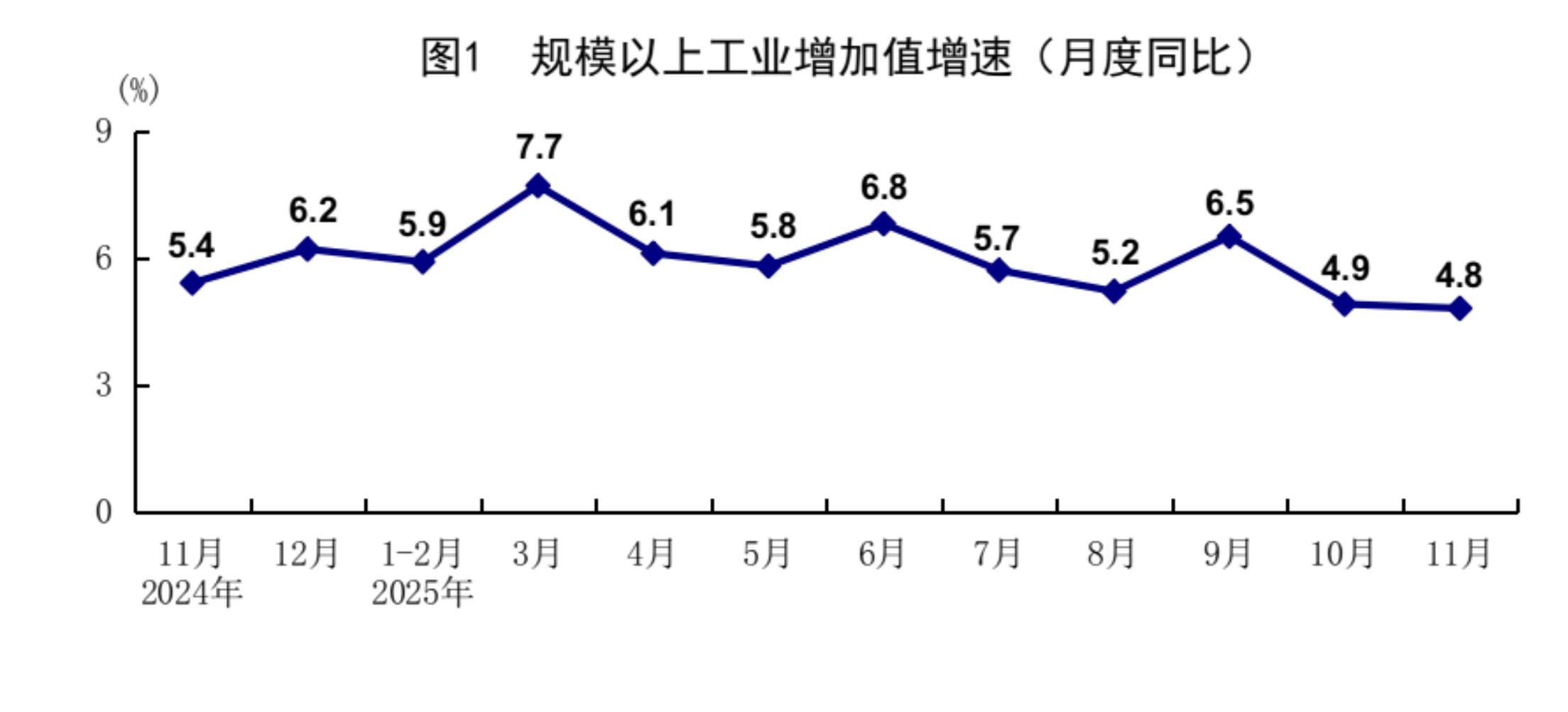
Core Insights - In November, the industrial added value of large-scale enterprises in China increased by 4.8% year-on-year and 0.44% month-on-month [1] - The mining industry saw a year-on-year increase of 6.3%, manufacturing grew by 4.6%, and the production and supply of electricity, heat, gas, and water increased by 4.3% [1] - The equipment manufacturing sector's added value rose by 7.7%, while high-tech manufacturing grew by 8.4%, outpacing the overall industrial growth by 2.9 and 3.6 percentage points respectively [1] Economic Type Analysis - State-controlled enterprises experienced a year-on-year growth of 4.2%, while joint-stock enterprises grew by 5.2%, foreign and Hong Kong, Macao, and Taiwan-invested enterprises increased by 3.4%, and private enterprises saw a growth of 3.2% [1] Product Performance - The production of 3D printing equipment, industrial robots, and new energy vehicles increased by 100.5%, 20.6%, and 17.0% year-on-year respectively [1] Overall Industrial Performance - From January to November, the industrial added value of large-scale enterprises increased by 6.0% year-on-year [1] - In November, the manufacturing purchasing managers' index was 49.2%, up by 0.2 percentage points from the previous month, while the business activity expectation index rose to 53.1%, an increase of 0.3 percentage points [1] Profitability - From January to October, the total profit of large-scale industrial enterprises reached 59,503 billion yuan, reflecting a year-on-year growth of 1.9% [1]
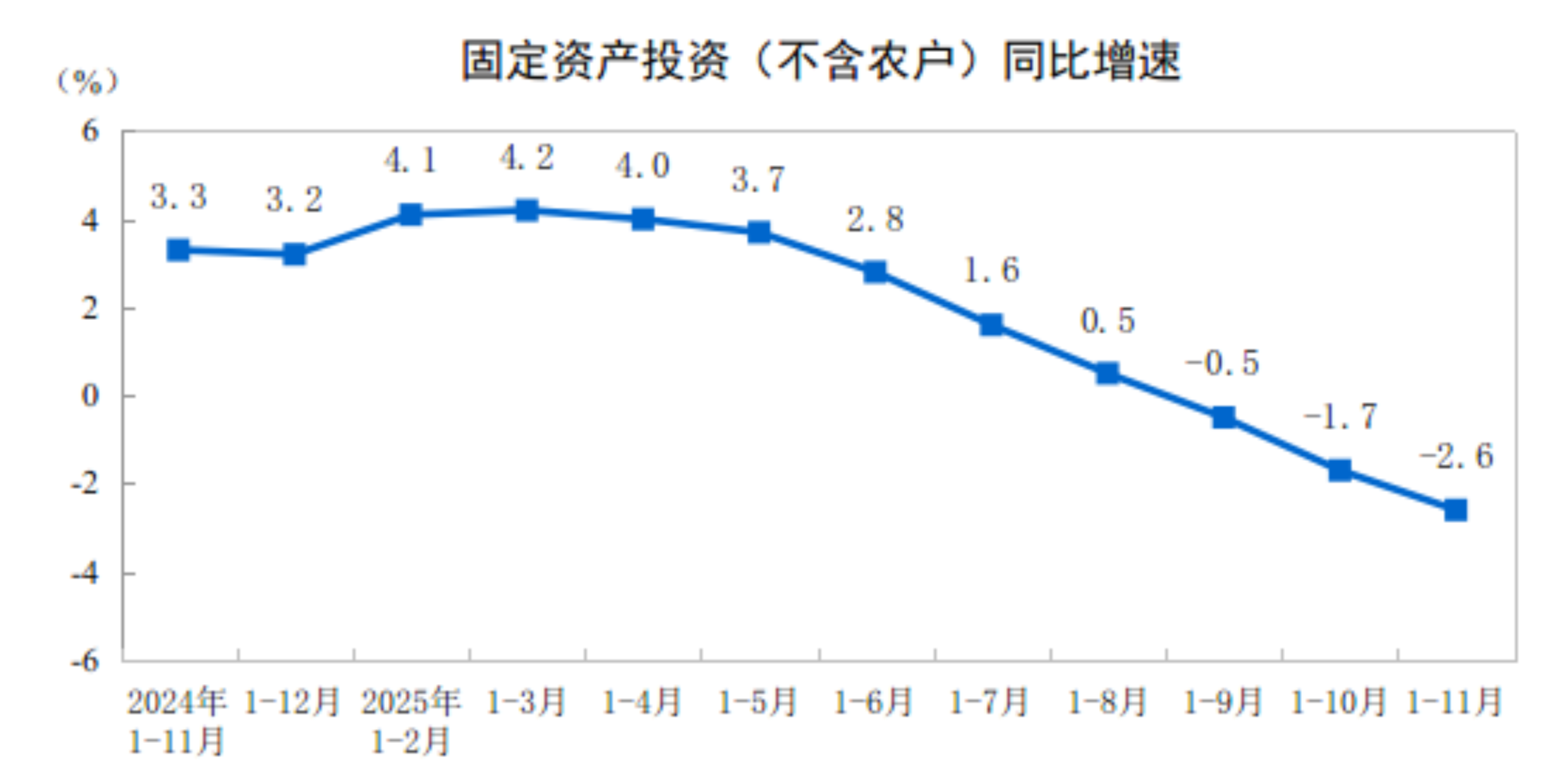
国家统计局:中国1-11月固定资产投资同比下降2.6%
Guo Jia Tong Ji Ju· 2025-12-15 02:04
Core Insights - In the first eleven months of 2025, China's fixed asset investment (excluding rural households) reached 444,035 billion yuan, showing a year-on-year decline of 2.6% [1] - Private fixed asset investment decreased by 5.3% year-on-year [1] Investment by Industry - Investment in the primary industry was 8,770 billion yuan, with a year-on-year growth of 2.7% [3] - Investment in the secondary industry totaled 162,243 billion yuan, increasing by 3.9% [3] - Investment in the tertiary industry was 273,022 billion yuan, reflecting a decline of 6.3% [3] - Within the secondary industry, industrial investment grew by 4.0%, with mining and manufacturing both showing increases of 4.0% and 1.9% respectively [3] - The electricity, heat, gas, and water production and supply industry saw a significant investment growth of 10.7% [3] - In the tertiary industry, infrastructure investment (excluding electricity, heat, gas, and water production and supply) decreased by 1.1% [3] - Notable growth in specific sectors included pipeline transportation (16.8%), water transportation (8.9%), and railway transportation (2.7%) [3] Regional Investment Trends - Eastern region investment fell by 6.6% year-on-year [3] - Central region investment decreased by 1.7% [3] - Western region investment saw a minor decline of 0.2% [3] - Northeast region investment experienced a significant drop of 14.0% [3] Investment by Registration Type - Domestic enterprises' fixed asset investment declined by 2.6% year-on-year [3] - Investment from Hong Kong, Macau, and Taiwan enterprises decreased by 2.2% [3] - Foreign enterprises' fixed asset investment saw a substantial decline of 14.1% [3]

11月份国民经济延续稳中有进发展态势
Guo Jia Tong Ji Ju· 2025-12-15 02:00
全年全国粮食产量14298亿斤,比上年增加167.5亿斤,增长1.2%,稳定在1.4万亿斤以上。其中,秋粮产量10732亿斤,比上年增加163.6亿斤,增长1.5%。全 国谷物产量13204亿斤,比上年增加158.4亿斤,增长1.2%。粮食播种面积增加、单产提高。全国粮食播种面积17.91亿亩,比上年增加134.8万亩,增长 0.1%;粮食单产399.1公斤/亩,每亩产量比上年增加4.4公斤,增长1.1%。 二、工业生产稳定增长,装备制造业和高技术制造业增长较快 11月份,全国规模以上工业增加值同比增长4.8%,环比增长0.44%。分三大门类看,采矿业增加值同比增长6.3%,制造业增长4.6%,电力、热力、燃气及水 生产和供应业增长4.3%。装备制造业增加值同比增长7.7%,高技术制造业增加值增长8.4%,分别快于全部规模以上工业增加值2.9和3.6个百分点。分经济类 型看,国有控股企业增加值同比增长4.2%;股份制企业增长5.2%,外商及港澳台投资企业增长3.4%;私营企业增长3.2%。分产品看,3D打印设备、工业机 器人、新能源汽车产品产量同比分别增长100.5%、20.6%、17.0%。1-11月份,全 ...
2025年1—11月份全国固定资产投资基本情况
Guo Jia Tong Ji Ju· 2025-12-15 02:00
Core Insights - The total fixed asset investment (excluding rural households) in China for January to November 2025 reached 444,035 billion yuan, representing a year-on-year decline of 2.6% [1][5]. Investment by Industry - Investment in the primary industry was 8,770 billion yuan, with a year-on-year growth of 2.7% [3][6]. - The secondary industry saw an investment of 162,243 billion yuan, growing by 3.9% year-on-year, with industrial investment specifically increasing by 4.0% [3][6]. - The tertiary industry experienced a decline in investment to 273,022 billion yuan, down 6.3% year-on-year [3][6]. Secondary Industry Breakdown - Within the secondary industry, mining investment grew by 4.0%, manufacturing investment increased by 1.9%, and investment in the electricity, heat, gas, and water production and supply sector surged by 10.7% [3][6]. Tertiary Industry Breakdown - Infrastructure investment (excluding electricity, heat, gas, and water production and supply) in the tertiary sector decreased by 1.1% year-on-year [3][6]. - Notable growth was observed in pipeline transportation (16.8%), water transportation (8.9%), and railway transportation (2.7%) [3][6]. Investment by Region - Eastern region investments fell by 6.6%, central region by 1.7%, western region by 0.2%, and northeastern region by 14.0% [3][6]. Investment by Registration Type - Domestic enterprises' fixed asset investment decreased by 2.6%, while investments from Hong Kong, Macau, and Taiwan enterprises fell by 2.2%, and foreign enterprises saw a significant decline of 14.1% [4][6]. Summary of Key Data - The overall fixed asset investment (excluding rural households) showed a decline of 2.6% year-on-year, with state-owned holding investments down by 1.1% and private investments down by 5.3% [5][6]. - Specific components such as construction and installation projects decreased by 6.4%, while equipment purchases increased by 12.2% [5][6].
澳大利亚邦迪海滩枪击事件已致16人死亡;三部门发文:更大力度提振消费;宁波通报患儿术后离世情况调查;中国乒协回应孙颖莎王楚钦退赛丨每经早参
Mei Ri Jing Ji Xin Wen· 2025-12-14 21:40
Group 1: Automotive Industry - The Ministry of Commerce, the People's Bank of China, and the Financial Regulatory Bureau jointly issued a notification to boost consumption, including measures to reduce penalties for early loan repayment during vehicle trade-ins and support for service and elderly care sectors [5] - Dongfeng Motor and Leap Motor announced their commitment to comply with the "Automotive Industry Price Behavior Compliance Guidelines," aiming to enhance price compliance management across the entire production and sales chain [14][15] Group 2: Economic Indicators - China's marine economy is projected to exceed 10 trillion yuan in production value in 2024, with a 5.6% year-on-year growth in the first three quarters of this year, highlighting its importance in national economic stability [5] - The Hong Kong government is set to launch public consultations for the upcoming fiscal budget, focusing on expanding economic development and fostering innovation and technology [6] Group 3: Corporate Developments - Yunda Holdings announced a board election, nominating a 24-year-old as a non-independent director candidate, indicating potential changes in corporate governance and strategy [16] - Texas Instruments has entered a strategic partnership with UBTECH Robotics to enhance the application of humanoid robots in semiconductor manufacturing [17] Group 4: Market Trends - The price of Feitian Moutai has seen a significant increase, with prices rising by 40 to 80 yuan per bottle recently, indicating a strong demand in the market [13] - The strategic cooperation between Fenbi and Huatu Shanding aims to explore AI applications in the examination training industry, reflecting a trend towards digital transformation in education [18]





聚焦中央经济工作会议·反响丨以实际行动推动高质量发展取得新成效——中央经济工作会议激励广大干部群众踔厉奋发开新局
Xin Hua Wang· 2025-12-14 13:51
Group 1 - The Central Economic Work Conference emphasized the importance of high-quality development and the need for practical actions to achieve new results in economic growth [1][3] - The conference highlighted the necessity of strengthening the county economy and enhancing the value chain in specific industries, such as the lemon industry in Anju County, which accounts for 70% of the national lemon planting area and production [3] - The meeting called for the construction of international technology innovation centers in key regions like Beijing, Shanghai, and the Guangdong-Hong Kong-Macao Greater Bay Area, aiming to promote regional collaborative innovation [5][6] Group 2 - The conference outlined the goal of advancing the Hainan Free Trade Port, with a significant milestone of full island closure operations set for December 18, which is expected to enhance foreign investment and trade [7] - The meeting stressed the importance of stabilizing employment for key groups, including college graduates and migrant workers, and proposed adjustments in educational resource allocation to increase high school and university enrollment [8] - The conference encouraged major economic provinces to take a leading role in economic stability and growth, with specific plans for technological innovation and regional development in areas like the Wuhan metropolitan area [7][8]
海外市场2026年度策略:云开雾霁,科技擎旗
Ping An Securities· 2025-12-14 12:42
Market Review - The MAGA policy framework has been established, leading to a rise in gold and a decline in the US dollar. In 2025, the Trump administration strongly promoted the "America First" policy, resulting in increased volatility in global capital markets, with gold leading the gains and the dollar weakening. The S&P 500 and Nasdaq indices rose by 17% and 22% respectively, while the dollar index fell by 8.8% throughout the year [3][9][10]. US Market - The US economy is expected to grow moderately in 2026, supported by both investment and consumption. The impact of previous tariffs is diminishing, and fiscal and monetary policies are showing effects. AI-related investments are anticipated to continue their strong momentum, while consumer spending is expected to gradually recover [3][4][9]. - Inflation remains sticky, with limited room for interest rate cuts. The expected range for rate cuts in 2026 is between 25-50 basis points, influenced by resilient wage growth and economic recovery [3][4][9]. - The political landscape, particularly the midterm elections, is likely to maintain a moderate policy tone, balancing economic stimulus with inflation control to create a favorable socio-economic environment [3][4][9]. US Stock Market - The US stock market is expected to continue its upward trend, driven by the AI narrative and recovery in cyclical and consumer sectors. Key investment opportunities include AI-related industries, which are still in the early stages of a potential bubble, and sectors benefiting from the "Great Beautiful Act" [3][4][9]. - The manufacturing and information sectors are projected to be the main beneficiaries of corporate tax cuts, while cyclical and consumer sectors are expected to recover as the economy stabilizes [3][4][9]. Hong Kong Stock Market - The Hong Kong stock market is anticipated to maintain a trend of oscillating upward, with structural opportunities emerging. The earnings growth in sectors such as semiconductors, automotive parts, and discretionary consumption is expected to improve significantly in 2026 [3][4][9]. - The liquidity environment is characterized by a decline in US Treasury yields, with foreign capital continuing to flow into the market. The strategic stability in US-China relations is likely to support risk appetite [3][4][9].
超117万人被裁!
Ge Long Hui A P P· 2025-12-14 08:33
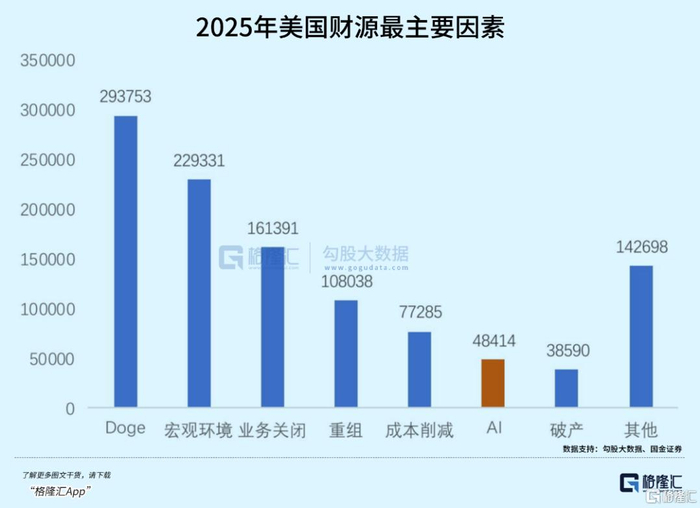
Group 1 - The core issue is the significant increase in layoffs across various sectors, with a total of 1,170,821 employees laid off in the U.S. as of November, marking a 54% increase from the previous year, approaching the levels seen during the 2008-2009 financial crisis [1] - The primary reason for the layoffs is attributed to the impact of the DOGE department led by Elon Musk, which has resulted in 293,753 federal employees and contractors losing their jobs, alongside 20,976 in private and non-profit sectors, an eightfold increase compared to 2024 [4] - The macroeconomic environment, characterized by high costs and tariffs, is also a significant factor contributing to the layoffs [6] Group 2 - The low-interest rate environment has led to a debt hangover, with many companies facing the need to refinance at higher rates, resulting in doubled interest expenses and halved net profits for struggling "zombie companies" [7][8] - The retail sector is the hardest hit, with a notable decline in consumer confidence, as evidenced by the Michigan Consumer Sentiment Index dropping to 51, a more than 20% decrease from the previous year [15] - The service industry has also seen significant layoffs, with 69,089 jobs cut throughout the year, a 64% increase, affecting a wide range of roles from restaurant staff to logistics coordinators [17] Group 3 - The technology sector has been particularly affected, contributing 35% of the layoffs, with a historical high of 28% of layoffs being middle management positions, as AI tools reduce the need for these roles [29][30] - Companies are increasingly using layoffs as a management tool to meet Wall Street's new performance metrics, leading to a culture where reducing headcount is seen as a standard practice rather than a response to crises [31] - The trend of layoffs in the tech industry is expected to continue, with predictions of a peak in cost-cutting benefits in 2026, as operational costs are projected to decrease significantly [37] Group 4 - The layoffs are not only affecting lower-level positions but are also targeting high-salary roles, particularly in finance and technology, indicating a shift in the labor market dynamics [27][28] - The reduction in middle management is leading to immediate operational efficiencies, with companies reporting significant cost savings and improved performance metrics following layoffs [35] - However, the long-term implications of these layoffs may hinder innovation, as a significant portion of laid-off employees hold critical technical expertise, potentially extending product development cycles [41][51]
李迅雷最新研判!明年将涌现更多结构性机会
证券时报· 2025-12-14 00:52
Group 1 - The core message of the article emphasizes the importance of the capital market in supporting national strategies and empowering the real economy, with a focus on structural opportunities arising from advancements in artificial intelligence and emerging industries [1][2][3] - The 2026 capital market is expected to present more structural opportunities, particularly influenced by the fourth industrial revolution and technological advancements [3][5] - The current economic structure in China shows a surplus in supply but a lack of demand, leading to downward pressure on prices, which is a structural issue that needs long-term observation [5][7] Group 2 - The improvement in the profitability of listed companies is a key factor supporting the performance of the A-share market this year, with a year-on-year profit growth of 5.47% in the first three quarters, surpassing the actual GDP growth rate [7][8] - The growth in profitability is concentrated in sectors such as software and services, technology hardware, and materials, while industries like real estate and consumer services are experiencing significant declines [8][9] - The 2026 market outlook includes a focus on four main directions: strong performance in gold and related sectors due to geopolitical tensions, long-term growth in AI technology stocks, emerging consumption trends related to younger demographics, and the attractiveness of high-dividend and fixed-income assets [9][11]

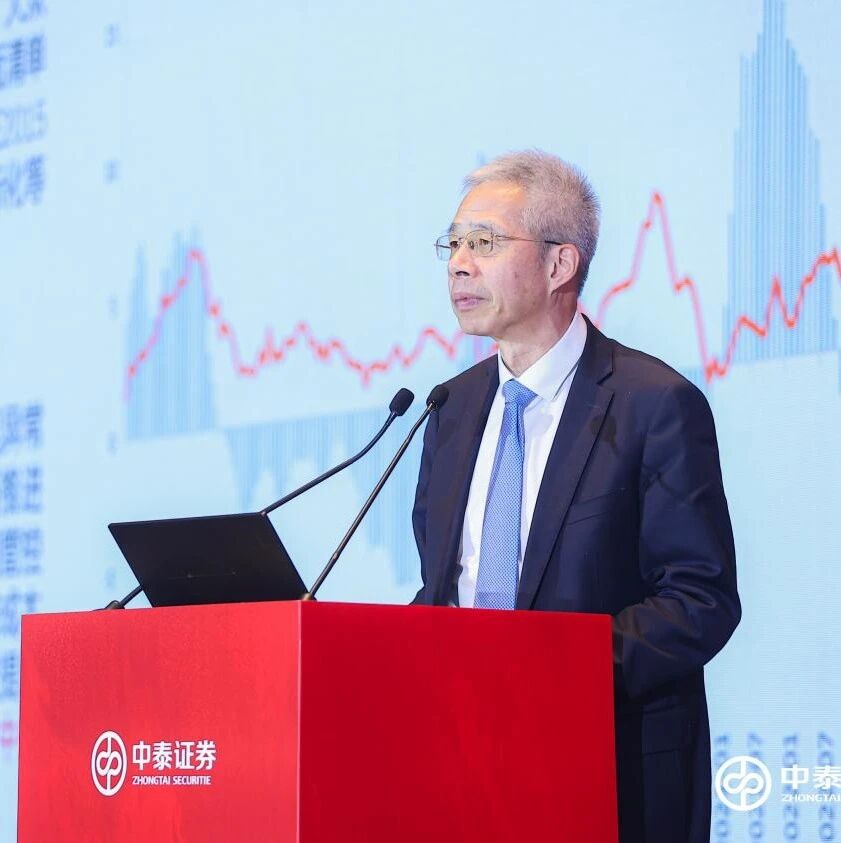
李迅雷最新研判!明年将涌现更多结构性机会
券商中国· 2025-12-13 15:15
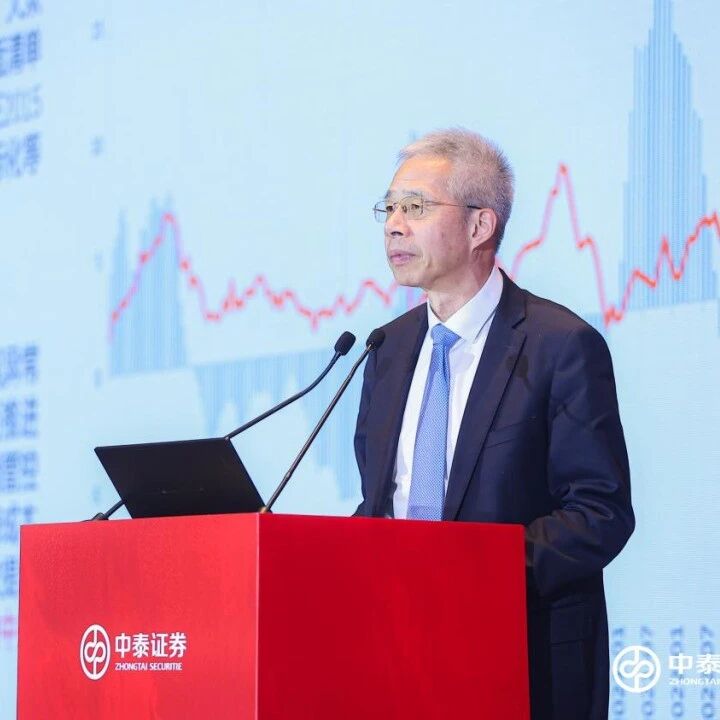
Core Viewpoint - The 2026 strategy conference held by Zhongtai Securities highlighted the importance of the capital market in serving national strategies and empowering the real economy, with a focus on structural opportunities driven by advanced manufacturing and emerging industries, particularly in the context of artificial intelligence [2][4][5]. Group 1: Economic Structure and Opportunities - The Chinese economic structure is characterized by a strong supply but weak demand, leading to downward pressure on prices, which is a structural issue involving industrial and income distribution [7]. - Despite challenges, structural opportunities exist, particularly in advanced manufacturing and emerging industries led by AI, which are transforming the economic landscape and creating new industry prosperity [8]. - The improvement in listed companies' profitability supports the performance of the A-share market, with a year-on-year growth of 5.47% in the first three quarters, surpassing the actual GDP growth rate [10]. Group 2: Market Outlook and Investment Directions - The capital market is expected to present more structural opportunities in 2026, particularly in technology and new consumption sectors, as traditional consumption growth is limited [9][11]. - Zhongtai Securities' strategy chief analyst, Xu Chi, anticipates a structural market rotation in 2026, focusing on key areas such as technology innovation and reducing reliance on Western supply chains [11][12]. - Four key investment directions for 2026 include: 1) Gold and related sectors due to geopolitical tensions; 2) AI technology stocks expected to perform well; 3) Emerging consumption related to younger demographics; 4) High dividend and fixed-income-like assets [13].