
自动驾驶

Search documents
无人驾驶货车龙头,完成新一轮超3亿美元融资
Zhong Guo Zheng Quan Bao· 2026-02-25 05:05
Core Viewpoint - RoboVan leader Jiushi Intelligent has completed a new financing round exceeding $300 million, with a company valuation surpassing 10 billion yuan [1] Group 1: Financing and Valuation - Jiushi Intelligent has raised over $300 million in its latest financing round, bringing its total valuation to over 10 billion yuan [1] - The investment round includes large industrial players and several government funds from first-tier cities [1] - This marks the sixth financing round for Jiushi Intelligent since its inception [1] Group 2: Strategic Developments - Jiushi Intelligent has merged its operations with Cainiao's unmanned vehicle business, operating under both Jiushi and Cainiao brands [1] - The integration aims to create a clear differentiation in brand positioning, with Jiushi focusing on full-stack self-research technology for autonomous driving and Cainiao targeting specific scenarios and key customers [1] - The merger is seen as a milestone in the autonomous driving industry, transitioning from "single-point breakthroughs" to "system integration" [1] Group 3: Market Expansion and Impact - Jiushi Intelligent plans to cover over 300 cities and regions globally by January 2026, with a cumulative delivery volume exceeding 1.5 billion packages [1] - The company claims to help clients reduce operational costs by an average of 66% [1] - The RoboVan fleet has grown to over 20,000 units, achieving a scale increase from hundreds to thousands within four years [2]
九识智能完成新一轮超3亿美元融资
Bei Jing Shang Bao· 2026-02-25 04:43
Core Insights - Jiushi Intelligent has completed a new financing round exceeding $300 million, with a valuation surpassing 10 billion RMB [1] - The company has raised funds six times since its establishment in 2021, focusing on artificial intelligence and L4-level autonomous driving technology [1] Company Overview - Jiushi Intelligent was founded in 2021 and specializes in the research and development of L4-level autonomous delivery vehicles, targeting urban branch transportation and B2B unmanned logistics [1] - The core product is the L4-level autonomous delivery vehicle, which aims to enhance efficiency in urban logistics [1] Market Expansion - By the end of 2025, Jiushi Intelligent plans to have its unmanned delivery vehicle business covering over 300 cities in China and expanding to international markets including Singapore, UAE, Japan, South Korea, and Malaysia [1] - In October 2025, Jiushi Intelligent signed an order with China Post for 7,000 unmanned vehicles [1] Strategic Developments - In January, Jiushi Intelligent completed a strategic merger with Cainiao's unmanned vehicle business, resulting in the operation of dual brands: Jiushi and Cainiao [1] - The combined RoboVan fleet exceeds 20,000 vehicles, covering over 300 cities across more than 10 countries globally [1]
2万台车跑出百亿估值,九识智能再融超3亿美元
3 6 Ke· 2026-02-25 03:43
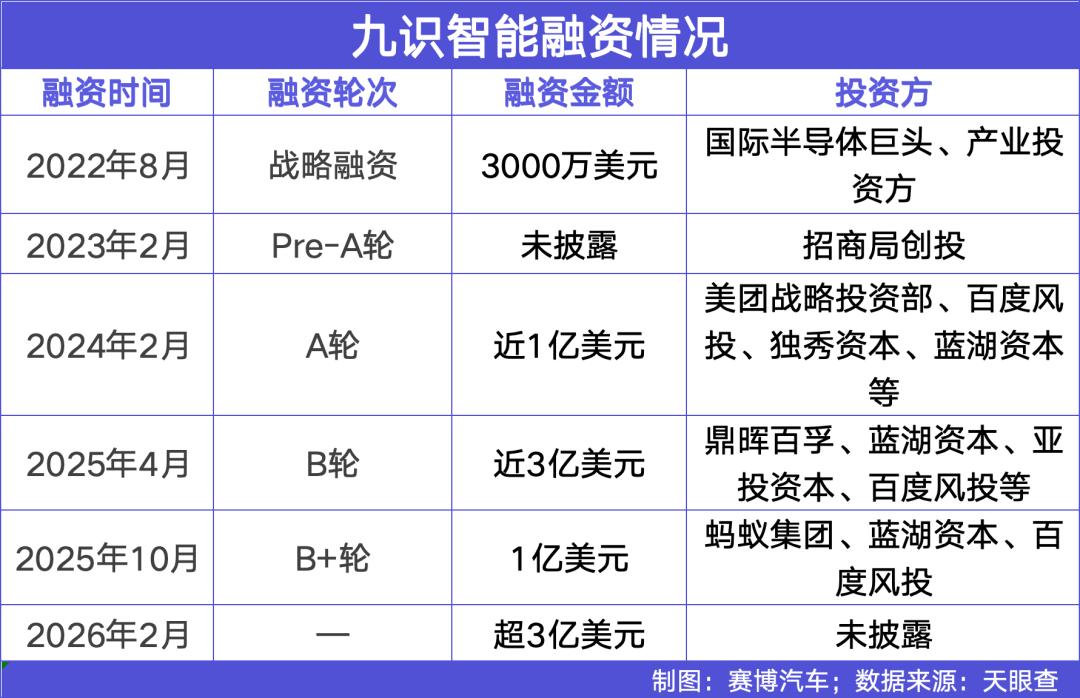
自动驾驶赛道又迎好消息。 近日,无人驾驶公司九识智能完成新一轮超3亿美元融资。此前,九识智能已完成5轮融资。至此,九识智能累计公开融资额已远超8亿美元(约合人民币 55亿元),公司估值突破百亿元大关。 | | | 九识智能融资情况 | | | --- | --- | --- | --- | | 融资时间 | 融资轮次 | 融资会频 | 投资元 | | 2022年8月 | 战略融资 | 3000万美元 | 国际半导体巨头、产业投 | | | | | 资方 | | 2023年2月 | Pre-A轮 | 未披露 | 招商局创投 | | 2024年2月 | A轮 | 近1亿美元 | 美团战略投资部、百度风 投、独秀资本、蓝湖资本 | | | | | 業 | | 2025年4月 | B轮 | 近3亿美元 | 鼎晖百孚、蓝湖资本、亚 | | | | | 投资本、百度风投等 | | 2025年10月 | B+轮 | 1 亿美元 | 蚂蚁集团、蓝湖资本、百 | | | | | 度风投 | | 2026年2月 | | 超3亿美元 | 未披露 | | | | | 制图:赛博汽车;数据来源:天眼查 | 这家成立于2021年的公司, ...

RoboVan首家百亿独角兽诞生,九识智能新完成3亿美金融资
Sou Hu Cai Jing· 2026-02-25 03:26
Group 1 - The core point of the article is that Jiushi Intelligent, a leading global autonomous driving technology company, has completed a new financing round exceeding $300 million, becoming the first unicorn in the global RoboVan sector to surpass a valuation of 10 billion RMB [1] - The round of investment includes large industrial players, several first-tier city government funds, and market-oriented USD and RMB investment institutions [1] - Jiushi has strategically merged with Cainiao's unmanned vehicle business, operating under both Jiushi and Cainiao brands, with a total RoboVan fleet size exceeding 20,000 vehicles [1] Group 2 - The combined operations cover over 300 cities in more than 20 countries globally, positioning Jiushi Intelligent as the leader in the sector [1]
小鹏新年亮剑,指向物理AI
Hua Er Jie Jian Wen· 2026-02-25 03:17
Group 1 - The core theme of Xiaopeng Motors' strategy for 2026 is "steady progress and breaking through," emphasizing the need to maintain scale and quality in the mainstream automotive market while advancing in physical AI technology [1] - Xiaopeng achieved a delivery volume of 429,400 vehicles in 2025, marking a year-on-year growth of 126% and becoming the first among new electric vehicle manufacturers to reach one million vehicles produced [1] - The company aims to transition from creating popular models to developing a broader product matrix to capture various market segments [6] Group 2 - Xiaopeng's CEO, He Xiaopeng, believes that the tipping point for autonomous driving has arrived, referring to it as the "DeepSeek moment," characterized by significant technological advancements and cost reductions [2] - The second-generation VLA (Vision-Language-Action) model, which is seen as a step towards L4 fully autonomous driving, is set to be officially launched this quarter [2] - The merger of the autonomous driving center and the intelligent cockpit center into a unified AI center indicates a strategic shift towards integrated decision-making and user interaction [2] Group 3 - The partnership with Volkswagen, which began in 2023, signifies a shift for Xiaopeng from a technology inputter to a technology exporter, enhancing its global competitiveness in autonomous driving [3] - Xiaopeng plans to become the first company to mass-produce robots, flying cars, and Robotaxis in the same year by 2026, marking a significant milestone in physical AI [4] - The company is set to pilot its ride-hailing model this year, aiming to establish a foundational cycle of technology, customers, and business [4] Group 4 - Xiaopeng's ambitious product strategy for 2026 includes launching over ten new models, with a focus on a dual-energy strategy to move beyond solely electric vehicles [6] - The company achieved over 45,000 overseas deliveries in 2025, a 96% year-on-year increase, and aims to double its overseas sales in 2026 [7] - The strategy for global expansion includes launching six global models and increasing overseas outlets to 680, with a focus on key markets such as Israel, Germany, and Norway [8] Group 5 - Xiaopeng plans to increase its global workforce by 8,000 in 2026, with a focus on nurturing talent from within to ensure cultural integration and operational consistency [10] - The company faces financial challenges due to ongoing price wars in the automotive industry and high R&D investments in AI and robotics [10] - The sales target for 2026 is set between 550,000 and 600,000 vehicles, representing a growth of approximately 40% from 2025 [10] Group 6 - The transition from survival to growth for Xiaopeng is marked by the need to capitalize on the "DeepSeek moment" in autonomous driving and successfully commercialize its advanced AI technologies [11] - The ability to navigate the challenges of engineering, supply chain, cost control, and regulatory approval will be crucial for Xiaopeng's success in the coming years [5][11]

RoboVan首家百亿独角兽诞生 九识智能新完成3亿美金融资
Di Yi Cai Jing· 2026-02-25 03:03
Group 1 - The core point of the article is that Jiushi Intelligent, a leading global autonomous driving technology company, has completed a new financing round exceeding $300 million, becoming the first unicorn in the global RoboVan sector to surpass a valuation of 10 billion RMB [1] - The round of investment includes large industrial players, several first-tier city government funds, and market-oriented USD and RMB investment institutions [1] - Jiushi has completed a strategic merger with Cainiao's unmanned vehicle business, operating under both Jiushi and Cainiao brands, with a total RoboVan fleet size exceeding 20,000 vehicles [1] Group 2 - The combined operations cover over 300 cities in 20 countries globally, positioning Jiushi Intelligent as the leader in the global market [1]
A股春节后首个交易日早盘急跌后反弹,恒生科技指数跌2.13%
Xin Yong An Guo Ji Zheng Quan· 2026-02-25 02:50
Market Performance - A-shares experienced a rebound after an initial drop, with the Shanghai Composite Index closing up 0.87% at 4117.41 points, and the Shenzhen Component Index rising 1.36%[1] - The Hang Seng Index fell 1.82% to 26590.32 points, with the Hang Seng Tech Index down 2.13% and the Hang Seng China Enterprises Index down 2.06%[1] - The total market turnover in Hong Kong was 2509.921 million HKD[1] Economic Indicators - The U.S. stock indices all closed higher, with the Dow Jones up 0.76% at 49174.5 points, the S&P 500 up 0.77% at 6890.07 points, and the Nasdaq up 1.04%[1] - During the Chinese New Year holiday, domestic travel spending reached a record 8034.83 billion RMB, an increase of 1264.81 billion RMB compared to the previous year[12] - The number of domestic travelers during the holiday was 596 million, an increase of 9.5 million compared to the previous year[12] Corporate Developments - The company "优乐赛共享服务" reported a revenue of 533 million RMB for the first eight months of the previous year, a year-on-year increase of 5.1%, but net profit fell by 7.8% to 22.025 million RMB[10] - "RedotPay," a Hong Kong stablecoin payment company, is considering an IPO in the U.S. with a fundraising target exceeding 1 billion USD[10] - "埃斯顿," an industrial robot manufacturer, reported a revenue of 3.804 billion RMB for the first nine months of the previous year, a year-on-year increase of 12.86%, but incurred a net loss of 253.72 million RMB[10]
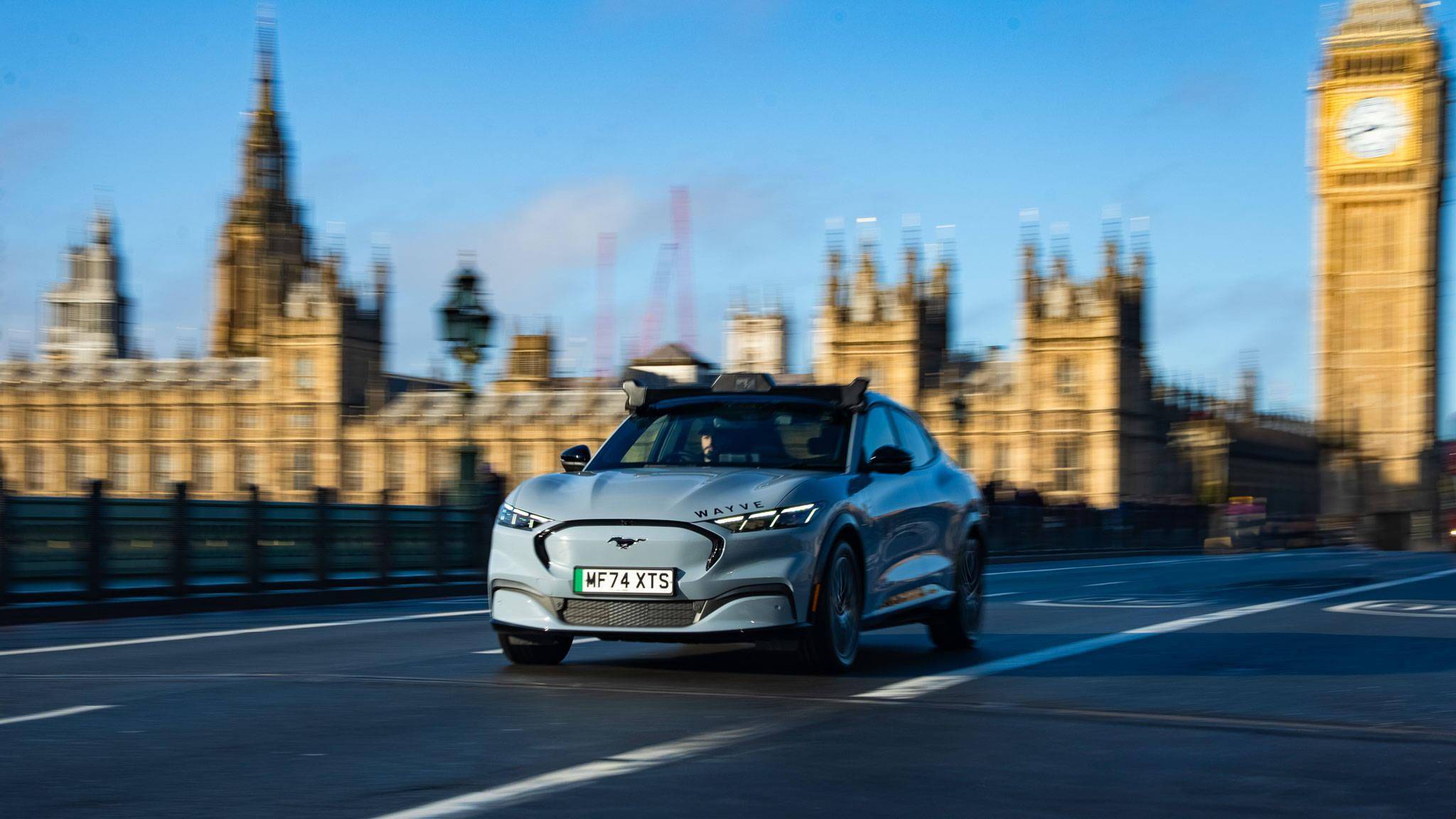
英伟达、微软增资自动驾驶厂商Wayve 后者估值冲至86亿美元
Ge Long Hui A P P· 2026-02-25 02:39
Group 1 - Wayve, an autonomous driving company, raised $1.2 billion in Series D funding, achieving a valuation of $8.6 billion [1] - The funding round was led by Eclipse, Balderton, and SoftBank's Vision Fund 2, with participation from Nvidia, Microsoft, and Uber [1] - Major automotive companies such as Mercedes-Benz, Nissan, and Stellantis also invested in this funding round [1]




Wayve完成D轮融资:软银、微软、英伟达、Uber、三大车企参与
Sou Hu Cai Jing· 2026-02-25 02:28
Core Insights - Wayve, a UK-based autonomous driving and embodied AI company, has completed a Series D funding round totaling $1.2 billion, raising its post-money valuation to $8.6 billion [1] Funding Details - The funding round was led by SoftBank, with participation from major tech and automotive companies including Microsoft, NVIDIA, Uber, Mercedes-Benz, Nissan, and Stellantis [1] - The current exchange rate translates the funding amount to approximately 82.67 billion RMB and the valuation to about 592.47 billion RMB [1] Product Development - Starting this year, consumers will be able to experience Wayve's technology through a commercial trial with Uber, featuring Robotaxi services [1] - By 2027, passenger cars equipped with Wayve's AI driving system are expected to be officially launched, initially offering L2+ level autonomous driving capabilities [1]
A股开盘速递 | 沪指涨0.15% 金属板块表现活跃
智通财经网· 2026-02-25 01:40
Market Overview - The three major A-share indices opened higher, with the Shanghai Composite Index rising by 0.15% and the ChiNext Index also increasing by 0.15% [1] Sector Performance - The metals sector showed strong performance, with Hunan Silver and Silver Nonferrous both rising over 2% [1] - AI applications and film industry sectors experienced the largest declines [1] Institutional Insights - Dongfang Securities maintains a bullish outlook, predicting the market will challenge the 4200-point level, with a focus on the computing industry chain and power infrastructure [1] - Everbright Securities expects trading activity to continue to increase, breaking the current oscillating pattern, with a potential for a new spring rally driven by sectors like humanoid robots, commercial aerospace, and autonomous driving [1] - Dongguan Securities notes that A-shares are entering a value-adding zone, with historical data indicating a high probability of gains post-Spring Festival, supported by upcoming policy expectations and macroeconomic benefits [1]