酒店餐饮

Search documents
行情清淡!资金造“妖”
Mei Ri Jing Ji Xin Wen· 2025-12-02 12:31
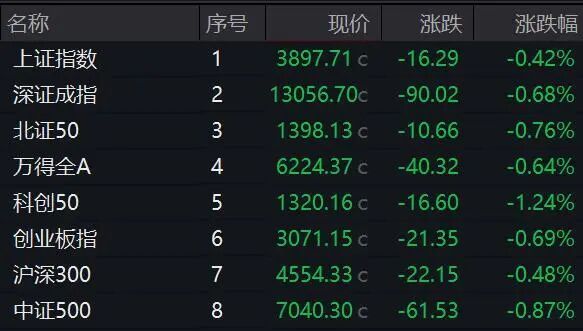
今天,A股三大指数集体回调。截至收盘,上证指数下跌0.42%,深证成指、创业板指数分别下跌 0.68%、0.69%。 整个A股市场的成交额为16072亿元,该数据是8月以来单日成交额的第三低,仅次于8月4日和11月28 日。个股跌多涨少,个股涨跌幅的中位数为下跌0.77%。 市场成交清淡,行情自然也就没有太大的起色。就连近期大盘的反弹,也显得有点蹒跚。 大市方面,上证指数上方目前存在两个压力位:一是11月21日的跳空缺口,二是11月20日平台高点3967 点附近。 在达哥看来,只要上证指数不跌破上周五的低点3856点,则依然处于反弹周期之内,参考龙头的首阴战 法,今天大盘就相当于一次正常的获利回吐。 由于上证指数上方两大压力位的存在,给人的感受是"肉"不多。因此,对于交易能力不足的投资者而 言,接下来的行情可能有点鸡肋。 大盘反弹时间能否延长、反弹空间能否拔高,后续可能需要观察重要宏观事件能否释放积极信号,比如 中共中央政治局会议、中央经济工作会议、美联储议息会议。 行情清淡,不甘寂寞的资金开始炒作妖股。昨天有18只个股连板,今天有11只个股再度涨停,连板率超 过六成。这也是市场少有的赚钱效应所在。 从A股历 ...
尾盘猛拉!000735,垂直涨停,这一概念突然爆发
Zheng Quan Shi Bao· 2025-12-02 09:09
Market Overview - The A-share market experienced fluctuations with the Shanghai Composite Index falling below 3900 points, and the North Shenzhen 50 index also failing to hold above 1400 points, leading to declines in the Shenzhen Component Index, ChiNext Index, and Sci-Tech 50 Index [1][2] - The trading volume slightly decreased to 1.61 trillion yuan, with a larger number of stocks declining compared to those that rose [1][2] Sector Performance - The Hainan Free Trade Zone concept stocks saw significant strength towards the market close, with stocks like Ronioushan (000735) hitting the daily limit up just before the market closed [1][4] - The Straits West Coast concept stocks maintained strong performance throughout the day, with several stocks reaching a 20% limit up [1][4] - Active sectors included the Straits West Coast, hotel and catering, Hainan Free Trade, and pharmaceutical commerce, while sectors like electrical manufacturing, energy metals, film and television, and education training saw the largest declines [2] Capital Flow - Communication sector attracted over 3.5 billion yuan in net inflow, while light industry manufacturing and defense industry received over 3 billion yuan and 2.8 billion yuan respectively [3] - Major outflows were observed in the computer sector, with over 4.5 billion yuan leaving, and electrical equipment and non-ferrous metals also experiencing significant outflows [3] Future Outlook - The market is expected to enter a favorable "profit-making effect" window, particularly around the Spring Festival and the Two Sessions, which typically lasts about 20 trading days [3] - Analysts suggest focusing on sectors with growth logic for the upcoming year, particularly in high-growth stocks and industries such as snacks, frozen foods, condiments, and dairy products, which are expected to benefit from seasonal demand [3] Policy Impact - The Hainan Free Trade Port is set to officially start its full island closure on December 18, 2025, with significant tax incentives including zero tariffs on imported goods and reduced corporate and personal income tax rates [7] - The policy is expected to enhance trade and accelerate the development of Hainan as an international tourism consumption center, benefiting related sectors such as tourism, hotels, and retail [7] Investment Recommendations - Analysts recommend focusing on companies within the tourism industry that are likely to benefit from the Hainan Free Trade policies [7] - The Fujian sector is also expected to benefit from policy dividends, industrial upgrades, and cross-strait integration, with a focus on digital economy and AI-related stocks [10]


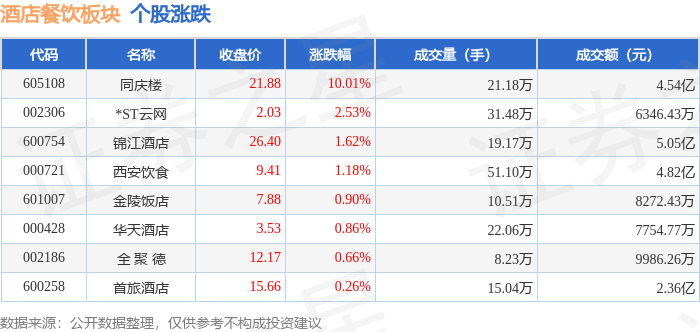
酒店餐饮板块12月2日涨1.65%,同庆楼领涨,主力资金净流入1.27亿元
Zheng Xing Xing Ye Ri Bao· 2025-12-02 09:03
Core Viewpoint - The hotel and catering sector experienced a rise of 1.65% on December 2, with Tongqinglou leading the gains, while the overall market indices, Shanghai Composite and Shenzhen Component, saw declines of 0.42% and 0.68% respectively [1] Group 1: Market Performance - The hotel and catering sector's notable gain was primarily driven by Tongqinglou, which closed at 21.88 with a significant increase of 10.01% [1] - Other notable performers included ST Yunwang with a rise of 2.53%, and Jinjiang Hotel with an increase of 1.62% [1] - The overall trading volume for the hotel and catering sector was substantial, with Tongqinglou achieving a transaction volume of 211,800 shares and a turnover of 454 million yuan [1] Group 2: Capital Flow - The hotel and catering sector saw a net inflow of 127 million yuan from institutional investors, while retail investors experienced a net outflow of 38.81 million yuan [1] - Tongqinglou attracted the most significant institutional net inflow of 109 million yuan, accounting for 23.93% of its total trading [2] - In contrast, Jinjiang Hotel and Kylin Hotel faced net outflows from institutional investors of 983.95 thousand yuan and 441.26 thousand yuan respectively [2]




从下跌到冲涨停,“广德三件套”火到A股
Zhong Guo Zheng Quan Bao· 2025-12-02 06:20
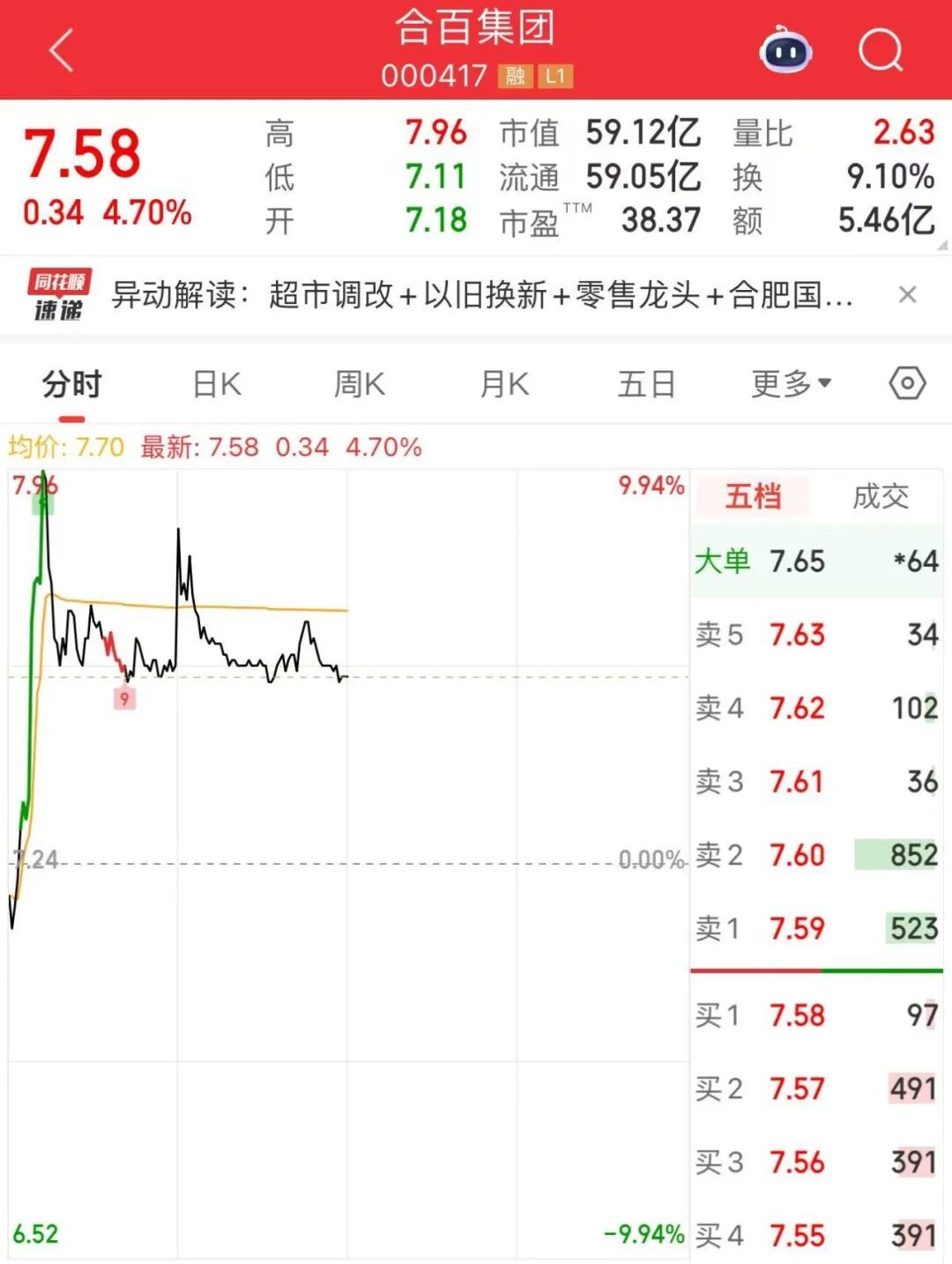
Group 1 - The "Guangde Three-piece Set" has gained significant popularity online, leading to a surge in related concept stocks, with prices rising continuously [5][6] - Stocks such as Tongqinglou, Hebai Group, and Hengxin Life have seen notable increases, with Tongqinglou hitting the daily limit and Hebai Group rising by 4.7% [6] - The "Guangde Three-piece Set" includes Guangde stew pot, Kawangka milk tea, and Zhanji peach crisp, which have attracted long queues and high demand from tourists [5][6] Group 2 - The commercial aerospace sector has shown active performance, with stocks like Zhaobiao Co., Yaguang Technology, and Aerospace Development experiencing significant gains [10] - The establishment of a dedicated Commercial Aerospace Department by the National Space Administration marks a new phase for China's commercial aerospace industry, indicating a push for high-quality development [12] - The National Space Administration has released an action plan for 2025-2027, outlining key measures to support the commercial aerospace sector, including encouraging new technology development and establishing a national commercial aerospace development fund [13]

从下跌到冲涨停!“广德三件套”火到A股
天天基金网· 2025-12-02 05:24
Group 1: Core Insights - The "Guangde Three-piece Set" has gained significant popularity online, leading to a surge in related concept stocks, with notable price increases for companies like Tongqinglou and Hebai Group [2][6][7] - The stock market showed a mixed performance, with the Shanghai Composite Index down by 0.55%, while sectors such as pharmaceuticals, Fujian Free Trade Zone, and tourism hotels experienced gains [4] Group 2: Industry Trends - The "Guangde Three-piece Set," consisting of Guangde stew pot, Kawangka milk tea, and Zhanji peach crisp, has become a viral sensation, resulting in long queues at stores and high demand for products [6][7] - The commercial aerospace sector is experiencing active performance, with stocks like Zhaobiao Co., Yaguang Technology, and Aerospace Development seeing significant gains [8][9] - The establishment of a dedicated Commercial Aerospace Department by the National Space Administration marks a new phase for China's commercial aerospace industry, indicating a push for high-quality development and regulatory support [12] - The National Space Administration has released an action plan for promoting high-quality and safe development in the commercial aerospace sector, outlining 22 key measures to support innovation and investment [12]

餐饮会员流量跟踪系列:从美团与霸王茶姬财报再议外卖大战的得与失
Guoxin Securities· 2025-12-01 15:30
Investment Rating - The report maintains an "Outperform" rating for the industry [5][37]. Core Insights - The report analyzes the recent financial performance of major players in the food delivery sector, including Meituan, JD Group, Alibaba, and Bawang Chaji, highlighting the impact of the ongoing delivery battle on their operations and profitability [1][2][3]. - It emphasizes that the low-frequency, low-ticket order subsidies are the primary reason for the significant losses in the instant retail business, which includes food delivery [2][19]. - The report suggests that the platforms are likely to return to a more rational subsidy strategy, focusing on high-ticket orders to improve unit economics [2][19]. Summary by Sections Meituan - In Q3 2025, Meituan reported revenues of 954.9 billion yuan, a year-on-year increase of 2.0%, but faced an adjusted net loss of 160.1 billion yuan, shifting from profit to loss [1][6]. - The core local business revenue was 674.5 billion yuan, down 2.8%, with an operating loss of 140.7 billion yuan [8][10]. - The food delivery segment is expected to see a 15% increase in order volume, but a 13% decline in revenue due to a decrease in average order value (AOV) and lower monetization rates [8][10]. JD Group and Alibaba - JD Group's Q3 2025 new business losses reached 157 billion yuan, while Alibaba's instant retail business incurred losses of approximately 361 billion yuan, with a per-order loss of about 5.3 yuan [2][17]. - Both companies are experiencing significant pressure on their overall performance due to the losses in their instant retail segments [2][19]. Bawang Chaji - Bawang Chaji reported a revenue of 32.08 billion yuan in Q3 2025, a decrease of 9.4%, with an adjusted net profit of 5.03 billion yuan, down 22.2% [3][21]. - The company has chosen a cautious approach to the delivery battle, avoiding price wars to maintain brand integrity and product strategy [3][32]. - The report notes that Bawang Chaji's same-store GMV declined by 27.9% in the Greater China region, reflecting the competitive pressures in the market [21][32]. Recommendations - The report recommends focusing on leading restaurant brands that are likely to benefit from increased subsidy efforts and are in a strong operational season, such as Guoquan, Haidilao, Yum China, and Xiaocaiyuan [3][37]. - It also highlights the potential of tea brands like Guming and Mixue Group, which are actively expanding their product offerings and private traffic strategies [3][37].
酒店餐饮板块12月1日涨1.83%,同庆楼领涨,主力资金净流出2381.9万元
Zheng Xing Xing Ye Ri Bao· 2025-12-01 09:09
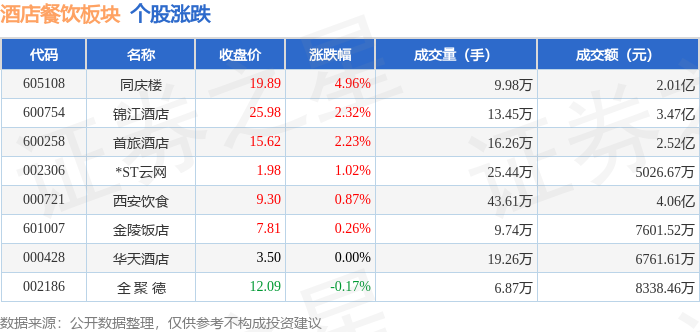
Group 1 - The hotel and catering sector increased by 1.83% on December 1, with Tongqinglou leading the gains [1] - The Shanghai Composite Index closed at 3914.01, up 0.65%, while the Shenzhen Component Index closed at 13146.72, up 1.25% [1] - Key stocks in the hotel and catering sector showed varied performance, with Tongqinglou closing at 19.89, up 4.96%, and Quanjude closing at 12.09, down 0.17% [1] Group 2 - The net outflow of main funds in the hotel and catering sector was 23.81 million yuan, while retail investors saw a net inflow of 30.52 million yuan [1] - Detailed fund flow data indicates that Tongqinglou had a main fund net inflow of 25.35 million yuan, while Xianyin Food experienced a net outflow of 29.80 million yuan [2] - The overall fund flow analysis shows that retail investors contributed positively to several stocks, despite the main and speculative funds showing net outflows [2]


美国股票策略观察_2026 展望-标普 500 目标位 7500 点-US Equity Strategy Watch_ Outlook for 2026 – S&P 500 target at 7,500
2025-12-01 00:49
Summary of the Conference Call Transcript Industry/Company Involved - **Industry**: US Equity Market - **Company**: HSBC Global Investment Research Core Points and Arguments 1. **S&P 500 Target for 2026**: HSBC introduces an end-2026 target for the S&P 500 at 7,500, indicating expectations for another year of double-digit gains, similar to the late 1990s equity boom [2][5][42] 2. **AI Investment Boom**: The AI-led capital expenditure (capex) boom is expected to support the economy, with technology leading the charge. This trend is anticipated to continue into 2026, with significant spending from hyperscalers [2][14][33] 3. **Consumer Behavior**: A bifurcated consumer market is expected in 2026, with high-income consumers benefiting while low-income consumers face challenges due to inflation and policy changes. This divergence is reflected in recent earnings reports from companies like Wynn Resorts and McDonald's [3][20][25] 4. **Earnings Growth Forecast**: HSBC forecasts a 12% earnings growth for the S&P 500 in 2026, supported by macro stability and the AI investment boom. This is slightly below the consensus estimate of 13% [5][11][33] 5. **Two-Speed Economy**: The economy is expected to operate at two speeds, with strong performance in AI-related sectors contrasted by weakness in manufacturing and residential construction [4][14][20] 6. **Trade and Immigration Policies**: Trade policy headwinds are expected to moderate, while immigration challenges will persist, impacting consumer demand and labor supply. The effective tariff rate is projected to remain elevated at 16.8% [3][25][30] 7. **Market Concentration**: The market rally has been concentrated, with less than one-third of companies outperforming the index, and the top tech companies accounting for 90% of returns since "Liberation Day" [7][9][11] 8. **Valuation Metrics**: The forward price-to-earnings (PE) ratio for the S&P 500 is currently at 21.7x, above 10-year highs, but justified by better profitability metrics [11][46] Other Important but Overlooked Content 1. **Risks to the AI Boom**: Potential risks include signs of an AI bubble deflation, slower revenue growth from hyperscalers, and delays in capital deployment [15][21] 2. **Consumer Confidence Trends**: Consumer confidence is rising among high earners while declining for lower-income groups, indicating a widening gap in economic sentiment [20][24] 3. **Impact of Policy Changes**: The absence of Fed rate cuts and persistent inflation are expected to create headwinds for consumer spending, particularly affecting lower-income households [20][30] 4. **Sector-Specific Earnings Growth**: Significant earnings growth is anticipated in sectors like materials, industrials, and energy, while sectors hit by tariffs, such as autos, are expected to see a profit swing in 2026 [33][40] This summary encapsulates the key insights and projections from the conference call, highlighting the anticipated trends in the US equity market and the factors influencing them.
“禁酒令”之下,县城五星级酒店的荒诞自救
虎嗅APP· 2025-11-28 13:42
Core Viewpoint - The article discusses the absurd self-rescue efforts of a five-star hotel in a small county facing challenges due to a "ban on alcohol" policy, which significantly impacts its business model reliant on government and corporate dining [5][8][16]. Group 1: Hotel Operations and Challenges - The hotel, known as "Qianxin Hotel," is a landmark establishment in a small county, heavily linked to the local coal industry and government functions [5][6]. - The hotel experienced initial success after its opening, boosted by the popularity of a nearby video game, but has since struggled with unstable revenue [6][7]. - A recent "ban on alcohol" policy threatens the hotel's core business, which primarily serves government and corporate clients for dining and events [8][17]. Group 2: Impact of the "Ban on Alcohol" - The "ban on alcohol" has created a climate of fear among potential customers, particularly public servants, who are now hesitant to dine out due to the risk of being reported [9][18]. - The hotel’s management is concerned that the ban will lead to a significant drop in business, as their main clientele consists of local officials and business owners [17][18]. - The article highlights the broader implications of the ban, noting that it has led to a cultural shift in dining habits, with many opting for low-key gatherings or avoiding restaurants altogether [19][20]. Group 3: Adaptation Strategies - In response to declining business, the hotel is exploring new strategies, such as offering lower-priced local dishes and outdoor dining options to attract customers [29][30]. - The management is considering innovative marketing approaches, including collaborations with local influencers to improve visibility and attract a broader clientele [34][35]. - Despite these efforts, the hotel faces challenges in changing perceptions, as many locals still view it as too upscale and expensive for casual dining [31][32].
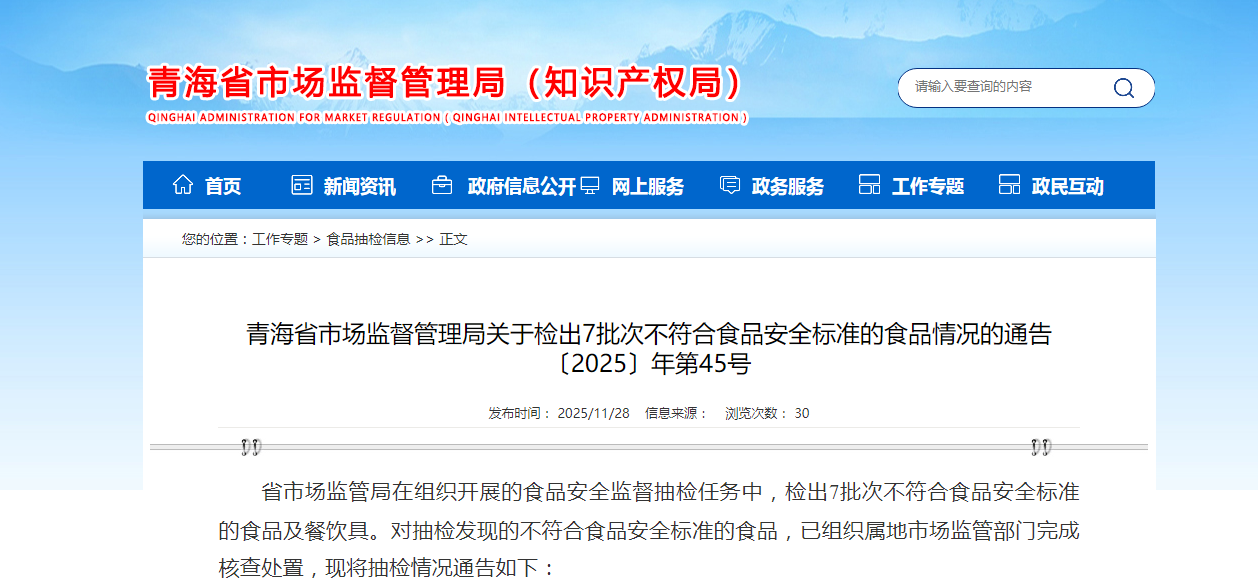
青海省市场监督管理局关于检出7批次不符合食品安全标准的食品情况的通告〔2025〕年第45号
Zhong Guo Zhi Liang Xin Wen Wang· 2025-11-28 09:13
Summary of Key Points Core Viewpoint - The Qinghai Provincial Market Supervision Administration has reported the detection of seven batches of food and catering utensils that do not meet food safety standards, prompting local regulatory actions for verification and disposal [2][3]. Group 1: Non-compliance Cases - The first case involves oilseed rape (ordinary cabbage) sold by Xinghewan Hualian Comprehensive Trading Co., which had a pesticide residue (chlorpyrifos) exceeding the national food safety standard, with a detected value of 0.14 mg/kg against a limit of 0.02 mg/kg [2]. - The second case pertains to Shanghai Qing (ordinary cabbage) sold by Xining Wangfujing Department Store, which also showed chlorpyrifos levels at 0.050 mg/kg, exceeding the permissible limit [4]. - The third case involves bananas sold by Qinghai Yinhao Hotel Management Co., where both thiamethoxam and thiamethoxam residues were found at 0.027 mg/kg, surpassing the standard [3]. - The fourth case is red sweet potatoes (yam) sold by Dazhong Lingxian Fruit and Vegetable Convenience Store, with residues of chlorfluazuron and high-efficiency chlorfluazuron at 0.12 mg/kg, exceeding the limit of 0.01 mg/kg [4]. - The fifth case involves round yellow peppers sold by Tongren Green Long Fruit and Vegetable Business, which had thiamethoxam levels at 0.24 mg/kg, exceeding the limit of 0.05 mg/kg [3]. - The sixth case concerns soup spoons used by Duoba Skewers Hotpot Restaurant, which contained anionic synthetic detergent (sodium dodecylbenzenesulfonate) at 0.014 mg/100cm², exceeding the allowable limit [4]. - The seventh case involves dry mixing plates used by Qingsheng Palace Beef Noodle Restaurant, which also showed anionic synthetic detergent levels at 0.074 mg/100cm², exceeding the permissible limit [3]. Group 2: Consumer Advisory - Consumers are advised to report any purchases or sightings of the listed non-compliant food items to the complaint hotline 12315 [3].