金融服务

Search documents
Upcoming U.S. jobs report, delayed by government shutdown, will likely show sluggish hiring
Fastcompany· 2025-12-16 18:51
The U.S. job market is sluggish and confusing this fall. The Labor Department is expected to provide at least a little clarity when it releases November numbers on hiring and unemployment Tuesday, 11 days late. "We're in Lehigh Valley, which is a big transportation hub in eastern Pennsylvania. We've seen some cooling in the logistics and transportation markets, specifically because we've seen automation in those sectors, robotics.†Forecasters surveyed by the data firm FactSet expect that employers added a ...


全球资本“用脚投票”:攻破7.05,人民币拿下“关键一战”
Sou Hu Cai Jing· 2025-12-16 16:38
Core Viewpoint - The recent surge in both onshore and offshore RMB exchange rates, breaking through the 7.05 mark against the USD, reflects a significant vote of confidence from global capital regarding China's economic outlook [1][3]. Exchange Rate Breakthrough - On December 15, the RMB continued its upward trend against the USD, with the onshore rate peaking at 7.0497 and the offshore rate reaching 7.0460, marking a notable recovery from earlier lows [1][3]. - The RMB's midpoint rate was reported at 7.0656, a decrease of 18 basis points from the previous trading day, while intra-day gains for the onshore and offshore RMB were nearly 200 and over 150 basis points, respectively [3]. Capital Flow Shift - The improvement in China's economic fundamentals and policy environment has led international investors to reassess the value of RMB-denominated assets, contributing to the recent appreciation of the currency [4]. - Goldman Sachs forecasts approximately $200 billion in capital inflows into the Chinese stock market over the next 12 months, indicating renewed global confidence in China's economic resilience [5]. Weakening Dollar - The depreciation of the USD has created favorable conditions for non-USD currencies, including the RMB, to appreciate [6]. - Since the beginning of 2025, the USD index has fallen by over 8%, with concerns over U.S. fiscal policy and debt further diminishing the dollar's attractiveness [6]. Policy Support - The stability and gradual appreciation of the RMB are supported by prudent and effective management from Chinese monetary authorities, aiming to maintain the currency at a reasonable and balanced level [7]. - The People's Bank of China has issued offshore RMB central bank bills to guide offshore market interest rates and stabilize market expectations [7]. Economic Resilience - The RMB's strong performance is underpinned by solid economic fundamentals, with China's GDP growth in Q1 2025 reaching 5.4%, surpassing both the previous year's growth and market expectations [9]. - Active fiscal policies and moderately accommodative monetary policies have provided robust support for economic stability, with key indicators such as fixed asset investment and retail sales showing positive growth [9]. Future Outlook - Market analysts maintain a cautiously optimistic view on the RMB's future trajectory, with predictions of a stronger exchange rate in the short term [10]. - The RMB is gradually shifting from being an optional asset to a necessary one in global reserve asset allocation, with its share in global foreign exchange reserves rising to around 3% [10].

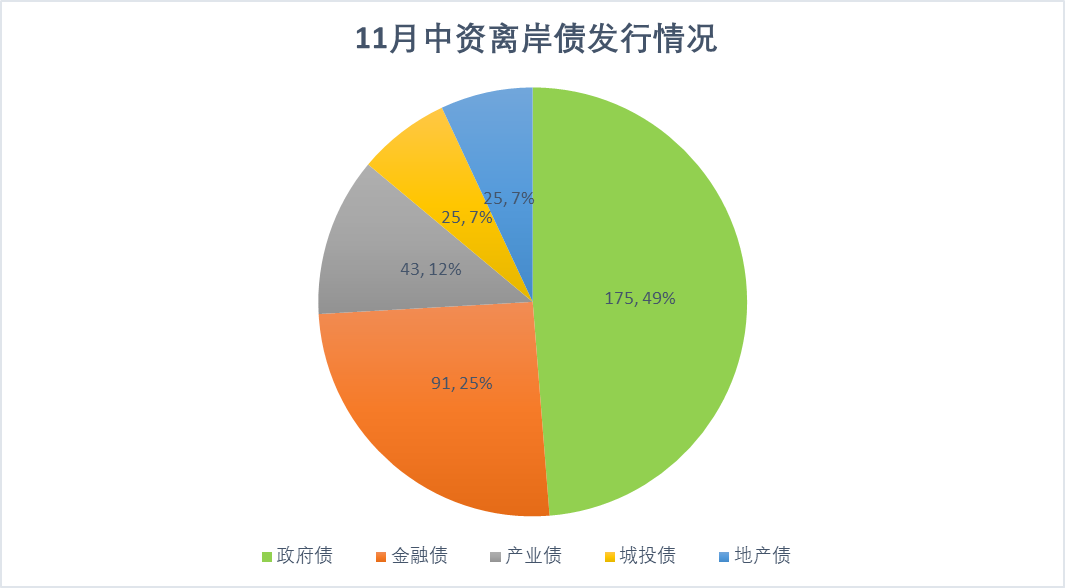
离岸观澜 | 11月中资离岸债发行规模创年内新高 年末兑付压力平稳可控
Xin Hua Cai Jing· 2025-12-16 16:16
Core Viewpoint - In November 2025, the issuance of offshore bonds by Chinese entities reached a record high for the year, totaling approximately $35.9 billion, driven by a surge in sovereign and government bond issuance alongside a recovery in corporate financing demand, reflecting global investors' strong recognition of Chinese assets [1][2]. Group 1: Issuance Statistics - A total of 119 offshore bonds were issued in November, marking the highest monthly issuance in the past 12 months [2]. - The Ministry of Finance issued $4 billion in sovereign bonds in Hong Kong and €4 billion in Luxembourg, with total subscription amounts reaching $118.2 billion and €100.1 billion, indicating a subscription multiple of 30 times and 25 times, respectively [2]. - The issuance by 47 Chinese enterprises amounted to $18.3 billion, with an average bond size of $250 million, showing multi-dimensional growth [3]. Group 2: Bond Types and Currencies - Government bonds accounted for approximately $17.5 billion (49%), financial bonds for about $9.1 billion (25%), industrial bonds for $4.3 billion (12%), city investment bonds for $2.5 billion (7%), and real estate bonds for $2.5 billion (7%) [3]. - The 119 offshore bonds included 47 RMB bonds, 50 USD bonds, 8 HKD bonds, 8 EUR bonds, and 6 bonds in other currencies [4]. Group 3: Secondary Market Performance - The secondary market for Chinese offshore bonds experienced narrow fluctuations, with investment-grade bonds outperforming high-yield bonds [5]. - As of the end of November, the Markit iBoxx Asian Chinese USD bond index was at 251.23, with a monthly increase of 0.07%, while the high-yield index decreased by 2.18% [5][8]. Group 4: Future Outlook and Debt Repayment Pressure - The overall repayment pressure for Chinese offshore bonds remains manageable, with $11.28 billion due in December 2025 and $15.81 billion in January 2026, which is expected to be the highest repayment pressure in the next six months [9][12]. - Analysts predict that investment-grade bonds will perform better in the future, driven by improving financing conditions and ongoing support for cross-border financing [12].
A股公司今年以来斥资逾9440亿元购买理财产品
Zheng Quan Ri Bao· 2025-12-16 16:09
Core Viewpoint - The phenomenon of listed companies using idle funds to purchase financial products has sparked market discussions, emphasizing the need for careful planning based on the company's development stage and actual funding needs [1] Group 1: Financial Product Purchases - A total of 1,147 A-share listed companies purchased 15,000 financial products this year, with a total subscription amount of 944.099 billion yuan, a year-on-year decrease of 18.76% [1] - Among the various financial products, structured deposits were the most favored, with a subscription amount of 563.834 billion yuan, accounting for 59.72% of the total [1] - Bank financial products followed with a total subscription of 108.124 billion yuan, while deposit products and brokerage financial products had subscription amounts of 76.969 billion yuan and 65.807 billion yuan, respectively [1] Group 2: Factors Influencing Purchase Trends - The overall amount of financial products purchased by listed companies has decreased due to three main factors: lower market interest rates reducing the attractiveness of financial product yields, a policy shift encouraging companies to enhance returns to investors through cash dividends and share buybacks, and a favorable capital market encouraging companies to invest in primary and secondary markets [2] - Despite the decline in enthusiasm for purchasing financial products, the subscription amount for brokerage financial products remained stable, with their proportion of total subscriptions rising from 5.76% last year to 6.97% this year [2] Group 3: Company-Specific Purchases - Seven listed companies have subscribed to financial products exceeding 10 billion yuan this year, with the highest being Jiuzhoutong at 29.164 billion yuan, followed by Hisense Home Appliances at 22.933 billion yuan, and ZTE Corporation and Dongpeng Beverage at 18.512 billion yuan and 14.094 billion yuan, respectively [3] - The funding sources for purchasing financial products mainly include self-owned funds and self-raised funds, with 335.301 billion yuan from self-owned funds (35.52%) and 608.798 billion yuan from self-raised funds (64.48%) [3] Group 4: Investment Principles - Companies should prudently determine the scale and duration of their investments in financial products, adhering to the principle of safety and prioritizing the protection of principal and shareholder interests [4]
S&P global U.S. services PMI comes in at 52.9 vs. 54.0 estimated
Youtube· 2025-12-16 15:15
Let's get to Rick Santelli. Hey Rick. >> Hi Carl.Indeed. These are December preliminary S&P global PMIs. On the manufacturing front coming in light at 51.8%.Also sequentially lower than last month's final 52.2%. That would be the lowest read since this summer July. If we look at the services 52.9%.We're expecting 54 in the rearview mirror. 54.1%. 52.9% equals where we were in June.To find a lower number, you're going back to April of this year. And finally, on the composite, 53.9% expected. 53 is what arriv ...

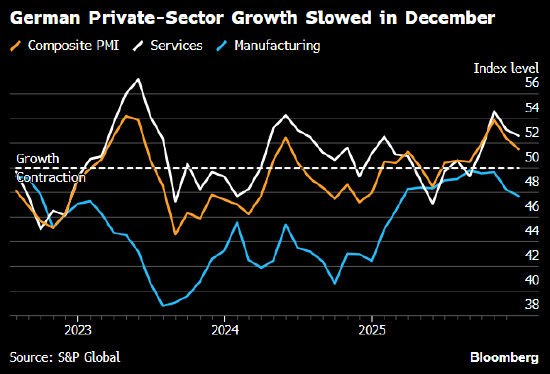
制造业疲软影响 德国企业活动低于预期
Xin Lang Cai Jing· 2025-12-16 14:44
Core Insights - The growth of private sector activity in Germany in December fell short of expectations, with the manufacturing sector recording its worst performance in ten months [1][3] - The S&P Global Composite Purchasing Managers' Index (PMI) decreased from 52.4 in the previous month to 51.5, remaining above the neutral 50 mark due to the service sector's expansion for the fourth consecutive month [1][3] Economic Outlook - Cyrus de la Rubia, an economist at Hamburg Commercial Bank, stated that the service sector is stabilizing the overall economy and is expected to contribute significantly to positive GDP growth in the fourth quarter [3][5] - The German economy, driven by infrastructure and defense spending under Chancellor Friedrich Merz, is projected to recover next year while currently striving for modest growth [3][5] - The German central bank and other forecasting institutions anticipate growth in output for the fourth quarter, aided by the European Central Bank's earlier interest rate cuts [3][5] Manufacturing Sector Analysis - The Purchasing Managers' Index contrasts with recent manufacturing data, which had painted a more optimistic industry outlook [3][5] - In October, factory orders surged, particularly due to a rise in transportation orders covering aircraft, ships, trains, and military vehicles, with industrial production data also exceeding expectations [3][5]
中央财办发声,信号很大
21世纪经济报道· 2025-12-16 13:49
Core Viewpoint - The article discusses the outcomes and expectations of China's economic performance as it approaches the end of the 14th Five-Year Plan and the beginning of the 15th, highlighting the resilience and vitality of the economy despite challenges [1][2]. Economic Performance and Outlook - The overall economic operation is stable, with a projected growth rate of around 5% for the year, leading to an economic total of approximately 140 trillion yuan [1]. - The construction of a modern industrial system is progressing, with advancements in technology and innovation, particularly in artificial intelligence, biomedicine, and robotics [1]. - Reforms and opening-up measures are advancing, with a focus on building a unified national market and addressing "involution" competition [2]. - There are positive developments in risk mitigation in key areas, including the orderly replacement of local government hidden debts and the completion of housing delivery tasks [2]. Challenges and Policy Directions - The article identifies ongoing challenges such as external environmental changes, weak domestic demand, and risks in key sectors [2]. - The economic foundation remains strong, with long-term supportive conditions for growth, including the advantages of the socialist system and a large market [3]. - The government plans to implement more proactive macroeconomic policies, maintaining necessary fiscal deficits and debt levels while enhancing the precision and effectiveness of fiscal spending [3][4]. Domestic Demand and Investment - Expanding domestic demand is a top priority, with domestic demand contributing 71% to economic growth in the first three quarters [5]. - The government aims to stimulate consumption by addressing structural changes and enhancing the supply of quality goods and services [5][6]. - Investment is expected to stabilize, with a focus on infrastructure and social welfare projects, while also encouraging private investment in high-tech and service sectors [6]. Technological Innovation and Market Development - The construction of international technology innovation centers in Beijing, Shanghai, and the Guangdong-Hong Kong-Macau Greater Bay Area is emphasized as a strategic move to enhance global competitiveness [7][8]. - The article discusses the need for a unified national market to improve resource allocation and market efficiency, addressing barriers to competition and market entry [9][10]. Trade and Foreign Investment - The government plans to expand high-level opening-up measures, including increasing service sector access and signing more trade agreements [11][12][13]. - Efforts will be made to optimize the business environment for foreign investment, including easing market access and enhancing support for foreign enterprises [13]. Regional Development and Coordination - The article outlines strategies for promoting regional coordinated development, focusing on the collaborative growth of different regions and supporting major economic provinces [14][15][16]. - Emphasis is placed on urban-rural integration and the development of new productive forces tailored to local conditions [15]. Green Transition and Employment - The government is committed to a green transition, with plans to achieve carbon peak and neutrality goals while enhancing the resilience of the energy system [16][17][18]. - Employment policies will focus on stabilizing job growth, particularly for key groups such as graduates and migrant workers, while promoting flexible employment and skills training [19][20]. Real Estate Market Stability - The article discusses the need for a stable real estate market, highlighting the potential for high-quality development despite current challenges [21][22]. - Measures will be taken to support the transformation of real estate companies and to encourage a new development model in the sector [22][23].

中国金融投资管理(00605):乾隆领达授出本金金额为2088万港元的贷款
智通财经网· 2025-12-16 13:08
Group 1 - The core point of the article is that China Financial Investment Management (00605) announced a loan agreement involving a principal amount of 20.88 million Hong Kong dollars, set to be provided by Qianlong Lingda to borrowers EX and FL, with a term of two years [1] Group 2 - The loan agreement is scheduled to be executed on December 16, 2025, indicating a future financial commitment [1] - The agreement highlights the company's ongoing activities in financial management and lending operations within the market [1] - The principal amount of the loan reflects the company's capacity to engage in significant financial transactions [1]
在美国,净资产达到这一水平才能算有钱人
财富FORTUNE· 2025-12-16 13:05
Core Insights - The perception of wealth among Americans has shifted, with an average of $2.3 million now considered necessary to be deemed wealthy, reflecting a significant increase from previous years [1][4] - The financial landscape has changed, with many millionaires including their homes in asset calculations, leading to a lower amount of investable assets [2][4] - Different generations have varying definitions of wealth, with younger generations setting lower thresholds compared to older generations [5][6] Group 1 - A survey by Charles Schwab indicates that the average amount Americans believe is needed to be considered wealthy is $2.3 million, down from $2.5 million last year but up 21% from $1.9 million in 2021 [1] - 63% of respondents feel that more money is required to be considered wealthy compared to the previous year, citing inflation and economic conditions as contributing factors [1] - The founder of Solomon Financial notes that many millionaires include their homes in their asset calculations, which often results in lower investable assets [2] Group 2 - The survey reveals generational differences in wealth perception, with Gen Z defining wealth at $1.7 million and financial comfort at $329,000, while Baby Boomers set the threshold at $2.8 million [5][6] - Experts suggest that older generations view wealth through the lens of security, focusing on real estate and retirement assets, while younger generations prioritize lifestyle and experiences [5][6] - The pessimism among younger generations regarding home ownership is noted as a significant factor affecting their wealth perception, as home ownership has historically been a primary means of wealth accumulation in the U.S. [6]

SCHD: Dividend Yield Disadvantage
Seeking Alpha· 2025-12-16 13:00
Group 1 - The Schwab U.S. Dividend Equity ETF™ (SCHD) has slightly outperformed the broader market since a previous bearish call in late September 2025, attributed to a solid 13% rally [1] - The article highlights the author's extensive experience in finance, particularly in the oilfield and real estate industries, with over a decade of experience in complex due diligence and M&A transactions [1] - The author has developed a keen interest in equity research and analysis, providing services for a Dubai-based family office with over $20 million in assets under management [1] Group 2 - The author emphasizes the ability to analyze financial statements, evaluate market trends, and identify key growth drivers across different industries [1] - There is a commitment to staying updated on the latest developments and trends in the equity research industry, alongside a focus on professional development [1]