
可控核聚变

Search documents
每日投行/机构观点梳理(2025-12-26)
Jin Shi Shu Ju· 2025-12-26 12:32
Group 1 - UBS Wealth Management predicts that the Chinese stock market will continue to have upward potential through 2026, driven by advanced manufacturing and technology as new growth engines [1] - The technology sector, which accounts for about half of the MSCI China Index, is becoming increasingly resilient to external shocks and U.S. economic cycles [1] - The Hang Seng Tech Index is expected to see a 37% growth in earnings per share by 2026, with approximately 7 trillion RMB in excess household savings likely to flow into the stock market [1] Group 2 - Barclays anticipates that the Bank of Japan will raise interest rates in July and December of 2026, influenced by the spring wage negotiation cycle [2] - The report emphasizes the importance of wage negotiations as a key factor in the Bank of Japan's monetary policy and its response to the risk of yen depreciation [2] Group 3 - OANDA reports that multiple factors are driving a historic surge in precious metals, with gold potentially reaching $5,000 per ounce and silver $90 per ounce in the coming year [3] - The report attributes the rise to speculative trading, low liquidity at year-end, expectations of long-term Fed rate cuts, a weaker dollar, and increased geopolitical risks [3] - Platinum and palladium prices have surged due to supply constraints and strong industrial demand, with platinum up approximately 165% and palladium over 90% year-to-date [3] Group 4 - CICC suggests focusing on asset trend changes rather than specific gold price predictions, as current gold prices are above short-term valuation models, indicating potential bubbles [4] - The report anticipates that the gold bull market may not end soon, but volatility is expected to increase as prices deviate from fundamental indicators [4] - CICC maintains an optimistic outlook on Chinese assets, emphasizing the benefits of the AI technology wave and ample liquidity, while suggesting a focus on technology growth in the short term [5][6] Group 5 - CITIC Securities highlights the importance of maintaining macro liquidity stability through tools like reserve requirement ratio cuts and interest rate reductions [6] - The report predicts a 5%-10% increase in the overall A-share market in 2026, with Hong Kong stocks expected to experience a rebound in performance [6] - The outlook for commodities includes expectations for gold to challenge $5,000 per ounce and copper prices to rise to $12,000 per ton due to supply constraints and demand drivers [6] Group 6 - CITIC Securities notes a trend of diminishing focus on quantitative targets by the People's Bank of China, with an emphasis on long-term structural reforms [7] - The report indicates that the central bank's policy may shift towards addressing supply-side issues and reducing financing costs [7] Group 7 - Huatai Securities states that the current appreciation of the RMB is likely to enhance foreign interest in RMB-denominated assets, creating a positive feedback loop for capital inflows [8] - The report suggests that the strengthening of the RMB will continue to support the valuation of both onshore and offshore RMB assets [8] Group 8 - CITIC Jin Investment reports that rising storage costs have begun to impact consumer electronics prices, with several manufacturers increasing product prices by 100-200 RMB [9] - The report indicates that the cost pressures from rising storage prices are likely to lead to a temporary decline in consumer electronics sales [9] Group 9 - Galaxy Securities notes that leading liquor companies are adjusting their strategies for 2026, focusing on maintaining price stability and channel profitability amid cyclical pressures [10] - The report emphasizes the importance of developing new consumer segments and adapting to new consumption trends as part of long-term transformation efforts [10]
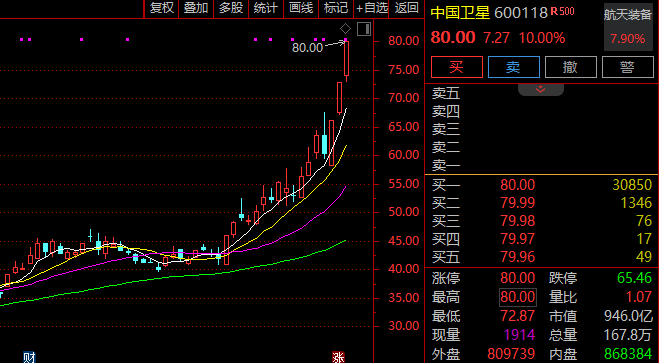
人气股600118,3连涨停 市值逼近千亿
Zheng Quan Shi Bao· 2025-12-26 08:44
Group 1: Market Overview - The A-share market saw a mixed performance on December 26, with the Shanghai Composite Index rising by 0.1%, the Shenzhen Component increasing by 0.54%, and the ChiNext Index up by 0.14% [1] - Sectors such as Hainan Free Trade Zone, duty-free, and tourism led the gains, while sectors like paper-making, photolithography machines, and liquid-cooled servers experienced declines [1] Group 2: Commercial Aerospace Sector - The commercial aerospace concept stocks remained active, with China Satellite (600118) hitting a three-day limit-up, bringing its total market value close to 100 billion and trading volume nearing 13 billion [2] - Shenjian Co. achieved a seven-day limit-up, focusing on 3D printing technology primarily for aerospace components, while not yet venturing into rocket engine applications [4] - Institutions noted that by 2025, the commercial aerospace industry is expected to accelerate, with over 100 satellites in orbit and private rocket companies entering the national satellite launch market [4] Group 3: Controlled Nuclear Fusion Sector - The controlled nuclear fusion sector rebounded in the afternoon, with stocks like Pangaea Micro-Transparent rising nearly 11% and Yongding Co. hitting the limit-up [5] - Investment logic in the controlled nuclear fusion industry is shifting from a distant "ultimate energy" narrative to a trend driven by engineering implementation, fueled by demand surges and technological breakthroughs [7] Group 4: Photovoltaic Sector - The photovoltaic sector showed strength, with stocks like GCL-Poly Energy and Junda Co. hitting the limit-up [7] - The State Administration for Market Regulation emphasized the importance of addressing "involution" competition in the photovoltaic industry, which has led to profitability challenges and hindered innovation and product upgrades [7]


科技自强、出海深化
SINOLINK SECURITIES· 2025-12-26 05:44
Investment Rating - The report suggests a positive outlook for the high-end equipment manufacturing industry in China, emphasizing a "dual-driven" growth model characterized by strong domestic demand and robust international expansion [3][5]. Core Insights - The high-end equipment industry in China is experiencing a structural transformation, with a focus on technological advancements and brand development, leading to increased global market share [3]. - The report highlights two main investment themes: the technological self-reliance driven by AI and the deepening international expansion of Chinese equipment manufacturers [4][5]. - Key sectors to watch include gas turbines, industrial mother machines, controlled nuclear fusion, quantum computing, robotics, and 3D printing, which are expected to drive future growth [4][41]. Summary by Sections Domestic Manufacturing and Investment - Manufacturing investment in China is under short-term pressure, but high-end manufacturing and equipment sectors are emerging as growth engines, with a 1.9% year-on-year increase in manufacturing fixed asset investment [15][19]. - The report notes that high-tech manufacturing and equipment manufacturing sectors maintain high levels of activity despite overall investment slowdowns [15][22]. Export Performance - China's high-end equipment exports are performing well, driven by the global AI investment boom and recovery in demand from developed markets [28][31]. - In the first ten months of 2025, China's exports of electromechanical products reached 13.43 trillion yuan, marking an 8.7% year-on-year increase [28][31]. Technological Self-Reliance - The report emphasizes the importance of technological self-reliance, particularly in sectors like gas turbines and quantum computing, which are expected to see significant growth due to increasing global demand [4][48]. - The global gas turbine market is projected to grow significantly, with sales expected to rise from 44.1 GW in 2023 to an average of 60 GW from 2024 to 2026, reflecting a 36% increase [49][50]. International Expansion - Chinese equipment manufacturers are poised for further international growth, particularly in emerging markets, with sectors like engineering machinery and agricultural equipment expected to see substantial export growth [5][41]. - The report highlights the potential for Chinese companies in the oil and gas equipment sector, particularly in the Middle East, where demand is expected to rise significantly [5][13].


2026年权益市场展望:结构性机遇凸显,多主线值得关注
Zheng Quan Shi Bao Wang· 2025-12-26 04:42
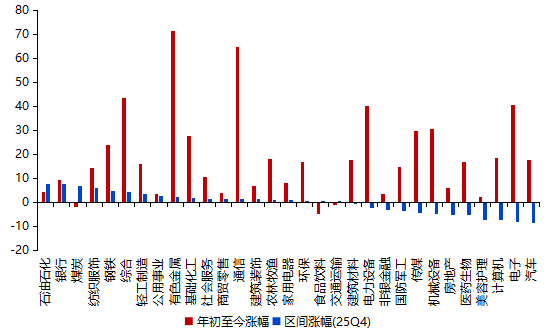
Core Viewpoint - The market is increasingly focused on investment opportunities for 2026 as the A-share market approaches the end of 2025, with sectors like metals, TMT, and power equipment performing well, while dividend stocks and real estate are under pressure [1] Group 1: Global Economic Environment - The global macroeconomic landscape is expected to show positive changes in 2026, with the U.S. likely to adopt more accommodative fiscal and monetary policies, potentially increasing the federal deficit by approximately $3.4 trillion over the next decade [4] - The anticipated fiscal expansion in the U.S. may require a low-interest-rate environment, which could improve global liquidity and stabilize the external environment for the A-share market [4] Group 2: Domestic Economic Policies - The Central Economic Work Conference at the end of 2025 has set a policy direction of "seeking progress while maintaining stability," indicating a focus on quality and efficiency improvements [5] - Industrial enterprises are at the bottom of the inventory cycle, with a narrowing decline in PPI suggesting an approaching recovery phase for corporate profits, as evidenced by a 3.2% year-on-year growth in net profit for all A-shares in Q3 2025 [5] Group 3: Investment Opportunities for 2026 - The A-share market is expected to remain structurally driven, with five key areas for investors to focus on: 1. AI Super Cycle: Continued growth in domestic and international computing power chains, with a focus on new technology iterations and the gaming industry [9] 2. High-end Manufacturing Overseas: Attention on sectors like energy storage and lithium batteries, as well as heavy-duty vehicles and engineering machinery that offer growth potential [11] 3. Strategic Resource Revaluation: Long-term focus on precious and industrial metals, with particular attention to energy and lithium carbonate showing signs of stabilization [11] 4. Frontier Technology Breakthroughs: Ongoing interest in industries such as robotics, solid-state batteries, and quantum computing [11] 5. New Consumption and Innovative Pharmaceuticals: Focus on sectors with solid fundamentals in consumer and technology spending, as well as innovative medical devices [11] Group 4: Market Liquidity - The degree of asset allocation migration towards equity markets is still in its early stages, with significant room for growth as indicators remain at historical lows [10] - Institutional investors, including insurance funds and bank wealth management products, are expected to become important sources of marginal capital in 2026, further enhancing market liquidity [10]
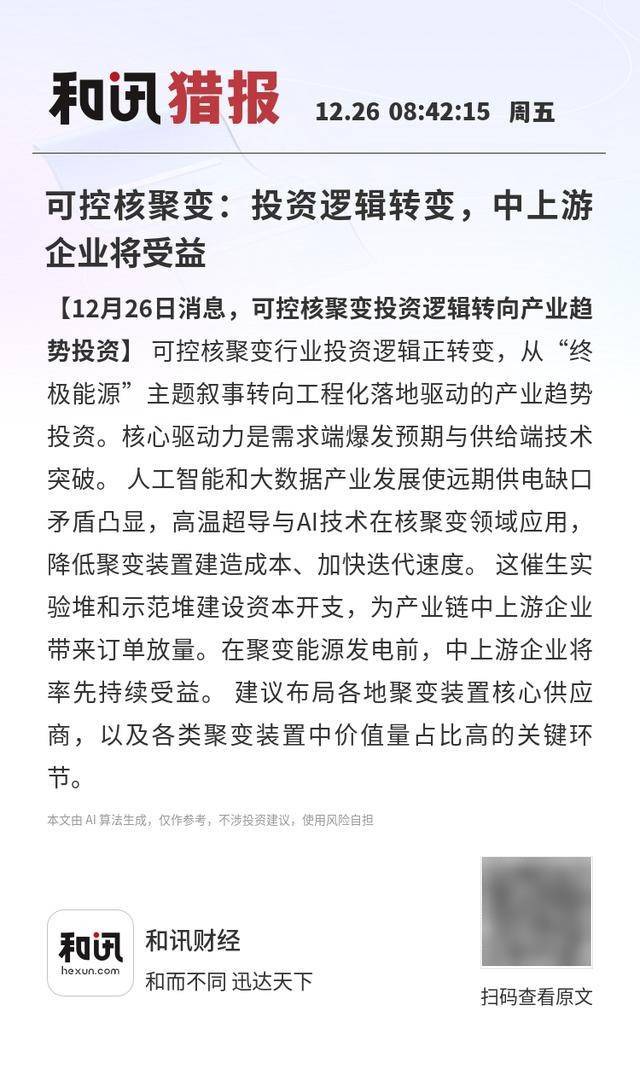
可控核聚变:投资逻辑转变,中上游企业将受益
Sou Hu Cai Jing· 2025-12-26 01:30
Core Insights - The investment logic in the controlled nuclear fusion industry is shifting from a "ultimate energy" narrative to an industry trend investment driven by engineering implementation [1] - The main driving forces are the expected explosion in demand and technological breakthroughs on the supply side [1] Group 1: Demand and Supply Dynamics - The development of artificial intelligence and big data has highlighted the long-term power supply gap [1] - The application of high-temperature superconductors and AI technology in nuclear fusion is expected to reduce construction costs of fusion devices and accelerate iteration speed [1] Group 2: Capital Expenditure and Market Opportunities - This shift is generating capital expenditures for the construction of experimental and demonstration reactors, leading to increased orders for upstream companies in the industry chain [1] - Upstream companies are expected to benefit continuously before fusion energy generation, suggesting a strategic investment opportunity in core suppliers of fusion devices and key segments with high value proportions [1]
中信建投:可控核聚变行业投资逻辑正从主题叙事转变为产业趋势投资
Zheng Quan Shi Bao Wang· 2025-12-26 00:29
Core Insights - The investment logic in the controlled nuclear fusion industry is shifting from a distant "ultimate energy" narrative to a trend driven by engineering implementation [1] - The core driving force comes from explosive demand expectations and technological breakthroughs on the supply side [1] Demand and Supply Dynamics - The rapid development of artificial intelligence and big data industries is increasingly highlighting the long-term power supply gap [1] - High-temperature superconductors and AI technology significantly reduce the construction costs of fusion devices and accelerate the iteration speed of these devices [1] Capital Expenditure and Market Opportunities - The combined effect of these advancements is leading to substantial capital expenditures for the construction of experimental and demonstration reactors [1] - Upstream material and midstream equipment companies are expected to benefit from a surge in confirmed orders [1] Strategic Recommendations - Companies providing core materials, key equipment, and systems for experimental and demonstration reactors will be the first to benefit and continue to gain from the significant growth dividends as the industry evolves from 0 to 1 [1] - It is recommended to invest in core suppliers of fusion devices across various regions and focus on key segments with a high value proportion in fusion devices [1]

年末分化行情,该往哪看?
Sou Hu Cai Jing· 2025-12-25 16:15
Group 1 - The market is experiencing a divergence where certain sectors like commercial aerospace, controllable nuclear fusion, and autonomous driving are seeing significant gains, while traditional sectors like liquor and consumer goods are declining [3][15] - The shift in market dynamics is attributed to fund reallocation by institutions, moving away from previously high-performing sectors like AI computing towards areas with strong policy support and low valuations [3][15] - Private equity firms are focusing on stocks that can genuinely benefit from industry trends, emphasizing the importance of commercial viability and cautioning against purely speculative investments [3][15] Group 2 - The misconception that all stocks rise in a bull market leads to poor investment decisions, as many sectors can still decline despite overall index gains [4][7] - Institutional behavior is a more reliable indicator of stock performance than news, as seen in the liquor sector where institutional participation waned despite positive consumption forecasts [7][13] - Data analytics can help identify stocks with active institutional involvement, which is crucial for making informed investment decisions [14][15] Group 3 - The current market divergence is viewed as an opportunity to identify stocks with sustained institutional support, particularly in emerging sectors like AI integration and engineering applications of superconductors [15][16] - Understanding who is participating in the market is essential for navigating the year-end volatility and positioning for future growth [15][16]
收评:沪指7连阳,保险、酿酒等板块拉升,机器人概念活跃
Zheng Quan Shi Bao Wang· 2025-12-25 07:49
Group 1 - The A-share market saw all three major indices rise collectively, with the Shanghai Composite Index recording its seventh consecutive day of gains, and nearly 3,800 stocks in the market showing positive performance [1] - As of the market close, the Shanghai Composite Index increased by 0.47% to 3,959.62 points, the Shenzhen Component Index rose by 0.33%, the ChiNext Index gained 0.3%, and the Northbound 50 Index climbed by 0.86%, with a total trading volume of 1.944 trillion yuan across the Shanghai, Shenzhen, and Northbound markets [2] - Key sectors that experienced upward movement included insurance, automotive, paper manufacturing, and liquor, while emerging concepts such as commercial aerospace, robotics, flying cars, and controllable nuclear fusion were also active [3] Group 2 - Dongguan Securities indicated that the current market is undergoing a phase of valuation recovery and asset rotation, with the fundamental economy at the bottom of the cycle experiencing structural transformation, and production capacity gradually being cleared [3] - The real estate and consumer sectors continue to face certain pressures, while the midstream manufacturing sector demonstrates strong resilience, and the technology industry is making positive progress with structural highlights emerging in new industries [3] - Although short-term liquidity appears volatile, it is expected to remain ample in the medium term due to fiscal and monetary policy support, with ongoing encouragement for long-term capital to enter the market and improvements in the capital market [3]

全球储能行业正开启增长新周期
Mei Ri Jing Ji Xin Wen· 2025-12-25 00:48
Group 1 - The global energy storage industry is entering a new growth cycle, with an expected addition of 438 GWh of new installations by 2026, representing a 62% year-on-year increase. The growth is driven by three factors: AI infrastructure, energy transition needs, and grid congestion [1] - The supply-demand relationship in the energy storage sector is significantly improving, transitioning from a destocking phase to a replenishment boom, leading to simultaneous increases in both volume and price in certain segments of the industry [1] Group 2 - The low-altitude economy is expected to achieve good growth as a strategic emerging industry, necessitating a more systematic and forward-looking policy framework to address core issues such as fragmented airspace management and the need for improved approval efficiency [2] - Infrastructure development for the low-altitude economy requires accelerated deployment of hard infrastructure networks and the advancement of low-altitude digital infrastructure and smart management [2] - The new type of flying vehicle centered around eVTOL is crucial for industry development, requiring breakthroughs in technology, improvement of the industrial chain, and acceleration of commercialization [2] Group 3 - Controlled nuclear fusion is viewed as the ultimate solution for the energy revolution due to its abundant fuel supply, environmental cleanliness, high energy density, and relative safety, making it a focal point of strategic competition in the energy sector among major countries [3] - With breakthroughs in high-temperature superconductors and AI technology, along with continuous policy and capital support, the construction of large scientific facilities is becoming a priority for various countries, and commercial fusion projects are gaining traction in the capital markets [3] - The current focus in the controlled nuclear fusion industry is on technological engineering and commercial feasibility breakthroughs, with significant investment opportunities concentrated in the upstream segments related to the construction of large scientific facilities and experimental reactors [3]
一半是海水一半是火焰 私募主题投资思路生变
Zhong Guo Zheng Quan Bao· 2025-12-24 21:35
临近年末,A股市场持续震荡,个股分化加剧。然而,与指数跌宕起伏形成鲜明对比的是,商业航天、 可控核聚变、无人驾驶、海南自贸港、新零售等主题概念板块却如火如荼,部分板块指数更在近期创出 历史新高。这种"个股分化、主题高潮"的分化格局,正成为年末市场最显著的特征,也考验着每一位市 场参与者的智慧。 多家受访的私募机构表示,这一现象是年末资金调仓与产业事件催化共振的结果。面对分化加剧的市 场,有的私募机构"拥抱趋势",有的"坚守价值"。机构的共识是,要对以AI为核心的产业机遇提前展开 多层次布局。 年末市场分化加剧 "现在市场就像一幅地图,指数区域是'温带',而几个热门主题板块简直是'热带'。"上海一家中型股票 私募的负责人李枫(化名)向中国证券报记者如此形容他近期的交易感受。其团队在11月降低了部分前 期涨幅过大的科技权重股仓位,将部分资金转向了事件密集催化的商业航天与可控核聚变主题板块,这 次主动的风格切换在年末为其组合带来了显著的阿尔法收益。 李枫的感受是年末市场结构性行情的缩影。多位接受采访的私募人士表示,这种"冰火两重天"的格局, 是资金面、政策面与时间节点多重因素共振的结果。 涌津投资董事长、投资总监谢 ...