消费品制造业

Search documents
主要指标回升向好 我国经济总体产出保持扩张——透视5月份PMI数据
Xin Hua She· 2025-05-31 07:16
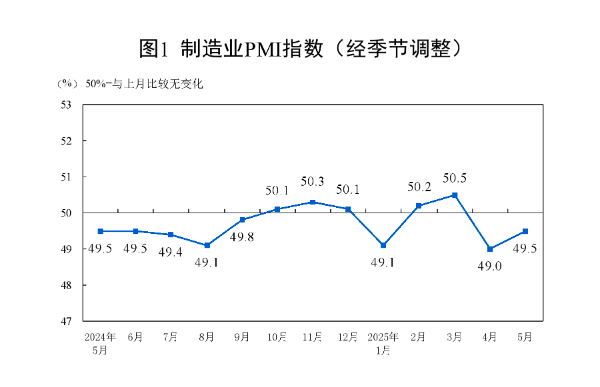
Economic Overview - In May, the manufacturing Purchasing Managers' Index (PMI) rose by 0.5 percentage points to 49.5%, indicating an improvement in economic conditions [1][2] - The comprehensive PMI output index increased by 0.2 percentage points, reflecting overall economic expansion [1][4] Manufacturing Sector - The new export orders index increased by 2.8 percentage points to 47.5%, suggesting a slowdown in the decline of manufacturing exports [2] - The new orders index rose by 0.6 percentage points to 49.8%, indicating stable market demand [2] - The manufacturing production index returned to the expansion zone at 50.7%, up by 0.9 percentage points [2] - The raw material purchasing index increased by 1.3 percentage points to 47.6%, showing a recovery in procurement activities [2] Key Industries - High-tech manufacturing PMI stood at 50.9%, remaining in the expansion zone for four consecutive months [3] - Equipment manufacturing PMI rose to 51.2%, and consumer goods PMI increased to 50.2%, reflecting improvements of 1.6 and 0.8 percentage points respectively [3] - Large enterprises' PMI increased by 1.5 percentage points to 50.7%, with production and new orders indices at 51.5% and 52.5% respectively [3] Non-Manufacturing Sector - The non-manufacturing business activity index was at 50.3%, slightly down by 0.1 percentage points but still indicating expansion [4] - The service industry business activity index rose by 0.1 percentage points to 50.2%, while the construction industry index decreased by 0.9 percentage points to 51% [4] - The non-manufacturing business activity expectation index was at 55.9%, indicating optimism among businesses [4]
制造业PMI回升至49.5%,企业信心保持稳定
Di Yi Cai Jing· 2025-05-31 03:11
Group 1: Manufacturing Sector - The manufacturing production index increased by over 4 percentage points, reaching above 54%, maintaining above 50% for 10 consecutive months [1] - The manufacturing PMI for May was reported at 49.5%, up 0.5 percentage points from the previous month, indicating a recovery in manufacturing activity [1] - The new export orders index rose to 47.5%, an increase of 2.8 percentage points, suggesting a slowdown in the decline of manufacturing exports [4] - The production index for manufacturing returned to the expansion zone at 50.7%, up 0.9 percentage points from the previous month [5] - Large enterprises reported a PMI of 50.7%, with a production index increase of 1.7 percentage points, indicating a strong recovery in supply and demand [5] Group 2: Non-Manufacturing Sector - The non-manufacturing business activity index was at 50.3%, a slight decrease of 0.1 percentage points, but still indicating expansion [10] - The civil engineering construction industry saw a significant increase in new export orders, with the business activity index rising to over 60% [10] - The telecommunications services business activity index rose to over 60%, reflecting strong demand in the sector [10][11] - The information services sector continues to show growth potential, supported by policy measures and sustained market demand [11]

工业企业利润加快恢复 彰显工业强大韧性和抗冲击能力
Jin Rong Shi Bao· 2025-05-28 01:43
Core Insights - The industrial sector in China has shown signs of recovery, with significant growth in revenue and profits for large-scale industrial enterprises in the first four months of the year [1][4] - Positive factors such as policy effects, marginal recovery in market demand, and efficient resource utilization have contributed to the improved operational conditions of industrial enterprises [1][4] Revenue and Profit Growth - From January to April, large-scale industrial enterprises achieved operating revenue of 43.44 trillion yuan, a year-on-year increase of 3.2% [1] - Profit growth for these enterprises was 1.4%, accelerating by 0.6 percentage points compared to the first quarter [1] - In April alone, profits increased by 3.0% year-on-year, up by 0.4 percentage points from March [1] Industrial Production Trends - In April, the industrial added value for large-scale enterprises grew by 6.1%, marking one of the highest monthly growth rates since last year [2] - Out of 41 major industrial categories, 36 experienced year-on-year growth in added value, indicating a broad-based recovery [2] Sector-Specific Performance - Manufacturing profits increased by 8.6% year-on-year from January to April, contributing significantly to overall industrial profit growth [2] - The equipment manufacturing sector led the profit growth with an 11.2% increase, contributing 3.6 percentage points to the total industrial profit growth [3] - High-tech manufacturing profits rose by 9.0%, surpassing the average growth rate of all large-scale industrial enterprises by 7.6 percentage points [3] Policy Impact and Future Outlook - The implementation of supportive policies, including the "two重" and "两新" initiatives, has stimulated domestic demand and contributed to industrial growth [2][4] - The introduction of long-term special government bonds and policies for equipment upgrades has positively impacted related industries [3] - Despite the positive trends, challenges such as international uncertainties and internal pressures on cash flow remain, necessitating continued support for struggling enterprises [4]
2025年1-4月工业企业利润分析:利润小幅改善,库存继续去化
Yin He Zheng Quan· 2025-05-27 08:33
宏观动态报告 F券 CG 利润小幅改善,库存继续去化 2025 年 1-4 月工业企业利润分析 分析师 张迪 网:zhangdi_yj @chinastock.com.cn 分析师登记编码:S0130524060001 研究助理:铁传奥 风险提示 1. 国内政策时滞的风险 2. 海外经济衰退的风险 www.chinastock.com.cn 证券研究报告 请务必阅读正文最后的中国银河证券股份有限公司免责声明 2025 年 5 月 27 日 5 月 27 日国家统计局发布:1—4 月份,全国规模以上工业企业实现利润总额 ● 21170.2 亿元,同比增长 1.4%(前值 0.8%); 实现营业收入 43.44 万亿元, 同比增长 3.2%(前值 3.4%)。3 月利润当月同比 3.0%(前值 2.6%)。工业 企业利润连续两个月正增走扩。 利润率改善对利润增速加快有较大贡献。从量、价、利润率三要素模型来看, o 贡献最多的还是量,工业增加值 1-4 月实现同比 6.4%的强劲增长,单月同比 上涨 6.1%,虽然 4 月工业增加值环比较 3 月有所下滑,但仍在"三抢"的带 动下有较高增速。4月转口贸易"抢出口"和 ...
中国国家发改委:将适时推出“两新”领域增量和储备政策
Zhong Guo Xin Wen Wang· 2025-05-20 15:41
Core Insights - The National Development and Reform Commission (NDRC) of China is set to enhance policy reserves and research on "Two New" initiatives, which include large-scale equipment updates and consumer goods trade-in programs, to stimulate consumption, stabilize investment, promote transformation, and improve livelihoods [1][2] Group 1: Consumption Enhancement - As of May 5, 2023, five major product categories, including automobiles, home appliances, digital products, home renovation, and electric bicycles, have driven sales of approximately 830 billion RMB [1] - The trade-in program for automobiles has seen over 3 million subsidy applications, while over 55 million units of 12 categories of home appliances have been purchased through trade-in programs [2] Group 2: Investment Growth - From January to April 2023, investment in equipment and tools increased by 18.2% year-on-year, contributing 64.5% to overall investment growth [1] - Investment in sectors closely related to "Two New," such as computer and office equipment manufacturing, consumer goods manufacturing, and equipment manufacturing, saw growth rates of 28.9%, 13.4%, and 8.2% respectively [1] Group 3: Transformation and Upgrading - The demand for green, intelligent, and high-quality products is driving equipment updates, which in turn enhance production efficiency and improve industry performance and profitability [1] Group 4: Policy Implementation - The NDRC plans to expedite fund allocation for the 2024 consumer goods trade-in program and improve fund utilization efficiency [2] - Future initiatives include simplifying subsidy application processes, establishing a direct funding mechanism, and implementing loan interest subsidies for equipment updates to reduce financing costs for businesses [2]
经济的变与不变——4月经济数据点评
一瑜中的· 2025-05-20 08:32
Core Viewpoint - The article emphasizes the resilience of the economy driven by policy support and export growth, while also highlighting the weakening trends in real estate and manufacturing sectors [2][3]. Group 1: Economic Stability - The investment sector shows strong performance, with equipment purchases contributing 64.5% to overall investment growth from January to April, with a year-on-year increase of 18.2% [5][11]. - Consumer demand for durable goods remains robust, with retail sales of home appliances and related categories contributing 27.4% to total retail sales in April, reflecting a growth rate of 10.6% for durable goods [5][11]. - The trade sector continues to perform well, with a trade surplus growth rate of 33.6% in April, supported by an 8.1% year-on-year increase in exports [5][11]. Group 2: Economic Changes - The real estate market shows signs of weakening, particularly in the "strong five cities" (Beijing, Shanghai, Shenzhen, Hangzhou, Chengdu), where the average price of second-hand homes fell by 0.2% in April, compared to a 0.46% increase in March [6][13]. - Manufacturing investment growth is slowing, particularly in the raw materials sector, which saw a significant decline in investment growth to 2.7% from January to April, down from previous levels [7][17]. Group 3: April Economic Data Overview - In April, industrial production growth was recorded at 6.1%, while service sector production index grew by 6.0%. Retail sales growth was 5.1%, down from 5.9% in March [21][22]. - The real estate sector experienced a decline in sales area by 2.1% year-on-year in April, with fixed asset investment growth slowing to 3.5% [21][30]. - The consumer price index (CPI) showed a slight deflation at -0.1%, while the producer price index (PPI) decreased by 2.7% [21][22]. Group 4: Employment and Investment Trends - The urban unemployment rate decreased to 5.1% in April, indicating a slight improvement in the job market [23]. - Fixed asset investment growth was recorded at 3.6% in April, with manufacturing investment showing a cumulative growth of 8.8% from January to April [37].

国家发改委:截至5月5日消费者购买12类家电以旧换新产品超过5500万台
Cai Jing Wang· 2025-05-20 03:34
Core Viewpoint - The utilization of long-term special government bond funds is driving the implementation of the "Two New" policy, which is crucial for expanding consumption, stabilizing investment, promoting transformation, and improving people's livelihoods [1][2][3] Group 1: Consumption Enhancement - In April, retail sales of home appliances, cultural office supplies, furniture, and communication equipment increased by 38.8%, 33.5%, 26.9%, and 19.9% year-on-year respectively, with the renovation season and replacement subsidies contributing to a 9.7% growth in building and decoration materials retail sales [1] - The sales of five major product categories, including automobiles and home appliances, reached approximately 830 billion yuan [1] Group 2: Investment Growth - From January to April, investment in equipment and tools increased by 18.2% year-on-year, contributing 64.5% to overall investment growth [1] - Investment in sectors closely related to the "Two New" policy, such as computer and office equipment manufacturing, consumer goods manufacturing, and equipment manufacturing, saw increases of 28.9%, 13.4%, and 8.2% respectively [1] Group 3: Transformation and Upgrading - The demand for green, intelligent, and high-quality products is driving production efficiency improvements, with high-tech manufacturing and digital product manufacturing value-added increasing by 10.0% year-on-year in April [2] - Retail sales of new energy vehicles reached 905,000 units, growing by 33.9%, with a penetration rate of 51.5%, up 7 percentage points year-on-year [2] Group 4: Social Welfare Improvement - The trade-in program for consumer goods has effectively met residents' demand for high-quality living, with over 3 million applications for vehicle trade-in subsidies and more than 55 million units of 12 categories of home appliances traded in [2] Group 5: Future Actions - The National Development and Reform Commission plans to accelerate fund allocation and improve fund utilization efficiency, including implementing loan interest subsidies for equipment updates and simplifying subsidy application processes [3] - There will be a focus on policy reserves and timely evaluation of progress in the "Two New" areas to ensure effective implementation [3]
四月经济数据刷屏!高技术制造业暴增10%,多项消费指标井喷式增长
Sou Hu Cai Jing· 2025-05-19 23:45
Economic Performance - In April, China's economy demonstrated significant resilience amid complex conditions, with major economic indicators showing stable and rapid growth [1] - The industrial added value for large-scale enterprises increased by 6.1% year-on-year and 0.22% month-on-month, marking a notable performance in monthly data since last year [1] - The service production index grew by 6.0% year-on-year, reaching the second-highest monthly growth rate this year [1] Domestic Demand - Positive changes were observed in domestic demand, with substantial sales growth in products related to the "old for new" consumption initiative, significantly supporting retail sales [1] - Retail sales of household appliances and audio-visual equipment surged by 38.8% year-on-year, continuing to accelerate this year [1] - Retail sales for cultural office supplies, furniture, and communication equipment increased by 33.5%, 26.9%, and 19.9% year-on-year, respectively, all exceeding the overall retail growth rate [1] Investment Trends - The effects of "two heavy" and "two new" policies are becoming increasingly evident, with investment in equipment and tools rising by 18.2% year-on-year from January to April, contributing 64.5% to total investment growth [1] - Investment in consumer goods manufacturing and equipment manufacturing grew by 13.4% and 8.2% year-on-year, reflecting the impact of industrial upgrading [1] Foreign Trade - China's foreign trade showed strong resilience, with total goods import and export value increasing by 2.4% year-on-year from January to April, accelerating by 1.1 percentage points compared to the first quarter [2] - Private enterprises' imports and exports rose by 6.8% year-on-year, outperforming the overall foreign trade situation [2] - Exports of electromechanical products grew by 9.5% year-on-year, indicating a positive trend [2] High-Tech Manufacturing - The added value of high-tech manufacturing above designated size increased by 10% year-on-year in April, with aerospace equipment manufacturing and integrated circuit manufacturing growing by 21.4% and 21.3%, respectively [2] - The added value of digital product manufacturing also achieved a 10% year-on-year increase [2] - Production of new energy products, such as electric vehicles and charging piles, rose by 38.9% and 43.1%, respectively, reflecting the deepening of green and low-carbon transformation [2] Real Estate Market - In April, housing prices in 70 large and medium-sized cities remained generally stable, with the year-on-year decline in first, second, and third-tier cities continuing to narrow [2] - The real estate market's transactions and prices are stabilizing, moving towards a recovery phase [2] Economic Resilience Factors - China's economic resilience is attributed to a stable economic foundation, numerous advantages, strong resilience, and significant potential [3] - The large-scale market, accelerated restructuring of the entire industrial chain, and continuous empowerment of new production factors provide systematic support for economic development [3] - Recent policy measures, including interest rate cuts and the establishment of new policy financial tools, aim to support technological innovation and expand consumption [3]
多项宏观政策协同发力 4月国民经济顶住压力稳定增长 应变克难 稳健前行
Xin Hua She· 2025-05-19 19:23
Economic Overview - The core viewpoint emphasizes that despite external shocks in April, China's economic foundation remains stable, with strong resilience and potential, supported by coordinated macro policies [1][7] - The overall economic recovery is expected to continue, bolstered by favorable conditions and proactive measures from various sectors [1][6] Industrial Performance - In April, the industrial added value for large-scale enterprises grew by 6.1% year-on-year, with 36 out of 41 major industries showing growth [2][3] - High-tech manufacturing saw a significant increase, with added value rising by 10% year-on-year, outpacing overall industrial growth [2][3] - Key sectors such as 3D printing and industrial control systems experienced substantial production increases of 60.7% and 29.5%, respectively [2] Investment Trends - Manufacturing investment in the first four months of the year increased by 8.8%, significantly higher than the overall investment growth [3] - High-tech service industry investment rose by 11.3%, indicating a strong focus on new productive forces and the transition of growth drivers [3] Consumer and Trade Dynamics - In April, the total retail sales of consumer goods reached 37,174 billion yuan, marking a 5.1% year-on-year increase [4][5] - The total import and export value in April was 38,391 billion yuan, with exports growing by 9.3% and imports by 0.8% [5] - The resilience of domestic consumption is highlighted, with policies supporting consumer spending expected to strengthen further [4][5] Policy and Future Outlook - The central government has emphasized the need for proactive macro policies, including interest rate cuts and reserve requirement ratio reductions, to support economic growth [1][6] - The outlook for May suggests continued economic resilience, driven by enhanced policy measures and a focus on domestic demand [1][6]
详解4月经济数据:工业增速维持高位,扩内需政策效应持续释放
第一财经· 2025-05-19 10:57
2025.05. 19 工业生产是经济稳定增长的重要支撑。今年以来,随着存量政策持续显效、增量政策有效落实,政 策"组合拳"效果不断显现。工业生产保持较快增长,产业发展向高端化、智能化、绿色化转型。 4月份,规模以上工业增加值同比增长6.1%。41个大类行业中,36个行业同比增长,增长面超过八 成。 本文字数:2510,阅读时长大约4分钟 作者 | 第一财经 祝嫣然 面对外部冲击影响加大、内部困难挑战叠加的复杂局面,4月份我国主要经济指标顶住压力、平稳运 行。 国家统计局5月19日发布的数据显示,4月份,全国规模以上工业增加值同比增长6.1%,比上月回 落1.6个百分点;社会消费品零售总额同比增长5.1%,比前值放缓0.8个百分点。1-4月份,全国固 定资产投资(不含农户)同比增长4.0%,比一季度回落0.2个百分点。 国家统计局新闻发言人付凌晖同日在国新办发布会上表示,4月份外部冲击影响加大,但我国经济基 础稳、优势多、韧性强、潜能大,宏观政策协同发力,各方面积极应变、主动作为,国民经济应变克 难稳定运行,发展质量持续提升,进一步增强了我们应对各种风险挑战的信心和底气。但也要看到, 国际环境变数仍多,多重风 ...