
电动汽车

Search documents
特斯拉业务重心转向,但中国供应商仍是中坚力量
Guan Cha Zhe Wang· 2026-02-02 11:53
Core Viewpoint - Tesla is shifting its business focus from electric vehicles to humanoid robots, with plans to produce the "Optimus" robot in the U.S. while still relying on China's extensive robot supply chain for components [1][4]. Group 1: Tesla's Plans and Production - Elon Musk announced plans to gradually reduce the production of Model S and Model X electric vehicles to convert the Fremont factory for "Optimus" production, aiming for mass production by the end of 2026 [5]. - The long-term goal is to produce 1 million humanoid robots annually at the Fremont factory, with a third-generation "Optimus" expected to launch in a few months [5]. - Musk expressed caution regarding the current performance of "Optimus," stating it is still in the early stages of development [5]. Group 2: Supply Chain and Component Suppliers - Tesla has been engaging with hundreds of Chinese component suppliers for over three years, collaborating on research and hardware design, with some suppliers already delivering prototype parts [3]. - Key potential suppliers include Zhejiang Sanhua Intelligent Control, which provides thermal management components, and Ningbo Top Group, which is developing actuators and other robot parts [3]. - Bain & Company estimates that Chinese suppliers will play a significant role in the global humanoid robot supply chain, accounting for at least 55% of the material costs for core components [4]. Group 3: Cost and Market Dynamics - Morgan Stanley predicts that component suppliers are likely to benefit first from the growth of the humanoid robot industry, with an expected 16% decrease in the total material costs for humanoid robots in China this year [6]. - Tesla aims to keep the manufacturing cost of each "Optimus" robot around $20,000 (approximately 138,900 RMB) [6]. - Analysts highlight that the cost and efficiency of the Chinese supply chain are key advantages, allowing for localized production and rapid response to design changes [5].


锂电池重大突破!马斯克:特斯拉实现干电极电池规模化生产
Hua Er Jie Jian Wen· 2026-02-02 09:53
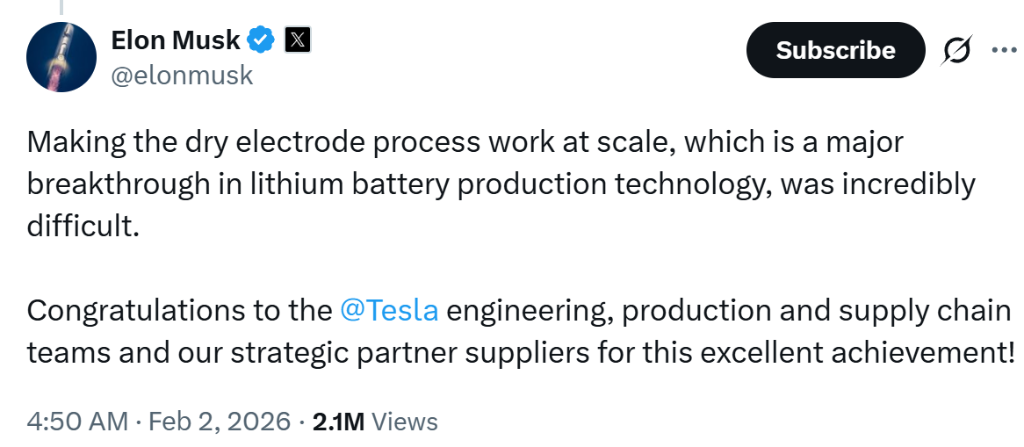
Core Insights - Tesla's CEO Elon Musk confirmed a significant breakthrough in lithium battery manufacturing with the successful scaling of dry electrode technology, marking a major advancement in reducing manufacturing costs and improving production efficiency in the electric vehicle industry [1][7]. Group 1: Technological Breakthrough - The dry electrode manufacturing process has been described as a "major breakthrough" in lithium battery production, overcoming a long-standing technical challenge that the industry deemed difficult to scale [1][5]. - This technology eliminates reliance on traditional wet solvent coating processes, validating the feasibility of dry processing in industrial production environments [7]. Group 2: Commercial Value - The dry electrode technology is expected to significantly reduce costs and energy consumption while simplifying factory processes, leading to lower capital expenditure requirements and greater production flexibility for Tesla in future battery capacity expansions [4]. - The new process also enhances performance, allowing for a pure dry cathode design that uses minimal binder (as low as 1.25%), thereby increasing energy density and extending battery life [8]. Group 3: Business Context - Tesla's energy storage business is experiencing strong growth, with annual deployment reaching 46.7 GWh and a 44% year-over-year increase in energy storage revenue to $3.4 billion [9]. - However, Tesla faces challenges in automotive sales, with a reported 20.2% decline in European sales from December 2024 to December 2025, highlighting the importance of technological innovations to maintain competitiveness and profit margins [10].
德国重启补贴 欧洲追赶电动汽车时代
Zhong Guo Qi Che Bao Wang· 2026-02-02 08:07
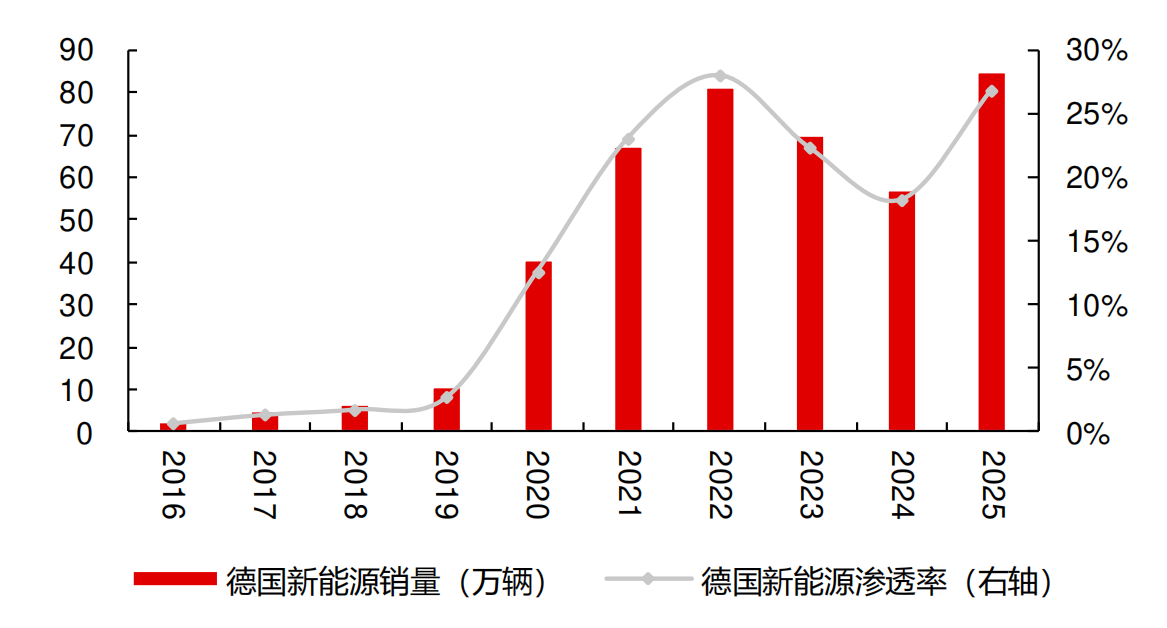
Group 1 - The German government announced the restart of a €3 billion electric vehicle subsidy program in early 2026, with a maximum subsidy of €6,000, aimed at revitalizing the domestic automotive industry and accelerating Europe's transition to electric vehicles [1][2] - The subsidy policy covers battery electric vehicles (BEVs), plug-in hybrid electric vehicles (PHEVs), and range-extended electric vehicles (EREVs), with a tiered subsidy structure based on household income and vehicle type [2][7] - The decision to restart the subsidy program comes after a significant decline in electric vehicle registrations in Germany, with a 27.4% drop in 2024, leading to a market share decrease from 18.7% in 2023 to 13.5% [2][5] Group 2 - The subsidy program is designed to stimulate consumption among middle and low-income households and promote a diversified technology approach in the electric vehicle market [2][5] - The absence of production restrictions in the subsidy policy is expected to benefit Chinese electric vehicle manufacturers, providing them with an opportunity to expand their market presence in Germany [6][8] - The competitive pricing of Chinese electric vehicles, enhanced by the subsidies, is likely to strengthen their market position, with brands like BYD and SAIC gaining traction in the German market [7][8] Group 3 - The overall economic conditions in Europe, including rising inflation and energy prices, may limit consumer purchasing power and affect the demand for electric vehicles despite the subsidies [10][13] - European automakers face challenges in battery technology and production costs, which may hinder their competitiveness against Chinese manufacturers [10][12] - The disparity in subsidies between traditional fuel vehicles and electric vehicles in Germany may reduce the incentive for local manufacturers to prioritize electric vehicle development [10][13]
中国对英投资的“绿色新现实”:在气候与金融的双轨驱动下寻求合作确定性 | 跨越山海-国别观察
Di Yi Cai Jing· 2026-02-02 03:48
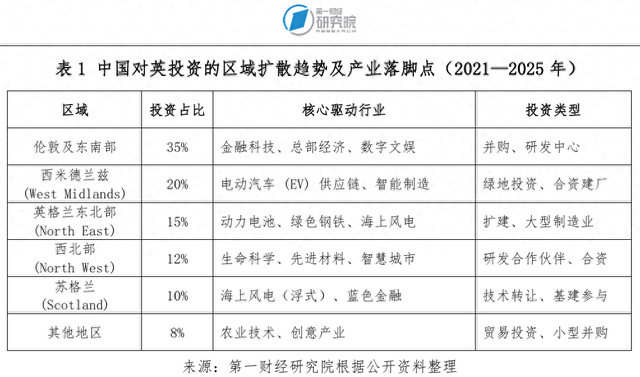
Core Insights - The visit of UK Prime Minister Keir Starmer to China in January 2026 resulted in 11 positive outcomes, marking a new phase in UK-China relations characterized by "re-engagement" and "divergence management" [1] - China's direct investment in the UK has shifted from "capital scale expansion" to "high-quality supply chain integration" over the past five years, with a significant rebound in investment flow expected in 2024-2025, driven by strong performance in renewable energy and greenfield projects [1][4] - The establishment of a "High-Level Climate and Nature Partnership" during the visit validates the business logic of collaboration in the "net-zero emissions" sector, highlighting the complementary strengths of both countries [1][3] Investment Trends - China's direct investment in the UK has transitioned from acquisition-driven capital to strategic greenfield projects, with FDI stock declining from approximately £6 billion in 2020 to £3.7 billion by the end of 2023, representing about 0.2% of the UK's total inward FDI [5][6] - Despite the decline in FDI stock, the number of Chinese projects in the UK has remained robust, averaging 37 to 46 new projects annually from 2021 to 2025, with a notable rebound in investment flow expected to reach €10 billion in 2024-2025 [5][6] Employment Impact - Chinese enterprises in the UK employ over 57,000 individuals and generate nearly £99 billion in annual revenue, with at least 9,356 new jobs created from 2021 to 2025, peaking at 2,814 new jobs in the 2023 fiscal year [6] Regional Investment Distribution - Investment from China has shifted from a concentration in London to a more balanced distribution across the UK, with greenfield investments rising to 60% of total investments by 2025, benefiting regions such as the West Midlands and North East England [8][11] Strategic Focus Areas - The focus of Chinese investment has moved towards renewable energy and electric vehicle supply chains, with significant investments in offshore wind, energy storage, and battery technology [14][19] - The West Midlands has become a key area for electric vehicle supply chains, while the North East and Yorkshire are transitioning from traditional heavy industries to low-carbon manufacturing [15][19] Challenges and Opportunities - The UK faces increasing competition from other European countries for Chinese investment, with regulatory uncertainties and unclear review processes diminishing its attractiveness [20][21] - The UK's National Security and Investment Act (NSIA) presents challenges for Chinese enterprises, as the unpredictability of the review process can lead to increased costs and project delays [23][24] Recommendations for Improvement - To enhance its attractiveness to Chinese investors, the UK should establish a green investment fast track for low-sensitivity projects and create a standardized trust framework to help Chinese enterprises navigate the regulatory landscape [28][29] - Strengthening post-investment support systems and ensuring clear communication regarding project delivery processes will be crucial for fostering a conducive investment environment [31]
电动汽车安全新国标发布 2026年7月1日正式实施
Zhong Guo Jing Ji Wang· 2026-02-02 03:03
Core Viewpoint - The newly revised national standard for electric vehicle safety (GB18384—2025) will be implemented on July 1, 2026, marking the first comprehensive revision since its integration in 2020, addressing emerging safety risks associated with rapid technological advancements in electric vehicles [1][2]. Group 1: Key Changes in the New Standard - The new standard mandates a physical disconnection between the high-voltage circuit of the vehicle and the rechargeable energy storage system, introducing a "one-button power-off" device as a physical disconnection mechanism, enhancing reliability and timeliness in accident rescue [2]. - Vehicles must be equipped with high-voltage or low-voltage maintenance disconnection devices, with high-voltage devices meeting IPXXB protection level requirements, ensuring that live parts drop to safe voltage levels within one second after disconnection [2]. - A new requirement for underbody scraping tests has been added, specifying a barrier of 150mm solid hemisphere and a test speed of 35 km/h, with no leakage, shell rupture, fire, or explosion allowed, while meeting insulation resistance requirements [2]. Group 2: Industry Implications - Since 2025, over ten safety standards for new energy vehicle technologies have been released or are under public consultation, covering areas such as power batteries, vehicle safety, intelligent networking, and key components, directly addressing consumer concerns [3]. - The implementation of the new standard is expected to enhance the overall safety control system for electric vehicles in China, providing authoritative technical basis for product access, quality supervision, and accident investigation, which is crucial for mitigating safety risks and solidifying China's leading position in the global new energy vehicle industry [3].
Kimi海外收入已超国内;唐宁街10号官宣:泡泡玛特欧洲总部将设在伦敦丨Going Global
创业邦· 2026-02-01 10:09
Key Insights - TikTok Shop in Southeast Asia has launched a "Spring Festival Uninterrupted" incentive plan to encourage merchants to prepare inventory and marketing materials ahead of the holiday season [5][6] - AliExpress is projected to be one of the fastest-growing platforms in the U.S. by 2025, with a website traffic increase of 18.7% year-on-year [6] - Pop Mart has announced London as its European headquarters, planning to open seven new stores in the UK and create over 150 jobs [9] - The total shipment of Pingtouge's "Zhenwu" PPU chips has reached several hundred thousand units, with performance comparable to NVIDIA's H20 [10] - Anta Sports is set to acquire a 29.06% stake in Puma, becoming its largest shareholder, which is expected to enhance its global market position [12] - Kimi's overseas revenue has surpassed domestic revenue, with a fourfold increase in global paid users following the release of its new model K2.5 [13] - BYD is collaborating with Vietnamese automaker Thaco to establish a $130 million electric vehicle battery factory in Vietnam [17] - SpaceX has applied to deploy up to 1 million satellites to create a data center network in orbit, significantly expanding its existing Starlink constellation [23] - Samsung Electronics has raised NAND flash prices by over 100% in Q1 2024 due to increased demand driven by AI applications [24][25]
炸裂!100万颗卫星!AI太空算力来了,马斯克要打造现实版“戴森球”!今年,SpaceX与特斯拉合并?
雪球· 2026-02-01 05:06
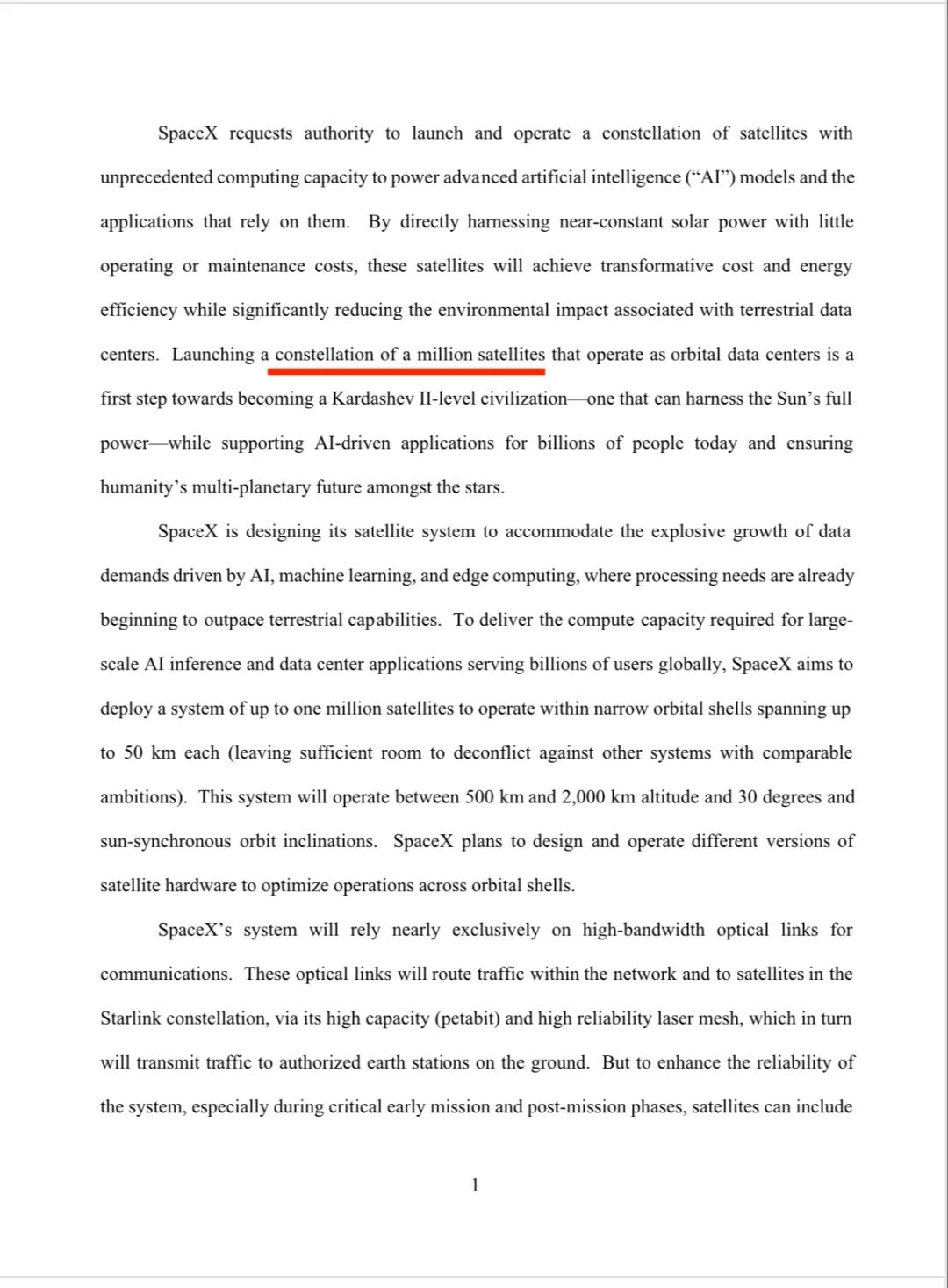
Core Viewpoint - SpaceX is planning to deploy up to 1 million satellites, which is 70 times the current number of active satellites in orbit, and is considering an IPO with a target valuation of $1.5 trillion, making it potentially the largest IPO in history [1][9][10]. Group 1: SpaceX IPO and Valuation - SpaceX's IPO is projected to have a target valuation of $1.5 trillion, which would surpass Saudi Aramco's IPO and become the largest on record [9]. - The expected financing could exceed $50 billion, significantly higher than previous major IPOs, such as Amazon and Microsoft [10][11]. Group 2: Business Structure and Revenue - SpaceX is expected to achieve revenues of $15 billion to $16 billion by 2025, with an EBITDA of approximately $8 billion [13]. - The Starlink service is the primary revenue driver, contributing 50% to 80% of the company's income, with over 9 million users and around 9,500 satellites launched since 2019 [13]. Group 3: Satellite Deployment Plans - SpaceX has submitted an application to the FCC to deploy a satellite system consisting of up to 1 million satellites, aimed at creating a space-based data center network [16][19]. - This plan is seen as a move to establish a computing empire in space, utilizing solar energy and laser links for data routing [19]. Group 4: Industry Trends and Future Projections - Analysts predict that the satellite launch numbers will increase from 5,000 to 50,000 annually between 2025 and 2040, driven by advancements in solar technology and the demand for AI capabilities [24]. - The market for photovoltaic cells in the satellite sector is expected to reach 328.8 billion yuan, with a potential growth of over 30 times compared to the short-term market [24].
SpaceX大动作!申请部署100万颗卫星
2 1 Shi Ji Jing Ji Bao Dao· 2026-02-01 02:27
Core Viewpoint - SpaceX has applied to launch up to 1 million satellites to create an orbital data center network around Earth, aimed at supporting advanced AI models and applications [1][10]. Group 1: Project Overview - SpaceX submitted an application to the FCC on January 30, describing the project as a satellite constellation with unprecedented computing power [1]. - The proposed "orbital data center system" is designed to handle explosive data growth from AI, machine learning, and edge computing, providing necessary computing capabilities for billions of users globally [1]. - The satellites will operate in a narrow orbital shell with a width of no more than 50 kilometers to avoid conflicts with other systems [1]. Group 2: Technical Specifications - The satellites will operate in a sun-synchronous orbit at altitudes between 500 kilometers and 2000 kilometers, utilizing nearly constant solar energy, which will significantly reduce operational and maintenance costs [2]. - The system will rely on high-bandwidth optical communication links and will connect with the existing Starlink constellation for data transmission to ground stations [3]. Group 3: Strategic Developments - Elon Musk is considering integrating SpaceX with his AI company xAI or Tesla to enhance space computing capabilities [7][10]. - The potential merger could create a "super ecosystem" combining rocket launches, satellite networks, electric vehicles, social media, and generative AI technologies [10]. - SpaceX is planning an IPO in June, aiming to raise up to $50 billion, with an estimated valuation of around $1.5 trillion, potentially making it the largest IPO in history [10].
'Big Short' Michael Burry Calls Tesla CEO Elon Musk 'Desperately Incentivized Futurist' Amid SpaceX Merger Reports: 'Elon Is An…'
Yahoo Finance· 2026-01-31 14:31
Core Viewpoint - Investor Michael Burry has referred to Elon Musk as a "futurist" amid discussions of potential mergers between Musk's companies, including Tesla, SpaceX, and xAI [1][2]. Group 1: Investor Perspectives - Burry described Musk as an "American treasure" but also criticized him as a "desperately incentivized futurist," indicating skepticism about the merger plans [2]. - Despite previously labeling Tesla as "ridiculously overvalued" and criticizing its supporters, Burry does not currently hold a short position against the company [3]. Group 2: Merger Discussions - Reports suggest that SpaceX is considering a merger with Tesla, a concept Musk hinted at previously regarding a "convergence" of his companies [5]. - Investor Gene Munster has praised the potential merger, suggesting that Musk is "thinking big" in anticipation of SpaceX's possible IPO this year, which Musk first mentioned during Tesla's annual shareholder meeting last November [5].
特斯拉的2026,一场关乎存亡的空前豪赌
Xin Lang Cai Jing· 2026-01-31 10:14
Core Insights - Tesla's 2025 financial report reveals a significant decline in revenue and profit, marking the first annual revenue drop in the company's history, with total revenue at $94.827 billion, down 3% year-over-year, and net profit plummeting 46% [2][5] - Despite a decrease in global vehicle deliveries by 8.6% to 1.636 million units, Tesla's stock showed mixed reactions, initially dropping 3.45% but later rebounding by 3.32% [2][5] - CEO Elon Musk announced a record capital expenditure exceeding $20 billion for 2026, aimed at AI chips, supercomputing clusters, robot production lines, and energy facilities [9][10] Financial Performance - Tesla's automotive business revenue fell to $69.526 billion, a 10% decrease, with significant declines in major markets: over 10% in the U.S., 39% in Europe, and 4.8% in China [5][6] - Energy business revenue reached $12.8 billion, a 26.6% increase, marking a record for five consecutive quarters [7] Business Transformation - Tesla is transitioning into a "physical AI company," leveraging data from its vehicles to enhance AI algorithms and improve autonomous driving capabilities [14][15] - The company aims to produce the humanoid robot Optimus by the end of 2026, with a planned annual production capacity of 1 million units [16][17] Market Perception - Investor sentiment is divided, with traditional automotive valuation metrics indicating Tesla's high P/E ratio of 418, while AI optimists argue for a valuation based on data advantages and algorithmic efficiency [21][22] - A significant portion of analysts (30 out of 50) recommend holding or selling Tesla stock, reflecting cautious attitudes towards the company's transformation prospects [24] Strategic Outlook - Tesla's strategy involves nurturing emerging businesses while the core automotive business is still viable, creating synergies between automotive, energy, and AI sectors [26] - The success of Tesla's paradigm shift hinges on the speed and efficiency of commercializing its AI technology [27]
