新能源

Search documents
我国首座海水漂浮式光伏项目建成投用
Xin Hua Wang· 2026-01-14 08:13
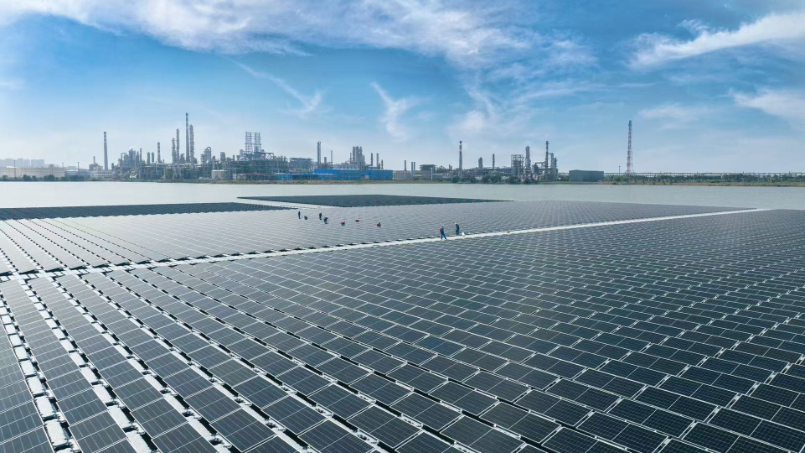
Group 1 - The project is China's first industrial floating photovoltaic project in a full seawater environment, with an annual green electricity generation of 16.7 million kilowatt-hours, reducing carbon dioxide emissions by 14,000 tons, equivalent to planting 750,000 trees [1][3] - The floating photovoltaic power station occupies approximately 60,000 square meters with a capacity of 7.5 megawatts, utilizing a design that allows the photovoltaic panels to rise and fall with the tides, improving efficiency by 5%-8% through enhanced cooling effects [3][4] - The project addresses challenges such as seawater corrosion and tidal fluctuations through three major innovations, including specialized floating bodies and anchoring systems, which reduce investment costs by about 10% compared to traditional pile-based structures [3][4] Group 2 - The completion of the floating photovoltaic project integrates the critical link in the new energy industry chain, forming a model of "photovoltaic to green electricity, green electricity to green hydrogen," facilitating high-quality coupling development of hydrogen energy and photovoltaics [4] - The company aims to expand its floating photovoltaic projects by an additional 23 megawatts, enhancing its new energy supply capacity as part of its strategy to build a clean and low-carbon energy supply system [4] - The company has initiated the "Ten Thousand Stations in the Sun" action plan, targeting the establishment of approximately 10,000 photovoltaic stations by 2027, while also focusing on geothermal energy and hydrogen energy to create a comprehensive hydrogen energy industry chain [4]


宁夏腾格里沙漠新能源基地建设稳步推进,一期项目年发电量达18亿千瓦时
Ren Min Ri Bao· 2026-01-14 08:13
Core Viewpoint - The Ningxia Tengger Desert New Energy Base is making steady progress, with its first phase generating an annual electricity output of 1.8 billion kilowatt-hours, contributing to China's energy transition through wind and solar power [2][3][12]. Group 1: Project Overview - The Ningxia Tengger Desert New Energy Base is the first project in China's "sand-gobi-desert" renewable energy base to be approved, started, and put into operation, featuring a total area of nearly 30,000 acres and over 2.2 million solar panels [3][12]. - The first phase of the project, with a capacity of 1 million kilowatts, was fully operational in April 2023, achieving an annual electricity generation of 1.8 billion kilowatt-hours [3][12]. Group 2: Ecological and Economic Benefits - The project aims to explore a dual benefit model of economic and ecological efficiency, accumulating valuable experience for similar projects [2][4]. - The vegetation coverage in the desert has increased from less than 5% to 25%, with some areas exceeding 40%, demonstrating effective ecological restoration alongside energy production [12]. Group 3: Innovative Construction Techniques - The project incorporates innovative construction techniques, such as using elevated concrete piles for solar panels to allow wind and sand to pass through, thus minimizing environmental impact [5][9]. - The design includes a "green energy + ecological governance" approach, utilizing complementary technologies to promote vegetation growth beneath and between solar panels [6][10]. Group 4: Operational Efficiency - The solar panels are equipped with tracking systems that adjust their angle to follow the sun, increasing annual electricity generation by approximately 8.9% compared to fixed systems [10]. - A 10% capacity energy storage system is integrated to manage the variability of renewable energy supply, ensuring stable electricity delivery [11].
推动新能源产业向“新”而兴
Ke Ji Ri Bao· 2026-01-14 08:13
Core Insights - The Hebei Jidian Longhua Independent Energy Storage Project has officially met grid connection conditions, marking a significant step in the development of renewable energy in the Beijing-Tianjin-Hebei region [1] - The project is part of a broader strategy by Hebei Transportation Investment Group to enhance the innovation and development of the province's renewable energy industry [1] Group 1: Renewable Energy Projects - The Hebei Jidian Longhua project is one of the largest energy storage projects in China, utilizing electrochemical technology [1] - The Chengde Weichang Deyou 200 MW photovoltaic energy storage integrated project has begun operation, covering over 7,000 acres and generating an average annual power output of 320 million kWh, sufficient for over 100,000 households [2] - The Haitang River Wind Farm, constructed by Hebei Shengde Infrastructure Construction Development Co., has installed 50 wind turbines with a capacity of 6 MW each, providing 670 million kWh of green electricity annually, saving 204,400 tons of standard coal and reducing CO2 emissions by approximately 545,300 tons [2] Group 2: Technological Innovations and Infrastructure - The company plans to increase investment in technological innovation and explore new paths for wind-solar complementary development [3] - The construction of the "Two Stations and One Channel" project in Chengde is progressing, with an expected addition of 8.5874 million kW of new energy grid connections by 2024, accounting for 43% of the city's total wind-solar power generation capacity [5] - The Hebei Jidian Longhua Independent Energy Storage Station will be fully operational by the end of March, meeting nearly half of Chengde's energy storage needs [8] Group 3: Energy Management Solutions - The energy storage station will store excess wind and solar energy during low demand periods and release it during peak demand, ensuring stable supply [7] - A new shared control center for renewable energy projects in Chengde is set to enhance operational efficiency, enabling centralized monitoring and remote control capabilities [8]
“塞上绿电”好风光
Jing Ji Ri Bao· 2026-01-14 08:13
素有"塞上江南"之称的宁夏,太阳能、风能资源充沛,可利用土地广阔,是全国首个新能源综合示 范区。近年来,宁夏大力推进新能源开发,可再生能源装机规模突破5000万千瓦,光伏发电成第一大电 源。当地的绿电优势正加速转化为经济优势,为区内外经济发展赋能添绿。 宁夏拥有丰富的太阳能、风能资源,光伏年平均利用小时数约1500小时,风电年平均利用小时数约 2000小时。加之区位优势独特,有沙漠、戈壁和荒漠等未利用土地可用于布局,建设大型光伏、风电项 目的基础得天独厚。 作为全国首个新能源综合示范区,宁夏近年来大力推进新能源开发,将绿电打造为自身绿色低碳转 型发展的一张名片。新型电力系统建设成效显著,单位国土面积新能源开发强度居全国首位,人均新能 源装机居全国前列。截至2025年8月,宁夏可再生能源装机规模历史性突破5000万千瓦,占总装机比重 达62.6%,光伏发电取代煤电成为第一大电源。 戈壁荒原,如何成就无限好"风光"?"塞上绿电"如何成为宁夏推动产业发展的重要优势? 宁夏还发挥规划引领作用,强化土地要素保障,通过开辟重点项目用地审批"绿色通道",切实推动 绿电产业项目建设。对绿电产业项目建设用地审批不受批次限制,允 ...
中国传统能源主产地实现绿色转型新跨越
Xin Hua Wang· 2026-01-14 08:13
Core Viewpoint - The article highlights the significant progress in green energy transformation in Inner Mongolia, particularly through the development of large-scale solar and wind energy projects, contributing to China's low-carbon goals and energy structure transition [1][2]. Group 1: Project Development - A solar photovoltaic project in the Kubuqi Desert has a total investment of approximately 5.5 billion yuan, covering nearly 29,000 acres, with a total installed capacity of 1.1 million kilowatts, expected to deliver 2.2 billion kilowatt-hours of green electricity annually [1]. - The project is part of a broader initiative to accelerate energy structure transformation in Inner Mongolia, aiming for the project to be connected to the grid by the end of 2025 [2]. Group 2: Renewable Energy Capacity - By the end of 2024, Inner Mongolia's renewable energy installed capacity is projected to reach 135 million kilowatts, surpassing that of coal-fired power [2]. - In 2022, the region's renewable energy generation exceeded 200 billion kilowatt-hours, with 60 billion kilowatt-hours exported [2]. Group 3: Hydrogen Production and Utilization - Inner Mongolia has innovated six market-oriented methods for renewable energy consumption, with hydrogen production from green electricity reaching 1.07 million tons per year [3]. - A hydrogen refueling station in Ordos can refuel a heavy-duty truck in just 15 minutes, producing 2,000 cubic meters of hydrogen per hour [3]. Group 4: Energy Infrastructure and Manufacturing - A new 500 kV transmission project in Ordos aims to address the challenge of transmitting 12 million kilowatts of renewable energy from the Kubuqi Desert [4]. - The renewable energy equipment manufacturing industry in Inner Mongolia is developing rapidly, with over 45 major energy and equipment manufacturing companies establishing regional headquarters in Hohhot [4]. Group 5: Export and Economic Impact - The company producing photovoltaic products plans to export 60% to 70% of its output, benefiting from a "green pass" that reduces carbon tariffs and enhances competitiveness [5]. - The government aims for the renewable energy equipment manufacturing industry to achieve an output value exceeding 270 billion yuan by 2025 [5].
内蒙古新能源装机达1.4亿千瓦
Ren Min Ri Bao Hai Wai Ban· 2026-01-14 08:13
Core Insights - Inner Mongolia has become the first province in China to exceed 140 million kilowatts in total installed renewable energy capacity, reaching 143.09 million kilowatts by the end of May this year, accounting for 52% of the region's total power capacity [1] Group 1: Renewable Energy Capacity - As of May 2023, Inner Mongolia's total installed renewable energy capacity reached 143.09 million kilowatts, making it the leading region in China for renewable energy development [1] - The renewable energy generation in Inner Mongolia from January to May 2023 was 124.7 billion kilowatt-hours, representing a year-on-year increase of 39.5% and accounting for 36% of the region's total power generation, an increase of 9 percentage points year-on-year [1] Group 2: Energy Export and Consumption - The region exported 43 billion kilowatt-hours of renewable energy, marking a year-on-year increase of 62% [1] - Local consumption of renewable energy reached 81.7 billion kilowatt-hours, with a year-on-year increase of 30.3% [1] - The responsibility weight for non-hydropower renewable energy consumption reached 36.8% [1] Group 3: Future Plans - Inner Mongolia plans to leverage its resource advantages to accelerate the construction of key projects, including large-scale wind and solar bases, desertification control, and integrated wind-solar projects [1] - The region aims to add 40 million kilowatts of new renewable energy capacity this year, pushing the total renewable energy capacity to exceed 170 million kilowatts and the renewable energy export volume to surpass 100 billion kilowatt-hours [1]
全球最大零碳氢氨项目在内蒙古投产
Ren Min Ri Bao· 2026-01-14 08:13
Core Viewpoint - The launch of the first phase of the world's largest zero-carbon hydrogen ammonia project, producing 320,000 tons, marks a significant advancement in renewable energy utilization in Inner Mongolia [1] Group 1: Project Overview - The project is located in Chifeng City, Inner Mongolia, and focuses on large-scale development and utilization of renewable energy [1] - The project aims to convert green electricity into green hydrogen, green ammonia, and green alcohol, contributing to carbon reduction in various industries [1] Group 2: Importance of Green Ammonia - Green ammonia serves as a crucial industrial raw material and a clean energy carrier, playing a vital role in carbon reduction across steel, chemical, power generation, and shipping industries [1] Group 3: Production Process - The project utilizes self-built large-scale renewable energy power stations to generate green electricity, which is then used to produce high-purity green hydrogen [1] - Green hydrogen is combined with nitrogen in a new synthesis tower through catalytic reactions to ultimately produce green ammonia, achieving a "zero-carbon" production process [1]
每3度就有1度是绿电,山东新型能源体系建设取得重大进展
Qi Lu Wan Bao· 2026-01-14 08:08
Core Insights - The article highlights the significant growth of renewable energy in Shandong, with an average annual increase of nearly 25% in installed capacity since the 14th Five-Year Plan, marking a historic shift from coal-dominated energy production to a more diversified energy structure [1][3] Group 1: Renewable Energy Development - Shandong has surpassed 100 million kilowatts in non-fossil energy generation capacity, historically exceeding coal power for the first time, contributing to high-quality economic development [1] - The HG14 project, the world's largest open-sea photovoltaic project, is set to be fully connected to the grid by the end of 2025, with the capacity to generate 1.78 billion kilowatt-hours annually, sufficient for 2.67 million urban residents [1][3] - As of November 2025, Shandong's non-fossil energy generation capacity is expected to reach 135 million kilowatts, accounting for 53.6% of the total power generation capacity, with solar power alone reaching 91.728 million kilowatts, maintaining the top position in the country for eight consecutive years [3] Group 2: Project Implementation Challenges - The HG14 project faced initial challenges in obtaining sea area usage rights due to existing aquaculture claims in the area, complicating the construction process [2] - A breakthrough occurred in November 2023 when the Ministry of Natural Resources issued a notice allowing for layered rights management of marine areas, enabling the coexistence of aquaculture and photovoltaic projects [2] - The project successfully obtained property rights for water surface and seabed space by July 2024, becoming the first in the country to implement layered marine rights [2] Group 3: Technological Innovations - The HG14 project employs innovative construction techniques, including a four-pile stable guiding frame to ensure the accurate positioning and leveling of solar panels, preventing shading and maximizing energy efficiency [3] - The project was completed and connected to the grid within 18 months, showcasing the effectiveness of these innovative methods in expediting renewable energy deployment [3]
赵明琪获任普洛斯中国CEO,聚焦新经济业务协同增效
Di Yi Cai Jing Zi Xun· 2026-01-14 07:59
Core Viewpoint - GLP Pte Ltd, a leading new economy infrastructure asset management and productive service company, has appointed Zhao Mingqi as the CEO of GLP China, marking a strategic move to enhance collaboration in its logistics, industrial infrastructure, computing centers, and renewable energy sectors [1][3]. Group 1: Leadership Appointment - Zhao Mingqi, a founding member of GLP, has been appointed as the CEO of GLP China, overseeing various business segments and reporting to the global CEO, Mei Zhimin [1][3]. - This appointment reflects GLP's commitment to local talent development and succession planning, emphasizing the importance of strengthening its new economy business in China [3]. Group 2: Business Expansion and Strategy - GLP China has expanded its operations from logistics supply chains to large-scale computing centers and renewable energy, establishing a highly integrated ecosystem [4]. - The company has built a strong reputation in private and public real estate funds and private equity investments, showcasing its collaborative business model [4]. Group 3: Operational Excellence - Zhao Mingqi has led a team of over 500 professionals, managing logistics and industrial infrastructure assets across 70 cities, with an operational area of 40 million square meters, serving over 2,500 clients [5]. - The company’s infrastructure solutions have significantly improved logistics supply chain efficiency, contributing to high occupancy rates and operational performance [5]. Group 4: Market Insights and Adaptation - GLP has continuously adapted its warehousing standards to meet the evolving needs of the Chinese market, participating in the development of national and industry standards [6][7]. - The company has transitioned its service focus from multinational corporations to local leading enterprises, with nearly 90% of its operations now supporting domestic demand [7]. Group 5: New Economy Infrastructure - GLP's services have expanded to include supply chain, computing, and renewable energy infrastructure, with 20 data centers providing 1.4 GW of IT load and over 1 GW of renewable energy capacity under management [7][9]. - The company plays a crucial role in supporting China's manufacturing upgrades, consumption boosts, and green transitions, aligning with national strategies for economic development [8][9]. Group 6: Investment and Future Outlook - GLP's real estate funds, such as the CICC GLP REIT, have been recognized for their robust performance, with significant dividends paid since its launch [10]. - Zhao Mingqi expressed confidence in leveraging GLP's unique business platform and insights to capture new opportunities for sustainable growth [10].

赵明琪获任普洛斯中国CEO,聚焦新经济业务协同增效
第一财经· 2026-01-14 07:53
Core Viewpoint - The appointment of Zhao Mingqi as CEO of GLP China signifies the company's commitment to local talent development and strategic focus on enhancing synergies in China's new economy business [3][5][8]. Group 1: Leadership and Strategy - Zhao Mingqi, a founding member of GLP, has played a crucial role in driving the rapid growth of the company's operations in China and has a strong sense of responsibility and mission towards the company's goals [3][5]. - The "Glocal" culture emphasizes the importance of local talent and empowerment, which is seen as a key factor for GLP's rapid development and competitive advantage in the Chinese market [5]. - Under Zhao's leadership, GLP has expanded its operations to include large-scale data centers and the renewable energy sector, while maintaining a strong reputation in private and public real estate funds and private equity investments [3][5][9]. Group 2: Market Position and Growth - GLP has established a comprehensive ecosystem by integrating logistics, industrial infrastructure, computing power, and renewable energy, which supports the rapid development of China's domestic industries and modern service sectors [8][9]. - The company operates over 40 million square meters of logistics and industrial infrastructure across 70 cities, serving more than 2,500 clients, with a focus on meeting domestic consumption needs [5][9]. - GLP's services have evolved from traditional logistics to encompass supply chain, computing power, and renewable energy, positioning the company as a key player in the new economy infrastructure sector [9][10]. Group 3: Investment and Financial Performance - GLP's real estate funds, such as the CICC GLP REIT, have been recognized for their robust performance, with 14 distributions totaling nearly 1.4 billion yuan since its launch, showcasing the company's expertise in asset management and operational efficiency [11]. - The company has attracted significant investment, including a $1.5 billion investment from the Abu Dhabi Investment Authority, highlighting confidence in GLP's prospects in China's new economy [10].