
商业航天

Search documents
A股再度陷入调整,有这些原因
Mei Ri Jing Ji Xin Wen· 2026-01-20 09:17
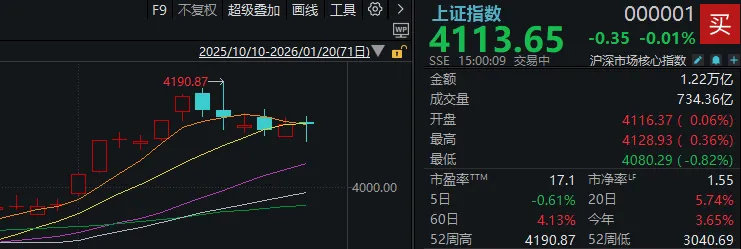
Market Overview - The three major indices in the A-share market collectively declined, with the ChiNext index dropping over 2% at one point. The Shanghai Composite Index closed down 0.01%, the Shenzhen Component Index down 0.97%, and the ChiNext Index down 1.79% [1] - Over 3,100 stocks in the market experienced declines, with total trading volume reaching 2.78 trillion yuan, an increase of 694 billion yuan compared to the previous trading day [1] Sector Performance - The chemical sector showed strong performance, while precious metals continued their upward trend, and the real estate sector was active. Conversely, sectors such as computing hardware and commercial aerospace saw significant declines [1] - The average stock price across the A-share market recorded its second bearish signal for 2026, indicating a cooling trend [3] External Influences - Concerns from the U.S. stock market, particularly due to negative sentiment stemming from news related to Japan and Greenland, affected the Asia-Pacific markets [4] - Japan's Prime Minister announced the dissolution of the House of Representatives for elections, leading to a sell-off in long-term Japanese government bonds and rising yields [5] - The impending U.S. tariffs on Greenland are contributing to increasing trade tensions, which may impact demand for U.S. assets and accelerate declines in global bond prices [5] A-share Market Dynamics - The financing buy-in amount for A-shares dropped to 267.4 billion yuan on January 19, down 20.35% from the previous Friday and 40.68% from the peak of 450.8 billion yuan on January 14 [6] - There has been a significant outflow of funds from stock ETFs, with over 400 billion yuan net outflow recorded, marking the third consecutive day of substantial outflows [8] Stock Trends - The market has seen a shift in trading dynamics, with a notable cooling in aggressive short-term trading styles. The number of consecutive daily limit-up stocks has decreased from six to three [9] - Technology stocks, particularly in computing hardware and AI applications, have generally retreated, while sectors like precious metals and chemicals have shown gains [9] Policy and Industry Insights - The Ministry of Industry and Information Technology and other departments have issued guidelines to promote zero-carbon factory construction, which is expected to support the green transformation and high-quality development of the chemical industry [11] - Analysts suggest that the Chinese chemical industry may experience a revaluation due to reduced capacity expansion, potentially leading to higher dividend yields and a shift from being a cash-consuming sector to a cash-generating one [11]

反直觉!春节前哪些业绩线能成为强压下的“避风港”?
格隆汇APP· 2026-01-20 08:55
Core Viewpoint - The article emphasizes the importance of focusing on performance metrics rather than speculative stories in the current cautious market environment, especially as the Chinese New Year approaches. It suggests that investors should look for stocks with solid earnings forecasts, but also consider valuation, institutional holdings, industry trends, and potential catalysts before making investment decisions [5][6]. Group 1: Investment Strategy - Investors should avoid the misconception that good performance guarantees profitability, as demonstrated by a case where a CXO company saw a 40% increase in net profit but had already experienced an 80% stock price increase prior to the announcement, leading to a sell-off [6][8]. - Key selection criteria for stocks include marginal performance improvement, low valuation (below the 30th percentile), concentrated institutional holdings, and industry catalysts, supported by favorable policies [8]. Group 2: Sector Analysis - **AI Power and Computing Infrastructure**: The demand for AI-related power and computing infrastructure is strong, with a projected 40% increase in investment from the State Grid during the 14th Five-Year Plan. Companies in this sector are expected to have stable earnings and low valuations [10]. - **Semiconductors and AI Applications**: The semiconductor market is expected to recover in 2025, with a projected global market size of $697 billion, driven by domestic substitution and AI infrastructure needs. Companies with solid order backlogs should be prioritized [13]. - **Robotics**: The robotics sector is gaining attention from institutional investors, with a focus on companies that have substantial orders and clean shareholding structures. The sector is expected to benefit from increased automation in manufacturing by 2026 [14]. - **Non-Ferrous Chemicals**: The non-ferrous sector is linked to the demand for new energy and AI infrastructure, with potential recovery in demand for industrial metals like copper and aluminum by 2025 [15]. - **Commercial Aerospace and Satellites**: Despite recent stock price corrections, the long-term outlook for the aerospace sector remains positive, with upcoming satellite launches and applications expected to drive performance [16]. - **Non-Bank Financials**: The brokerage sector is expected to benefit from increased market activity, with estimates of net profit for CITIC Securities reaching 30.05 billion yuan in 2025, a 38.46% increase [18]. - **CXO in Pharmaceuticals**: The pharmaceutical sector should focus on CXO companies with solid performance metrics, as the global biopharmaceutical investment is expected to reach $63.88 billion in 2025, a 10.13% increase [20]. - **Cash Flow and Dividend Stocks**: In a cautious market, stocks with stable cash flow and high dividend yields (over 4%) are recommended as defensive positions [23]. - **Overseas Expansion**: Companies with strong overseas channels and brand power are positioned to benefit from global market growth, particularly in manufacturing sectors [24]. Group 3: Portfolio Management - Investors are advised to diversify their portfolios, suggesting a mix of 50% growth stocks, 30% defensive value stocks, and 20% turnaround opportunities to mitigate risks in a volatile market [28].

商业航天上演过山车行情 板块加速“去伪存真”
Di Yi Cai Jing· 2026-01-20 08:52
Core Viewpoint - The commercial aerospace sector experienced a significant downturn on January 20, with many stocks hitting their daily limit down, marking the end of a month-long rally. The sector's volatility is attributed to a combination of policy changes, clarifications of business relevance, and recent launch failures [1][2][3] Market Performance - As of January 20, the commercial aerospace sector index (BK0963) fell over 3.2%, with individual stocks like Xice Testing (301306.SZ) and Aerospace Hongtu (688066.SH) dropping more than 11%. A total of 11 stocks hit their daily limit down, while others like Aerospace HuanYu (688523.SH) and Shenglu Communication (002446.SZ) saw declines exceeding 8% [2][3] - The index has decreased from above 3100 points on January 12 to around 2790 points, ending a rapid rise that began in late November 2025 when it climbed from approximately 1900 points. By December 2025, at least 10 stocks had doubled in price [2][3] Factors Influencing Market Changes - The recent market correction is influenced by multiple factors, including over 20 listed companies issuing risk warnings or clarifications about their lack of substantial involvement in commercial aerospace. For instance, Aerospace Hongtu stated that a strategic cooperation agreement signed in July 2023 has not led to any significant business collaboration [3][6] - The sector faced setbacks with launch failures, including the Long March 3B rocket's mission failure and the unsuccessful maiden flight of the private commercial rocket by Star River Power [3][4] Policy and Industry Developments - The previous surge in the sector was driven by favorable policies, such as China's application for 203,000 new satellites, marking a significant resource declaration in the global aerospace sector. Additionally, the Shanghai Stock Exchange announced that commercial rocket companies could apply for IPOs under specific standards [4][5] - Recent developments indicate that several companies with core technology capabilities are in the IPO preparation stage, although many have not yet gone public [6][9] Financial Challenges - Financial data reveals that companies in the sector are facing significant challenges. For example, Blue Arrow Aerospace reported net losses of 8.21 billion yuan in 2022 and projected losses of 12.16 billion yuan in 2023, with cumulative losses exceeding 35 billion yuan over three and a half years [7][8] - The commercial viability of the sector is constrained by the need for low-cost and high-reliability technologies, where domestic capabilities still lag behind international competitors like SpaceX [8][9] Investor Sentiment and Future Outlook - Despite the recent downturn, long-term prospects for the commercial aerospace sector remain positive, with investors encouraged to focus on companies with core technological capabilities and commercial potential. The market is transitioning from speculative enthusiasm to more cautious value assessment [9][10] - Analysts suggest that the current market dynamics may resemble those of the new energy sector, with ongoing policy support and potential for profitability improvements, indicating that the sector may continue to experience fluctuations in the short to medium term [9][10]
两头堵 | 谈股论金
水皮More· 2026-01-20 08:49
Market Overview - The A-share market showed a mixed performance today, with the Shanghai Composite Index slightly down by 0.01% closing at 4113.65 points, while the Shenzhen Component Index fell by 0.97% to 14155.63 points, and the ChiNext Index dropped by 1.79% to 3277.98 points [2][6] - The total trading volume in the Shanghai, Shenzhen, and Beijing markets reached 280.44 billion, an increase of 72 billion compared to the previous day [2] Market Dynamics - The market is experiencing a cooling trend, which can occur through either active or passive means. Currently, the market is responding rationally to regulatory signals, with state-owned entities playing a significant role in guiding market trends [4] - The broad-based ETFs, particularly the CSI 1000 ETF, have taken a leading role in market movements, indicating a shift in investment focus towards low-valuation sectors [4] Sector Performance - Significant outflows were observed in sectors such as CPU-related stocks, with NewEase ranked first in capital outflow. The photovoltaic sector also saw over 7 billion in outflows, affecting major stocks like Longi Green Energy and Tongwei Co. [5] - In contrast, sectors related to real estate, such as building materials and construction, showed relative stability, suggesting a migration of funds towards undervalued sectors [5] Regulatory Impact - The current regulatory approach aims to suppress excessive speculation in individual stocks by allowing indices to adjust moderately, which is intended to maintain a stable market environment leading up to the Spring Festival [6] - The overall market sentiment reflects a clear cooling trend, with a net outflow of nearly 100 billion in major funds, indicating the core objective of regulatory measures [6]

商业航天上演过山车行情,板块加速“去伪存真”
Di Yi Cai Jing· 2026-01-20 08:48
Core Viewpoint - The commercial aerospace sector experienced a significant downturn on January 20, with many stocks hitting their daily limit down, marking the end of a month-long rally. The sector's volatility is attributed to a combination of policy changes, clarifications of business relevance, and recent launch failures [1][2][3]. Market Performance - As of January 20, the commercial aerospace sector index (BK0963) fell over 3.2%, with individual stocks like Xice Testing (301306.SZ) and Aerospace Hongtu (688066.SH) dropping more than 11%. A total of 11 stocks hit their daily limit down, while others like Aerospace Huanyu (688523.SH) and Shenglu Communication (002446.SZ) saw declines exceeding 8% [2][3]. - The index has decreased from above 3100 points on January 12 to around 2790 points, ending a rapid rise that began in late November 2025, during which at least 10 stocks doubled in price [2][3]. Factors Influencing Market Changes - The recent market cooling is attributed to multiple factors, including over 20 companies issuing risk warnings or clarifications about their lack of substantial involvement in commercial aerospace. For instance, Aerospace Hongtu stated that its strategic cooperation with a space technology company has not led to any significant business collaboration [3][6]. - The sector faced setbacks with launch failures, including the Long March 3B rocket and the private commercial rocket from Star River Power, which both experienced mission failures [3][4]. Policy and Industry Developments - The previous surge in the sector was driven by favorable policies, such as China's application for 203,000 new satellites, the largest in recent years, and the Shanghai Stock Exchange's announcement allowing commercial rocket companies to apply for IPOs under specific standards [4][5]. - Recent developments indicate that several companies with core technology capabilities are in the IPO preparation stage, although many have not yet gone public [6][7]. Financial Challenges - Financial data reveals significant challenges for companies in the sector. For example, Blue Arrow Aerospace reported net losses of 8.21 billion yuan in 2022, 12.16 billion yuan in 2023, and 9.16 billion yuan in 2024, with a total loss exceeding 35 billion yuan over three and a half years [7][8]. - The commercial viability of these companies is hindered by their early-stage development and the high costs associated with rocket technology, which still lag behind international competitors [8]. Future Outlook - Despite the recent downturn, long-term prospects for the commercial aerospace sector remain positive, with industry experts suggesting that the current market correction may help identify companies with genuine technological capabilities and commercial potential [9]. - Analysts believe that the sector may experience a recovery similar to the renewable energy market, driven by ongoing policy support and potential improvements in profitability [9].


股评两头堵 | 谈股论金
Xin Lang Cai Jing· 2026-01-20 08:39
Group 1 - The market is experiencing a cooling trend, which can occur through either active or passive means, with the current situation reflecting a relatively rational market response to regulatory signals [1] - The China Securities 1000 ETF played a leading role in the market today, influencing the overall market trend alongside other major ETFs [1] - Structural differences in the market are notable, with major state-owned enterprises and financial stocks maintaining positive performance, while broad-based ETFs exerted downward pressure on speculative stocks [1] Group 2 - Significant capital outflows were observed in sectors such as CPU-related stocks and the photovoltaic sector, with over 7 billion yuan flowing out of the latter [2] - In contrast, sectors related to real estate, such as building materials and construction, showed relative stability, indicating a shift of funds towards undervalued sectors [2] - The regulatory goal is to suppress excessive speculation in individual stocks by gradually adjusting major indices to influence market sentiment [2] Group 3 - The market indices showed a clear cooling trend, with the Shanghai Composite Index down 0.01%, the Shenzhen Component down 0.97%, and the ChiNext Index down 1.79% [3] - The total trading volume reached 2.77 trillion yuan, with a net outflow of nearly 100 billion yuan, reflecting the core objective of regulatory cooling [3] - The current adjustment aims to maintain a stable market outlook before the Spring Festival while avoiding excessive market bubbles [3]
商业航天第一波人赚钱了
投资界· 2026-01-20 08:21
Core Viewpoint - The commercial space industry is experiencing a significant surge, with multiple companies preparing for IPOs, indicating a potential boom in investment opportunities in this sector [2][9]. Group 1: IPO Developments - Blue Arrow Aerospace's IPO application was accepted in just 156 days, setting a new record for the Sci-Tech Innovation Board [2]. - Several commercial space companies, including Blue Arrow Aerospace and Zhongke Aerospace, are in the process of preparing for IPOs, with around 10 companies aiming for listings [2][9]. - The anticipated IPOs are expected to raise substantial capital, with Blue Arrow Aerospace planning to raise 7.5 billion yuan [4]. Group 2: Investment Opportunities - Jin Feng Technology's investment in Blue Arrow Aerospace has resulted in a significant increase in market value, with Jin Feng's market capitalization rising by over 60 billion yuan in just six trading days [5][6]. - Jin Feng Technology initially invested 150 million yuan in Blue Arrow Aerospace, which has now appreciated to a book value of 812 million yuan, indicating a substantial return on investment [4]. - The commercial space sector has seen a wave of stock price increases, with several companies experiencing significant gains, reflecting the wealth effect from the upcoming IPOs [6][9]. Group 3: Market Sentiment - There is a growing sense of urgency among investors to capitalize on the upcoming IPOs in the commercial space sector, with many expressing concerns about missing out on potential gains [8][10]. - The market is witnessing increased activity in secondary share transactions, as investors seek to acquire stakes in companies with strong IPO prospects [7][8]. - The sentiment in the investment community is that the commercial space sector could be the next major wave of IPOs, similar to the recent surge in GPU-related listings [9].


收评:港股恒指跌0.29% 科指跌1.16% 黄金股普涨 商业航天概念走弱
Xin Lang Cai Jing· 2026-01-20 08:11
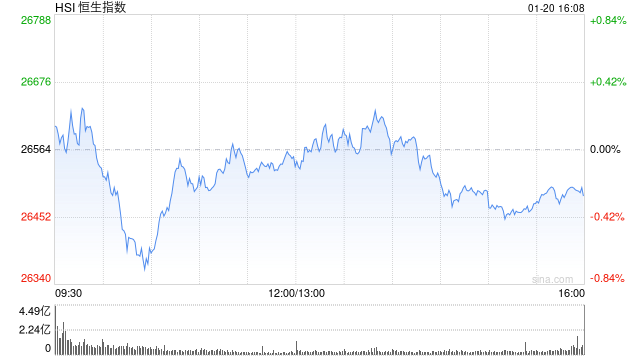
Market Overview - The Hong Kong stock market indices collectively declined, with the Hang Seng Index falling by 0.29% to 26,487.51 points, the Hang Seng Tech Index down by 1.16%, and the National Enterprises Index decreasing by 0.43% [2][7]. Sector Performance - Technology stocks experienced a mixed performance, with Xiaomi dropping over 2%, Tencent and Meituan down more than 1%, while Baidu saw an increase of nearly 1% [2][7]. - Gold stocks generally rose, with Zijin Mining International increasing by over 5%. Spot gold prices surged, breaking the $4,700 mark, reaching a new historical high [3][8]. - The commercial aerospace sector weakened, with Asia Pacific Satellite falling over 6%. Regulatory comments indicated that the "cooling" of the market is aimed at eliminating bubbles and directing funds towards quality assets [4][9]. - Biopharmaceutical stocks continued to retreat, with WuXi AppTec declining over 3%. Positive developments in the innovative drug sector were noted during the JPM conference, with multinational pharmaceutical companies and biotech firms revealing new pipeline layouts and significant transactions [4][9].
烟台市政协委员滕瑶:打造“国际临空岛”,拥抱临近空间产业蓝海
Qi Lu Wan Bao· 2026-01-20 08:05
Core Viewpoint - The government work report emphasizes the active development of the near-space industry and aims to complete over 10 rocket launches and tests by 2026, marking a significant shift in the aerospace industry in Yantai [1][4]. Group 1: Government Initiatives - The report highlights Yantai's unique position as the only offshore launch mother port in China, leveraging commercial aerospace as a technological support and near-space industry as an extension [3][10]. - The government aims to accelerate the integration of the Dongfang Spaceport into the national commercial aerospace layout, establishing a demonstration service system for the "Dongfang Huiyan" remote sensing constellation [4][5]. Group 2: Commercial Aerospace Development - Yantai's commercial aerospace development began with its first offshore rocket launch in 2019, leading to the establishment of 32 aerospace projects and a production capacity of 50 solid rockets annually [5][9]. - The successful recovery of rockets at sea is expected to significantly reduce costs and improve launch frequency, aligning with the trend towards reusable, high-frequency, and low-cost rockets [9][12]. Group 3: Near-Space Industry - The near-space industry, defined as the airspace below 200 kilometers, is seen as a new blue ocean for industrial upgrading, providing long-term observation capabilities that complement satellite functions [8][9]. - The industry is expected to support various applications, including meteorological forecasting and emergency rescue, with a comprehensive supply chain from raw materials to operational services [9][10]. Group 4: International Near-Space Island - The initiative to create an "International Near-Space Island" aims to integrate space and near-space resources, establishing a national-level industrial demonstration zone [10][11]. - The development of this industry requires collaboration among policies, talent, and capital, with proposals for optimizing talent cultivation and attracting social capital to support commercial aerospace growth [11][12]. Group 5: Future Outlook - The commercial aerospace and near-space industries are projected to become core growth drivers for Yantai's economy during the 14th Five-Year Plan, transitioning the city from a marine economy to a strong aerospace hub [12].

长城基金尤国梁:商业航天后续或仍有诸多催化
Xin Lang Cai Jing· 2026-01-20 08:00
Core Viewpoint - The commercial aerospace sector is experiencing a capital surge in early 2026, with active performance in related stocks, although there has been a recent cooling off after a period of rapid growth [1][8]. Group 1: Market Dynamics - The recent fluctuations in the commercial aerospace sector are normal and do not indicate a trend reversal, as the previous surge was driven by multiple factors including industrial transformation, favorable policies, and international developments [2][10]. - Key events that contributed to the previous rise include a significant increase in rocket launch frequency in the second half of last year and the successful launch of reusable rockets, which addressed domestic capacity constraints and laid the foundation for commercialization [2][10]. - The government has recognized commercial aerospace as one of the three strategic emerging industries, highlighting its importance in national planning and strategy [2][10]. Group 2: Future Catalysts - There are still numerous positive events expected to catalyze the sector, such as successful recovery of reusable rockets, low-orbit communication satellite applications, second-generation satellite tenders, and IPOs of key commercial aerospace companies [2][10]. - The future market dynamics will likely depend on which sector—rockets, satellite manufacturing, or applications—experiences significant advancements or catalysts [3][11]. Group 3: Growth Potential - Commercial aerospace is viewed as a burgeoning industry with substantial growth potential, particularly in low-orbit satellite internet, which has already connected a large user base and demonstrated viable business models [4][12]. - The industry chain is extensive, involving various segments such as satellite research and manufacturing, rocket production and launch, ground equipment, and satellite application services [4][13]. - The development of satellite applications and services is expected to mirror telecommunications operators, potentially capturing greater value in the long term [4][13]. Group 4: Investment Considerations - Valuation concerns exist within the commercial aerospace sector, as the overall industry valuation was already high before the recent market surge [5][14]. - The market tends to price new industries based on long-term growth potential rather than current financial metrics, necessitating ongoing assessment of industry developments [5][14]. - Investors should differentiate between temporary market corrections and long-term risks, focusing on companies with competitive advantages and technological barriers while avoiding speculative investments [6][14].