
计算机

Search documents
——基金市场与ESG产品周报20260309:行业主题基金净值回调,周期主题、商品ETF资金大幅净流入-20260309
EBSCN· 2026-03-09 05:49
- The report does not contain any quantitative models or factors related to quantitative analysis[1][2][3]

信用业务周报:地缘冲突或如何影响大类资产?-20260309
ZHONGTAI SECURITIES· 2026-03-09 05:32
1. Report Industry Investment Rating - Not provided in the content 2. Core Viewpoints of the Report - The recent escalation of the US-Iran conflict has led the global capital market to enter a phase of geopolitical risk repricing. Different durations of military conflicts have different impacts on major asset classes. Short - term conflicts cause a pulse - like increase in volatility, medium - term regional wars lead to supply shortages and trend - like movements in safe - haven assets, and long - term confrontations have far - reaching impacts on the global economy. For A - shares, short - term impacts are mainly through risk - preference and sentiment, while in the medium and long term, A - shares are still mainly driven by their own logic [5][8] - Short - term, the escalation of the US - Iran conflict may cause short - term shocks to A - shares, with defensive sectors strengthening and high - elasticity sectors correcting. Medium - term, the core variable is whether the conflict affects the Strait of Hormuz, leading to structural differentiation. Long - term, external geopolitical disturbances will not change the trend of A - shares returning to the domestic economic fundamentals, but will strengthen the allocation consensus on long - term investment themes [8] 3. Summary by Relevant Catalogs Market Review - **Market Performance**: Last week, most major market indices declined, with the Shanghai Composite Index performing relatively well, down 0.93% week - on - week. Among major industry indices, the energy and public utility indices performed well, up 7.38% and 3.44% respectively, while the telecommunications service and information technology indices were weak, down 5.23% and 4.35% respectively. Among the 30 Shenwan primary industries, 6 industries rose, with the petroleum and petrochemical, coal, and public utility industries rising 8.06%, 3.79%, and 3.42% respectively. The media, non - ferrous metals, and computer industries fell 6.97%, 5.47%, and 5.29% respectively [9][16][18] - **Trading Heat**: The average daily trading volume of the Wind All - A Index last week was 26446.19 billion yuan (previous value was 24402.93 billion yuan), at a relatively high historical level (96.70% of the three - year historical quantile) [21] - **Valuation Tracking**: As of March 6, 2026, the valuation (PE_TTM) of the Wind All - A Index was 23.43, down 0.28 from last week, at the 98.90% quantile of the past 5 years. Among the 30 Shenwan primary industries, 6 industries' valuations (PE_TTM) recovered [25] Market Observation - **How Major Asset Classes May Evolve After Geopolitical Conflicts**: Short - term conflicts (within one month) lead to a pulse - like increase in major asset volatility, with "safe - haven trading" as the main theme. For example, after the 2019 attack on Saudi Aramco's facilities, the Brent crude oil price rose sharply but quickly returned to fundamental pricing. Safe - haven trading was mainly focused on the US dollar rather than gold. If the conflict turns into a regional war lasting more than two months, the supply gap in the crude oil market will be persistent, and safe - haven assets will show a trend - like performance. For example, during the 2011 Libyan civil war, the oil price rose significantly, and gold and US Treasury bond prices increased for more than half a year. When the conflict becomes a long - term confrontation lasting several years, it will have a profound impact on the global economy. For example, after the Russia - Ukraine conflict entered the long - term stage in the second half of 2022, it led to European energy - supply structure adjustments. For A - shares, short - term impacts are mainly through risk - preference and sentiment, while in the medium and long term, A - shares are mainly driven by their own logic [5][8] - **Investment Recommendations**: Short - term, the escalation of the US - Iran conflict may cause short - term shocks to A - shares, with defensive sectors strengthening and high - elasticity sectors correcting. Beneficial assets include crude oil and natural gas. Medium - term, the core variable is whether the conflict affects the Strait of Hormuz, leading to structural differentiation. Beneficial assets include shipping, public utilities, and military industries. Long - term, external geopolitical disturbances will not change the trend of A - shares returning to the domestic economic fundamentals, but will strengthen the allocation consensus on long - term investment themes such as domestic substitution, national security, and industrial upgrading [8]
廖市无双-地缘冲击下-中线调整是否开启
2026-03-09 05:18
Summary of Conference Call Notes Industry or Company Involved - The notes primarily discuss the Chinese stock market, focusing on various sectors including technology, energy, and finance, as well as macroeconomic factors affecting these industries. Core Points and Arguments 1. **Market Conditions**: The market is in a consolidation phase, with expectations for the Shanghai Composite Index to stabilize around 4,000 points by mid to late March. The small-cap growth index may continue to adjust until late April due to earnings pressure and divergence signals [1][2][3]. 2. **Sector Performance**: - **Technology and Growth**: The technology sector, particularly chips and small-cap indices, is showing signs of weakness with confirmed MACD divergence. The ChiNext Index and STAR 50 have also experienced significant declines [5][8]. - **Energy Transition**: Geopolitical tensions are boosting traditional energy sectors (oil, coal), but caution is advised against chasing high prices in oil and petrochemicals. Renewable energy, particularly power and grid equipment, remains a focus for potential investment opportunities [1][19]. - **Defensive Stocks**: The banking sector has completed a five-wave decline and shows potential for a 6%-8% rebound, making it a defensive choice in the current market [1][18]. 3. **Market Dynamics**: The market is expected to experience a triangular consolidation pattern, with the Shanghai Composite Index potentially testing the 4,000-point level. The Hang Seng Technology Index is also under pressure but has found support near the 500-day moving average [3][14]. 4. **Investment Strategy**: - A balanced approach is recommended, maintaining mid-term positions while controlling portfolio elasticity. The focus should be on sectors with defensive characteristics and potential for recovery [18][19]. - The banking sector is highlighted as a short-term buy point due to its defensive nature and recent bottoming signals [18]. 5. **Geopolitical Impact**: The ongoing geopolitical tensions are influencing market sentiment and sector performance, particularly in energy and technology. The potential for further escalation could lead to increased volatility [6][19]. Other Important but Possibly Overlooked Content 1. **Sector Rotation**: The notes indicate a clear sector rotation, with traditional energy and dividend-paying stocks outperforming, while technology and cyclical sectors lag behind [6][27]. 2. **Technical Signals**: The presence of MACD divergence in several indices suggests caution, particularly in technology and growth sectors, indicating potential for further declines [5][9]. 3. **ETF Trends**: The increase in ETF shares, particularly in the securities sector, reflects a growing interest in these assets, indicating a shift in market sentiment [24]. 4. **Future Outlook**: The notes suggest that the market may stabilize by late March, with a potential for a more robust recovery if certain conditions are met, particularly in the banking and energy sectors [14][18]. This summary encapsulates the key insights and strategic recommendations from the conference call, providing a comprehensive overview of the current market landscape and future expectations.
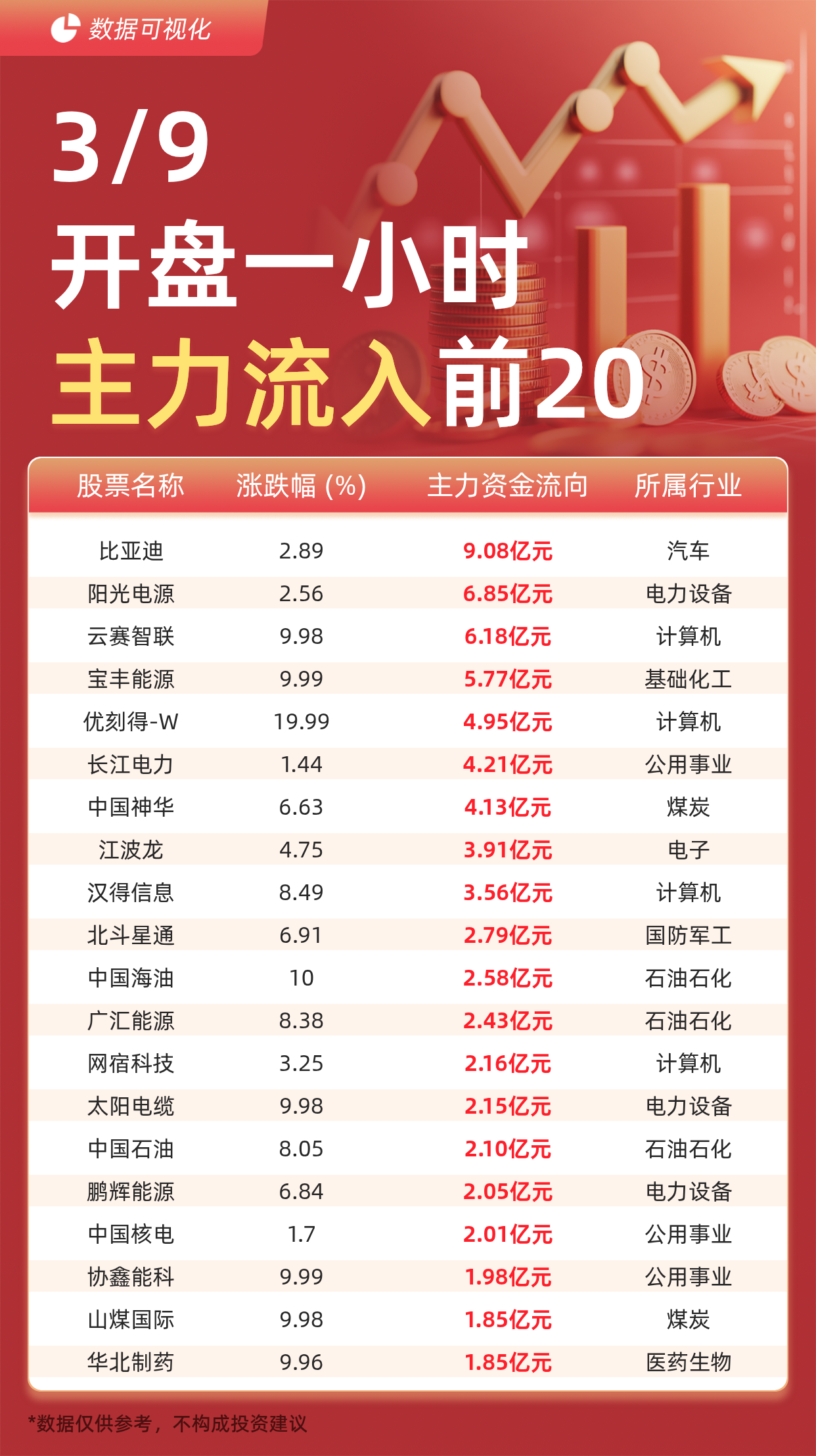
主力资金流入前20:比亚迪流入9.08亿元、阳光电源流入6.85亿元
Jin Rong Jie· 2026-03-09 02:41
Group 1 - The main stocks with significant capital inflow include BYD (9.08 billion), Sungrow Power (6.85 billion), and YunSai ZhiLian (6.18 billion) [1] - The top performing stocks by percentage increase are Baofeng Energy (9.99%), YK Technology-W (19.99%), and YunSai ZhiLian (9.98%) [2][3] - The sectors represented in the top inflow stocks include automotive, power equipment, computer, and coal [2][3] Group 2 - BYD leads with a capital inflow of 9.08 billion and a price increase of 2.89% [2] - Sungrow Power has a capital inflow of 6.85 billion with a price increase of 2.56% [2] - The total capital inflow for the top 20 stocks reflects strong investor interest across various sectors [1]




涂鸦智能(TUYA):主营业务稳健,AI战略稳步推进
GUOTAI HAITONG SECURITIES· 2026-03-08 15:19
Investment Rating - The report maintains a rating of "Buy" for Tuya Smart (TUYA.N) [1] Core Insights - The company demonstrates robust revenue growth and significant improvement in profitability, with a notable increase in AI developers and substantial progress in its AI strategy [2][3] - The company is expected to achieve revenues of $354.04 million, $393.54 million, and $445.44 million for the years 2026, 2027, and 2028 respectively, reflecting year-on-year growth rates of 10.0%, 11.2%, and 13.2% [4][8] - The net profit is projected to rise significantly, reaching $67.86 million, $80.48 million, and $96.74 million for the years 2026, 2027, and 2028, with growth rates of 17.2%, 18.6%, and 20.2% respectively [4][8] Financial Summary - Total revenue for 2025 is forecasted at $321.79 million, representing a year-on-year increase of 7.8%. The PaaS business is expected to generate $231.2 million, up 6.5%, while the SaaS business is projected to reach $44.9 million, growing by 13.4% [4][8] - The overall gross margin is anticipated to be 48.2%, an increase of 0.8 percentage points year-on-year, with a net profit of $57.89 million for 2025 [4][8] - The company has approximately 3,000 PaaS platform customers, with premium customers contributing about 88.3% of PaaS revenue, and over 1.8 million AI developers, marking a 37% increase from 2024 [8] AI Strategy Progress - The number of AI developers on the platform has significantly increased, with the company launching around 16,000 AI agents and new products such as the AI Life Assistant and Physical AI Engine (PAE), indicating a shift towards replicable AI applications and monetizable products [8] - The expansion of the AI ecosystem is seen as a crucial foundation for future commercialization, with the dual drivers of PaaS platform connectivity and AI empowerment being central to the company's sustained growth [8]

开源证券晨会纪要-20260308
KAIYUAN SECURITIES· 2026-03-08 14:44
Core Insights - The report highlights the resilience of the Chinese economy amidst increasing internal and external uncertainties, emphasizing the need for structural reforms and a focus on quality growth [12][19] - The government has set a GDP growth target of 4.5%-5% for 2026, indicating a shift towards optimizing supply and enhancing price stability [13][25] - The report discusses the impact of geopolitical tensions, particularly in the Middle East, on global oil prices and inflation, which could influence monetary policy decisions by the Federal Reserve [9][10] Macro Economic Analysis - The U.S. labor market shows signs of pressure with a decrease of 92,000 non-farm jobs in February, which is below market expectations, indicating a potential slowdown in economic growth [5][8] - The unemployment rate in the U.S. rose slightly to 4.4%, while wage growth remains stable, suggesting that inflationary pressures may persist [6][7] - The report suggests that the Federal Reserve is likely to maintain a wait-and-see approach due to the current labor market conditions and geopolitical risks [8][10] Industry Insights - The AI sector is experiencing rapid evolution, with applications transitioning from chat-based systems to more complex agent-based models, which is expected to drive demand for cloud computing and related services [33][42] - The automotive industry, particularly in the realm of autonomous driving, is poised for growth as companies like Xiaoma Zhixing achieve operational profitability with their Robotaxi services [34][39] - The food and beverage sector is anticipated to benefit from government policies aimed at boosting consumption and enhancing supply chain dynamics, particularly in essential consumer goods [47][48] Investment Strategies - The report recommends focusing on companies that are leading in AI application and cloud infrastructure, as well as those involved in the autonomous vehicle supply chain [33][34][45] - It suggests that the food and beverage industry will see a recovery driven by increased consumer spending and supportive government policies [47] - The report emphasizes the importance of structural reforms in enhancing the quality of growth and addressing supply-side challenges in various sectors [12][25][28]
主动量化周报:3月微盘仍将强势,4月回归主线行情
ZHESHANG SECURITIES· 2026-03-08 13:25
Investment Rating - The industry investment rating indicates a positive outlook, with expectations for the industry index to outperform the CSI 300 index by more than 10% [28] Core Insights - In March, the main sectors are expected to see a slowdown in capital inflow, while the micro-market is likely to maintain its strength [10][12] - Geopolitical risks, particularly from the Israel-Iran situation, have influenced A-share movements, with a notable decline in the ETF risk preference index, indicating a downward trend in market risk appetite [11] - The rise in oil prices has not been accompanied by a corresponding drop in equity assets, suggesting that underlying risks may still persist [11] - The report recommends focusing on sectors benefiting from price increases, particularly agriculture, forestry, animal husbandry, and transportation [11] Summary by Sections 1. Weekly Insights - The main sectors are experiencing a decrease in capital inflow, with a potential shift towards smaller market capitalizations [10] - The micro-market is expected to continue its strong performance due to structural capital inflows from newly issued and existing quantitative products [12] 2. Timing - The A-share index has shown a slight decline of 0.93% over the past week, indicating a marginal upward trend in daily movements [14] - The activity level of informed traders has decreased, reflecting a cautious outlook for the market [15] 3. Industry Monitoring - Significant net inflows were observed in the oil, transportation, and non-ferrous metal sectors, with net inflows of 31.2 billion, 25.3 billion, and 23.4 billion respectively [19] - Conversely, the electronics, computer, and power equipment sectors experienced notable net outflows of 84.7 billion, 45.5 billion, and 38.0 billion respectively [19] 4. Style Monitoring - The report highlights a shift in market preferences, with value stocks outperforming growth stocks this week [25] - High-quality earnings assets have shown continued excess returns, while high turnover stocks have underperformed the market average [25]
解读两会政府工作报告及“十五五”规划《纲要(草案)》
Guotou Securities· 2026-03-08 12:53
Investment Rating - The industry investment rating is "Outperform the Market - A" [5] Core Insights - The government work report and the "14th Five-Year Plan" outline a strong emphasis on technological innovation and new productivity, providing clear investment direction for the computer industry and the broader technology sector [1][11] - The report highlights the importance of fostering new momentum and accelerating high-level technological self-reliance, focusing on emerging industries, smart economy, and self-sufficiency in core technologies [2][12] - The concept of "smart economy" is introduced, emphasizing the integration of AI into various industries, which is expected to create significant investment opportunities as AI applications move into commercialization [3][13] - The "14th Five-Year Plan" prioritizes technological innovation and digital development as major national strategic tasks, reflecting the importance of new productivity [14] Summary by Sections Government Work Report - The report reviews the achievements of 2025, emphasizing advancements in AI, robotics, and quantum technology, and outlines tasks for 2026, including support for small and medium enterprises in digital transformation and the establishment of smart factories [11][12] - It identifies key investment directions such as digitalization, smart manufacturing, quantum technology, and embodied intelligence [2][12] "14th Five-Year Plan" - The plan categorizes technological innovation and digital development as critical strategic tasks, aiming to build a new industrial development sequence that includes strategic emerging industries and future industries [14] - It encourages the development of industries like integrated circuits, aerospace, and biomedicine, while also focusing on future industries such as quantum technology and brain-computer interfaces [14] Market Performance - The computer sector has underperformed relative to the broader market indices, with a decline of 5.48% in the past week, while the Shanghai Composite Index fell by 0.93% [15][16] - The computer industry index ranked 29th among 30 industry indices, indicating weaker performance compared to other sectors [18] Investment Recommendations - Suggested areas for investment include quantum technology, embodied intelligence, 6G, and AI-related applications, models, and data, as well as tools that empower research and innovation [3][14]
主动量化周报:3月微盘仍将强势,4月回归主线行情-20260308
ZHESHANG SECURITIES· 2026-03-08 12:48
Quantitative Models and Construction Methods 1. **Model Name**: Five-Dimensional Industry Allocation Model - **Model Construction Idea**: The model is designed to identify industry allocation opportunities by analyzing five dimensions of market data. - **Model Construction Process**: The specific construction process of the model is not detailed in the report, but it is used to recommend industries based on the latest results. For example, the model suggests focusing on the diffusion of price increase logic to low-level sectors, such as agriculture, forestry, animal husbandry, fishery, and transportation industries[1][11]. - **Model Evaluation**: The model is effective in identifying structural opportunities in the market under specific conditions, such as geopolitical risks and market volatility[11]. 2. **Model Name**: Industry Rotation Strategy Based on Consensus Forecast Net Profit FTTM QoQ - **Model Construction Idea**: This model uses the quarter-on-quarter (QoQ) change in forward twelve-month (FTTM) consensus forecast net profit as an industry screening indicator to construct an industry rotation strategy. - **Model Construction Process**: - The model selects industries based on the QoQ change in FTTM consensus forecast net profit. - Historical backtesting was conducted over the period from 2019 to 2025. - **Model Evaluation**: The model demonstrates strong effectiveness during earnings seasons, with the highest median excess return in April compared to other months[13]. --- Model Backtesting Results 1. **Five-Dimensional Industry Allocation Model**: No specific backtesting results or numerical values are provided in the report. 2. **Industry Rotation Strategy Based on Consensus Forecast Net Profit FTTM QoQ**: - Backtesting period: 2019-2025 - Median excess return in April: 2.4%, the highest among all months[13] --- Quantitative Factors and Construction Methods 1. **Factor Name**: BARRA Style Factors - **Factor Construction Idea**: The BARRA style factors are used to analyze market preferences and style shifts during periods of market adjustment. - **Factor Construction Process**: - The factors include turnover, financial leverage, earnings volatility, earnings quality, profitability, investment quality, long-term reversal, EP value, BP value, growth, momentum, non-linear market capitalization, market capitalization, volatility, dispersion, and dividend yield. - The performance of these factors is monitored weekly to assess their impact on market trends[21][22]. - **Factor Evaluation**: The factors provide insights into market style preferences, such as the preference for value over growth and the performance of high-quality earnings assets during the week[25]. --- Factor Backtesting Results 1. **BARRA Style Factors**: - Turnover: -0.3% - Financial Leverage: -0.1% - Earnings Volatility: 0.0% - Earnings Quality: 0.3% - Profitability: -0.2% - Investment Quality: 0.2% - Long-Term Reversal: -0.4% - EP Value: 0.2% - BP Value: 0.2% - Growth: 0.0% - Momentum: 0.7% - Non-Linear Market Capitalization: -0.5% - Market Capitalization: -0.2% - Volatility: -0.2% - Dispersion: -1.4% - Dividend Yield: 0.0%[22][25]
策马逐牛9:把握一季报最强线索:涨价+出海
CAITONG SECURITIES· 2026-03-08 11:54
Group 1: Overview of the Two Sessions - The growth target has been adjusted downwards from 5% to a range of 4.5-5%, with a continued focus on consumption and domestic demand [2][9] - Fiscal spending is expected to remain close to last year's levels, with a total deficit of 11.9 trillion yuan for 2026, comprising a deficit of 5.89 trillion yuan, special bonds of 4.4 trillion yuan, and special treasury bonds of 1.6 trillion yuan [2][9] - Special treasury bonds of 2.5 billion yuan will be allocated for new consumption, with an additional 1 billion yuan for fiscal-financial collaborative special funds [2][9] Group 2: Performance Trading Period Post Two Sessions - The correlation between market trading signals and performance changes will strengthen after the Two Sessions, with a focus on price increases and overseas expansion [3][13] - The upcoming month will see a concentrated disclosure of annual and quarterly reports, which will significantly influence market trading styles and directions [3][13] - High-prosperity industries are expected to focus on overseas "offensive HALO" and domestic "defensive HALO" strategies [3][15] Group 3: Impact of Rising Oil Prices on Asset Classes and Industries - During the oil price upcycle, stocks and commodities tend to perform well, with a monthly increase probability of 73% for stocks and 68% for commodities [4][26] - In contrast, during the downcycle, gold becomes a focus, with a monthly increase probability of 62% [4][26] - Key cyclical industries during the oil price upcycle include food and beverage, banking, automotive, home appliances, coal, and chemicals, which show significant cyclical characteristics [4][26] Group 4: Investment Strategy Directions - The report recommends focusing on "offensive HALO" strategies, which include price increases and overseas expansion in sectors such as TDI, amino acids, and high-end manufacturing [5] - Defensive HALO strategies involve sectors with low fund holdings, such as coal and construction, as well as TMT sectors with low correlation [5] - Emerging technology sectors like commercial aerospace, domestic computing power, and quantum communication are highlighted as potential catalysts for investment [5]