创新药

Search documents
淳厚基金陈印:挖掘现金流可持续增长带来的投资机会
Zhong Guo Zheng Quan Bao· 2025-11-03 00:18
Core Insights - The article emphasizes the importance of sustainable future cash flow as a key investment principle, focusing on sectors that are expected to benefit from this trend [1][3]. Investment Philosophy - The investment philosophy centers around the principle that future cash flow should balance growth potential and risk control, with a broader definition that includes tracking the ultimate destination of funds [3]. - The analysis of cash flow is not limited to financial statements but considers macroeconomic factors that influence cash flow sustainability [3]. Sector Focus - The investment manager identifies four key sectors for potential investment opportunities: 1. **Internet Sector**: Increasing reliance on internet platforms for work and life is expected to provide stable cash flow advantages [6]. 2. **Innovative Pharmaceuticals**: The trend of overseas pharmaceutical companies acquiring early-stage options in Chinese innovative drugs is anticipated to create stable cash flow [6]. 3. **Shipping Industry**: Global trade volumes are not decreasing, and the shipping industry is expected to benefit from increased trade activities [6]. 4. **Export Chain**: Export companies are positioned to benefit from nominal growth in overseas markets while maintaining cost advantages domestically [7]. Valuation Assessment - The investment strategy involves a balanced industry allocation with slight tilts towards favored sectors, while also seeking undervalued opportunities that have not yet been recognized by the market [5]. - Valuation is a primary consideration in selecting specific stocks, with a focus on ensuring that performance growth aligns with current valuations [5]. Policy Influence - The investment manager closely monitors policy impacts, particularly in sectors that may benefit from government subsidies, which can provide additional cash flow [4].


十大券商一周策略:4000点后如何应对?盘整震荡中布局再平衡
Zheng Quan Shi Bao· 2025-11-02 22:27
Group 1 - The current index level is not as critical as the underlying quality of the market, with structural opportunities still present despite short-term fears in the technology sector [1] - The overall growth is entering a recovery phase, with improvements in net profit margins across various sectors, indicating a broadening of growth opportunities [2] - The market is expected to experience a period of consolidation, with a potential shift in investment styles as the year-end approaches [4] Group 2 - The recent U.S.-China trade discussions have alleviated external uncertainties, contributing to a positive outlook for the A-share market [5] - The focus is shifting towards internal structural optimization, with an emphasis on sectors like AI and emerging technologies for medium-term growth [6] - The market is likely to see increased volatility in the technology sector due to high allocation levels and potential style shifts [11] Group 3 - The A-share market is anticipated to maintain a bullish trend, supported by a favorable macroeconomic environment and ongoing policy support [10] - There is a notable concentration of fund holdings in technology and growth sectors, indicating strong investor interest despite potential risks [8] - The recovery in profitability is expected to solidify the bull market, with a focus on cyclical and consumer sectors for future growth [10]
淳厚基金陈印: 挖掘现金流可持续增长带来的投资机会
Zhong Guo Zheng Quan Bao· 2025-11-02 20:41
Core Insights - The article emphasizes the importance of sustainable future cash flow as a key investment principle, focusing on sectors that are expected to benefit from this trend [1][2]. Group 1: Investment Philosophy - The investment philosophy centers around the principle that future cash flow should balance growth potential and risk control [2]. - Cash flow is viewed from a macro perspective, tracking the ultimate destination of funds rather than being limited to financial statements [2]. - The performance of growth stocks in the A-share market is linked to the certainty of future cash flows, with examples like optical module stocks demonstrating this principle [2][3]. Group 2: Sector Focus - The four main sectors identified for investment opportunities include: - **Internet Sector**: Increasing reliance on internet platforms for work and life leads to stable cash flow advantages [4]. - **Innovative Pharmaceuticals**: Overseas companies are acquiring early-stage options for innovative drugs in China, providing stable cash flow to this sector [5]. - **Shipping Sector**: Global trade volumes remain stable, with opportunities arising from transshipment trade, supporting cash flow in the shipping industry [5]. - **Export Chain**: Export companies benefit from nominal growth in overseas economies while maintaining cost advantages domestically, enhancing competitiveness [5]. Group 3: Valuation and Portfolio Management - The investment strategy involves a balanced industry allocation with slight tilts towards favored sectors, while also identifying undervalued reversal opportunities [3]. - Valuation is a primary consideration in selecting specific stocks, with a focus on dynamic tracking to assess the reasonableness of valuations [3]. - Adjustments to the portfolio are made when performance growth or future orders do not align with current valuation increases [3].
挖掘现金流可持续增长带来的投资机会
Zhong Guo Zheng Quan Bao· 2025-11-02 20:16
Core Insights - The article emphasizes the importance of sustainable future cash flow as a key investment principle, focusing on sectors that are expected to benefit from this trend [1][2][3] Investment Focus Areas - The internet sector is highlighted as a key area due to its increasing reliance in work, study, and daily life, which provides a stable cash flow advantage [3][4] - The innovative pharmaceutical sector is noted for its potential cash flow stability, driven by overseas companies acquiring early-stage options for innovative drugs in China [4] - The shipping industry is seen as benefiting from global trade volumes, with increased activity through transshipment trade contributing to cash flow [4] - The export chain is identified as a sector with significant potential, as domestic companies can leverage nominal growth in overseas markets while maintaining cost advantages [4] Investment Strategy - The investment strategy involves a balanced industry allocation with slight tilts towards favored sectors, while also seeking undervalued opportunities that have not yet been recognized by the market [2][3] - Valuation is a primary consideration in selecting specific stocks, with a focus on ensuring that performance growth aligns with current valuations [3]
【十大券商一周策略】4000点后如何应对?结构性机会仍存,盘整震荡中布局再平衡
Zheng Quan Shi Bao Wang· 2025-11-02 15:37
Group 1 - The current market index is at a similar level to 2015, but with significantly better quality and lower valuation, indicating that there is no need to overly focus on the index points themselves [1] - Structural opportunities still exist in various sectors such as new energy, chemicals, consumer electronics, resources, and machinery, despite short-term investor caution primarily in the technology sector [1] - The focus for the remainder of the year should be on structural adjustments, with recommendations to invest in traditional manufacturing upgrades, Chinese companies going abroad, and edge AI [1] Group 2 - The overall growth is entering a recovery cycle, with improvements in net profit margins across various sectors due to accelerated overseas expansion and the implementation of anti-involution measures [2] - The performance of large and mid-cap stocks, which are closely related to the overall economy, shows greater earnings elasticity, indicating a positive trend in China's asset growth [2] - Certain sectors, including emerging technology and cyclical industries, are in a recovery and expansion phase, while others face excess supply pressures [2] Group 3 - The A-share market is expected to experience a period of horizontal adjustment due to the exhaustion of previous upward momentum and the upcoming policy vacuum [4] - The electronic industry and innovation sectors have seen record high allocations in fund reports, suggesting potential structural adjustments in the market [4] - Key investment areas include coal, oil and gas, new energy, non-bank financials, public utilities, media, food and beverage, and transportation [4] Group 4 - The market trend remains positive, supported by macro policies and resilient fundamentals from third-quarter earnings reports [5] - Technology companies with real technological barriers and those aligned with national strategies are expected to be key investment themes [5] - The construction of projects is anticipated to enhance the industrial chain, benefiting companies through increased orders and performance releases [5] Group 5 - The focus is shifting from macro risks to internal structural optimization following the completion of the third-quarter reports and the resolution of U.S.-China trade discussions [6] - The AI sector remains a mid-term industry focus, with potential for rotation within growth sectors [6] - Attention is drawn to industries such as non-ferrous metals, AI applications, power storage, and emerging themes like controlled nuclear fusion and commercial aerospace [6] Group 6 - The market is expected to experience short-term fluctuations and adjustments, with a long-term optimistic outlook due to stable internal and external policies [7] - The new profit growth cycle has begun, with a focus on low-base sectors that may release greater elasticity next year [7] - The technology sector's high allocation in institutional portfolios indicates a need to monitor performance and potential shifts in investment strategies [7] Group 7 - The market is undergoing a rebalancing phase, with a high concentration of active equity fund holdings in the TMT sector, indicating a shift in investor sentiment [8] - There is a growing skepticism towards capital expenditure expansion in overseas markets, while domestic industries are expected to benefit from improved operational conditions [8] - Attention is recommended for upstream resources and sectors benefiting from domestic price stabilization and economic recovery [8] Group 8 - The technology growth sector is experiencing a slowdown in short-term over-allocation, leading to increased volatility [9] - The TMT sector's allocation by funds has reached historical highs, indicating a strong focus on technology growth as a primary market driver [10] - The potential for further increases in fund allocations to the TMT sector suggests ongoing interest and investment opportunities in technology [10] Group 9 - The expectation of a shift from strategic decoupling to a phase of cooperation between the U.S. and China is likely to enhance risk appetite for RMB assets [11] - The market is not expected to experience a straightforward upward trajectory, but the overall bullish sentiment remains intact despite potential high-level fluctuations [11] - The focus on low-position cyclical sectors and overseas opportunities is anticipated to be a key investment strategy moving forward [11]
关键时刻,最新研判!
Zhong Guo Ji Jin Bao· 2025-11-02 15:25
Core Viewpoint - The Shanghai Composite Index has broken through the 4000-point mark, indicating a potential new round of a "healthy slow bull" market driven by the recovery of market confidence and structural changes in the economy [1]. Market Drivers - The primary driver for the recent market rise is the restoration of confidence in the capital market, supported by favorable policies and improved corporate earnings [18][19]. - Liquidity improvement and industry logic, particularly in technology sectors like AI and renewable energy, are significant factors driving the market [19][20]. - The market's upward movement is attributed to a combination of macroeconomic improvements, positive policy expectations, and an increase in risk appetite [19]. Sources of Incremental Capital - Incremental capital is mainly coming from long-term institutional funds, social security, and the transfer of household savings into equity markets [20][21]. - The current funding structure is healthier compared to previous years, with a notable increase in the proportion of long-term patient capital [22][23]. Main Investment Themes - The technology growth sector remains the primary focus, with AI expected to be a significant opportunity over the next 3 to 5 years [24][25]. - There is an expectation of a balanced market style, with potential shifts between growth and value sectors [27]. Policy Impact - The "policy combination" has played a crucial role in stabilizing market expectations and boosting investor confidence [28][29]. - Continuous and coordinated policy efforts have successfully shaped market sentiment and provided a foundation for the current market rally [30]. Potential Risks - The primary risk identified is the possibility of global macroeconomic growth falling short of expectations, which could impact corporate earnings [31][32]. - High valuation sectors may face risks if actual earnings do not meet market expectations, leading to potential corrections [33]. Investment Strategy Recommendations - It is advised to shift from aggressive investment strategies to optimizing portfolio structures, focusing on defensive and growth balance [34][35]. - Investors are encouraged to maintain a diversified asset allocation to mitigate risks associated with concentrated positions in overheated sectors [36]. Conditions for a "Healthy Slow Bull" Market - The conditions for a new "healthy slow bull" market are in place, including stable blue-chip stocks, strong long-term capital inflows, and a low current allocation of household assets to equities [36][37]. - A stable operating environment for businesses and improved investor risk tolerance are essential for solidifying long-term market trends [38].

创金合信基金毛丁丁:创新药板块值得长期看好
Shang Hai Zheng Quan Bao· 2025-11-02 14:37
Core Viewpoint - The innovative drug sector is experiencing rapid development driven by policy support, patent breakthroughs, and an improving ecosystem, making it a long-term investment opportunity [1] Group 1: Industry Trends - The innovative drug industry is increasingly integrated into the global pharmaceutical supply chain, with Chinese companies playing a significant role in drug research and development [1][3] - The market share of Chinese innovative drug companies is growing, indicating a positive long-term outlook for the sector [1][3] Group 2: Investment Strategy - The investment approach combines top-down and bottom-up strategies, focusing on high-quality companies with positive fundamental trends to achieve better returns [2] - A balanced allocation strategy is employed to mitigate risks associated with individual sectors or stocks, along with strict adherence to stop-loss rules [2] Group 3: Technological Advancements - The continuous development of AI technology is enhancing efficiency in basic research and optimizing drug design and clinical trial processes [3] - AI is being utilized by innovative drug companies to screen and advance drug development, with some products already entering clinical validation stages [3] - Significant breakthroughs are anticipated in drug design and development, particularly for cancer and autoimmune diseases, as well as advancements in gene therapy for metabolic diseases [3]
百亿级公募基金“新考验”:如何兼顾业绩与规模
Shang Hai Zheng Quan Bao· 2025-11-02 14:37
Core Insights - The article discusses the challenge of achieving both performance and scale growth for large-cap active equity funds in the context of a rising equity market over the past year [1] Group 1: Performance of Large-Cap Active Equity Funds - As of the third quarter, there are 33 active equity funds with assets exceeding 10 billion yuan, with E Fund Blue Chip Select leading at 36.413 billion yuan [2] - Most of these funds have achieved positive returns over the past year, with notable performances such as Yongying Technology Smart Mixed Fund returning approximately 270% [2] - Other funds like China Europe Digital Economy Mixed Fund and Yongying Advanced Manufacturing Smart Mixed Fund also reported returns of 181.08% and 136.49% respectively [2] Group 2: Scale Changes and Market Dynamics - Despite strong performance, over half of the large-cap active equity funds have experienced a decline in scale, with 10 funds seeing reductions of over 20% [4] - The difficulty in adjusting positions for larger funds and the growing preference for ETFs among investors have contributed to this trend [4] - A fund manager noted that sustained long-term performance is crucial for retaining investors [4] Group 3: Future Strategies and Market Outlook - Fund managers are focusing on sectors like domestic consumption, technology, and high-end manufacturing for the fourth quarter [5][6] - E Fund Blue Chip Select's manager emphasizes the importance of free cash flow and intrinsic value accumulation in driving market capitalization growth [5] - The manager of Xinchuan He Run Fund highlights the positive interaction between fundamentals and liquidity, suggesting a potential market trend reversal [6]
医药生物行业跟踪周报:2025创新药医保谈判启动与调整到位,积极布局优质标的-20251102
Soochow Securities· 2025-11-02 14:05
Investment Rating - The report maintains an "Overweight" rating for the pharmaceutical and biotechnology industry [1]. Core Insights - The 2025 National Medical Insurance negotiation has commenced, with a focus on innovative drugs and a significant increase in the number and quality of applications for drugs outside the basic medical insurance directory [17][18]. - The report highlights a robust performance of the pharmaceutical sector, with the A-share pharmaceutical index showing a year-to-date increase of 21.1%, outperforming the CSI 300 index by 3.17% [4][9]. - The report emphasizes the long-term growth potential of China's innovative drug market, driven by a large patient pool, favorable policies, and a strong pipeline of innovative drugs [16]. Summary by Sections 1. Industry Performance - The A-share pharmaceutical index has increased by 1.31% this week and 21.1% year-to-date, with significant outperformance against the CSI 300 index [4][9]. - The Hang Seng Healthcare Index has shown a year-to-date increase of 73.53%, outperforming the Hang Seng Technology Index by 40.06% [4][9]. 2. R&D Progress and Company Dynamics - Pfizer has initiated two global Phase III clinical studies for PD-1/VEGF dual antibodies, targeting non-small cell lung cancer and colorectal cancer [4]. - The report notes that 310 generic names have passed the formal review for inclusion outside the basic medical insurance directory, marking a 24.5% increase from 2024 [18]. 3. Industry Insights and Regulatory Developments - The report ranks favored sub-industries as follows: innovative drugs > research services > CXO > traditional Chinese medicine > medical devices > pharmacies [10][12]. - The report identifies key companies to watch, including Innovent Biologics, BeiGene, and Hengrui Medicine, among others, for their strong clinical competitiveness [12][18]. 4. Market Review - The report indicates that the pharmaceutical sector's adjustment has narrowed, with some sub-industries experiencing slight rebounds [4][9]. - The report provides a detailed overview of stock performance, highlighting significant gainers and losers in the A-share and H-share markets [4][9].

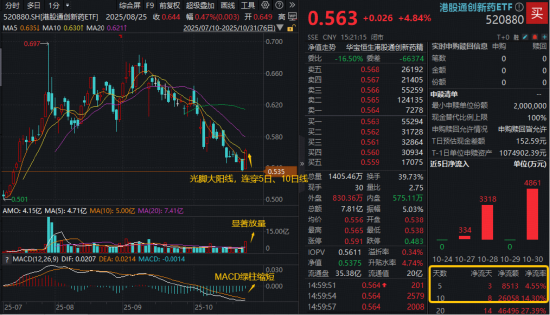
创新药大反攻!520880,惊现光脚大阳线!释放什么信号?
Xin Lang Ji Jin· 2025-11-02 13:57
Core Viewpoint - The innovative drug sector experienced a significant surge on October 31, with notable performances in both A-shares and Hong Kong stocks, driven by the initiation of the 2025 national medical insurance negotiations and the introduction of a "commercial insurance innovative drug catalog" mechanism [1][3]. Group 1: Market Performance - The A-share innovative drug ETF (562050) rose by 2.46%, while the Hong Kong innovative drug ETF (520880) surged by 5.25%, indicating high elasticity in the sector [1]. - Major stocks such as Sanofi and InnoCare Pharmaceuticals saw gains of 11% [1]. - The Hang Seng Hong Kong Stock Connect Innovative Drug Select Index has shown a year-to-date increase of 108.14%, outperforming other innovative drug indices [4][5]. Group 2: Policy and Market Drivers - The introduction of the "commercial insurance innovative drug catalog" is expected to alleviate the payment pressure for high-value innovative drugs [1][3]. - The recent meeting between U.S. and Chinese leaders has reduced potential risk factors that previously suppressed the sector's performance, leading to a possible influx of capital back into the market [3]. - The ongoing earnings season, with strong performances from companies like Innovent Biologics and Hengrui Medicine, is boosting confidence in the sector [3]. Group 3: Technical Analysis - The Hong Kong innovative drug ETF (520880) has shown a significant bullish trend, breaking through key moving averages and indicating a potential reversal in market sentiment [1]. - The MACD indicator shows a notable reduction in bearish momentum, suggesting a shift towards bullish conditions [1]. Group 4: Fund Characteristics - The Hong Kong innovative drug ETF (520880) passively tracks the Hang Seng Hong Kong Stock Connect Innovative Drug Select Index, which exclusively includes innovative drug development companies [3][4]. - The top ten holdings account for 71.63% of the index, highlighting the dominance of leading companies in the sector [4].