
轻工制造

Search documents
券商金股2025年12月投资月报:金融工程月报-20251201
Guoxin Securities· 2025-12-01 11:18
Quantitative Models and Construction Methods - **Model Name**: Securities Firm Golden Stock Performance Enhancement Portfolio **Model Construction Idea**: The model aims to optimize the selection of stocks from the securities firm's golden stock pool to outperform the benchmark index, specifically the actively managed equity fund index. It leverages a multi-factor approach and portfolio optimization techniques to control deviations in individual stocks and styles while aligning with the industry distribution of public funds[37][42]. **Model Construction Process**: 1. Use the securities firm's golden stock pool as the stock selection space and constraint benchmark. 2. Apply a multi-factor model to further refine the stock selection within the pool. 3. Optimize the portfolio to control deviations in individual stocks and styles relative to the golden stock pool. 4. Use the industry distribution of all public funds as the industry allocation benchmark. 5. Adjust the portfolio at the beginning of each month based on the latest recommendations and market data[37][42]. **Model Evaluation**: The model demonstrates strong alpha generation potential and consistently outperforms the benchmark index, reflecting the research strength of securities firms[42]. Model Backtesting Results - **Securities Firm Golden Stock Performance Enhancement Portfolio**: - **Absolute Return (Monthly)**: -1.06% (20251103-20251128)[41] - **Excess Return (Monthly)**: +1.39% relative to the actively managed equity fund index[41] - **Absolute Return (Year-to-Date)**: +33.65% (20250102-20251128)[41] - **Excess Return (Year-to-Date)**: +4.42% relative to the actively managed equity fund index[41] - **Ranking in Actively Managed Equity Funds (Year-to-Date)**: 35.37th percentile (1227/3469)[41] - **Annualized Return (2018-2025)**: +19.34%[43] - **Annualized Excess Return (2018-2025)**: +14.38% relative to the actively managed equity fund index[43] - **Performance Ranking (2018-2025)**: Top 30% of actively managed equity funds every year[43] Quantitative Factors and Construction Methods - **Factor Name**: Total Market Capitalization **Factor Construction Idea**: Reflects the size of a company, often used to capture the size effect in stock returns[26][27]. **Factor Construction Process**: Calculate the total market capitalization of each stock in the golden stock pool. Group stocks into quintiles based on their market capitalization and calculate the long-short portfolio returns for each group[26][27]. **Factor Evaluation**: Demonstrates strong performance in both the recent month and year-to-date periods[26][27]. - **Factor Name**: Single-Quarter Revenue Growth **Factor Construction Idea**: Measures the growth in revenue over a single quarter, capturing the growth potential of a company[26][27]. **Factor Construction Process**: Compute the quarter-over-quarter revenue growth for each stock. Group stocks into quintiles based on their growth rates and calculate the long-short portfolio returns for each group[26][27]. **Factor Evaluation**: Exhibits strong performance year-to-date[26][27]. - **Factor Name**: SUR (Surprise) **Factor Construction Idea**: Captures the degree to which a company's earnings or revenue exceed market expectations[26][27]. **Factor Construction Process**: Calculate the difference between actual and expected earnings or revenue for each stock. Group stocks into quintiles based on their surprise levels and calculate the long-short portfolio returns for each group[26][27]. **Factor Evaluation**: Performs well in both the recent month and year-to-date periods[26][27]. - **Factor Name**: EPTTM (Earnings to Price Trailing Twelve Months) **Factor Construction Idea**: A valuation factor that measures the earnings yield of a stock[26][27]. **Factor Construction Process**: Compute the ratio of trailing twelve-month earnings to the current stock price for each stock. Group stocks into quintiles based on their EPTTM values and calculate the long-short portfolio returns for each group[26][27]. **Factor Evaluation**: Underperforms year-to-date[26][27]. - **Factor Name**: Expected Dividend Yield **Factor Construction Idea**: Reflects the expected return from dividends, often used as a value factor[26][27]. **Factor Construction Process**: Calculate the expected dividend yield for each stock. Group stocks into quintiles based on their yields and calculate the long-short portfolio returns for each group[26][27]. **Factor Evaluation**: Underperforms year-to-date[26][27]. - **Factor Name**: BP (Book-to-Price Ratio) **Factor Construction Idea**: A valuation factor that measures the book value relative to the stock price[26][27]. **Factor Construction Process**: Compute the ratio of book value to stock price for each stock. Group stocks into quintiles based on their BP values and calculate the long-short portfolio returns for each group[26][27]. **Factor Evaluation**: Underperforms year-to-date[26][27]. Factor Backtesting Results - **Total Market Capitalization**: Strong performance in the recent month and year-to-date[26][27] - **Single-Quarter Revenue Growth**: Strong performance year-to-date[26][27] - **SUR (Surprise)**: Strong performance in the recent month and year-to-date[26][27] - **EPTTM (Earnings to Price Trailing Twelve Months)**: Weak performance year-to-date[26][27] - **Expected Dividend Yield**: Weak performance year-to-date[26][27] - **BP (Book-to-Price Ratio)**: Weak performance year-to-date[26][27]
金融工程月报:券商金股 2025 年 12 月投资月报-20251201
Guoxin Securities· 2025-12-01 08:22
Quantitative Models and Construction Methods - **Model Name**: Securities Firm Golden Stock Performance Enhancement Portfolio **Model Construction Idea**: The model aims to optimize the selection of stocks from the securities firm golden stock pool, using a multi-factor approach to achieve stable outperformance relative to the benchmark index (Active Equity Hybrid Fund Index) [37][42] **Model Construction Process**: 1. The securities firm golden stock pool is used as the stock selection space and constraint benchmark [42] 2. The portfolio optimization method is applied to control deviations in individual stocks and styles between the portfolio and the golden stock pool [42] 3. The industry allocation is based on the distribution of all public funds [42] 4. The portfolio's benchmark is the Active Equity Hybrid Fund Index, and the portfolio's position last month was 90.48% [37] **Model Evaluation**: The model demonstrates strong alpha generation potential and stable performance, consistently outperforming the benchmark index over multiple years [42][43] Model Backtesting Results - **Securities Firm Golden Stock Performance Enhancement Portfolio**: - **Absolute Return (Monthly)**: -1.06% [41] - **Excess Return (Monthly)**: 1.39% relative to the Active Equity Hybrid Fund Index [41] - **Absolute Return (Year-to-Date)**: 33.65% [41] - **Excess Return (Year-to-Date)**: 4.42% relative to the Active Equity Hybrid Fund Index [41] - **Ranking in Active Equity Funds (Year-to-Date)**: 35.37% percentile (1227/3469) [41] - **Annualized Return (2018-2025)**: 19.34% [43] - **Annualized Excess Return (2018-2025)**: 14.38% relative to the Active Equity Hybrid Fund Index [43] - **Performance Ranking (2018-2025)**: Top 30% of active equity funds every year [43] Quantitative Factors and Construction Methods - **Factor Name**: Total Market Capitalization **Factor Construction Idea**: Reflects the size of a company, often used to capture size-related effects in stock returns [26][27] **Factor Evaluation**: Demonstrated strong performance both in the past month and year-to-date [26][27] - **Factor Name**: Single-Quarter Surprise (SUR) **Factor Construction Idea**: Measures the degree of earnings surprise in a single quarter, capturing the market's reaction to unexpected earnings [26][27] **Factor Evaluation**: Performed well in both the past month and year-to-date [26][27] - **Factor Name**: Single-Quarter Revenue Growth **Factor Construction Idea**: Tracks the growth rate of revenue in a single quarter, reflecting a company's operational growth [26][27] **Factor Evaluation**: Strong performance year-to-date [26][27] - **Factor Name**: EPTTM (Earnings to Price Trailing Twelve Months) **Factor Construction Idea**: A valuation factor that measures earnings relative to price over the trailing twelve months [26][27] **Factor Evaluation**: Underperformed year-to-date [26][27] - **Factor Name**: Expected Dividend Yield **Factor Construction Idea**: Captures the expected dividend income relative to the stock price, often used as an income-focused valuation metric [26][27] **Factor Evaluation**: Underperformed year-to-date [26][27] - **Factor Name**: BP (Book-to-Price Ratio) **Factor Construction Idea**: A valuation factor that measures the book value of equity relative to the stock price [26][27] **Factor Evaluation**: Underperformed year-to-date [26][27] Factor Backtesting Results - **Total Market Capitalization**: Strong performance in both the past month and year-to-date [26][27] - **Single-Quarter Surprise (SUR)**: Strong performance in both the past month and year-to-date [26][27] - **Single-Quarter Revenue Growth**: Strong performance year-to-date [26][27] - **EPTTM**: Weak performance year-to-date [26][27] - **Expected Dividend Yield**: Weak performance year-to-date [26][27] - **BP (Book-to-Price Ratio)**: Weak performance year-to-date [26][27]
76只股涨停 最大封单资金10.51亿元
Zheng Quan Shi Bao Wang· 2025-12-01 07:47
截至收盘,上证指数报收3914.01点,上涨0.65%;深证成指收于13146.72点,上涨1.25%;创业板指上 涨1.31%;科创50指数上涨0.72%。 两市涨停股一览 | 代码 | 简称 | 收盘价(元) | 换手率(%) | 涨停板封单(万股) | 封单资金(万元) | 行业 | | --- | --- | --- | --- | --- | --- | --- | | 002792 | 通宇通讯 | 26.16 | 0.93 | 4018.59 | 105126.45 | 通信 | | 000063 | 中兴通讯 | 46.30 | 8.13 | 2030.01 | 93989.58 | 通信 | | 000547 | 航天发展 | 14.86 | 8.98 | 3323.34 | 49384.82 | 国防军工 | | 600977 | 中国电影 | 19.02 | 1.03 | 2236.83 | 42544.45 | 传媒 | | 001318 | 阳光乳业 | 17.57 | 9.09 | 2090.12 | 36723.41 | 食品饮料 | | 002565 | 顺灏股份 | 8.83 ...


今日75只个股涨停 主要集中在电子、通信等行业
Zheng Quan Shi Bao Wang· 2025-12-01 07:43
(文章来源:证券时报网) Choice统计显示,12月1日,沪深两市可交易A股中,上涨个股有3134只,下跌个股有1853只,平盘个 股有164只。不含当日上市新股,共有75只个股涨停,8只个股跌停。从所属行业来看,涨停个股主要集 中在电子、通信、化工、国防军工、轻工制造等行业。 ...
金融工程月报:券商金股2025年12月投资月报-20251201
Guoxin Securities· 2025-12-01 06:50
- The report highlights that in November 2025, the top-performing factors in the broker's gold stock pool were total market capitalization, single-quarter revenue surprise, and SUR, while factors like intraday return, analyst net upgrade magnitude, and analyst net upgrade ratio performed poorly[3][26] - For the year 2025, the best-performing factors were total market capitalization, single-quarter revenue growth, and SUR, whereas EPTTM, expected dividend yield, and BP underperformed[3][26] - The broker's gold stock performance enhancement portfolio achieved an absolute return of -1.06% for the month (20251103-20251128) and an excess return of 1.39% relative to the mixed equity fund index[5][41] - For the year (20250102-20251128), the portfolio achieved an absolute return of 33.65% and an excess return of 4.42% relative to the mixed equity fund index, ranking in the 35.37% percentile among active equity funds[5][41] - The broker's gold stock performance enhancement portfolio has consistently outperformed the mixed equity fund index from 2018 to 2022, ranking in the top 30% of active equity funds each year[12][37][43]
12月A股市场展望
Sou Hu Cai Jing· 2025-12-01 04:52
Market Overview - The A-share market has shown a significant downward trend in November, contrasting sharply with the optimistic expectations at the beginning of the month, with the Shanghai Composite Index declining by 1.67% and the ChiNext Index falling by 4.23% [1][2] - Defensive sectors such as banking and textiles performed relatively well, while growth sectors like technology and automotive faced substantial declines, with the computer industry down by 5.26% [1][2] Key Factors Influencing Market Performance - A notable cooling in global artificial intelligence investment themes has directly impacted the performance of growth sectors, initiated by a significant pullback in U.S. tech stocks, with the Nasdaq index experiencing a maximum drop of 7.37% in November [2][3] - Domestic economic recovery momentum remains insufficient, as indicated by a drop in the manufacturing Purchasing Managers' Index (PMI) to 49.0, and a 5.5% year-on-year decline in profits for industrial enterprises [3][4] - The tightening of global liquidity conditions has also exerted pressure on risk assets, with U.S. non-farm payrolls increasing by 119,000 in September, leading to a shift in market expectations regarding the Federal Reserve's interest rate policies [3][4] Market Behavior and Trends - As the year-end approaches, institutional investors are adopting strategies to lock in profits and preserve performance, leading to a shift from high-valuation sectors to low-valuation defensive stocks, resulting in significant market structure differentiation [4][5] - The overall market turnover has decreased from around 2 trillion to approximately 1.7 trillion, indicating reduced liquidity and increased volatility in individual stocks [4][5] Investment Strategy and Outlook - A "defensive + growth" allocation strategy is recommended, balancing stable cash flow from defensive sectors like banking and utilities with increased exposure to high-growth areas such as energy storage and military industries [6][7] - The energy storage sector is expected to grow over 40% due to rising demand and policy support, while the military sector benefits from ongoing national defense modernization efforts [6][7]
356只个股流通市值不足20亿元
Zheng Quan Shi Bao Wang· 2025-12-01 01:43
Core Insights - Small-cap stocks exhibit higher volatility and activity compared to large-cap stocks, making them more likely to become market leaders [1] Market Overview - As of November 28, there are 919 stocks with a circulating market value below 3 billion yuan, and 356 stocks with a circulating market value below 2 billion yuan [1] - A total of 1,641 stocks have a total market value below 5 billion yuan, with 514 stocks below 3 billion yuan [1] Smallest Market Capitalization Stocks - The three stocks with the smallest circulating market values are: - *ST Yuan Cheng: 189 million yuan - Kuntai Co., Ltd.: 651 million yuan - Kangliyuan: 698 million yuan [1] - The three stocks with the smallest total market values are: - *ST Yuan Cheng: 189 million yuan - *ST Changyao: 813 million yuan - *ST Suwu: 881 million yuan [1] Selected Stocks with Low Market Capitalization - A list of stocks with circulating market values below 2 billion yuan includes: - *ST Yuan Cheng: 189 million yuan, PE ratio: N/A, Industry: Construction Decoration - Kuntai Co., Ltd.: 651 million yuan, PE ratio: 47.32, Industry: Automotive - Kangliyuan: 698 million yuan, PE ratio: 36.15, Industry: Light Industry Manufacturing - Other notable stocks include: - Yangzhou Jinqiao: 719 million yuan, PE ratio: 25.10, Industry: Textile and Apparel - Keres: 735 million yuan, PE ratio: 179.75, Industry: Communication [1][2]




11月28日沪深两市强势个股与概念板块
2 1 Shi Ji Jing Ji Bao Dao· 2025-11-28 10:19
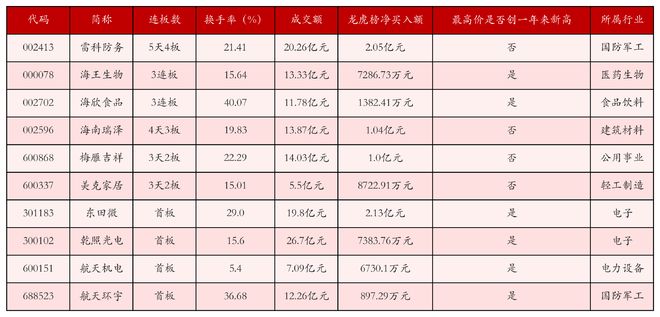
Strong Stocks - As of November 28, the Shanghai Composite Index rose by 0.34% to 3888.6 points, the Shenzhen Component Index increased by 0.85% to 12984.08 points, and the ChiNext Index went up by 0.7% to 3052.59 points [1] - A total of 82 stocks in the A-share market hit the daily limit up, with the top three strong stocks being: LeiKe Defense (002413), Haiwang Bio (000078), and HaiXin Food (002702) [1] - The top 10 strong stocks showed significant trading activity, with LeiKe Defense having a turnover rate of 21.41% and a trading volume of 2.05 billion yuan, while Haiwang Bio and HaiXin Food also demonstrated strong performance with notable trading volumes and turnover rates [1] Strong Concept Sectors - The top three concept sectors with the highest gains were Titanium Dioxide Concept (up 4.31%), Hainan Free Trade Zone (up 3.54%), and Dairy Industry (up 2.82%) [2] - The Titanium Dioxide Concept had a 100% increase in its constituent stocks, indicating strong market performance [2] - Other notable sectors included Terahertz (up 2.69%) and Phosphorus Chemical (up 2.32%), both showing a high percentage of rising constituent stocks [2]

REPORTIFY 3.0 版本正式发布
深研阅读 Reportify· 2025-11-28 09:28
Core Viewpoint - The article announces the official release of REPORTIFY 3.0, highlighting its complete reconstruction from previous versions and the introduction of an Agent platform that enhances user experience and functionality [1][2]. Group 1: Major Updates in REPORTIFY 3.0 - REPORTIFY 3.0 features a simplified homepage with built-in agents for immediate use, along with a new "Agent Square" for users to share their created agents [3]. - The introduction of the Agent Builder allows users to create agents through a simple mode for quick setups or a workflow mode for more complex scenarios [5][6]. - The system supports both single-column and double-column layouts for agent operation, catering to different output needs [9][10]. Group 2: Agent Functionality and Integration - The Agentic Workflow is based on agents as fundamental nodes, enabling dynamic reasoning and decision-making during execution [2]. - Users can integrate various third-party applications and custom MCPs, significantly expanding the capabilities of the agents [12]. - The task system allows users to create tasks using natural language, which automatically configures an agent to execute the task [16][21]. Group 3: Pricing and Sustainability - Due to rising development, model, and data costs, the company plans to implement a price increase for the service, encouraging users to renew at current rates [2].

2026年金融工程年度策略:万象更新,乘势而行
CAITONG SECURITIES· 2025-11-28 08:48
Group 1 - The public fund investment strategy shows robust growth in both scale and number, with active equity funds achieving an average return of 29.69% in 2025, outperforming major indices [2][23][27] - The top three sectors for active equity fund holdings are technology, manufacturing, and cyclical industries, indicating a strong focus on growth-oriented sectors [2][28] - The market outlook for 2026 suggests continued structural opportunities in A-shares, with technology growth remaining a key theme, while Hong Kong stocks are seen as undervalued [2][3] Group 2 - The index fund market has reached a historical high in both scale and number, with total assets amounting to 6.14 trillion yuan, reflecting a significant increase of 32.27% from the previous year [2][37][40] - The ETF segment dominates the index fund market, accounting for 76.10% of total assets, with a notable increase in industry-themed ETFs [2][38][40] - The performance of thematic funds, particularly in technology, has been outstanding, with technology-themed funds achieving an average return of 44.06% in 2025 [2][27][28]