
传媒

Search documents
20cm速递|科创创业ETF(588360)午后涨近1%,科技产业趋势向好
Mei Ri Jing Ji Xin Wen· 2025-10-15 05:35
科创创业ETF(588360)跟踪的是科创创业50指数(931643),单日涨跌幅达20%,该指数从科创板与 创业板中精选市值大、流动性好的50只新兴产业股票,覆盖半导体、新能源、生物医药等核心领域。指 数样本聚焦硬科技及成熟创新企业,具有较高的行业集中度和龙头效应,能够综合反映中国前沿产业的 技术壁垒与成长性表现。 (文章来源:每日经济新闻) 平安证券指出,本轮牛市由科技板块主导,2025年是"人工智能+"时代,TMT有望获得更多超额收益。 电子行业在全球AI创新热潮和算力需求增长驱动下实现领涨,半导体、消费电子和AI算力方向多点开 花;计算机行业受益于政策、技术与基本面改善共振,AI算力和应用方向保持高景气;传媒行业中游 戏子赛道表现突出,情绪消费主线具备估值性价比。新能源领域固态电池技术引领产业变革,传统板块 走出通缩后有望量利齐升。整体来看,科技产业趋势向好,电子、计算机、传媒等行业涨幅领先且存在 业绩支撑,AI产业链将持续深化发展。 ...

行业轮动模型由高切低,增配顺周期板块
GOLDEN SUN SECURITIES· 2025-10-15 05:17
Quantitative Models and Construction Methods 1. Model Name: Industry Relative Strength (RSI) Model - **Model Construction Idea**: This model identifies leading industries by calculating their relative strength (RS) based on historical price performance over different time windows [10] - **Model Construction Process**: 1. Use 29 first-level industry indices as the configuration targets [10] 2. Calculate the price change rates for the past 20, 40, and 60 trading days for each industry index [10] 3. Rank the industries based on their price change rates for each time window and normalize the rankings to obtain RS_20, RS_40, and RS_60 [10] 4. Calculate the average of the three rankings to derive the final RS value: $ RS = \frac{RS_{20} + RS_{40} + RS_{60}}{3} $ [10] 5. Industries with RS > 90% by the end of April are identified as potential leading industries for the year [10] - **Model Evaluation**: The model successfully identified key annual industry trends, such as high dividend, resource products, exports, and AI, which were validated by market performance throughout the year [10][12] 2. Model Name: Industry Sentiment-Trend-Crowding Framework - **Model Construction Idea**: This framework provides two industry rotation strategies based on market conditions: 1. High sentiment + strong trend, avoiding high crowding (aggressive strategy) 2. Strong trend + low crowding, avoiding low sentiment (conservative strategy) [6][14] - **Model Construction Process**: 1. Evaluate industries based on three dimensions: sentiment, trend, and crowding [6][14] 2. Use sentiment as the core metric for the aggressive strategy, with crowding as a risk control factor [14] 3. Use trend as the core metric for the conservative strategy, avoiding low-sentiment industries [14] 4. Allocate weights to industries based on their scores in the three dimensions [6][14] - **Model Evaluation**: The framework is effective in adapting to different market conditions and has shown strong performance in historical backtests [6][14] 3. Model Name: Left-Side Inventory Reversal Model - **Model Construction Idea**: This model identifies industries with potential for recovery by analyzing sectors in distress or those with low inventory pressure and high analyst optimism [24] - **Model Construction Process**: 1. Identify industries currently in distress or recovering from past distress [24] 2. Focus on sectors with low inventory pressure and potential for restocking [24] 3. Incorporate analyst long-term positive outlooks for these industries [24] - **Model Evaluation**: The model effectively captures recovery opportunities in industries undergoing inventory restocking cycles, providing significant absolute and relative returns [24] --- Model Backtesting Results 1. Industry Relative Strength (RSI) Model - **Annualized Return**: Not explicitly mentioned - **Excess Return**: Not explicitly mentioned - **Information Ratio (IR)**: Not explicitly mentioned - **Maximum Drawdown**: Not explicitly mentioned - **Monthly Win Rate**: Not explicitly mentioned - **Performance Highlights**: - Industries with RS > 90% by April 2024 included coal, utilities, home appliances, banking, petrochemicals, communication, non-ferrous metals, agriculture, and automotive [10] - These industries showed strong performance, with key themes being high dividends, resource products, exports, and AI [10][12] 2. Industry Sentiment-Trend-Crowding Framework - **Annualized Return**: 22.1% (long-only portfolio) [14] - **Excess Return**: 13.8% (annualized) [14] - **Information Ratio (IR)**: 1.51 [14] - **Maximum Drawdown**: -8.0% [14] - **Monthly Win Rate**: 68% [14] - **Performance Highlights**: - 2023 excess return: 7.3% [14] - 2024 excess return: 5.7% [14] - 2025 YTD excess return: 2.8% [14] 3. Left-Side Inventory Reversal Model - **Annualized Return**: Not explicitly mentioned - **Excess Return**: - 2023: 17.0% (relative to equal-weighted industry benchmark) [24] - 2024: 15.4% (relative to equal-weighted industry benchmark) [24] - 2025 YTD: 7.8% (relative to equal-weighted industry benchmark) [24] - **Information Ratio (IR)**: Not explicitly mentioned - **Maximum Drawdown**: Not explicitly mentioned - **Monthly Win Rate**: Not explicitly mentioned - **Performance Highlights**: - Absolute return: - 2023: 13.4% [24] - 2024: 26.5% [24] - 2025 YTD: 26.4% [24] --- Quantitative Factors and Construction Methods 1. Factor Name: Sentiment Factor - **Factor Construction Idea**: Measures the overall sentiment of an industry to identify high-growth opportunities [14] - **Factor Construction Process**: 1. Evaluate the sentiment of each industry based on relevant metrics (not explicitly detailed in the report) [14] 2. Rank industries by sentiment scores [14] - **Factor Evaluation**: Sentiment is a core metric in the aggressive strategy of the Industry Sentiment-Trend-Crowding Framework, providing strong signals for high-growth opportunities [14] 2. Factor Name: Trend Factor - **Factor Construction Idea**: Measures the strength of market trends to identify industries with strong momentum [14] - **Factor Construction Process**: 1. Evaluate the trend of each industry based on relevant metrics (not explicitly detailed in the report) [14] 2. Rank industries by trend scores [14] - **Factor Evaluation**: Trend is a core metric in the conservative strategy of the Industry Sentiment-Trend-Crowding Framework, offering a simple and replicable approach to industry allocation [14] 3. Factor Name: Crowding Factor - **Factor Construction Idea**: Measures the level of crowding in an industry to identify overbought or underbought sectors [14] - **Factor Construction Process**: 1. Evaluate the crowding level of each industry based on relevant metrics (not explicitly detailed in the report) [14] 2. Rank industries by crowding scores [14] - **Factor Evaluation**: Crowding is used as a risk control factor in both aggressive and conservative strategies of the Industry Sentiment-Trend-Crowding Framework [14] --- Factor Backtesting Results 1. Sentiment Factor - **Annualized Return**: Not explicitly mentioned - **Excess Return**: Not explicitly mentioned - **Information Ratio (IR)**: Not explicitly mentioned - **Maximum Drawdown**: Not explicitly mentioned - **Monthly Win Rate**: Not explicitly mentioned 2. Trend Factor - **Annualized Return**: Not explicitly mentioned - **Excess Return**: Not explicitly mentioned - **Information Ratio (IR)**: Not explicitly mentioned - **Maximum Drawdown**: Not explicitly mentioned - **Monthly Win Rate**: Not explicitly mentioned 3. Crowding Factor - **Annualized Return**: Not explicitly mentioned - **Excess Return**: Not explicitly mentioned - **Information Ratio (IR)**: Not explicitly mentioned - **Maximum Drawdown**: Not explicitly mentioned - **Monthly Win Rate**: Not explicitly mentioned
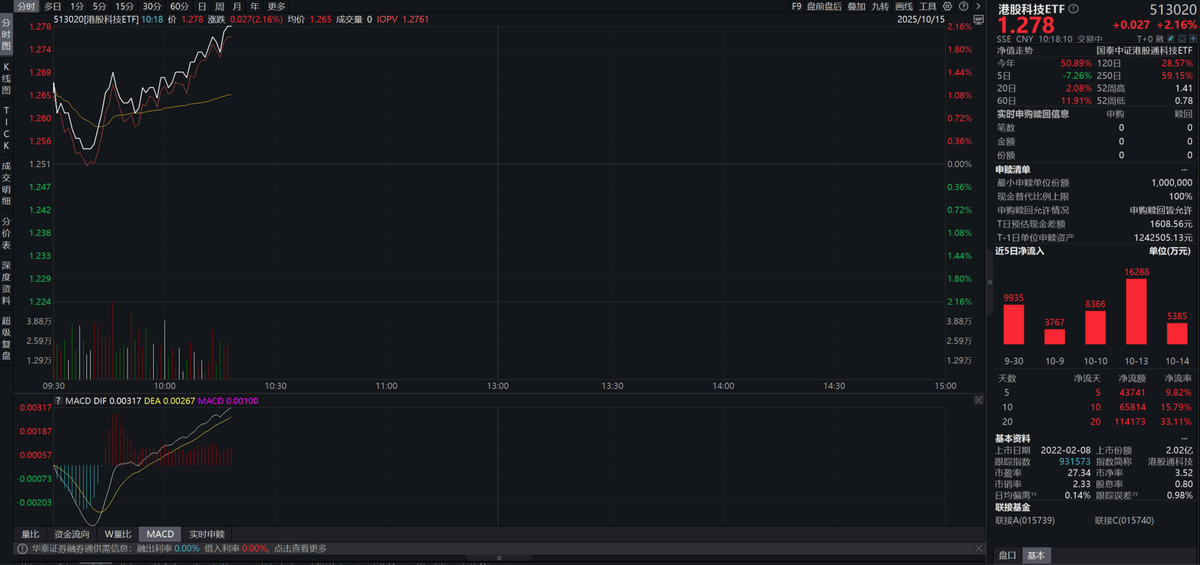
鲍威尔发言提振降息预期,港股科技ETF(513020)盘中涨超2%
Sou Hu Cai Jing· 2025-10-15 03:00
Group 1 - Federal Reserve Chairman Jerome Powell's speech on October 14 indicated a potential end to the balance sheet reduction in the coming months, supporting investor expectations for another rate cut this month [2][3] - Powell noted a deterioration in the labor market, with evidence showing low levels of layoffs and hiring, which further bolstered the outlook for a rate cut [3] - The Hong Kong stock market has seen significant activity this year, particularly in sectors like innovative pharmaceuticals, renewable energy, and technology, with the Hong Kong Technology ETF (513020) rising over 50% year-to-date [2][3] Group 2 - The Hong Kong Technology ETF (513020) tracks the CSI Hong Kong Stock Connect Index, including major stocks like Alibaba, Tencent, and BYD, making it a quality investment option for exposure to the Hong Kong market [4] - The top ten constituents of the Hong Kong Technology ETF include Alibaba (11.93%), Tencent (10.79%), and Xiaomi (8.08%), among others, indicating a diverse portfolio in the technology sector [5] Group 3 - The Hong Kong Technology Connect Index has outperformed the Hang Seng Technology Index and the Hong Kong Internet Index, with a cumulative increase of 76.06% since 2018, compared to 7.18% and 16.50% for the latter two indices [6] - The expectation of continued rate cuts by the Federal Reserve may enhance the attractiveness of Hong Kong technology stocks, as lower interest rates typically boost the valuation of growth sectors [8]

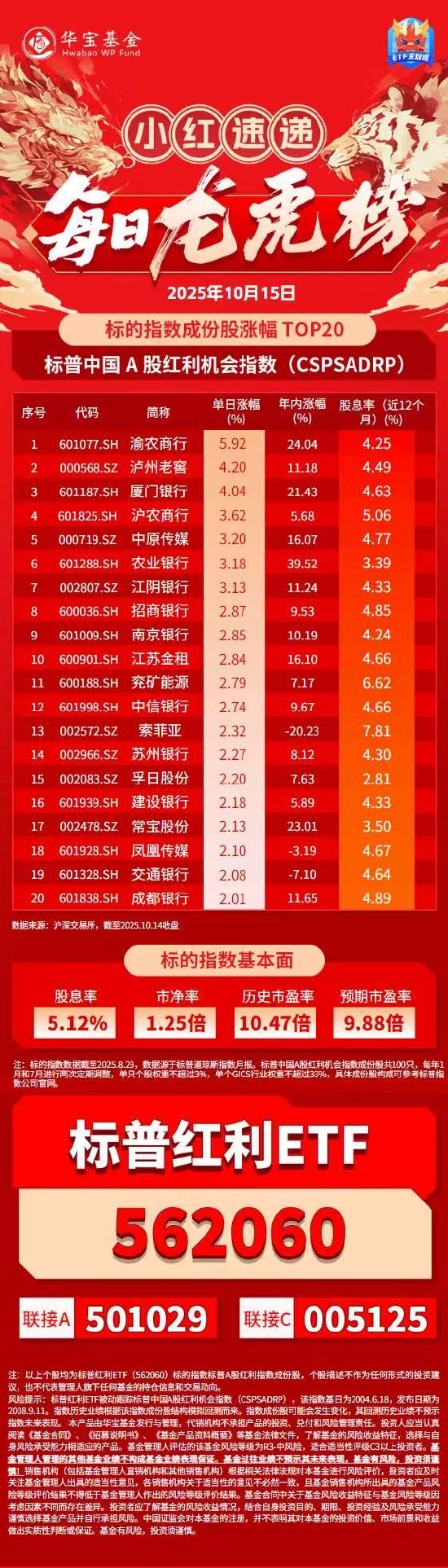
小红日报|标普红利ETF(562060)标的指数收涨0.49%,银行板块涨幅靠前
Xin Lang Ji Jin· 2025-10-15 02:02
Core Insights - The article highlights the top-performing stocks in the S&P China A-Share Dividend Opportunity Index, showcasing significant price increases and dividend yields for various companies [1]. Group 1: Stock Performance - The top stock, 渝农商行 (601077.SH), experienced a price increase of 5.92% and a year-to-date increase of 24.04%, with a dividend yield of 4.25% [1]. - 泸州老窖 (000568.SZ) saw a 4.20% increase, with an 11.18% year-to-date rise and a dividend yield of 4.49% [1]. - 厦门银行 (601187.SH) recorded a 4.04% increase, a 21.43% year-to-date rise, and a dividend yield of 4.63% [1]. Group 2: Dividend Yields - The article lists several companies with notable dividend yields, including 家非亚 (002572.SZ) at 7.81%, and 究矿能源 (600188.SH) at 6.62% [1]. - 农业银行 (601288.SH) has a year-to-date increase of 39.52% and a dividend yield of 3.39% [1]. - 招商银行 (600036.SH) shows a year-to-date increase of 9.53% with a dividend yield of 4.85% [1].






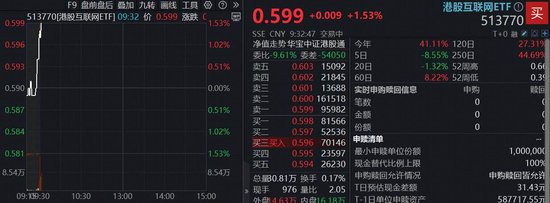
美联储突发,降息大消息!港股AI回暖,核心资产513770上行1.5%,阿里巴巴、小米集团涨超2%
Xin Lang Ji Jin· 2025-10-15 01:52
10月15日,港股早盘高开,恒指、恒科指双双涨超1%,科网龙头大面积飘红,哔哩哔哩-W领涨4%,阿 里巴巴-W、小米集团-W双双涨逾2%,美团-W、腾讯控股跟涨逾1%。港股AI核心工具——港股互联网 ETF(513770)场内价格现涨1.53%。 港股互联网ETF(513770)及其联接基金(A类017125;C类017126)跟踪中证港股通互联网指数,阿 里巴巴-W、腾讯控股、小米集团-W是其前3大权重股,权重占比分别为18.92%、15.60%、11.54%,前 10大持仓汇聚各领域互联网龙头公司,合计占比超73%,龙头优势显著,为港股AI核心标的。 | 十大权重 | | | | 更新日期: 2025-10-03 | | --- | --- | --- | --- | --- | | 证券代码 | 证券名称 | 中证一级行业分类 | 中证二级行业分类 | 权重(%) | | 9988 HK | 阿里巴巴-W | 可选消费 | 零售业 | 18.92 | | 0700.HK | 腾讯控股 | 通信服务 | 传媒 | 15.60 | | 1810.HK | 小米集团-W | 信息技术 | 电子 | 11.54 ...

接续为上海营商环境加油助力 市政府召开体验官座谈会
Jie Fang Ri Bao· 2025-10-15 01:48
Core Points - The Shanghai municipal government held a meeting to discuss the feedback on the 8.0 version of the business environment optimization action plan and suggestions for the upcoming 9.0 version [1][2] - The meeting featured various representatives from different sectors who shared their observations and recommendations regarding the business environment in Shanghai [1][2] Group 1 - The business environment is crucial for the survival and development of enterprises and reflects the core competitiveness of the city [2] - The Shanghai government has implemented eight versions of the business environment optimization action plan, with over 1,200 reform measures introduced [2] - A new batch of over 200 city-level business environment experience officers has been appointed, representing various fields including experts, business entities, and industry associations [2] Group 2 - The government aims to enhance the efficiency and precision of policy measures by encouraging experience officers to identify issues early and propose innovative solutions [2] - The experience officer mechanism is expected to be normalized, standardized, and operated efficiently to support the ongoing improvement of the business environment [2]
27家创业板公司前三季业绩亮相 85.19%预增
Zheng Quan Shi Bao Wang· 2025-10-15 01:37
Core Insights - 27 companies listed on the ChiNext board have released their performance forecasts for the first three quarters, with 23 companies expecting profit increases, representing 85.19% of the total [1] - The overall proportion of companies with positive forecasts is 92.59%, with 2 companies expecting to turn a profit and 2 companies forecasting profit declines [1] Performance Forecasts - Among the companies expecting profit increases, 9 companies anticipate a net profit growth of over 100%, while 6 companies expect a growth between 50% and 100% [1] - The company with the highest expected net profit growth is Morning Light Bio, forecasting a median increase of 372.80% [1] - Other notable companies include Glacier Network and Bai Ao Intelligent, with expected net profit growths of 207.09% and 184.12%, respectively [1] Company Performance Data - The following companies are highlighted for their significant expected profit increases: - Morning Light Bio (Code: 300138) - Expected net profit growth: 372.80%, Latest closing price: 13.99, Year-to-date change: 62.33% [1] - Glacier Network (Code: 300533) - Expected net profit growth: 207.09%, Latest closing price: 38.10, Year-to-date change: 92.81% [1] - Bai Ao Intelligent (Code: 300836) - Expected net profit growth: 184.12%, Latest closing price: 56.53, Year-to-date change: 95.40% [1] - Other companies with notable growth include Chuan Jin Nuo (171.61%), Jin Li Yong (168.00%), and Bo Teng (139.09%) [1]



【机构观债】2025年9月信用债交易热度回温 市场风险偏好分层
Xin Hua Cai Jing· 2025-10-14 14:24
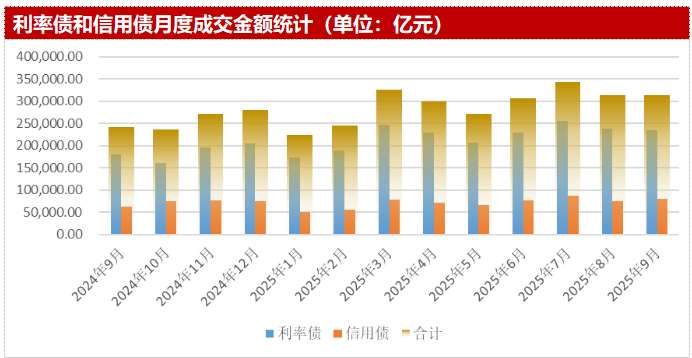
Core Insights - The credit bond secondary market showed significant recovery in September, with a layered risk preference in credit bond trading, indicating a trend of shortening duration for high-quality bonds and extending duration for low-quality bonds [1][3] - The total transaction amount in the bond secondary market for September reached 372,501.24 billion, marking a year-on-year increase of 22.12% and a slight month-on-month increase of 0.04% [1][3] Credit Bonds - In September, the transaction amount for credit bonds was 79,565.22 billion, reflecting a year-on-year growth of 27.39% and a month-on-month increase of 6.87%, indicating a notable recovery in the credit bond market [3] - The transaction characteristics of credit bonds showed a preference for high-quality bonds with shorter durations, while low-quality bonds saw an extension in duration, particularly in the case of AA-rated municipal bonds [3][4] - The industrial bonds' transaction amount slightly decreased by 1.61%, while the municipal bond sector became a highlight with a month-on-month increase of 11.83%, demonstrating sustained market enthusiasm for municipal bonds amid ongoing debt resolution efforts [3] Credit Spread - The overall credit spread continued to show narrow fluctuations, with a year-on-year contraction of 26.29 basis points and a slight month-end decrease of 0.19 basis points [4] - As of September 30, the median credit spreads for various industries showed that household appliances, real estate, and electric equipment had higher spreads, while food and beverage, media, and public utilities had lower spreads [4] - The household appliances sector experienced the largest decline in credit spread this month, benefiting from new consumption stimulus policies, although it remains at a high level [4] Municipal Bonds - The overall credit spread for municipal bonds remained relatively stable, with slight fluctuations across regions, except for Gansu Province, which saw a significant widening of spreads, indicating higher risk premium demands from investors [5] - Regions like Guizhou, Yunnan, and Liaoning experienced notable narrowing of municipal bond spreads, exceeding 100 basis points, attributed to ongoing debt resolution policies and improved market confidence [5] Future Outlook - The expectation for the fourth quarter indicates a low-level fluctuation in trading spreads but with increasing structural differentiation, particularly in industrial and municipal bonds [6] - The industrial bond spreads are expected to have limited downward space due to most industries already being at relatively low levels, while high-spread sectors like household appliances and real estate may experience volatility due to policy changes and fundamental pressures [6] - The ongoing debt resolution policies are anticipated to remain the core driving force for municipal bonds, with most regional spreads expected to maintain low-level operations after narrowing [6]
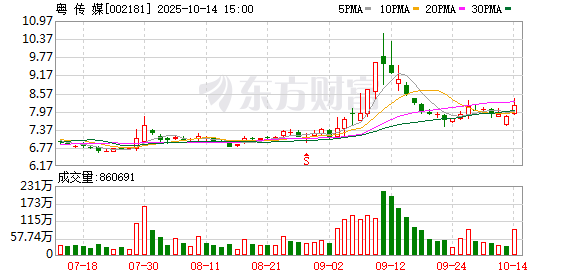
粤传媒:关于子公司部分固定资产报废处置的进展公告
Zheng Quan Ri Bao· 2025-10-14 14:11
Core Points - The company announced the transfer of 29 scrap printing production equipment and related spare parts through a public auction, with a minimum bid price set at 1,040,726 yuan [2] - The final auction price for the equipment and spare parts was 1,375,726 yuan, with Mr. Chen confirmed as the buyer [2] - An asset transaction contract has been signed between the company and Mr. Chen following the auction [2]

华鑫证券研究所所长谭倩:三重逻辑共振 科技引领A股行情
Zheng Quan Ri Bao Wang· 2025-10-14 12:52
Core Viewpoint - The A-share market has undergone significant structural changes over the past year, with the technology sector showing remarkable performance, driven by three levels of logical resonance, leading to an optimistic outlook for the future [1][3]. Macro Level - Strong support from national strategies is driving the rapid development of emerging industries, with a focus on breaking through key core technologies and promoting technological innovation through top-level institutional design and financial resource allocation [1][2]. - The State Council has issued opinions to deeply implement the "Artificial Intelligence +" initiative, promoting the integration of AI with various sectors of the economy and society [1]. Meso Level - A new round of technological innovation is catalyzing the revaluation of Chinese technology assets, with notable advancements in AI, robotics, and smart driving, showcasing the emergence of excellent Chinese tech companies [2]. - Examples include DeepSeek achieving performance comparable to ChatGPT at a fraction of the cost, and significant cultural milestones such as the success of "Nezha 2" at the box office [2]. Micro Level - Improvement in liquidity conditions and the influx of incremental capital are supporting the technology market, with foreign capital turning bullish and a rebalancing of domestic and foreign funds [2]. - From January to August, non-bank deposits increased by 5.87 trillion yuan, a historical high for the same period, while margin trading balances and new institutional accounts surged, particularly in the computer and communication sectors [2].