
云计算

Search documents
鲁股观察 | 5亿营收吞36亿标的未果,德固特跨界“蛇吞象”折戟
Xin Lang Cai Jing· 2025-11-11 05:47
Core Viewpoint - Qingdao Degute Energy Equipment Co., Ltd. announced the termination of its major asset restructuring plan to acquire 100% equity of Haowei Cloud Computing Technology Co., Ltd. due to disagreements on key commercial terms [1][4]. Group 1: Restructuring Details - The restructuring process began on June 29, 2025, and was terminated less than five months later due to a lack of consensus on valuation, performance commitments, and compensation terms [4]. - Degute stated that no formal substantial agreements were signed, thus the termination does not incur any breach of contract liabilities [4]. - The company committed to not planning any major asset restructuring for at least one month following the termination announcement [4]. Group 2: Financial Context - Degute's revenue for 2024 was just over 500 million yuan, while Haowei's revenue for the same period was 3.6 billion yuan, highlighting a significant disparity in company sizes [5]. - As of March 2025, Degute's total assets were 1.156 billion yuan compared to Haowei's 5.617 billion yuan [5]. - Degute's financial performance showed a decline, with a 9.29% year-on-year decrease in revenue to 382 million yuan and a 26.39% drop in net profit to 72.26 million yuan for the first three quarters of 2025 [6]. Group 3: Market Reaction - Following the termination announcement, Degute's stock price fell by 19.99% to 26.13 yuan on November 10, 2025, after previously experiencing a 20% increase on October 14, 2025, due to initial optimism about the acquisition [6]. - The company currently has orders worth 558 million yuan, with 41.22% of these being overseas orders, and a gross margin increase of 0.62 percentage points to 40.39% [6].


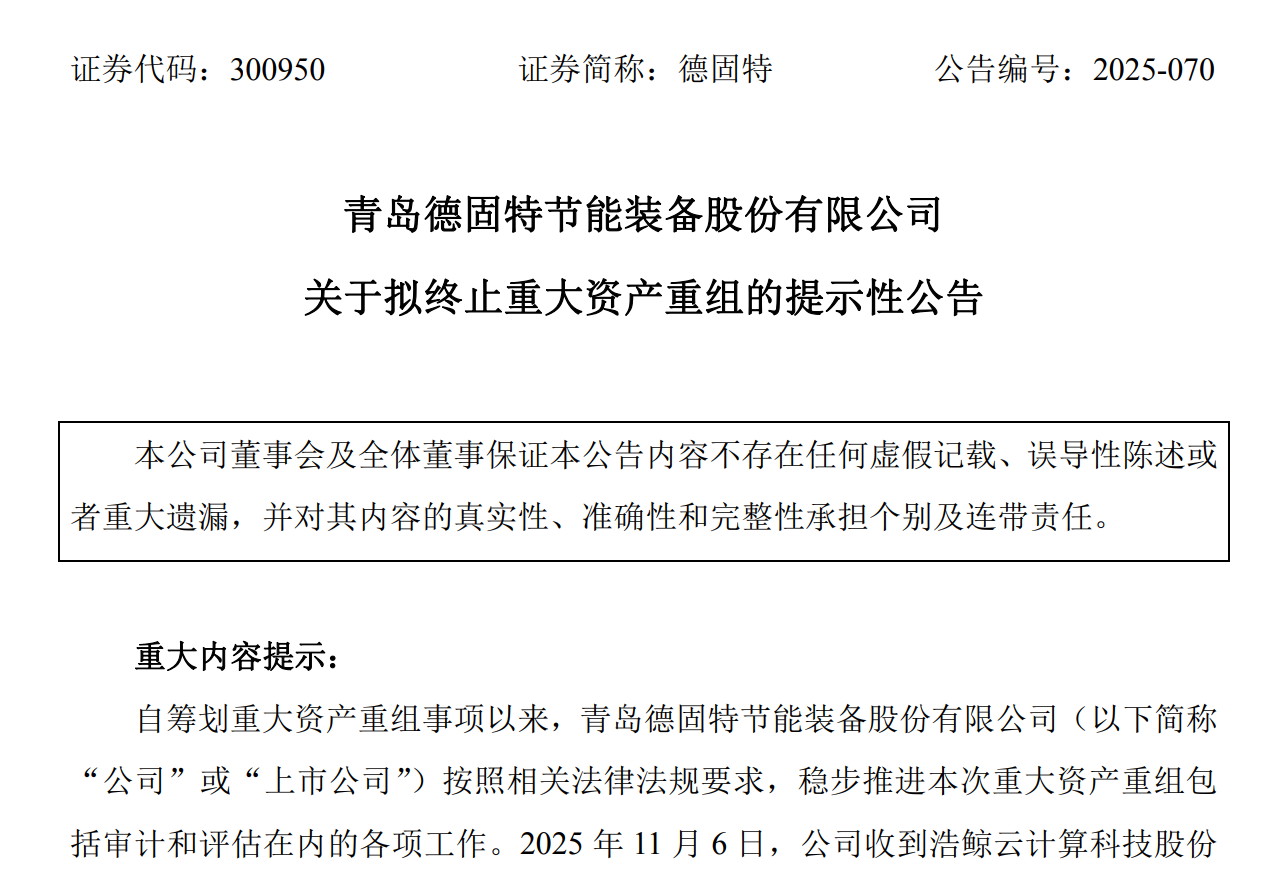
CoreWeave三季度营收13.6亿美元超预期,建设缓慢导致下调全年营收指引,股价盘后重挫6%
Sou Hu Cai Jing· 2025-11-11 03:28
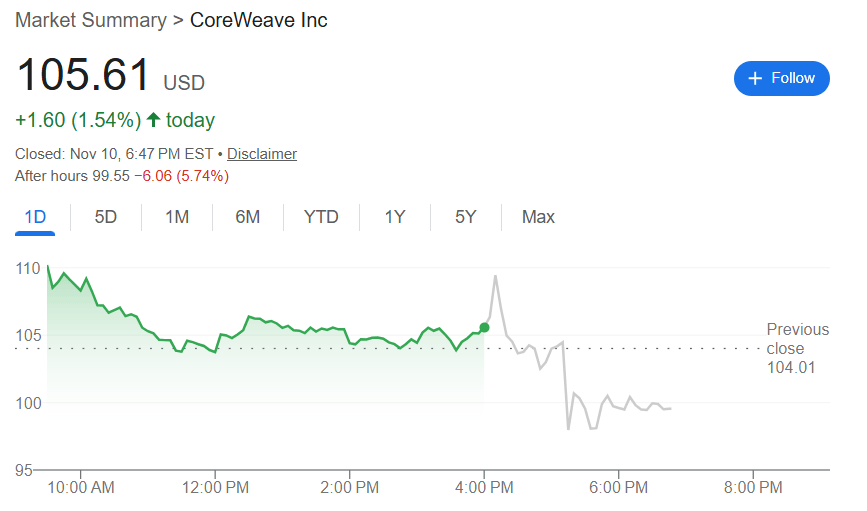
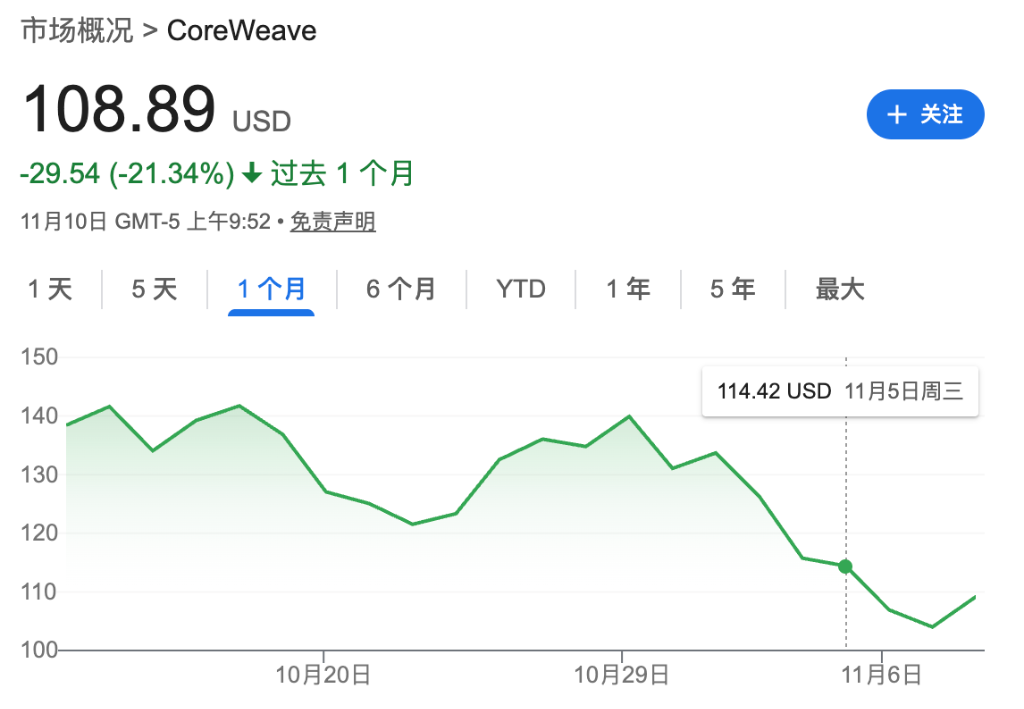
Core Financial Performance - CoreWeave reported Q3 revenue of $1.36 billion, a 134% year-over-year increase, exceeding the expected $1.29 billion [3][4] - The company experienced a net loss of $110 million, significantly reduced from a net loss of $359 million in the same period last year [3][4] - Operating profit margin was only 4%, below the expected 6.5% and lower than the previous year's margin [3][4] Revenue Guidance and Order Backlog - The revenue guidance for 2025 was lowered from a previous high of $5.35 billion to a range of $5.05 billion to $5.15 billion, below analyst expectations of $5.29 billion, primarily due to delays from a third-party data center contractor [3][4] - The company's order backlog reached $55.6 billion, nearly double that of the previous quarter [4][5] - Significant contracts include a $14.2 billion six-year agreement with Meta and an expanded $6.5 billion agreement with OpenAI [4][5] Capital Expenditure and Growth Strategy - CoreWeave's CEO indicated that the company is facing constraints due to a shortage of "powered-shell" data centers for rapid deployment [5] - Following a failed acquisition of Core Scientific, CoreWeave is accelerating its own data center construction, particularly in Pennsylvania [5] - The projected capital expenditure for 2026 is expected to exceed double that of 2025's estimated $12-14 billion, raising concerns about the aggressive investment pace relative to anticipated revenue [5]
海外科技公司2025Q3业绩总结:资本开支预期上调,云需求信号强劲
Southwest Securities· 2025-11-11 02:57
Investment Rating - The report indicates a positive investment outlook for the technology sector, particularly for major cloud service providers and digital advertising companies [2]. Core Insights - The combined revenue of the four major overseas technology companies reached $411.4 billion in Q3 2025, marking a year-on-year increase of 16%, the highest growth rate since Q1 2022 [4][12]. - Net profit for these companies totaled $86.6 billion, with an overall net profit margin of approximately 21% [15][17]. - Capital expenditure expectations for 2026 have been significantly raised, with projections indicating a potential doubling of capacity over the next two years [4][6]. - Cloud revenue growth has reached historical highs, with a year-on-year increase of 26% in Q3 2025, reflecting strong demand signals [4][7]. - Digital advertising revenue also exceeded market expectations, with a year-on-year growth of 18% [4][7]. Performance Overview - The four major technology companies reported a combined revenue of $411.4 billion in Q3 2025, with a year-on-year growth rate of 16% [12][14]. - Net profit for Q3 2025 was $86.6 billion, with a net profit margin of about 21% [15][17]. - Microsoft, Google, Amazon, and Meta all reported revenues that exceeded market expectations, with specific figures of $77.7 billion, $102.3 billion, $180.2 billion, and $51.2 billion respectively [9][22][27]. Capital Expenditure - Capital expenditure guidance has been revised upwards, with Microsoft indicating a growth rate for FY2026 that will exceed FY2025 [4][6]. - Amazon projected a cash capital expenditure of approximately $125 billion for 2025, with expectations for continued increases in 2026 [4][6]. Cloud Computing - The combined cloud revenue of the three major cloud providers reached $79.1 billion in Q3 2025, with year-on-year growth rates of 28% for Microsoft, 34% for Google, and 20% for Amazon [4][7]. - Backlog orders for cloud services showed strong demand, with year-on-year growth rates of 51% for Microsoft, 82% for Google, and 22% for Amazon [4][7]. Digital Advertising - The total advertising revenue for the four major companies was $145.7 billion in Q3 2025, reflecting a year-on-year increase of 18% [4][7]. - Each company reported growth in advertising revenue, with Microsoft at 15%, Google at 13%, Amazon at 24%, and Meta at 26% [4][7].
美元“荒”与全球“慌”?
2025-11-11 01:01
Summary of Key Points from Conference Call Industry Overview - The discussion primarily revolves around the **U.S. liquidity crisis** and its impact on **global risk assets** and the **AI sector**. The focus is on the implications of the Federal Reserve's actions and market dynamics. Core Insights and Arguments 1. **Liquidity Crisis and Its Causes** The liquidity crisis is attributed to the Federal Reserve's balance sheet reduction, decreased bank reserves, and increased short-term liquidity demands, compounded by market sentiment fluctuations and concerns over AI bubbles [1][10][6]. 2. **Impact on Global Risk Assets** Tightening U.S. liquidity has negatively affected global risk assets, with the dollar index rising above 100. However, fundamental factors do not support a significant decline in the dollar [3][4]. 3. **Current Market Conditions** The market is experiencing a downturn, particularly in the tech sector, with the Nasdaq showing volatility. The Hong Kong stock market is also affected, fluctuating around 26,000 points [3][4][13]. 4. **AI Bubble Concerns** While there are concerns about an AI bubble, the valuation of major tech companies remains below 35 times earnings, which is not extreme compared to the internet bubble era. Key metrics such as demand, capability, leverage, and valuation do not indicate overheating [11][2]. 5. **Federal Reserve's Historical Context** The Fed's previous balance sheet reduction in 2019 led to a liquidity crisis, prompting a return to expansionary policies. Currently, the Fed has halted balance sheet reduction to prevent similar issues [9][10]. 6. **Future Dollar Trends** The dollar is expected to strengthen slightly in Q4 2023 to Q1 2024, influenced by potential aggressive policies from Trump and overall economic uncertainty [12]. 7. **E-commerce Performance** The performance of major e-commerce platforms during the Double Eleven shopping festival showed a slowdown, with Alibaba and JD.com experiencing single-digit growth, while Pinduoduo and Kuaishou saw double-digit growth [18][19]. 8. **AI Technology Integration** AI technology has been increasingly integrated into e-commerce platforms, enhancing user experience and operational efficiency. Companies like Alibaba are leveraging AI for various applications, indicating a growing trend in the sector [21][22]. 9. **Investment Outlook for Internet Sector** Caution is advised for the internet sector in Q4 due to consumer pressure and high base effects, but long-term optimism remains, particularly regarding technological advancements and AI investments [22][24]. 10. **Cloud Computing's Role in AI** Cloud computing is crucial for AI development, providing the necessary resources for model training and inference. The demand for AI is expected to benefit the cloud computing sector significantly [26]. Other Important Insights - **Market Sentiment and Investment Trends** The current market sentiment reflects a cautious approach, with investors advised to focus on dividend strategies and potential cyclical stock opportunities as the credit cycle peaks [13][17]. - **Future Capital Expenditure Projections** Capital expenditure growth expectations for major cloud service providers have been revised upward to 20%, indicating strong demand and backlog in orders [27]. - **Software Sector's Importance** A shift from hardware to software demand in the AI sector is anticipated, with strong performance in SaaS companies potentially supporting sustainable growth in AI investments [28][30]. This summary encapsulates the critical points discussed in the conference call, providing insights into the current market dynamics, challenges, and future outlooks within the relevant industries.
巨头宣布大裁员!“连通知我们的人力也收到被裁邮件”
Sou Hu Cai Jing· 2025-11-11 00:45
Group 1 - Amazon has announced a global organizational optimization, resulting in a net reduction of approximately 14,000 corporate jobs, marking the largest restructuring since late 2022 [1] - The layoffs will affect key departments including Human Resources, Cloud Computing (AWS), Advertising, and Devices & Services, with a significant impact on the China region where some departments have seen a 50% reduction in staff [2] - Since 2022, Amazon has laid off over 27,000 employees, driven by a strategy focused on AI transformation and organizational flattening, amid slowing growth in the China market [2] Group 2 - Amazon stated that the layoffs are aimed at focusing on AI transformation and making the organization more agile, despite potential concerns regarding operational pressures [3] - The company reported a net sales figure of $167.7 billion for Q2 of fiscal year 2025, a 13% year-over-year increase, with net profits rising by 35% to $18.2 billion, indicating robust performance [3] - The international business growth rate has slowed to 4.9% in Q1 of 2025, influenced by uncertainties in the global trade environment and competition from emerging platforms [4] Group 3 - The layoffs are part of a strategic shift from "scale expansion" to "efficiency priority," with a focus on reallocating resources to high-profit areas such as AI and cloud computing [6] - Amazon's CEO Andy Jassy indicated that fewer employees will be needed for current tasks as the company continues to implement more AI technologies [6] - The restructuring includes significant cuts to middle management, with strict criteria for layoffs, particularly targeting those managing fewer than seven employees [4]

【好文重读】全球热潮!投资港股半导体芯片,终于有了高纯的ETF新品...
Xin Lang Ji Jin· 2025-11-11 00:00
Group 1 - The core strength of NVIDIA is attributed to the significant increase in capital expenditures by global tech giants, driven by AI, which has been a key driver of the recent bull market in US stocks and has spurred growth in the global semiconductor industry [2] Group 2 - Major tech companies are ramping up capital expenditures, with Alphabet raising its 2025 capital expenditure guidance from $85 billion to $91-93 billion, and predicting a "significant increase" in 2026 [5] - Microsoft reported a capital expenditure of $34.9 billion for the recent quarter, a 74% year-over-year increase, exceeding market expectations, and guiding for over $30 billion in the next quarter [6] - Meta has adjusted its 2025 capital expenditure guidance from $66-72 billion to $70-72 billion, forecasting that growth in 2026 will be "significantly greater" than in 2025 [6] Group 3 - The demand for AI is igniting a "super cycle" in storage chips, with Samsung and SK Hynix signing a preliminary chip supply agreement for the "Stargate" AI data center project, which requires 900,000 DRAM wafers per month, more than double the current global HBM capacity [7] - Global storage chip prices have surged, with server DRAM prices increasing by 171.8% year-over-year in Q3 2025, and DDR5 memory prices rising over 50% in the past month [7] - Major storage manufacturers are reducing traditional DDR4 production to below 20% to focus on higher-margin HBM and DDR5, leading to supply tightness and price increases [7] Group 4 - The Hong Kong stock market is witnessing a significant investment boom in the semiconductor sector, supported by strong domestic policies aimed at achieving breakthroughs in key technologies [9] - The newly launched Hong Kong Information Technology ETF (159131) tracks the CSI Hong Kong Information Technology Composite Index, consisting of 42 hard tech companies, with a structure of 70% hardware and 30% software [9] - The index's constituent stocks are expected to show high growth in earnings, with major companies like Xiaomi, SMIC, and Kingdee International projected to see substantial profit increases [9] Group 5 - The Hong Kong semiconductor sector has shown impressive performance, with leading companies like Hua Hong Semiconductor, Shanghai Fudan, and InnoPhase achieving significant stock price increases this year [12] - The top constituent stock, SMIC, has seen a year-to-date increase of over 143% [12] Group 6 - Goldman Sachs has expressed optimism about Hua Hong Semiconductor's prospects, raising its target price by 13% to 87 HKD, reflecting a forecasted P/E ratio of 51.5 times for 2028 [14] - The influx of southbound capital into Hong Kong stocks has exceeded 1.25 trillion HKD this year, indicating a growing demand for domestic capital allocation in Hong Kong stocks [15] Group 7 - The recent US-China meeting has reduced trade friction uncertainties in the semiconductor industry, supporting product exports and supply chain stability [16] - The meeting's outcomes, combined with the Fed's interest rate cuts and domestic tech policies, are expected to enhance the activity in the semiconductor sector, positioning it as a core growth area in the A-share market [16] Group 8 - The Hong Kong Information Technology ETF (159131) is set to launch on November 13, coinciding with a pivotal moment for the domestic semiconductor industry [17][18]


美国金融市场观望情绪浓厚
2 1 Shi Ji Jing Ji Bao Dao· 2025-11-10 23:06
特约撰稿 王应贵 据新华社11月9日报道,美国国会参议院已就结束联邦政府"停摆"达成一致。 国会预算之争导致美国政府部门关门长达一月有余,重要经济报告延迟公布,对金融市场影响最大的通 货膨胀和就业报告缺失让投资者焦虑和不知所措。美国经济不确定性风险升高,投资者已变得非常谨 慎。自今年10月以来,标准普尔500指数微涨0.60%;黄金涨3.53%;比特币大跌9.40%;十年期国债收 益率由4.150%降至4.093%;美元指数涨2.1%。近期,各项指标在变差,上周标准普尔500指数跌 1.63%。 美国政府总负债由10月底的38.05万亿美元增长至目前的38.17万亿美元,几乎每天增加超10亿美元;每 个纳税人平均分摊32.82万美元的债务,这给美国政府造成的压力越来越大。政府关门导致补充营养援 助计划(Supplemental Nutrition Assistance Program,SNAP,即"食品券")发不出来,影响到4000多万 人的生计;近300万联邦雇员被迫休无薪假,现役军人工资靠私人借贷解决;由于联邦航空管理局人手 不够,上千个航班被取消。 联邦基金利率下调只是降低了短期借贷成本,对中长期利率影 ...

CoreWeave Q3财报前瞻:巨额积压订单在前,天价资本开支在后,市场等待转折信号
Hua Er Jie Jian Wen· 2025-11-10 15:33
Core Viewpoint - CoreWeave is facing challenges in balancing revenue growth with surging capital expenditures, as it prepares to release its Q3 earnings report on November 10, 2023. Investors are concerned about the company's ability to maintain high growth while moving towards profitability [1][4]. Revenue and Earnings - CoreWeave is expected to report approximately $1.3 billion in revenue for Q3, more than doubling year-over-year, but is projected to have an adjusted loss of $0.36 per share, which, while an improvement from a $0.53 loss in Q2, indicates the company is still far from profitability [4]. - The operating profit margin is anticipated to decline to about 14.3%, down from over 21% in the same period last year, primarily due to increased capital expenditures to meet customer demand [4]. Customer Concentration Risks - The company's revenue is heavily reliant on a few major tech clients, including Meta, Microsoft, and Alphabet, raising concerns about the sustainability of its growth. While this concentration provides stable income during high AI demand, it also poses potential risks [4][5]. - Despite these concerns, analysts suggest that the strong market demand may alleviate worries about customer concentration, as new clients could quickly replace any departing major client [4]. Capital Expenditure and Cash Flow - CoreWeave's capital expenditures are projected to reach approximately $14 billion this year, with two-thirds expected to be realized in Q4. This significant investment is aimed at accelerating sales growth by 2026 [5]. - Analysts note that revenue growth may be constrained by supply capacity, potentially necessitating further capital expenditures next year, which could challenge cash flow management [6]. Order Backlog and Future Guidance - Investors are keenly interested in the growth of CoreWeave's backlog and recurring purchase orders, which will directly impact revenue expectations for the upcoming quarters. Jefferies analysts predict that recurring purchase orders could double year-over-year to $60 billion this quarter [3][6]. - There is anticipation regarding whether the company will provide guidance for fiscal year 2026, which would be crucial for assessing its long-term growth prospects [6].
十月AI行业复盘:云商仍在追加CapEx投入,模型商业化有望加速,全面看好国内AI产业链
Changjiang Securities· 2025-11-10 15:21
Investment Rating - The report maintains a "Positive" investment rating for the software and services industry [11]. Core Insights - Major overseas cloud service providers (CSPs) continue to increase capital expenditures (CapEx) to meet strong downstream demand, with expectations of sustained AI computing power demand through 2026 [3][19]. - The report expresses a comprehensive positive outlook on the domestic AI industry chain, highlighting the internet sector as a key player and domestic computing power as a flexible direction [3][9]. Summary by Sections Financial Performance of Major CSPs - In Q3 2025, major CSPs reported robust revenue growth, with Microsoft achieving $77.7 billion in revenue (YoY +18%), Google at $102.3 billion (YoY +16%), Meta at $51.2 billion (YoY +26%), and Amazon at $180.2 billion (YoY +13%) [6][20]. - The overall revenue for the four major CSPs reached approximately $411.4 billion, a 16% increase YoY, with a net profit of about $86.6 billion, growing 6% YoY [20]. Capital Expenditure Trends - CSPs are significantly increasing their CapEx, with Microsoft at $34.9 billion (YoY +75%), Google at $24.0 billion (YoY +83%), Meta at $19.4 billion (YoY +111%), and Amazon at approximately $35.1 billion (YoY +55%) in Q3 2025 [7][26]. - The total CapEx for the four major CSPs is expected to exceed $360 billion in 2025, reflecting a nearly 60% YoY growth [28]. AI Model Commercialization - Anthropic has raised its revenue forecast for the year by approximately 26% to $4.7 billion (about 33.5 billion yuan), with a projected 1134% YoY growth [8]. - OpenAI is accelerating its commercialization efforts, focusing on creating an AI operating system and maximizing computing power infrastructure [8][9]. Investment Recommendations - The report suggests focusing on leading domestic computing power chains and internet giants poised for a second surge driven by AI [9].



AI投资狂潮再起? 逢低买盘正在用真金白银守护“AI牛市叙事”
Zhi Tong Cai Jing· 2025-11-10 14:35
Core Viewpoint - The AI investment frenzy is driving a tech stock bull market in 2023, with predictions of approximately 10% upside remaining for U.S. tech stocks for the rest of the year, despite short-term disturbances [1][3]. Group 1: Market Sentiment and Predictions - Wedbush predicts that the current tech stock bull market is experiencing normal short-term fluctuations due to the AI investment craze, and investors are eager to adopt a "buy the dip" strategy [1]. - Major Wall Street firms, including Goldman Sachs and Morgan Stanley, reject the notion of an AI bubble, asserting that the bull market driven by AI is far from over [1][7]. - Analysts emphasize that recent market volatility, particularly in stocks like Palantir and Nvidia, presents significant buying opportunities, as historical data shows that performance is key and short-term factors do not hinder long-term bullish trends [2][3]. Group 2: Financial Performance and Growth - The third quarter earnings season for global tech stocks highlighted strong cloud computing revenue from companies like Microsoft, Amazon, and Alphabet, reinforcing the narrative of a long-term AI bull market [3]. - Predictions indicate that capital expenditures by large tech companies could rise significantly from approximately $380 billion in 2023 to nearly $550 billion to $600 billion by 2026, driven by the next wave of AI spending [4]. - Palantir is identified as a key indicator of enterprise AI demand, with its U.S. commercial business growth exceeding Wall Street expectations, reflecting a broader trend of accelerated AI investments by businesses and government organizations [4]. Group 3: Market Reactions and Opportunities - Following strong earnings reports from AI chip leaders like AMD and major financial institutions refuting the AI bubble theory, market concerns about an AI bubble have diminished, leading to significant stock price increases among Asian tech giants linked to AI [5]. - Major buying activity is observed in AI leaders like Nvidia and TSMC, as the market rebounds from recent downturns, indicating investor confidence in the long-term fundamentals of AI [6]. - Analysts from Morgan Stanley note clear signs of recovery in corporate earnings driven by AI, with a significant shift in earnings expectations indicating a turning point [7].
