
云计算

Search documents
周末利空突袭!科技巨头被唱空:微软8连跌!下周科技股要凉了?
Sou Hu Cai Jing· 2025-11-08 17:24
Core Insights - Microsoft reported an 18% revenue growth and a 40% increase in cloud computing, yet its stock price fell for eight consecutive days, marking the longest decline since 2011, resulting in a market cap loss of over $300 billion. This decline reflects a shift in market sentiment regarding the sustainability of AI investments [1] - Other tech giants like Meta and Nvidia also faced significant stock price drops due to increased capital expenditures in AI, indicating a broader market concern about the balance between heavy investment and slow profit realization [3] Group 1: Market Reactions - The market's reaction to Microsoft's earnings report was negative, with an 8-day stock price decline despite strong financial results, highlighting investor skepticism about AI investments [1] - Meta's stock plummeted 11.33% in a single day after announcing increased AI spending, leading to a market cap loss of 1.52 trillion yuan [3] - The Philadelphia Semiconductor Index fell by 1.53% in one week, and both the Nasdaq 100 and indices tracking major tech companies dropped approximately 4%, marking the largest weekly decline since April [3] Group 2: AI Investment Dynamics - Major tech companies, including Microsoft, Google, Amazon, and Meta, collectively spent $77.1 billion on capital expenditures in the first quarter, a 64% year-over-year increase, primarily for data center construction and AI chip procurement [5] - Despite the surge in investment, Microsoft acknowledged a 98% utilization rate of AI infrastructure, indicating unmet customer demand and potential overcapacity concerns [5] - Conflicting signals emerged in the market, with OpenAI announcing a $450 billion data center project while Microsoft paused some data center projects due to excess capacity, raising questions about the sustainability of AI investments [5] Group 3: Institutional Perspectives - Analysts are increasingly concerned about the concentration of capital in a few tech stocks, with warnings from various executives about potential market corrections and the health of the tech sector [7] - Apple's conservative approach to AI investment contrasts with the aggressive strategies of Microsoft and Meta, as Apple reported better-than-expected revenue and profit, suggesting a reevaluation of investment strategies in the current environment [7] Group 4: Market Fundamentals - The disconnect between fundamentals and valuations is evident, as seen with Palantir Technologies, which has a rolling P/E ratio of 446 despite positive earnings reports, indicating a shift in market focus towards risk [9] - Tightening liquidity conditions, exacerbated by the U.S. government shutdown and increased short-term debt issuance, are adding pressure to the market [9] - Uncertainty regarding the Federal Reserve's interest rate path is diminishing the appeal of high-growth tech stocks, prompting caution among investors [10]



深信服(300454):盈利能力改善 围绕AI+安全持续发力
Xin Lang Cai Jing· 2025-11-08 08:39
Core Insights - The company reported a revenue of 5.125 billion yuan for the first three quarters of 2025, representing a year-on-year growth of 10.62% with a net profit attributable to shareholders of -0.081 billion yuan [1] - In Q3 2025, the company achieved a revenue of 2.116 billion yuan, a year-on-year increase of 9.86%, and a net profit attributable to shareholders of 0.147 billion yuan, reflecting a significant growth of 1097.40% [1] - The company's gross margin stood at 60.94%, slightly down by 0.53 percentage points compared to the same period last year, while the decrease in expense ratio contributed to improved profit performance [1] Financial Performance - The net cash flow from operating activities for the first three quarters was 0.013 billion yuan, showing a substantial improvement year-on-year [1] - The company’s adjusted net profit (excluding non-recurring items) for Q3 was 0.123 billion yuan, marking a year-on-year increase of 3276.12% [1] Market Position - The company maintained a stable industry position, ranking first in the overall hyper-converged market and full-stack hyper-converged market in China for H1 2025 according to IDC [1] - In Q2 2025, the company was also ranked first in the application delivery market in China [1] - The company received top rankings in various categories during the 2025 Cybersecurity Awareness Week Technology Summit, including "AI-based automated analysis and response for cybersecurity" and "noise reduction for cybersecurity alert logs" [1] Product Development - The company launched the AI Coding platform CoStrict, aimed at enhancing end-to-end R&D efficiency and shortening overall development cycles for enterprises [2] - The new generation AICP computing platform is compatible with various mainstream GPUs and open-source models, improving activation efficiency [2] - The company continues to advance in AI and security, providing large model safety solutions [2] Investment Outlook - The company is expected to perform well in the cybersecurity and cloud computing sectors, with projected EPS for 2025, 2026, and 2027 being 0.87, 1.25, and 1.74 yuan respectively, maintaining a "buy" rating [2]

机器人大军+DeepFleet,亚马逊云科技重塑物流AI未来
Sou Hu Cai Jing· 2025-11-08 08:03
Core Insights - Amazon has achieved two significant milestones in the robotics and AI sector: the deployment of its one millionth robot and the introduction of the DeepFleet generative AI model, enhancing fleet management efficiency [2][12]. Group 1: Robotics Milestones - The deployment of the one millionth robot solidifies Amazon's position as a leading global mobile robot manufacturer and operator, with this robot now operational in a distribution center in Japan [2]. - Amazon's robot fleet now spans over 300 facilities worldwide, showcasing the extensive reach and integration of its robotic systems [2]. Group 2: DeepFleet AI Model - DeepFleet is designed to optimize the movement of robots within Amazon's delivery network, increasing operational time by 10%, which leads to faster and more cost-effective package deliveries [2][12]. - The AI model utilizes Amazon's vast logistics data and cloud services like Amazon SageMaker to redefine fleet management efficiency [6]. Group 3: Robotics Innovation Journey - Amazon's robotics journey began in 2012 with a single type of robot, evolving into a diverse fleet that includes Hercules, Pegasus, and the fully autonomous Proteus robot, enhancing efficiency and safety in warehouse operations [7][11]. - The introduction of these robots has not only improved operational efficiency but also created new technical job opportunities for employees [11]. Group 4: Practical Value of Technology - DeepFleet exemplifies Amazon's pragmatic approach to AI innovation, focusing on solving real-world problems rather than technology for its own sake, resulting in faster delivery speeds and lower operational costs [12][14]. - The integration of robotics has significantly reduced the physical strain on employees by taking over high-risk repetitive tasks, while also fostering skill development through training programs [14]. Group 5: Future Vision and Investment - The combination of the one million robot milestone and DeepFleet technology presents a promising future where robots and AI will collaboratively reshape delivery and logistics [16]. - Amazon plans to invest $100 billion in AI computing power and cloud infrastructure, aiming to leverage its technological strength to support global opportunities and innovations for businesses [16].



OpenAI 终于意识到,单靠微软,实现不了AGI
AI前线· 2025-11-08 05:33
撰稿 | 李文朋 编辑 | 王一鹏 奥特曼和纳德拉为期 5 年的蜜月期,终于出现了结束的征兆。 11 月 3 日消息,OpenAI 与亚马逊云科技(AWS)正式公布一项价值约 380 亿美元的多年战略合作 协议。根据协议,OpenAI 将通过 AWS 获取大规模计算资源,包括数十万块 NVIDIA 图形处理器, 以及可扩展至数百万 CPU 的计算容量,该部署计划将于 2026 年底全面完成。 这一事件发生在"2025 年 10 月 28 日微软与 OpenAI 签订新协议"之后,与 OpenAI"重组"几乎同期进 行。 所谓"新协议",指的是 2025 年 10 月 28 日,微软与 OpenAI 签署的临时"最终框架协议",撤销微软 对 OpenAI 享有的"优先购买权",微软持股比例降低至 27%。 这一步骤标志着 OpenAI 从依赖微软开始走向"自主多元"。 据 OpenAI 透露,预计未来需投资 1.4 万亿美元用于构建计算基础设施,以支持 AGI 的实现。奥特 曼强调,实现 AGI 这一目标的实现需要海量计算能力作为保障。 一直以来,OpenAI 经营模式受非营利框架限制,在利润和股权分配上存在约 ...

海内外云厂商发展与现状(二):AI投入、算力建设梳理与ROI测算
Sou Hu Cai Jing· 2025-11-08 03:37
Group 1: AI Investment and Capital Expenditure - Global cloud vendors are significantly increasing their investments in AI, with capital expenditures and computing power construction showing remarkable growth characteristics [1][2] - Overseas cloud vendors began accelerating investments from Q3 2023, while domestic vendors are expected to start growth around mid-2024, with both maintaining a year-on-year growth rate of over 50% in capital expenditures [1][12] - Leading cloud vendors are investing more than 100% of their net profits and over 60% of their operating cash flow into AI infrastructure, indicating a strong commitment to capital investment [1][22] Group 2: Computing Power Construction - The global data center investment scale is rapidly increasing, projected to reach $600 billion by 2025 and potentially $3-4 trillion by 2030 [2][39] - Major overseas vendors like Microsoft plan to double their data center capacity to 10GW in the next two years, while Google has invested over $170 billion in three years, with GPU and TPU computing power each accounting for half [2][39] - Domestic vendors, such as Alibaba, plan to invest 380 billion yuan in AI infrastructure over the next three years, with energy consumption expected to reach 15GW by 2032 [2][39] Group 3: Chip Development and Layout - ASIC products are expected to be launched intensively in the coming years, with NVIDIA currently holding over 80% market share in the computing power market, especially in training scenarios [2][39] - Cloud vendors are pursuing supply chain autonomy and cost reduction through self-developed or collaboratively developed ASIC chips, with domestic chip manufacturers continuously catching up in performance [2][39] Group 4: Commercialization and ROI - AI cloud services encompass GPU leasing, MaaS/API services, and PaaS/SaaS services, with overseas vendors like Microsoft and Google experiencing rapid revenue growth in AI-related services [3][39] - Domestic vendors primarily derive AI cloud revenue from GPU leasing, with significant growth in the MaaS layer [3][39] - By 2030, leading cloud vendors are expected to achieve positive cash flow contributions from their AI businesses, with a return on invested capital (ROIC) of over 10% and an investment recovery period of approximately six to ten years [3][39]

2025云产业和标准应用大会在京召开
Xin Hua Wang· 2025-11-08 01:00
Core Insights - The "2025 Cloud Industry and Standard Application Conference" was successfully held in Beijing, focusing on cloud computing industry development, standard system construction, technology trends, and ecological collaboration [1][2] - The China Electronic Technology Standardization Institute aims to enhance the standardization of cloud computing, supporting high-quality development and global competitiveness [1] - The Ministry of Industry and Information Technology emphasizes the critical role of cloud computing in fostering new productive forces and driving industrial transformation [1][2] Group 1 - The cloud computing sector in China has established a comprehensive standard system, with a total of 45 national standards published, and is actively participating in international standardization efforts [2] - The "Cloud Computing Comprehensive Standardization System Construction Guide (2025 Edition)" aims to formulate over 30 national or industry standards by 2027, serving more than 1,000 enterprises [2] - The conference released the "2025 Enterprise AI Cloud Industry Ecosystem Map," outlining the collaborative innovation landscape of the industry [3] Group 2 - Experts from leading organizations such as Huawei Cloud and the University of Science and Technology of China shared insights on the integration of cloud computing and artificial intelligence, computational power applications, and cloud-native technologies [3] - The conference recognized outstanding contributions in cloud computing standardization by awarding excellent working group leaders, member units, and individuals [3]
Big Tech Trouble; Economic Downturn Trigger Weekly Slide
Schaeffers Investment Research· 2025-11-07 20:01
Core Insights - AI remains a focal point in the market, with major indexes experiencing volatility due to valuation concerns despite initial gains from Big Tech earnings [1][2] - Private sector job data showed a significant month-on-month increase for October, positively impacting major indexes, although they are on track for their first weekly drop in four weeks [2] - Consumer sentiment hit a record low, indicating potential challenges ahead for the market [2] Company Earnings - Palantir Technologies reported an earnings beat but faced valuation concerns, while Uber Technologies struggled due to a negative outlook on robotaxis [3] - Unity Software achieved a top-line beat, boosting its stock performance, whereas Advanced Micro Devices saw increased options activity despite a Q3 earnings beat [3] - Datadog managed to avoid the tech sector selloff, and Applovin raised its current-quarter outlook after a strong third-quarter performance [4] Major Deals - IREN signed a significant five-year cloud infrastructure deal worth $9.7 billion with Microsoft, indicating strong demand for cloud services [5] - Cipher Mining secured a 15-year lease and AI workload agreement with Amazon, showcasing the growing intersection of crypto and AI [5] - Kimberly-Clark announced the acquisition of Kenvue, a Johnson & Johnson spinoff, valued at $48.7 billion, highlighting consolidation in the consumer goods sector [5] Economic Impact - The ongoing government shutdown, now the longest in history, is disrupting economic data, with key inflation data and Federal Reserve commentary expected soon [6] - Upcoming earnings reports from major companies such as Applied Materials, Cisco Systems, and Walt Disney are anticipated to provide further insights into market trends [6]
一周热榜精选:非农继续跟随政府停摆,特朗普关税案或败北?
Jin Shi Shu Ju· 2025-11-07 13:56
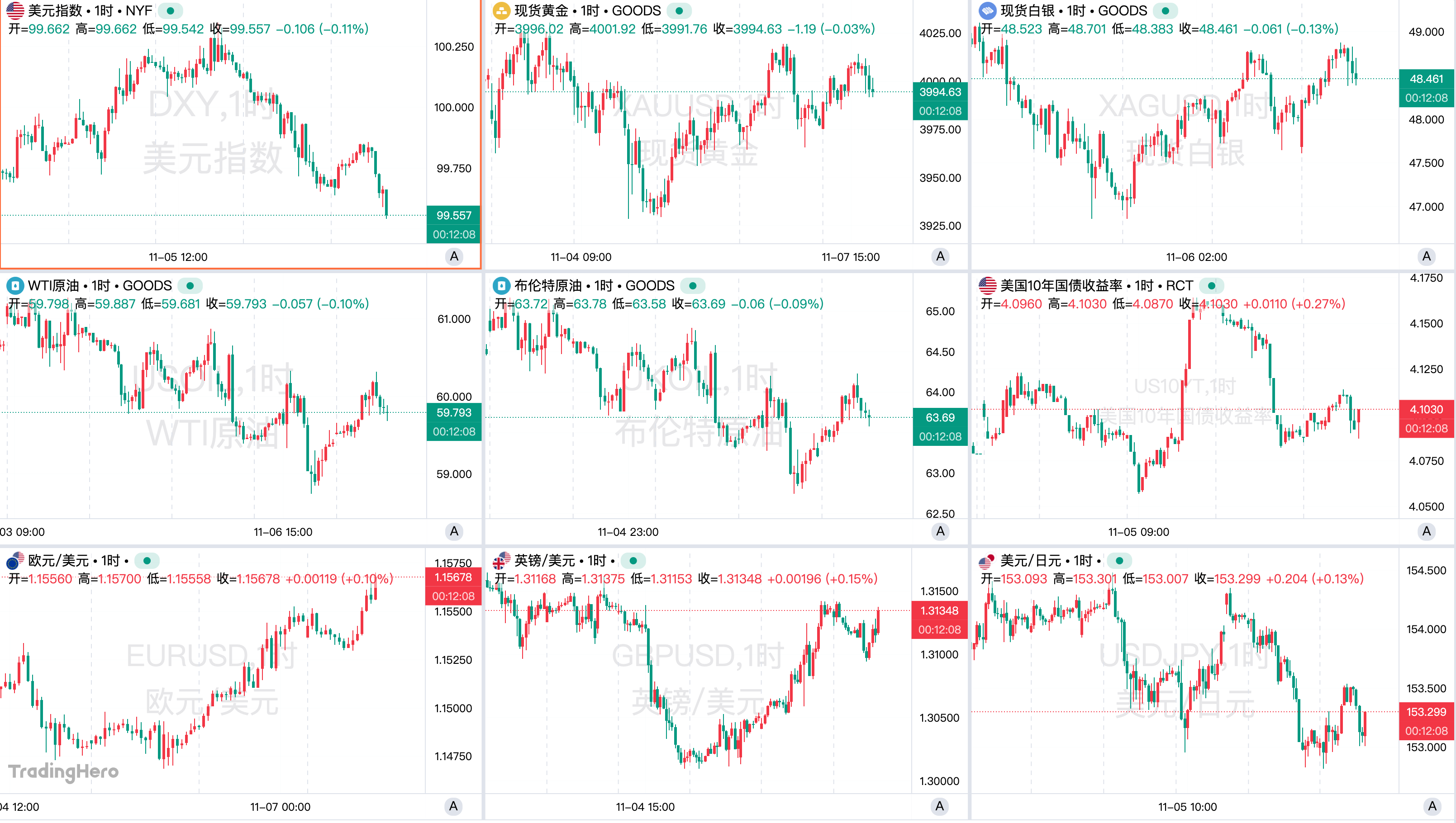
Market Overview - The US dollar index experienced fluctuations this week, initially rising above the 100 mark to reach a three-month high before falling back below 100 on Thursday, currently reported at 99.55 [1] - The precious metals market saw significant volatility, with gold prices dropping to a near one-month low of $3930 per ounce before rebounding, while silver fluctuated between $47 and $49 per ounce [1] - The oil market continued its downward trend, with both crude oil benchmarks declining for four consecutive trading days due to weak factory activity in Asia and rising global inventories [1] Employment and Economic Indicators - The US job market showed mixed signals, with ADP reporting an addition of 42,000 jobs in October, ending a two-month decline, while Challenger reported a record 153,000 layoffs, a 175% year-over-year increase [6] - The Federal Reserve is engaged in heated discussions regarding potential interest rate cuts, with differing opinions on the current economic conditions and inflation risks [7] Political Developments - The US government shutdown continues to impact the economy, with the Congressional Budget Office estimating losses of $11 billion after six weeks and $14 billion after eight weeks, affecting air travel and food assistance programs [8][9] - The Supreme Court is debating the legality of Trump's tariffs, with skepticism from both liberal and conservative justices, potentially impacting future trade policies [10] Corporate Developments - Goldman Sachs predicts limited impact on trade dynamics even if the Supreme Court rules against Trump's tariffs, while also noting potential 30% returns for Chinese stocks by the end of next year [5] - Tesla's shareholders approved a $1 trillion compensation plan for Elon Musk, aiming for a market cap increase from $2 trillion to $8.5 trillion, with ambitious targets set for vehicle deliveries and autonomous driving capabilities [15][16] Industry Insights - The US government updated its critical minerals list, adding ten new minerals including copper and silver, to reduce reliance on foreign sources and promote domestic mining [14] - OpenAI and Amazon Web Services entered a $38 billion computing power agreement, marking a significant collaboration in the AI and cloud computing sectors [18] - Nvidia's CEO expressed confidence in China's potential to win the AI race, criticizing Western regulatory approaches [17]


ETF量化配置策略更新(251031)
Yin He Zheng Quan· 2025-11-07 13:50
Group 1: Macro Timing Strategy - The macro timing strategy has an annualized return of 7.67% as of October 31, 2025, with a Sharpe ratio of 1.45 and a Calmar ratio of 1.67, indicating a maximum drawdown of -4.60% [2][4][5] - The latest portfolio allocation includes 7.01% in CSI 300 ETF, 7.99% in CSI 500 ETF, 55.94% in government bond ETF, 11.63% in soybean meal ETF, 5.02% in non-ferrous ETF, 7.40% in gold ETF, and 5.00% in currency ETF, with no allocation to S&P 500 ETF and corporate bond ETF [7][8] Group 2: Momentum Strategy - The momentum strategy has an annualized return of 18.25% since January 2020, with a Sharpe ratio of 0.88 and a Calmar ratio of 0.64, experiencing a maximum drawdown of -28.72% [9][10] - The latest portfolio allocation includes 27.01% in Huatai-PB CSI Telecom Theme ETF, 24.92% in Fuguo CSI Tourism Theme ETF, 21.52% in Xinhua CSI Cloud Computing 50 ETF, 16.38% in Huatai-PB CSI Smart Car ETF, and 8.17% in Huaxia CSI Artificial Intelligence ETF [13][14] Group 3: Sector Rotation Strategy - The sector rotation strategy has an annualized return of 10.00% since 2020, with an excess return of 7.27% relative to CSI 300, and a maximum drawdown of -42.98% [15] - The latest portfolio includes home appliance ETF, green power ETF, steel ETF, new energy vehicle ETF, financial ETF, and agricultural ETF, while excluding non-ferrous metals ETF and transportation ETF [18][19] Group 4: Copula-Based Second-Order Stochastic Dominance Strategy - The Copula-based second-order stochastic dominance strategy has an annualized return of 14.41% since January 2020, with a Sharpe ratio of 0.68 and a maximum drawdown of -42.62% [20][24] - The latest portfolio allocation includes 5.00% in Huaxia CSI Petrochemical Industry ETF, 85.00% in Fuguo CSI 800 Bank ETF, 5.00% in Fuguo CSI All-Index Securities Company ETF, and 5.00% in Bosera CSI Oil and Gas Resources ETF [23][25] Group 5: Quantile Random Forest Technology ETF Allocation Strategy - The quantile random forest technology ETF allocation strategy has an annualized return of 13.54% since 2020, with a Sharpe ratio of 0.76 and a maximum drawdown of -29.89% [26] - The latest portfolio allocation consists of 95.63% in technology ETFs, including 4.78% in Jiahua National Communication ETF, 4.78% in Tianhong CSI Photovoltaic Industry ETF, 4.78% in Huabao CSI Military Industry ETF, 76.51% in Ping An CSI Consumer Electronics Theme ETF, and 4.78% in Fuguo CSI Technology 50 Strategy ETF [29][30]
鑫元基金张峥青:政策与周期共振,科技投资进入新阶段
Zhong Guo Jing Ying Bao· 2025-11-07 13:20
Core Insights - The core idea of the article emphasizes the strategic importance of "technological self-reliance and strength" in China's 14th Five-Year Plan, indicating a strong focus on technological innovation as a key driver for economic development [1][2]. Policy and Market Opportunities - The A-share technology sector is expected to have significant potential due to the "14th Five-Year Plan" which aims to accelerate high-level technological self-reliance and lead the development of new productive forces [2]. - The government is set to provide continuous financial and resource support to sectors such as computing power, semiconductors, industrial automation, and green energy over the next decade, enhancing the growth and profitability expectations for the technology industry [2][3]. Impact of Global Interest Rate Changes - Changes in the global interest rate environment will affect technology companies through five main channels: 1. Discount rates and risk premiums will directly impact the valuation of growth-oriented technology companies, particularly in sectors like SaaS, cloud computing, and AI applications [3]. 2. Global liquidity and cross-border capital flows will influence the valuation of technology sectors in emerging markets, with lower interest rates improving liquidity and market focus on growth-oriented technology [3][4]. 3. Lower financing costs will benefit capital expenditures in technology firms, particularly in AI infrastructure investments [4]. 4. Currency fluctuations will affect profit margins for import-dependent technology manufacturers, improving cost structures during periods of a weaker dollar [4]. 5. Changes in risk appetite will drive shifts in investment styles, favoring high-growth technology stocks during periods of declining interest rates [4][5]. Identifying Policy Benefits and Risks - Investors should focus on performance and competitive advantages rather than merely chasing concepts, emphasizing the importance of matching valuation with profitability [6][8]. - The essence of valuation risk lies in the risk of realization, where short-term volatility in the technology sector often stems from market overestimation of growth expectations [6][8]. - A balanced investment approach is recommended, focusing on core assets with global competitiveness and innovation capabilities while being flexible in response to policy signals and market conditions [7][8]. Evaluating Valuation Risks - The technology sector's valuation is closely tied to market risk appetite and liquidity, with some segments experiencing short-term overheating and potential valuation bubbles [8][10]. - Investors should return to fundamentals, focusing on quantifiable performance indicators such as customer conversion rates, order visibility, and free cash flow [8][10]. Understanding Policy Dynamics - Distinguishing between long-term "institutional dividends" and short-term "emotional catalysts" is crucial for investors, as policies must be understood in terms of their transmission mechanisms and execution capabilities [9][10]. - The true value of policies is reflected in their long-term impact on industry data, such as fiscal spending and project approvals, rather than immediate market reactions [11].