
消费

Search documents
[1月9日]指数估值数据(大盘继续上涨,牛市到什么阶段;港股指数估值表更新;抽奖福利)
银行螺丝钉· 2026-01-09 14:08
Core Viewpoint - The overall market is experiencing an upward trend, with the index approaching a rating of 3.90 stars, indicating a potential for further growth in the near future [1]. Group 1: Market Performance - All market segments, including large, medium, and small-cap stocks, have seen increases, with small-cap stocks showing the most significant gains [2]. - The CSI 1000 and 2000 indices are now considered overvalued, while the CSI 500 and low-volatility indices are quickly approaching overvaluation [2]. - Since 2018, the CSI 500 low-volatility index has nearly doubled, driven by valuation increases, profit growth, and low-volatility rebalancing [2]. Group 2: Market Phases and Trends - The current bull market is characterized by structural trends, where not all sectors rise or fall together, indicating a rotation in market styles [2]. - The A-share market has seen a significant increase of over 60% since September 2024, with three notable upward waves contributing to a total rise of approximately 74% [2][3]. - Market liquidity is a key driver of the current upward trend, influenced by the Federal Reserve's interest rate cuts and the overall global liquidity environment [3][5]. Group 3: Liquidity Factors - The Federal Reserve's anticipated interest rate cuts through 2026 are expected to maintain a favorable liquidity environment [5]. - A significant amount of deposits, approximately 30 trillion yuan, is set to mature in 2026, with a portion likely to flow into financial assets, including stocks [8][10]. - The current low interest rates on deposits are expected to redirect some funds into the stock market, although not all will enter equities [10][11]. Group 4: Corporate Earnings Growth - Corporate earnings are recovering, with a notable increase in profits for the technology sector, which is leading the market [17][18]. - Some sectors, such as consumer goods, are still experiencing declines in earnings, indicating a mixed performance across different industries [20]. - Continuous monitoring of corporate earnings growth will be essential in 2026 to gauge market expectations [21][22]. Group 5: Investment Strategy - As the market approaches a rating of 3.90 stars, the optimal phase for stock fund investments may have passed, suggesting a shift towards asset allocation and profit-taking strategies [23][24]. - The focus for 2026 should be on managing asset allocation rather than aggressive stock fund purchases [24]. Group 6: Hong Kong Market Insights - The Hong Kong market has also returned to a rating of 3.90 stars, with updated valuations provided for various indices [25]. - The valuation table for Hong Kong indices includes metrics such as P/E ratios and dividend yields, offering insights for potential investors [26].


[1月7日]指数估值数据(3点几星级该如何投资,未来还会有5星吗;免费领好书福利)
银行螺丝钉· 2026-01-07 14:00
Core Viewpoint - The market is currently rated at 3.9 stars, indicating a stable but cautious investment environment, with a notable decrease in the proportion of undervalued stocks [1][8]. Market Performance - The Shanghai and Shenzhen 300 index experienced a slight decline, while small and mid-cap stocks showed minor gains [2]. - The ChiNext and STAR Market, representing growth styles, also saw slight increases [5]. - After a significant rise in previous days, Hong Kong stocks faced a downturn, although the Hang Seng Technology index remains at a normal valuation [6][7]. Valuation Insights - The valuation table shows a significant reduction in the green (undervalued) stocks, with the last instance of no green stocks occurring in early 2021 [3][9]. - The current market conditions suggest that if the market continues to rise, the proportion of red (overvalued) stocks will increase [11]. - Historically, during periods of 5-star ratings, the proportion of undervalued stocks was high, indicating a favorable investment environment [12]. Investment Strategies by Star Rating - At 5-star ratings, it is a phase of significant undervaluation, where various indices are typically undervalued, making it a good time for asset allocation and dollar-cost averaging [17][22][23]. - At 4-star ratings, while undervalued stocks decrease, some still remain, allowing for continued asset allocation but with a recommendation to limit stock exposure based on age [24][26]. - At 3-star ratings, the number of undervalued stocks significantly drops, and overvalued stocks begin to increase, making it less suitable for large investments in stock funds [27][28]. - Ratings of 2 to 1 star indicate late-stage bull markets, with 1-star ratings being rare and typically associated with extreme market conditions [34][36][39]. Future Outlook - The potential for future 5-star opportunities exists, with historical patterns suggesting that such opportunities may arise every 3-5 years across various asset classes [41][44]. - Long-term investment strategies should focus on maintaining a presence in the market, as opportunities for undervalued investments will continue to emerge [49].

策略深度报告:“十五五”开局,破浪前行
Xinda Securities· 2026-01-07 08:55
Group 1 - The positive factors for stabilizing profits are increasing, including weak endogenous economic recovery, policy support, and potential improvements in PPI and real estate [4][11][18] - The PPI is expected to show marginal improvement due to seasonal demand and supply-demand balance driven by "anti-involution" policies [4][18][22] - The real estate market is experiencing a downtrend, but there are signs of potential stabilization, with some data showing slight improvements [4][28][29] Group 2 - The core factors influencing the height of the liquidity bull market are policies and stock market funds, with smaller bull markets focusing on profits while larger bull markets are driven by macro liquidity [4][11][18] - The capital market's institutional dividends can easily drive large-scale bull markets, and the "asset shortage" logic is expected to enhance the willingness to allocate funds to the stock market [4][18][22] - The regulatory policy adjustment rhythm will be crucial in the mid-term of the bull market, with significant changes in investor behavior expected as the market progresses [4][11][18] Group 3 - The style judgment indicates that small-cap growth stocks remain a trend, but there will be volatility in the mid-term of the bull market [4][29][31] - Long-term trends favor small-cap stocks, but there may be significant quarterly fluctuations influenced by new resident funds and growth-value style disturbances [4][31][32] - Growth style is likely to maintain a performance advantage over value style [4][31][32] Group 4 - Industry allocation suggests a foundation in finance, with technology as the main line and themes rotating actively [4][33][39] - Non-bank financials are gaining elasticity and have certain allocation value, while technology is expected to see a second wave of growth in the later stages of the bull market [4][33][39] - Key sectors to watch include power equipment, certain cyclical industries, and new consumption, focusing on improvements in ROE [4][39][42][44]
2025资本市场年度人物盘点:老将承压,新生代突围
Nan Fang Du Shi Bao· 2026-01-07 04:17
Group 1 - The core trend in the 2025 Chinese capital market indicates a shift from scale expansion to value return, emphasizing hard-core strength over conceptual speculation [2] - The experiences of industry veterans and new generation entrepreneurs reflect the necessity of risk awareness, essence adherence, and innovation embrace to navigate market changes [2] Group 2 - The resignation of Vanke's former CEO, Zhu Jiusheng, marks a significant event in the real estate sector, highlighting the vulnerabilities of high-leverage models amid industry downturns [4] - Xiaomi's CEO Lei Jun faces challenges in the automotive sector, where safety concerns and brand reputation are critical as consumer expectations evolve from mere production to quality [6] - BYD's Wang Chuanfu celebrates record sales of 4.6024 million electric vehicles globally, yet faces declining domestic revenue and profit, indicating the need for technological depth and operational excellence [8] Group 3 - The emergence of new entrepreneurs like Liu Jingkang, who launched a drone brand to compete with DJI, illustrates the survival imperative of differentiation in a competitive landscape [11] - Peng Zhihui's transition from Huawei employee to entrepreneur showcases the capital market's recognition of technical talent, but the challenge remains in converting technical prowess into sustainable profits [13] - Wang Xingxing's company, Yushutech, aims for an IPO, representing the maturation of the embodied intelligence sector, where commercialization and market expectations will dictate future success [15] Group 4 - Bubble Mart's founder Wang Ning experiences a volatile year, with significant revenue growth followed by a sharp decline in stock price, emphasizing the need to shift from reliance on hit products to ecosystem building [20] - Cambricon's Chen Tian Shi sees a turnaround with consecutive profitable quarters, driven by AI computing demand, highlighting the importance of technological barriers and ecosystem development in hard tech [22] - Liang Wenfeng's low-profile yet impactful contributions in AI through DeepSeek demonstrate that sustained innovation is crucial for success in the artificial intelligence era [24][25]

我国情绪消费市场规模超2万亿元,港股消费ETF(159735)盘中交投活跃,机构:消费板块或将迎来业绩修复成长空间
2 1 Shi Ji Jing Ji Bao Dao· 2026-01-07 02:18
Group 1 - The Hang Seng Tech Index experienced a decline of over 1%, while the CSI Hong Kong Stock Connect Consumer Theme Index saw a slight increase of 0.02% as of the report time [1] - Among the constituent stocks, companies such as Shangmei Co., Ltd. rose by over 2%, with other notable gainers including KANAT Optics, AUX Electric, Mao Ge Ping, Xiao Cai Yuan, and Master Kong Holdings [1] - The Hong Kong Consumer ETF (159735) tracked the CSI Hong Kong Stock Connect Consumer Theme Index, which consists of 50 large-cap consumer-related stocks with good liquidity, reflecting the overall performance of consumer stocks within the Hong Kong Stock Connect [1] Group 2 - The emotional consumption market in China is rapidly growing, projected to increase from 16.3 trillion yuan in 2022 to 27.2 trillion yuan by 2025, and expected to exceed 45 trillion yuan by 2029 [1] - Over 90% of young people recognize the concept of "emotional value," with nearly 60% willing to pay for it, indicating a strong market potential driven by the younger demographic [1] - Experts believe that Chinese products and services have unique advantages in the emotional consumption sector, which is becoming a significant growth area in the overall consumption market [1] Group 3 - According to Everbright Securities, the consumption sector is expected to stabilize due to policy support and a rebound in consumer confidence, potentially leading to performance recovery and growth opportunities [2] - Leading companies in specific sub-sectors are noted for their strong resilience and competitive market positions [2]

中信证券|China Themes:2026年投资展望
Xin Lang Cai Jing· 2026-01-07 01:18
Macro and Policy - In 2026, China's macroeconomic growth is expected to show a mild recovery with a projected GDP growth rate of 4.9%, supported by resilient exports and gradually recovering investments, although consumer goods consumption may face short-term pressure [4][14] - The focus of policies will be on building a modern industrial system, which is anticipated to yield significant results in technological innovation and industrial upgrades [4][14] Major Asset Classes - The asset environment in 2026 is expected to exhibit marginal liquidity easing and mild economic recovery, with recommendations favoring commodities over stocks and bonds [3][13] - The expected annual increase for the Wind All A index is projected to be between 5% and 10%, while Hong Kong stocks may experience a rebound in performance and valuation recovery [3][13] - Commodity prices are anticipated to stabilize, with Brent crude oil expected to fluctuate between $58 and $70 per barrel, and gold potentially reaching $5,000 per ounce [3][13] Technology - The narrative around AI is expected to deepen, continuing to reshape the value of the technology sector, with a shift from "model iteration" to "scenario implementation" [5][15] - Domestic computing power and semiconductor equipment are expected to thrive under the trend of self-sufficiency, while AI-related sectors are projected to experience significant growth [5][15] Consumer Sector - The consumer sector is expected to stabilize due to low expectations and valuations, with a focus on wealth effect transmission and supply-side optimization driving business turning points [6][16] - Long-term investment strategies should emphasize changes in consumer structure, particularly in new products and categories driven by emotional and health-related demands [6][16] Healthcare - The healthcare sector is likely to benefit from improved payment systems and accelerated international expansion, with domestic innovative drugs entering a phase of payment improvement and market realization [7][17] Energy - The energy sector is expected to see continued price increases for copper, aluminum, gold, and battery metals, driven by supply constraints and increasing demand [7][17] - Coal companies are projected to improve performance in line with coal prices, with recommendations for selecting stocks based on low-cost positioning and capacity expansion [7][17] Infrastructure - The real estate market is showing signs of recovery, with expectations for a stabilization foundation in 2026, and companies may enter a critical year for balance sheet repair [8][18] - The public utility and environmental sectors are recommended for investment, particularly in water and gas industries, which are expected to recover as gas prices fall and demand rises [8][18] Financial Sector - The financial industry is approaching a cyclical turning point, with improved operating conditions expected as interest rates stabilize and insurance sector concerns ease [8][18] - Economic recovery is anticipated to drive demand for financial services, with a focus on high-dividend financial stocks as a stable investment choice [8][18] Manufacturing - The manufacturing sector's growth is expected to be driven by resilient overseas demand and a recovery in domestic demand, with AI continuing to be a major growth driver [9][19] - Companies are advised to focus on risk-resistant core assets while capitalizing on global expansion and technological advancements [9][19]


【百亿基金内参】锁定2026新主线:AI Agent突破、航空黄金窗口与消费预期差
Sou Hu Cai Jing· 2026-01-06 17:02
Group 1 - The core viewpoint emphasizes that 2026 will be a pivotal year for AI applications, with personal general agents potentially being the biggest breakthrough and investment focus [1] - The aviation industry is experiencing a rare improvement in supply-demand dynamics, supported by three favorable factors: ticket prices, oil prices, and exchange rates [1] - Despite pressures on complete vehicles, there are highlights in the automotive sector due to the globalization of auto parts and the favorable cycle in heavy-duty trucks, leading to excess returns [1] - Consumer expectations show a divergence, with high-end products and cost-effective options both thriving, indicating that structural prosperity is underestimated by the market [1]
[1月6日]指数估值数据(大盘继续上涨,回到3星级;螺丝钉定投实盘第397期发车;养老指数估值表更新)
银行螺丝钉· 2026-01-06 14:41
Core Viewpoint - The overall market has risen, returning to a valuation of 3.9 stars, marking the first time in 2023 that it has reached this level, indicating a potential bullish trend in the market [1]. Group 1: Market Performance - The market has experienced its fourth round of 3-point valuations since 2015, with previous instances in late 2017 and early 2021 lasting several months to half a year [1]. - The Hong Kong stock market entered the 3-point valuation earlier, in Q3 2025, while A-shares experienced a slight pullback in Q4 but have shown strong performance in the last two weeks [1]. - Both large, mid, and small-cap stocks have risen, with value styles also seeing an increase, and the growth style, particularly in the STAR Market, performing strongly [1]. Group 2: Investment Strategy - Following the return to a 3.9-star valuation, the active selection portfolio has returned to normal valuation, leading to a pause in new investments [2]. - The "Yuexinbao" investment strategy remains undervalued but is close to normal valuation, indicating a potential for future growth [3][4]. - If the market continues to rise, it may reach normal valuation, prompting a pause in regular investments [5]. Group 3: Portfolio Adjustments - Recent growth in certain active selection portfolios has led to some assets reaching overvaluation, prompting a reallocation towards undervalued assets [10]. - The index enhancement portfolio may reach overvaluation soon, with a reference PE ratio of approximately 19 times [12]. - Any opportunities for profit-taking will be executed in a phased manner, ensuring a strategic approach to portfolio management [15]. Group 4: Investment Products - The "Yuexinbao" portfolio consists of 40% stocks and 60% bonds, designed for stable market participation with a built-in cash flow distribution feature [17]. - The automatic profit-taking feature has been implemented for the "Ding" series portfolios, allowing for seamless transitions to more stable investment options when necessary [19]. - The personal pension investment strategy includes a focus on classic combinations of growth and value styles, with a current emphasis on waiting for undervalued opportunities [21].

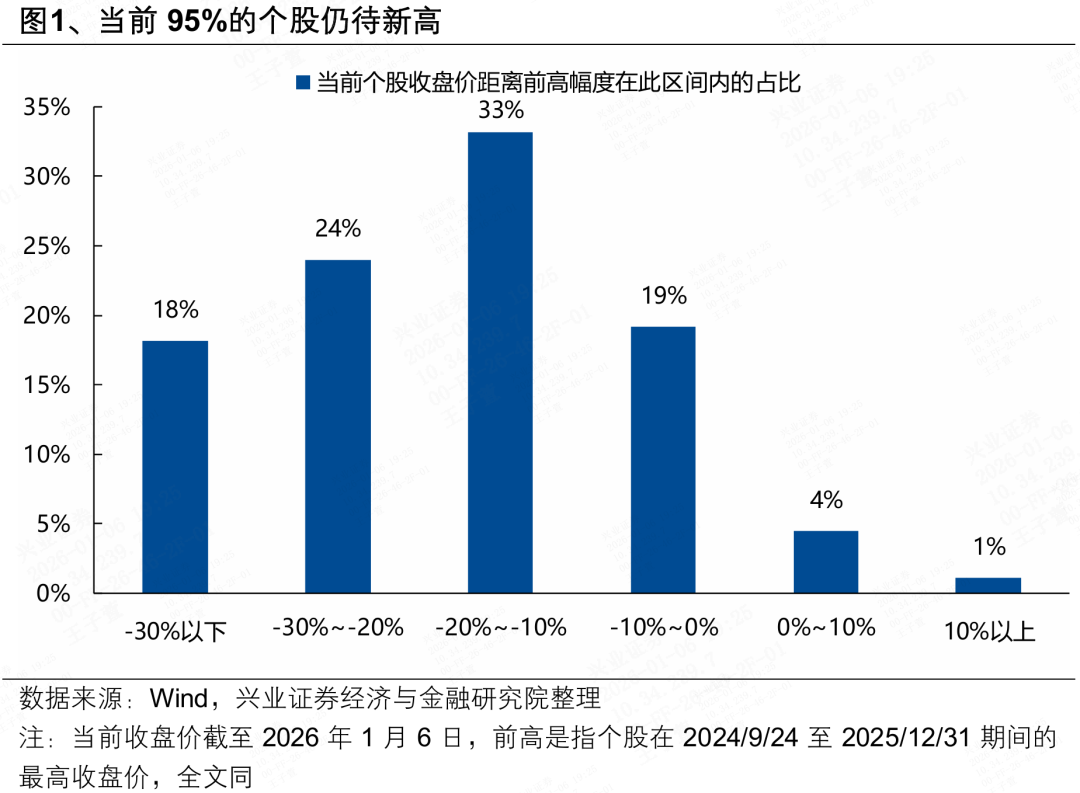
兴业证券:95%个股仍待新高 市场或存在结构性机会
智通财经网· 2026-01-06 12:43
Core Viewpoint - As of January 6, 95% of individual stocks have not broken their previous highs, despite major indices reaching new highs, indicating potential structural opportunities in the market [1][2]. Group 1: Market Overview - Major indices such as the Shanghai Composite Index, All A-shares, CSI 300, and CSI 800 have all reached new highs, but only 5% of individual stocks have surpassed their previous highs [2]. - The previous high for individual stocks is defined as the highest closing price from September 24, 2024, to December 31, 2025, with most stocks still down by over 10% from these highs [2]. Group 2: Sector Performance - The sectors that have broken through previous highs are concentrated in a few segments, particularly in large financials represented by insurance, and sectors benefiting from price increases such as non-ferrous metals, chemicals, petrochemicals, and construction materials [1][5]. - Other sectors that have seen new highs include military, machinery, and home appliance components driven by commercial aerospace and robotics [1][5]. Group 3: Sectors Near Previous Highs - Sectors that have not yet broken their previous highs but are close include technology growth (commercial vehicles, semiconductors, communication equipment), cyclical industries (steel raw materials, renovation materials), and consumer sectors (animal health, textiles, agriculture) [10]. - Industries with significant gaps to their previous highs include technology growth (motors, software, batteries, photovoltaics), dividend sectors (electricity, white goods, banks), and consumer sectors (food and beverage, social services, retail) [13].

法兴:2025年香港窝轮及牛熊证总成交额达4.4945万亿港元 同比升55%
Zhi Tong Cai Jing· 2026-01-06 07:21
受惠港股市场投资气氛炽热,个股轮证成交急增。当中,ATMX 轮证成交同比急增逾七成;泡泡玛特 (09992)、中芯(00981)及宁德时代(03750)等相关产品亦受追捧;美股窝轮方面,较多资金留意 Nvidia(NVDA.US)及特斯拉(TSLA.US)。 法兴上市产品销售部董事蔡秀虹表示,2025年轮证市场交投火热,投资者运用轮证特性捕捉波动市况, 并加强美股窝轮部署。该行进一步扩大美股相关资产的覆盖范围,新增博通(AVGO.US)及奈飞 (NFLX.US)窝轮,以满足投资者在美股"科技七雄"以外的交易需求。 fund (原标题:法兴:2025年香港窝轮及牛熊证总成交额达4.4945万亿港元 同比升55%) 智通财经APP获悉,法国兴业银行(法兴)表示,2025年香港市场的窝轮及牛熊证总成交额达4.4945万亿 港元,同比大升55%,创2021年以来新高,占大市成交约7.3%。其中,窝轮总成交额达1.903万亿港 元,同比升50%;牛熊证总成交额达2.5915万亿港元,同比升58%。 ...
