
炼化

Search documents
大炼化周报:“金九”旺季临近,长丝下游需求有所改善-20250831
Xinda Securities· 2025-08-31 04:28
Investment Rating - The industry investment rating is "Positive" as the industry index is expected to outperform the benchmark [144]. Core Insights - The report highlights that the demand for long filaments is improving as the "golden September" season approaches, indicating a potential uptick in downstream demand [2]. - The Brent crude oil price averaged $68.34 per barrel as of August 29, 2025, reflecting a week-on-week increase of 2.26% [2][3]. - Domestic and international refining project price differentials are being tracked, with domestic price differentials at 2408.08 CNY/ton, down 0.51% week-on-week, while international differentials are at 1080.85 CNY/ton, down 0.47% [2][3]. Refining Sector Summary - The report notes that U.S. tariffs on Indian goods have raised market concerns, but a decrease in U.S. crude, gasoline, and distillate inventories has supported prices [2]. - As of August 29, 2025, Brent and WTI crude prices were $68.12 and $64.01 per barrel, respectively, showing slight increases from the previous week [13]. - Domestic refined oil prices have slightly decreased, while overseas prices have generally increased [2]. Chemical Sector Summary - Chemical prices are generally weak, with price differentials narrowing, although some products have seen structural demand-driven price improvements [2]. - Polyethylene prices have increased slightly, while polypropylene prices have weakened, leading to an overall narrowing of price differentials [53]. - EVA prices have risen significantly due to increased procurement in the photovoltaic sector, with price differentials widening [53]. Polyester Sector Summary - Polyester product prices have seen slight increases due to raw material price support, with PX costs strengthening [88]. - The report indicates that the supply of polyester long filaments has slightly decreased due to maintenance and operational issues, while demand is showing signs of improvement as the autumn season approaches [107]. - The average prices for POY, FDY, and DTY are reported at 6878.57 CNY/ton, 7135.00 CNY/ton, and 8028.57 CNY/ton, respectively [107]. Performance of Major Refining Companies - As of August 29, 2025, the stock price changes for six major refining companies were as follows: Rongsheng Petrochemical (+0.0%), Hengli Petrochemical (+2.98%), Dongfang Shenghong (+5.02%), Hengyi Petrochemical (+3.34%), Tongkun Co. (+2.80%), and Xin Fengming (+5.07%) [130]. - Over the past month, stock price changes were: Rongsheng Petrochemical (+6.71%), Hengli Petrochemical (+12.09%), Dongfang Shenghong (+7.90%), Hengyi Petrochemical (+6.39%), Tongkun Co. (+18.88%), and Xin Fengming (+24.84%) [130]. Industry Index Performance - The report states that the Cinda Refining Index has increased by 43.20% since its inception, outperforming the oil and petrochemical industry index, which rose by 22.26% [133].
荣盛石化(002493):油价与芳烃景气下行带动25Q2业绩下滑,未来景气有望加速修复
Shenwan Hongyuan Securities· 2025-08-29 08:47
Investment Rating - The investment rating for Rongsheng Petrochemical is "Buy" (maintained) [1] Core Views - The company's performance in Q2 2025 declined due to falling oil prices and a downturn in aromatics profitability, but future recovery is anticipated [6] - The company reported a revenue of 148.63 billion yuan in H1 2025, a year-on-year decrease of 7.83%, and a net profit of 602 million yuan, down 29.82% year-on-year [6] - Strategic cooperation with Saudi Aramco is expected to enhance growth potential through technology sharing and resource collaboration [6] Financial Data and Profit Forecast - Total revenue forecast for 2025 is 344.785 billion yuan, with a year-on-year growth rate of 5.6% [5] - Net profit for 2025 is projected at 3.637 billion yuan, reflecting a significant increase of 402.0% compared to the previous year [5] - The company plans to maintain a PE ratio of 27 for 2025, with a target valuation based on comparable companies [6]

恒力石化(600346):反内卷下炼化景气度触底反弹在即
Changjiang Securities· 2025-08-28 09:15
Investment Rating - The investment rating for the company is "Buy" and is maintained [9]. Core Views - The company reported a revenue of 103.887 billion yuan for the first half of 2025, a year-on-year decrease of 7.69%. The net profit attributable to the parent company was 3.050 billion yuan, down 24.08% year-on-year, while the net profit excluding non-recurring items was 2.296 billion yuan, a decline of 35.16% year-on-year [2][6]. - In Q2 2025, the company achieved a revenue of 46.863 billion yuan, a year-on-year decrease of 13.45% and a quarter-on-quarter decrease of 17.82%. The net profit attributable to the parent company was 999 million yuan, down 46.81% year-on-year and 51.28% quarter-on-quarter [2][6]. - The report highlights that the refining and chemical industry is expected to rebound as the "anti-involution" policy is implemented, leading to a potential improvement in the industry's prosperity [11]. Financial Performance - The company is projected to achieve net profits of 6.49 billion yuan, 8.95 billion yuan, and 11.83 billion yuan for the years 2025, 2026, and 2027, respectively. The corresponding price-to-earnings ratios based on the closing price on August 25, 2025, are 18.6X, 13.5X, and 10.2X [11]. - The report provides detailed financial forecasts, including total revenue and profit margins, indicating a gradual recovery in profitability over the next few years [17]. Industry Insights - The company is positioned as a unique player in the industry, integrating oil, coal, and chemicals within a single industrial park, which significantly reduces operational and logistics costs [11]. - The report notes that the aromatic chain is expected to see continuous improvement in prosperity due to limited supply growth of PX while downstream demand remains stable [11].

恒力石化(600346):行业竞争格局或持续优化,现金流改善推动股东回报增强
Xinda Securities· 2025-08-28 08:35
公司研究 [Tabl 点评报告 e_ReportType] [Table_StockAndRank] 恒力石化(600346.SH) | 投资评级 | 买入 | | --- | --- | | 上次评级 | 买入 | 证券研究报告 [Table_A 刘红光 uthor 石化行业联席首席分析师 ] 执业编号:S1500525060002 邮箱:liuhongguang@cindasc.com 刘奕麟 石化行业分析师 执业编号:S1500524040001 联系电话:13261695353 邮箱:liuyilin@cindasc.com 信达证券股份有限公司 CINDA SECURITIES CO.,LTD 北京市西城区宣武门西大街甲127号金隅 大厦B座 邮编:100031 [行业Table_T 竞争格局 itle] 或持续优化,现金流改善推动股东回报增强 [Table_ReportDate] 2025 年 8 月 28 日 [Table_S 事件: ummary] 2025 年 8 月 22 日晚,恒力石化发布 2025 年半年度报告。2025 年 上半年公司实现营业总收入 1039.44 亿元,同比下降 7 ...
威联化学多措并举:转型、技改、智造锻造企业竞争力
Qi Lu Wan Bao Wang· 2025-08-28 05:20
Group 1 - The core viewpoint of the article emphasizes the need for companies in the refining industry to adapt to changing market demands by transitioning from fuel-based operations to chemical production [3][4]. - The company is investing heavily in upgrading existing refining facilities to improve processing efficiency and reduce reliance on traditional fuel markets, aiming for sustainable development [3][4]. - The introduction of advanced technologies and equipment is a key strategy for the company to lower costs and enhance operational efficiency, including significant investments in energy-saving upgrades [4]. Group 2 - The company is accelerating its smart manufacturing initiatives, aiming to enhance production efficiency by 30% and reduce labor costs by 20% over the next two years through the use of IoT and automation technologies [5]. - Real-time monitoring and data integration across production, sales, and procurement are being implemented to improve decision-making and operational effectiveness [5].

中金公司(601995.SH):看好炼化整体盈利水平改善 维持荣盛石化跑赢行业评级
Xin Lang Cai Jing· 2025-08-28 03:24
Core Viewpoint - The report from China International Capital Corporation (CICC) indicates that the overall profitability of the refining industry is expected to improve due to stable oil prices since the third quarter, with a positive outlook for the petrochemical industry chain's profit recovery by 2026, maintaining a "outperform" rating for Rongsheng Petrochemical [1] Industry Summary - The implementation of the "anti-involution" policy in China is accelerating an industry reshuffle focused on eliminating inefficient capacity, regulating market competition, and improving supply quality [1] - Approximately 48.8 million tons of small-scale capacity, under 2 million tons, have yet to exit the market, accounting for about 5% of the current refining capacity [1] - There is 145 million tons of refining capacity between 200 million and 300 million tons per year, representing about 15% of the total [1] - Continuous advancement and implementation of anti-involution policies are expected to create a new development landscape for the refining industry [1] - The elimination of outdated facilities and optimization of capacity will further increase industry concentration, with resources concentrating towards leading enterprises [1] Company Summary - Rongsheng Petrochemical operates the world's largest integrated refining and chemical project with a capacity of 40 million tons per year at its green petrochemical base [1] - The company is expected to benefit continuously from the current competitive landscape characterized by limited increments and capacity reductions [1]

开源证券晨会纪要-20250828
KAIYUAN SECURITIES· 2025-08-27 23:31
Macro Economic Overview - The cumulative profit of national industrial enterprises from January to July 2025 decreased by 1.7% year-on-year, while cumulative operating income increased by 2.3% year-on-year [5] - In July, the profit growth rate improved marginally, with a year-on-year increase of 2.8 percentage points to -1.5% [6] - Investment income is expected to continue contributing positively to profits, with a notable increase in the South China Comprehensive Index since June indicating potential growth in investment income [6] Industry Insights Computer Industry - The "Artificial Intelligence+" action plan was released, aiming for over 70% application penetration of new intelligent terminals and intelligent agents by 2027 [12] - The policy covers six major areas, promoting AI applications across technology, industry, consumption, and governance [13] - The domestic AI ecosystem is expected to flourish due to policy and technological synergies [14] Agriculture, Forestry, Animal Husbandry, and Fishery - Huadong Co., Ltd. reported a revenue of 4.244 billion yuan in H1 2025, with a net profit of 76 million yuan, reflecting a significant year-on-year increase of 163.98% [17] - The company aims to reduce costs in pig farming, targeting a cost of 13 yuan per kilogram by the end of 2025 [19] - The company has established a national layout for pig slaughtering, enhancing cash flow stability [20] Coal Mining Industry - China Coal Energy reported a revenue of 74.44 billion yuan in H1 2025, down 19.9% year-on-year, with a net profit of 7.71 billion yuan, down 21.3% [22] - The company’s coal production and sales volume increased by 1.3% and 1.4% respectively, despite a significant drop in coal prices [23] - The company has a high dividend potential, with a cash dividend of 0.166 yuan per share announced for H1 2025 [24] Chemical Industry - Rongsheng Petrochemical reported a 12.28% year-on-year increase in net profit excluding non-recurring items in H1 2025 [27] - The company’s revenue from chemical products decreased by 7.83%, while the gross margin for refining products improved [28] - The global petrochemical industry is undergoing restructuring, which may benefit the company [29] Steel and Nonferrous Metals - Jincheng Mining reported a 47.82% increase in revenue to 6.316 billion yuan in H1 2025, with a net profit growth of 81.29% [31] - The company’s resource segment saw a significant increase in sales revenue, driven by higher production volumes [32] - The mining service business is expected to grow, with new contracts signed worth 7.1 billion yuan [33] Real Estate and Construction - China Resources Vientiane Life reported a revenue of 8.524 billion yuan in H1 2025, with a net profit increase of 7.4% [44] - The company achieved a gross margin increase of 3.1 percentage points to 37.1% [44] - The company plans to distribute 100% of its core net profit as dividends for the first time [45]
全球最大柴油吸附分离装置在广西钦州一次开车成功
Zhong Guo Xin Wen Wang· 2025-08-27 12:52
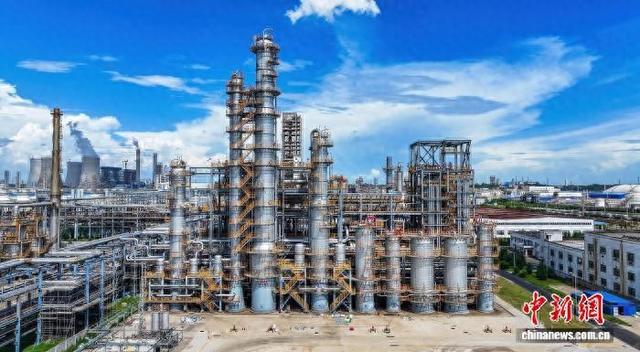
Core Viewpoint - The successful commissioning of the world's largest 2 million tons/year diesel adsorption separation unit marks a significant advancement in the integrated transformation and upgrading of the petrochemical industry in Southwest China, providing a scalable and efficient solution for the global refining industry's transition from "oil-heavy" to "chemical-heavy" production [1][2]. Group 1: Project Overview - The diesel adsorption separation unit is part of a major national petrochemical project with a total investment of 30.5 billion yuan, covering over 4,400 acres [5]. - The project commenced construction in July 2023 and is expected to be fully completed by July 14, 2025, with initial operations starting on October 18, 2023 [5]. Group 2: Technological Innovation - The unit utilizes a proprietary "diesel adsorption separation" technology developed by Kunlun Engineering and CNOOC Tianjin Chemical Research Design Institute, which allows for precise molecular-level control to separate diesel into high-quality olefin and aromatic raw materials [2]. - The process enhances raw material utilization efficiency by over 15% compared to traditional methods, while also reducing energy consumption and carbon emissions [2]. Group 3: Industry Impact - The project is expected to facilitate the transformation of Guangxi's petrochemical industry from a "fuel-type" refinery to a "chemical products and organic materials-type" enterprise, filling gaps in high-end chemical new materials in the region [5]. - It aims to support the establishment of a trillion-yuan green chemical new materials industry cluster in Guangxi, enhancing China's position in the global refining industry and contributing to national energy security and high-quality development of the chemical industry [5].

东海证券给予荣盛石化买入评级:2025H1业绩承压,持续加深产业链布局静待周期复苏
Sou Hu Cai Jing· 2025-08-27 04:04
Group 1 - The core viewpoint of the report is that Donghai Securities has given a "buy" rating for Rongsheng Petrochemical (002493.SZ) based on several favorable factors [1] - Decrease in raw material costs is beneficial for the refining and polyester sectors, while the decline in the price spread of aromatic products is negatively impacting the chemical sector's profits [1] - Continuous capital investment and orderly project construction are highlighted as positive indicators for the company's future performance [1] - The refining industry landscape is expected to improve under the "anti-involution" context, with leading companies likely to benefit first [1]
太平洋给予恒力石化买入评级:油价震荡及检修影响短期业绩,或受益于行业“反内卷”
Sou Hu Cai Jing· 2025-08-27 00:42
Group 1 - The core viewpoint of the report is that Pacific Securities has given a "buy" rating for Hengli Petrochemical (600346.SH) with a latest price of 17.53 yuan [1] - The rating rationale includes the impact of volatile oil prices and maintenance affecting short-term performance, with profitability expected to be under pressure in Q2 2025 [1] - The report expresses optimism about the refining sector's continued recovery against the backdrop of an "anti-involution" trend in the industry [1] Group 2 - The report highlights potential risks such as fluctuations in raw material prices, product price volatility, slower project progress, declining demand, and intensified industry competition [1]