
现代服务业

Search documents
省发改委:现代服务业发展将纳入编制中的广东“十五五”规划
Nan Fang Du Shi Bao· 2025-08-22 10:16
Core Insights - Guangdong Province is actively developing the modern service industry, which has become a key pillar for economic growth and employment, supporting high-quality economic and social development [2] Group 1: Modern Service Industry Development - The overall scale of the service industry in Guangdong has been continuously expanding [2] - A special meeting was held on August 22 to accelerate the construction of a modern industrial system, focusing on modern service industry development [2] - The Director of the Guangdong Development and Reform Commission, Ai Xuefeng, emphasized the need for coordinated efforts to strengthen the development of the modern service industry [2] Group 2: Planning and Strategy - The development of the modern service industry will be included in the upcoming "14th Five-Year Plan" for the province [2] - A specific "14th Five-Year Plan" for the development of modern service industry will be organized to provide a guideline for high-quality development during this period [2] Group 3: Low-altitude Economy - The Guangdong Development and Reform Commission is focusing on the high-quality development of the low-altitude economy, addressing areas such as mechanism construction, airspace reform, infrastructure, industrial layout, and application scenarios [2] - There have been practical advancements in urban governance, air traffic, and low-altitude tourism, contributing to the standardization of the low-altitude economy [2]


广东养老护理服务人员缺口大,银发经济等新消费需求旺盛
Nan Fang Nong Cun Bao· 2025-08-22 10:00
Core Insights - The demand for high-end nursing and smart elderly care services in Guangdong is significantly outpacing supply, leading to a substantial shortage of nursing care personnel [2][9] - The service industry in Guangdong is projected to contribute 8.14 trillion yuan to the province's GDP in 2024, accounting for 10.6% of the national total and maintaining a 57.5% share of the province's GDP [6][7] Group 1 - The current supply of specialized services such as high-end nursing and smart elderly care is insufficient, resulting in a large gap in nursing care personnel [9][10] - There is a growing demand for new consumption trends such as smart health care, customized tourism, and the silver economy, driven by increasing resident incomes [10][11] - Regulatory, policy, and environmental factors are constraining the growth of these new consumption demands [11] Group 2 - Recommendations from the research group include upgrading the living service industry towards higher quality and diversity [12] - Support for cities like Guangzhou to create national-level high-standard silver economy industrial parks is encouraged [13] - The proposal includes utilizing existing special funds to support key projects in the silver economy and seeking additional funding sources for infrastructure development [14][15]

一场现代服务业“头脑风暴”:广东人大再开产业专题会
2 1 Shi Ji Jing Ji Bao Dao· 2025-08-22 01:53
Core Insights - The Guangdong Provincial People's Congress is focusing on modern service industries as a key driver for economic growth, highlighting its increasing contribution to the national economy [1][2] - The service sector in Guangdong is projected to reach a value of 8.14 trillion yuan in 2024, accounting for 11% of the national total, and has maintained the top position in the country for 40 consecutive years [2][3] - Modern service industries are expected to continue growing, driven by rising consumer spending and the ongoing transformation of various sectors [6][7] Economic Contribution - In 2024, the value added by the service sector in Guangdong is expected to be 8.14 trillion yuan, with modern service industries contributing 64.5% of this value [2][3] - The number of large-scale service enterprises in Guangdong reached over 40,900, representing 15.9% of the national total, with their revenue accounting for 14.3% of the country's total [3] - The service sector's growth rate in the first half of 2025 was 4.6%, outpacing GDP growth by 0.4 percentage points [4] Sectoral Focus - Key areas of growth within modern service industries include finance, modern trade services, and scientific research and technology services [6][7] - The Guangdong government is prioritizing the development of productive service industries, including logistics, information services, and service-oriented manufacturing [4][5] Challenges and Opportunities - The service sector faces challenges such as the need for high-end service supply and talent shortages in finance, technology, and design [7] - The shift in consumer behavior towards service-oriented consumption is creating new opportunities for growth, with service retail expected to grow by 6.2% in 2024 [6][7] - The integration of advanced technologies like big data and AI is anticipated to further enhance the service sector's growth potential [6]
习言道|讲好新时代西藏故事
Zhong Guo Xin Wen Wang· 2025-08-21 00:13
Core Viewpoint - Xi Jinping emphasized the importance of maintaining political stability, social stability, ethnic unity, and religious harmony in Tibet during a report from the Tibet Autonomous Region Party Committee and government [1][2][4][5]. Group 1: Political and Social Stability - The need to ensure political stability and social stability in Tibet is paramount [4][5]. - Promoting the awareness of the Chinese national community and enhancing the construction of this community is essential [9]. Group 2: Economic Development - High-quality development should be promoted based on the unique characteristics of Tibet, focusing on highland specialty industries, particularly in agriculture, animal husbandry, and clean energy [16]. - Continuous development of resource processing industries and active promotion of modern service industries are necessary [16]. Group 3: Cultural and Ethnic Integration - There is a call to create a national model area for ethnic unity and progress, promoting the common national language and facilitating exchanges among different ethnic groups [11]. - The importance of integrating Tibetan Buddhism with socialist society is highlighted, along with the need for legal governance of religious affairs [15]. Group 4: Party Leadership - The necessity of adhering to the leadership of the Party and strengthening Party building is emphasized for effective governance in Tibet [19]. - The guiding principle of using Xi Jinping's thoughts on socialism with Chinese characteristics for the new era to unify and inspire all ethnic groups is stressed [19].
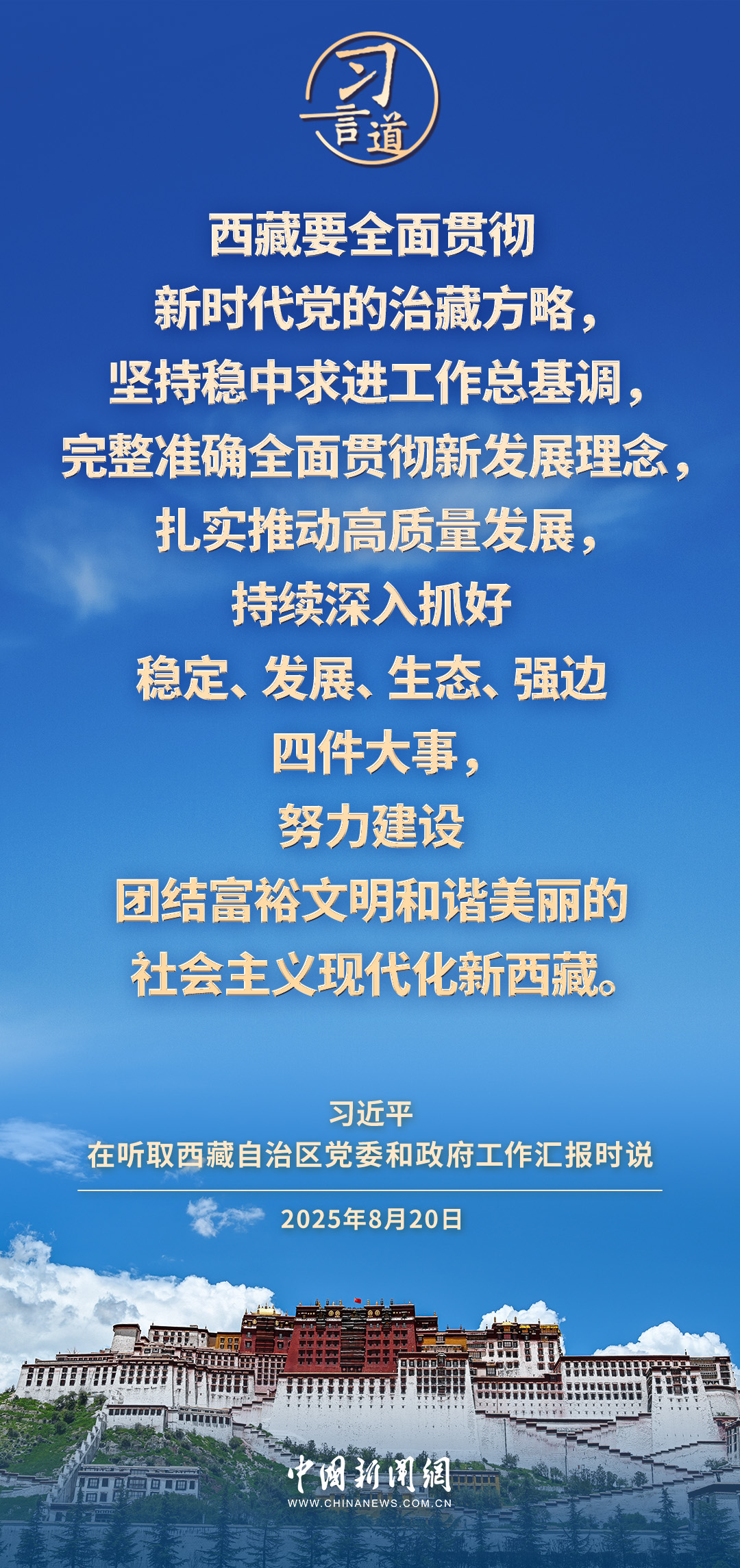
习近平:全面贯彻新时代党的治藏方略 努力建设团结富裕文明和谐美丽的社会主义现代化新西藏
中国基金报· 2025-08-20 11:47
Core Viewpoint - The article emphasizes the importance of implementing the Party's governance strategy in Tibet, focusing on stability, development, ecology, and border security to build a modern socialist Tibet that is united, prosperous, civilized, harmonious, and beautiful [1][2]. Group 1: Development Strategy - Tibet's development should leverage its unique characteristics, promoting high-quality growth through the development of specialty agriculture, clean energy, and resource processing industries [2]. - Major projects such as the Yarlung Tsangpo River hydropower project and the Sichuan-Tibet Railway should be advanced effectively [2]. - There is a need to enhance ecological civilization, balancing carbon reduction, pollution control, and green expansion to protect Tibet's environment [2]. Group 2: Social Stability and Governance - Maintaining political stability, social order, and ethnic unity is crucial for Tibet's governance [1][3]. - Strengthening the awareness of the Chinese national community and promoting the integration of various ethnic groups is essential [1]. - The article highlights the importance of grassroots party organizations in fostering community cohesion and governance [3]. Group 3: Party Leadership and Construction - The article stresses the necessity of upholding the Party's leadership and enhancing its construction in Tibet [3]. - It calls for the promotion of the spirit of old Tibet and the "Two Roads" spirit to inspire local officials and talent [3]. - A focus on strict party discipline and anti-corruption measures is emphasized to create a clean political environment [3].

透视前7个月“国家账本” 改善“民之关切”兜底百姓民生
Yang Shi Wang· 2025-08-20 07:21
Core Insights - The Ministry of Finance reported that the national general public budget revenue showed the highest growth in July, with the cumulative growth for January to July turning positive for the first time this year [1][5]. Revenue Performance - In July, the national general public budget revenue reached 202.73 billion yuan, a year-on-year increase of 2.6%, with central and local revenues growing by 2.2% and 3.1% respectively, marking the highest monthly growth of the year [3]. - For the period of January to July, the total national general public budget revenue was 1,358.39 billion yuan, reflecting a growth of 0.1%, which is an increase of 0.4 percentage points compared to the first half of the year [5]. Tax Revenue Trends - Tax revenue showed a significant narrowing of decline, with July tax revenue at 180.18 billion yuan, a year-on-year increase of 5%, continuing to recover since April [8]. - From January to July, total tax revenue was 1,109.33 billion yuan, down by 0.3%, but this decline was 0.9 percentage points less than in the first half of the year. Domestic value-added tax and domestic consumption tax grew by 3% and 2.1% respectively, with increases of 0.2 and 0.4 percentage points compared to the first half [8]. Sector Performance - The equipment manufacturing and modern service industries showed strong tax revenue performance, with tax revenue from railway, shipbuilding, and aerospace equipment growing by 33%, and computer and communication equipment by 10.1% [10]. - The scientific research and technical service industry saw a tax revenue increase of 12.7%, while the cultural, sports, and entertainment sectors grew by 4.1% [10]. Expenditure Overview - National general public budget expenditure maintained growth, with total expenditure from January to July reaching 1,607.37 billion yuan, a year-on-year increase of 3.4% [11]. - Key areas of expenditure included social security and employment, which grew by 9.8%, education by 5.7%, and health by 5.3%, while housing security expenditure saw a slight increase of 0.2% [13].
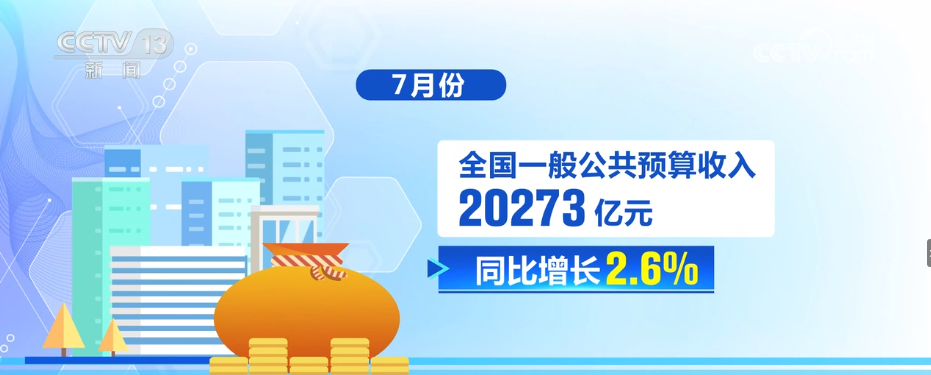
7月份全国一般公共预算收入同比增长2.6% 增幅为今年以来最高
Ren Min Ri Bao· 2025-08-20 00:48
Group 1 - In July, the national general public budget revenue reached 20,273 billion yuan, with a year-on-year growth of 2.6%, marking the highest increase this year [1] - Cumulative revenue from January to July amounted to 135,839 billion yuan, reflecting a growth of 0.1%, with the increase rate improving by 0.4 percentage points compared to the first half of the year [1] - Tax revenue in July was 18,018 billion yuan, showing a year-on-year increase of 5%, continuing the upward trend since April [1] Group 2 - National general public budget expenditure maintained growth, totaling 160,737 billion yuan from January to July, with a year-on-year increase of 3.4% [2] - Key areas of expenditure included social security and employment (up 9.8%), education (up 5.7%), and health care (up 5.3%) [2] - Expenditure on energy conservation and environmental protection grew by 4.3%, while cultural, tourism, sports, and media spending increased by 5.3% [2]
经济景气水平回升 财政收入增速转正!前7个月证券交易印花税同比增长62.5%
Zheng Quan Shi Bao· 2025-08-20 00:13
Group 1 - In July, national general public budget revenue showed a significant recovery, with a year-on-year growth of 2.6%, marking the highest monthly growth rate of the year [1] - For the first seven months, the total general public budget revenue reached 135,839 billion yuan, with a year-on-year growth of 0.1%, indicating a positive turnaround compared to the previous period [1] - Tax revenue in July increased by 5%, the highest growth rate of the year, contributing to a significant narrowing of the revenue decline in the first seven months [2] Group 2 - The corporate income tax decreased by 0.4% in the first seven months, but the decline was significantly narrowed by 1.5 percentage points compared to the first half of the year, which was a key factor in the growth of tax revenue in July [2] - The growth in tax revenue in July was supported by a narrowing decline in the Producer Price Index (PPI), highlighting the strong correlation between price factors and tax revenue [2] - The securities transaction stamp duty saw a remarkable year-on-year growth of 62.5% in the first seven months, reflecting a recovery in market confidence [2] Group 3 - The equipment manufacturing and modern service industries showed strong tax revenue performance, with specific sectors like railway, shipbuilding, and aerospace equipment seeing tax revenue growth of 33% [3] - General public budget expenditure for the first seven months reached 160,737 billion yuan, with a year-on-year growth of 3.4%, maintaining a focus on social welfare spending [3] - Expenditure in social security and employment grew by 9.8%, indicating a continued emphasis on improving public welfare [3] Group 4 - Local government special bonds and other financial instruments contributed to a government fund budget expenditure growth of 31.7% in the first seven months, amounting to 2.89 trillion yuan [4] - With the reduction of disruptions from extreme weather, infrastructure investment growth is expected to rebound in the second half of the year due to sufficient project and funding support [4]
天津西青:打造京津冀协同创新“强磁场” 赋能新质生产力
Zhong Guo Xin Wen Wang· 2025-08-19 19:48
Group 1: Core Insights - The article emphasizes the development of a new model for integrated urban and industrial growth in Tianjin's Xiqing District, focusing on creating a high-quality innovation hub in the Beijing-Tianjin-Hebei region [1][5] - The Xiqing Economic and Technological Development Zone has attracted 288 new enterprises in the first half of the year, showcasing significant advancements in smart manufacturing and digital transformation [2][5] - The establishment of partnerships with Beijing's innovation resources has led to over 10 projects being signed, enhancing the region's technological capabilities [2][3] Group 2: Industry Collaboration - The article highlights the importance of industry chain collaboration, with local policies facilitating rapid commercialization of research outcomes and fostering deep integration of technology and industry in sectors like smart connected vehicles and biomedicine [3][5] - The construction of innovation platforms, such as the synthetic biology innovation transformation platform, supports the growth of biotech companies by providing essential services from research to pilot testing [3][5] Group 3: Talent Development - The integration of education and industry is emphasized, with Tianjin University playing a crucial role in supplying talent and intellectual support for regional development through collaborative programs [4][5] - The article notes that the synergy between government support and a robust industrial ecosystem has attracted high-end talent, enabling local companies to advance from "Made in China" to "Created in China" [4][5]
一文读懂前7月财政数据:财政收入增速由负转正
Di Yi Cai Jing· 2025-08-19 10:47
Group 1 - The overall fiscal revenue is recovering, supported by increased government bond issuance, while fiscal expenditure remains robust [1][6] - In the first seven months of the year, the national general public budget revenue reached 135839 billion yuan, with a year-on-year growth of 0.1% [2] - The tax revenue for the same period was 110933 billion yuan, showing a slight decline of 0.3% year-on-year, but the decline is narrowing [2][4] Group 2 - The growth rate of tax revenue has not kept pace with economic growth, which was 5.3% in the first half of the year [2][3] - Major tax categories showed improvement, with domestic value-added tax increasing by 3%, domestic consumption tax by 2.1%, and personal income tax by 8.8% [4] - Non-tax revenue grew by 2% to 24906 billion yuan, significantly lower than the previous year's growth of 12% [5] Group 3 - Government fund budget revenue was 23124 billion yuan, down 0.7% year-on-year, with land use rights revenue declining by 4.6% [6] - Fiscal expenditure for the first seven months was 160737 billion yuan, up 3.4%, with social security and education spending growing above average [6][7] - Government fund budget expenditure surged by 31.7% to 54287 billion yuan, primarily directed towards major project construction [7]