能源金属

Search documents
博迁新材涨2.02%,成交额1.50亿元,主力资金净流入608.82万元
Xin Lang Zheng Quan· 2026-01-07 03:01
Core Viewpoint - Boqian New Materials has shown a positive stock performance with a year-to-date increase of 2.94% and significant growth in revenue and net profit for the first nine months of 2025 [2][3]. Group 1: Stock Performance - On January 7, Boqian New Materials' stock rose by 2.02%, reaching 67.32 CNY per share, with a trading volume of 150 million CNY and a turnover rate of 0.86%, resulting in a total market capitalization of 17.611 billion CNY [1]. - The stock has experienced a 2.11% decline over the last five trading days but has increased by 30.26% over the past 20 days and 9.37% over the last 60 days [2]. Group 2: Financial Performance - For the period from January to September 2025, Boqian New Materials reported a revenue of 805 million CNY, reflecting a year-on-year growth of 10.79%, and a net profit attributable to shareholders of 152 million CNY, which is a 78.17% increase compared to the previous year [2]. - The company has distributed a total of 374 million CNY in dividends since its A-share listing, with 249 million CNY distributed over the last three years [3]. Group 3: Shareholder Information - As of September 30, 2025, the number of shareholders for Boqian New Materials increased by 18.44% to 21,000, while the average number of circulating shares per person decreased by 15.57% to 12,434 shares [2]. - Among the top ten circulating shareholders, Hong Kong Central Clearing Limited holds 6.6204 million shares, an increase of 1.2243 million shares from the previous period, while new shareholder Qianhai Kaiyuan New Economy Mixed A holds 3.4410 million shares [3].

逼空 | 谈股论金
水皮More· 2026-01-06 10:17
Market Performance - The A-share market continues to show strong performance, with the Shanghai Composite Index achieving a 13-day winning streak, reaching its highest level since July 2015, closing at 4083.67 points, up 1.50% [3][5] - The Shenzhen Component Index rose by 1.40% to 14022.55 points, while the ChiNext Index increased by 0.75% to 3319.29 points. The total trading volume in the Shanghai and Shenzhen markets reached 283.26 billion, an increase of 26.51 billion from the previous day [3][5] Market Dynamics - The current market trend is characterized as a "short squeeze" rally, with the Shanghai Composite Index breaking through previous highs and maintaining a strong upward momentum [4][5] - Nearly 4000 stocks rose, with only 1210 declining, indicating a broad-based rally. The median increase among stocks was 0.8% [5] Sector Performance - The insurance sector led the market with a gain of over 4%, indicating its role as a core driver of the current rally since early December [5] - The securities sector also performed well, benefiting from prior adjustments, while the banking sector contributed to stabilizing the index despite initial declines [5] - Technology stocks, particularly in communications and semiconductors, faced adjustments, leading to a weaker performance in the ChiNext Index [6] Capital Flow - Significant capital outflows were observed in the communications sector, with approximately 11.1 billion leaving, while the securities sector saw a net inflow of 3.9 billion, indicating a potential shift in market focus [6] - The overall market experienced a net outflow of about 8 billion, despite the strong index performance, suggesting caution among investors [7] Future Outlook - The current market rally is seen as an early start to the spring market, but there are concerns regarding upcoming earnings reports that could impact speculative stock performance [7] - Investors are advised to monitor the performance of the Hang Seng Index and the Hang Seng Technology Index, which showed signs of a pullback towards the end of the trading day [7]

主力资金 | 尾盘主力资金大幅出逃2股
Zheng Quan Shi Bao· 2026-01-06 09:59
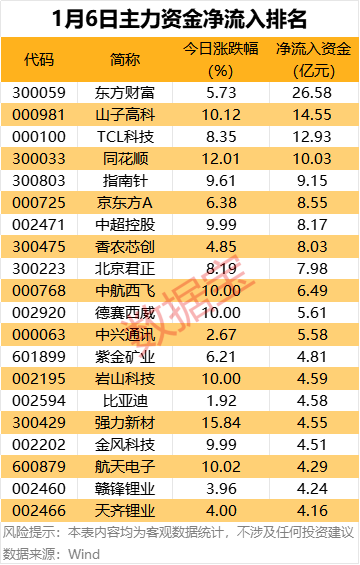
Core Viewpoint - The A-share market continues to show strong performance, with the Shanghai Composite Index achieving a 13-day winning streak, reaching its highest level since July 2015. However, there was a net outflow of main funds totaling 17.668 billion yuan across the market [2]. Group 1: Industry Performance - All major industry sectors saw gains, with notable increases in insurance, energy metals, chemical fertilizers, securities, and small metals. The beauty and personal care sector was the only one to decline [2]. - Among the 13 industries with net inflows, non-ferrous metals, non-bank financials, automotive, and computer sectors had net inflows of 3.423 billion yuan, 2.185 billion yuan, 1.477 billion yuan, and 1.064 billion yuan respectively. Other sectors like banking, oil and petrochemicals, electronics, and public utilities also saw inflows exceeding 100 million yuan [2]. Group 2: Individual Stock Performance - A total of 54 stocks experienced net inflows exceeding 200 million yuan, with 10 stocks seeing inflows over 600 million yuan. Notably, Dongfang Caifu had a net inflow of 2.658 billion yuan, while Shanzhi Gaoke saw 1.455 billion yuan [3][4]. - The top stocks with significant net inflows included: - Dongfang Caifu: 5.73% increase, 2.658 billion yuan net inflow - Shanzhi Gaoke: 10.12% increase, 1.455 billion yuan net inflow - TCL Technology: 8.35% increase, 1.293 billion yuan net inflow - Tonghuashun: 12.01% increase, 1.003 billion yuan net inflow - Zhinan Zhen: 9.61% increase, 915 million yuan net inflow [4]. Group 3: Net Outflow Analysis - A total of 63 stocks experienced net outflows exceeding 200 million yuan, with notable outflows from Zhongji Xuchuang, Xinyi Sheng, and Tianji Shares, each exceeding 1 billion yuan [5][6]. - The stocks with the highest net outflows included: - Zhongji Xuchuang: -2.93% change, 2.647 billion yuan net outflow - Xinyi Sheng: -2.13% change, 2.277 billion yuan net outflow - Tianji Shares: 0.35% change, 1.281 billion yuan net outflow [6]. Group 4: Tail-End Fund Movement - At the end of the trading day, the main funds saw a net inflow of 1.805 billion yuan, with significant inflows in the computer, non-bank financial, and national defense industries, each exceeding 400 million yuan [7]. - Individual stocks with notable tail-end inflows included: - Dongfang Caifu: 5.73% increase, 508.907 million yuan net inflow - Liou Shares: 6.94% increase, 271.545 million yuan net inflow - Tonghuashun: 12.01% increase, 233.563 million yuan net inflow [8].





能源金属板块1月6日涨4.11%,华友钴业领涨,主力资金净流入18.78亿元
Zheng Xing Xing Ye Ri Bao· 2026-01-06 08:56
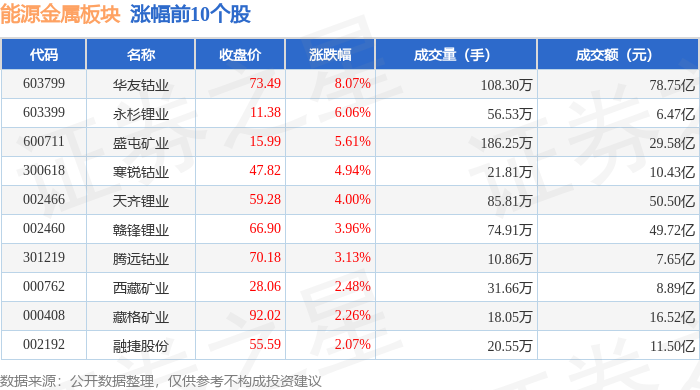
Group 1 - The energy metals sector increased by 4.11% on January 6, with Huayou Cobalt leading the gains [1] - The Shanghai Composite Index closed at 4083.67, up 1.5%, while the Shenzhen Component Index closed at 14022.55, up 1.4% [1] - Key stocks in the energy metals sector showed significant price increases, with Huayou Cobalt rising by 8.07% to a closing price of 73.49 [1] Group 2 - The energy metals sector saw a net inflow of 1.878 billion yuan from main funds, while retail investors experienced a net outflow of 1.272 billion yuan [2] - Major stocks like Huayou Cobalt and Ganfeng Lithium attracted significant main fund inflows, with Huayou Cobalt receiving 4.43 billion yuan [3] - Retail investors showed a negative trend in several stocks, with notable outflows from Ganfeng Lithium and Tianqi Lithium [3]




收评:沪指涨1.5%再创十年新高 小金属板块领涨
Zhong Guo Jing Ji Wang· 2026-01-06 07:19
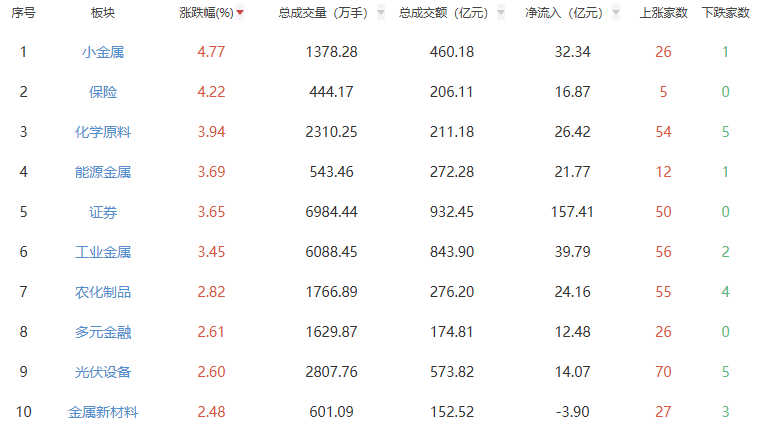
Core Viewpoint - The A-share market experienced a collective rise in the three major indices, with the Shanghai Composite Index reaching a ten-year high, indicating positive market sentiment and investor confidence [1]. Market Performance - The Shanghai Composite Index closed at 4083.67 points, up by 1.50%, with a trading volume of 11,757.69 billion yuan - The Shenzhen Component Index closed at 14,022.55 points, up by 1.40%, with a trading volume of 16,307.39 billion yuan - The ChiNext Index closed at 3,319.29 points, up by 0.75%, with a trading volume of 7,565.29 billion yuan [1]. Sector Performance - The top-performing sectors included: - Small Metals: up by 4.77%, with a trading volume of 1,378.28 million hands and a net inflow of 32.34 billion yuan - Insurance: up by 4.22%, with a trading volume of 444.17 million hands and a net inflow of 16.87 billion yuan - Chemical Raw Materials: up by 3.94%, with a trading volume of 2,310.25 million hands and a net inflow of 26.42 billion yuan [2]. - Sectors that experienced declines included: - Beauty and Personal Care: down by 0.12%, with a trading volume of 257.74 million hands and a net outflow of 0.86 billion yuan - Components: down by 0.07%, with a trading volume of 1,461.75 million hands and a net outflow of 24.80 billion yuan [2].
有色金属:地缘局势增加供给不确定性
GUOTAI HAITONG SECURITIES· 2026-01-06 07:04
股票研究 /[Table_Date] 2026.01.06 地缘局势增加供给不确定性 [Table_Industry] 有色金属 | [姓名table_Authors] | 电话 | 邮箱 | 登记编号 | | --- | --- | --- | --- | | 李鹏飞(分析师) | 010-83939783 | lipengfei2@gtht.com | S0880519080003 | | 魏雨迪(分析师) | 021-38674763 | weiyudi@gtht.com | S0880520010002 | | 刘小华(分析师) | 021-38038434 | liuxiaohua@gtht.com | S0880523120003 | | 王宏玉(分析师) | 021-38038343 | wanghongyu@gtht.com | S0880523060005 | | 梁琳(分析师) | 021-23185845 | lianglin@gtht.com | S0880525070014 | | 李阳(分析师) | 021-23185618 | liyang7@gtht.com | S088052 ...
A股午盘|沪指涨1.14% 保险涨幅居前
Xin Lang Cai Jing· 2026-01-06 04:00
Group 1 - The Shanghai Composite Index rose by 1.14%, breaking the previous high from November 14, 2025, and reaching a new ten-year high [1] - The Shenzhen Component Index increased by 0.81%, while the ChiNext Index fell by 0.04% [1] - The Sci-Tech Innovation Board Index gained 1.05%, indicating positive momentum in the tech sector [1] Group 2 - Brokerage and insurance sectors showed the highest gains, reflecting strong investor confidence [1] - Stocks related to trading software, energy metals, semiconductors, brain-computer interfaces, commercial aerospace, and intelligent driving concepts experienced significant strength [1] - Adjustments were noted in computing hardware sectors such as CPO and high-speed copper connections [1]
午评:沪指半日涨1.14% 保险板块涨幅居前
Zhong Guo Jing Ji Wang· 2026-01-06 03:46
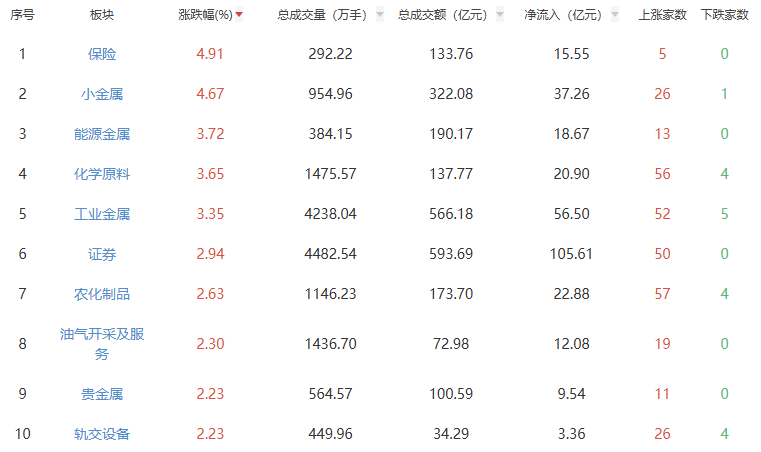
Core Viewpoint - The A-share market showed mixed performance with the Shanghai Composite Index rising over 1% in early trading, indicating positive investor sentiment despite some sector declines [1]. Market Performance - The Shanghai Composite Index closed at 4069.38 points, up 1.14% - The Shenzhen Component Index closed at 13940.24 points, up 0.81% - The ChiNext Index closed at 3293.18 points, down 0.04% [1]. Sector Performance Top Performing Sectors - Insurance sector increased by 4.91% with a total trading volume of 292.22 million hands and a net inflow of 15.55 billion - Small metals sector rose by 4.67% with a trading volume of 954.96 million hands and a net inflow of 37.26 billion - Energy metals sector gained 3.72% with a trading volume of 384.15 million hands and a net inflow of 18.67 billion [2]. Underperforming Sectors - Communication equipment sector decreased by 0.68% with a trading volume of 1889.06 million hands and a net outflow of 77.51 billion - Components sector fell by 0.65% with a trading volume of 929.90 million hands and a net outflow of 31.50 billion - Beauty care sector declined by 0.25% with a trading volume of 157.47 million hands and a net outflow of 0.42 billion [2].
盛新锂能涨2.08%,成交额15.41亿元,主力资金净流入3000.32万元
Xin Lang Zheng Quan· 2026-01-06 02:41
Core Viewpoint - The stock price of Shengxin Lithium Energy has shown significant growth, with a year-to-date increase of 8.51% and a notable rise of 100.75% over the past 60 days, indicating strong market interest and potential in the lithium sector [2]. Group 1: Stock Performance - As of January 6, Shengxin Lithium Energy's stock price increased by 2.08%, reaching 37.36 CNY per share, with a trading volume of 1.541 billion CNY and a turnover rate of 4.58% [1]. - The company has experienced a 6.11% increase over the last five trading days and a 26.22% increase over the last 20 trading days [2]. Group 2: Financial Performance - For the period from January to September 2025, Shengxin Lithium Energy reported a revenue of 3.095 billion CNY, reflecting a year-on-year decrease of 11.53%, while the net profit attributable to shareholders was -752 million CNY, a decline of 62.96% [2]. - The company has distributed a total of 929 million CNY in dividends since its A-share listing, with 811 million CNY distributed over the past three years [3]. Group 3: Shareholder Information - As of September 30, 2025, the number of shareholders for Shengxin Lithium Energy reached 124,200, an increase of 1.92% from the previous period, with an average of 6,974 shares held per shareholder, a decrease of 1.88% [2]. - Hong Kong Central Clearing Limited is now among the top ten circulating shareholders, holding 10.4329 million shares as a new shareholder, while Huaxia Industry Prosperity Mixed A has exited the top ten list [3].
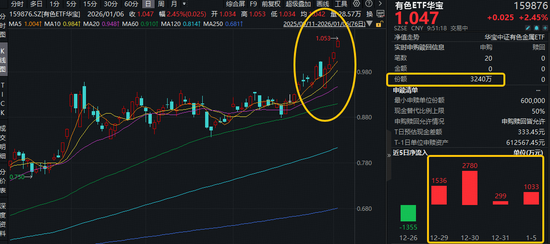
业绩喜报潮来袭!有色ETF华宝(159876)拉升3%再创历史新高!获资金净申购3240万份,近4日狂揽5648万元!
Xin Lang Cai Jing· 2026-01-06 02:01
Core Viewpoint - The non-ferrous metal sector is leading the market, with the popular ETF, Huabao Non-Ferrous ETF (159876), reaching a historical high and attracting significant capital inflow, indicating strong investor confidence in the sector's future performance [1][8]. Group 1: Market Performance - The Huabao Non-Ferrous ETF (159876) saw an intraday increase of 3.03%, currently up 2.45%, marking a new historical high [1][8]. - As of January 5, the latest scale of the Huabao Non-Ferrous ETF reached 879 million yuan, also a historical high [1][8]. - The ETF has received a net subscription of 32.4 million units, with a total capital inflow of 56.48 million yuan over the past four days, reflecting positive market sentiment [1][8]. Group 2: Stock Performance - Leading stocks in the non-ferrous metal sector include Huayou Cobalt, which rose by 7.44%, and several others like Luoyang Aluminum and Zhongjin Lingnan, which increased by over 5% [2][10]. - Notable companies such as Zijin Mining are expected to achieve a net profit of 51 to 52 billion yuan in 2025, representing a year-on-year growth of 59% to 62% [2][11]. Group 3: Future Outlook - Analysts predict that the non-ferrous metal sector is likely to continue its bullish trend, with expectations of a bull market driven by monetary, demand, and supply factors in 2026 [3][12]. - The consensus among institutions is that the non-ferrous metal sector is entering a "super cycle," with varying degrees of performance across different metals [4][13].