
债券

Search documents
7月下旬债市调整,多只债基年内收益率由正转负
Huan Qiu Wang· 2025-08-05 03:27
Group 1 - The bond market has experienced a rapid increase in interest rates since July 21, with the 10-year government bond yield rising from 1.66% to 1.75% and the 30-year yield surpassing 1.99% [1][3] - The adjustment in the bond market is attributed to multiple factors, including the introduction of "anti-involution" policies and rising commodity prices. However, the market expectations stabilized with the important mid-year meetings, reducing concerns and redemption risks [3][4] - As of August 1, the 10-year government bond yield decreased to approximately 1.69%, and the 30-year yield fell to around 1.95% [3] Group 2 - The adjustment in the bond market has directly impacted the net value performance of bond funds, with an average return of -0.12% for pure bond funds from July 21 to August 1, and nearly 80% of these funds reporting negative returns [3] - Nine funds experienced a decline of over 1%, with notable losses in long-term bond funds such as Debon Ruiyu Rate Bond A and Huatai Baixin Zunyi Rate Bond 6-Month Holding A, which reported returns of -1.37% and -1.30% respectively [3] - Several institutions remain optimistic about the bond market, suggesting that the current adjustment may present a reallocation opportunity, with expectations of a stable upward trend in August due to a favorable monetary policy outlook [4]


美联储竟要降息4次?比特币、以太坊本周这样布局!暴跌后狂拉!HAEDAI翻倍,LIZARD爆涨10倍!操作很关键!
Sou Hu Cai Jing· 2025-08-05 03:25
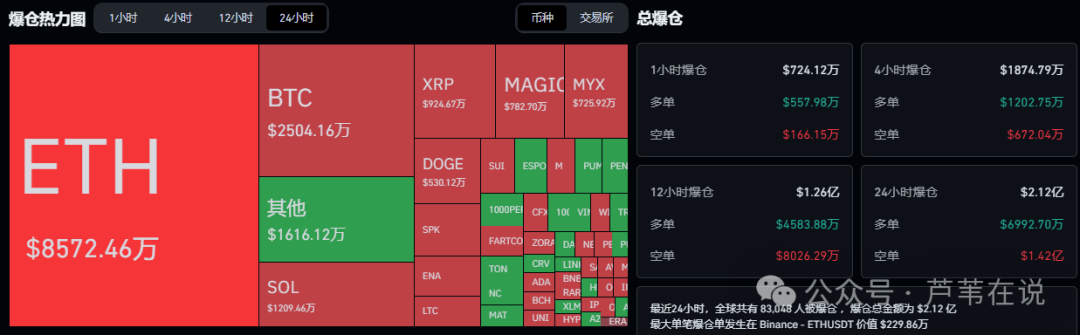
Group 1 - The U.S. stock market experienced a rebound after two days of decline, with major indices recovering losses from the previous week, primarily due to Trump's increasing influence over Federal Reserve personnel and market expectations for interest rate cuts [1] - In the past 24 hours, a total of 83,048 individuals were liquidated, with a total liquidation amount of $212 million, including $69.9 million from long positions and $142 million from short positions [1] Group 2 - The market anticipates an 80% probability of interest rate cuts following the impact of the recent non-farm payroll data, although expert opinions may quickly reverse [2] - Bitcoin (BTC) is currently experiencing a narrow range of fluctuations between $104,000 and $115,500, with potential upward movement towards $116,411 [2] - Ethereum (ETH) has rebounded strongly, reaching $3,725, and is at a critical resistance level; a breakthrough could confirm a reversal [4] Group 3 - The dominance of Bitcoin is declining, while Ethereum and altcoins are expected to rise, with altcoins following Ethereum's lead [6] - Recent trading activity has shown significant profits, with one asset, $LIZARD, surging to a market value of $12 million, indicating a potential for substantial future gains [6]
债市机构行为分析框架概览——宏观利率篇
2025-08-05 03:20
债市机构行为分析框架概览——宏观利率篇 20250729 摘要 高频成交数据能及时反映债市机构买卖趋势,但存在数据滞后和买卖加 总为零的局限性,需结合移动平均等方法平滑噪音,识别趋势。 托管数据分类粗糙且滞后,无法及时反映当月持仓变动,对快速变化的 市场行情意义有限,且未包含保险资管等重要参与者数据。 机构行为通过规模变动和策略分歧影响债券定价。例如,禁止手工补息 导致银行存款短缺,推动资金价格上升,利好某些券种。 理财产品行为趋于保守,将流动性管理压力外包给公募基金,可能预防 性赎回债券基金,从而带动利率调整,需密切关注其可能带来的市场波 动。 当前债市表现出急跌急涨、波动加剧等特征,公募基金久期逐年攀升, 反映出投资者不愿意退出长期持有,以及整体债券发行期限拉长导致久 期风险被动拉伸。 未来两三年内债券资产荒将持续存在,机构只能接受未来较长时间内收 益偏低的现实,企业不愿意借钱使得机构难以配置到合意的高息资产, 投资难度较大。 银行通过账户划分调节利润表压力,TPL 账户对利润表造成压力,AC 账 户适用于吃票息,OCI 账户用于中长期交易,通过综合收益变动实现对 利润表调节。 Q&A 债市机构行为研究的 ...
详解债券增值税政策调整
2025-08-05 03:16
Summary of Key Points from the Conference Call Industry Overview - The conference call discusses the impact of the new value-added tax (VAT) policy on the bond market, specifically focusing on government bonds, local government bonds, and financial bonds [1][2][3]. Core Insights and Arguments - The restoration of VAT on government bonds aims to address market distortions caused by previous tax exemptions, which led to increased short-term trading and market volatility [1][3]. - The new VAT rates are set at 6% for proprietary accounts and 3% for asset management products, including public funds, which narrows the tax gap between these entities [1][6]. - The expected impact on the yield spread between new and old bonds is estimated to be between 5 to 10 basis points, although actual changes may be less due to shared tax burdens between buyers and sellers [1][5][7]. - The new tax policy may reduce market enthusiasm for new bonds due to increased costs, but higher coupon rates on new bonds will require investors to weigh the benefits against the costs [9]. - The credit bonds will not see changes in income tax policies, leading to a narrowing of the yield spread between credit bonds and other types of bonds due to the increase in yields for government, local government, and policy bank bonds [8]. Additional Important Content - The new policy is expected to have limited direct effects on fiscal revenue, as it primarily targets new bond issuances while existing bonds retain their tax-exempt status until maturity [3][4]. - The market anticipates that the yield spread between new and old bonds will widen, but the actual increase may be 3 to 5 basis points lower than theoretical estimates due to the shared tax burden [7]. - The introduction of the new VAT policy may lead to a shift in asset allocation, with funds potentially moving from the bond market to dividend stocks, especially in light of the Federal Reserve's interest rate cut expectations [11]. - There is a risk that the tax exemption for public funds may be gradually removed, which could significantly impact the market, although any changes are expected to be implemented slowly [12]. Conclusion - The new VAT policy on bonds is a significant regulatory change that aims to improve market efficiency but may also lead to shifts in investor behavior and asset allocation strategies. The implications for public funds and the overall bond market dynamics warrant close monitoring.
债券增值税政策调整影响几何?
2025-08-05 03:16
Summary of Conference Call Notes Industry Overview - The conference call discusses the impact of the cancellation of the value-added tax (VAT) exemption on government bonds, local bonds, and financial bonds in the bond market, focusing on the long-term mechanisms and stability of the bond market [1][3][4]. Key Points and Arguments 1. **Cancellation of VAT Exemption**: The removal of the VAT exemption for government bonds aims to promote the long-term mechanism of the bond market and prevent unilateral declines. This is expected to increase the overall yield curve in the long term [1][3][4]. 2. **Short-term Benefits for Existing Bonds**: Existing bonds will continue to enjoy the VAT exemption during a transition period, providing a temporary benefit to holders of these bonds [1][3][5]. 3. **Impact on Fiscal Revenue**: The cancellation of the VAT exemption is projected to increase fiscal revenue by approximately 50 billion, but it will also raise the cost of issuing bonds, favoring central government finances over local governments [1][7]. 4. **Market Reactions**: Initial market reactions to the policy change included a rise in yields by 1 to 2 basis points, but yields quickly fell back to 1.69% as the market recognized the benefits for existing bonds [3][5]. 5. **Central Bank's Role**: The central bank is focused on maintaining a relatively loose liquidity environment while preventing excessive capital turnover, with overnight funding rates expected to remain between 1.37% and 1.4% [1][9]. 6. **Long-term Risks**: The central bank is concerned about long-term risks associated with unilateral declines in the bond market, which could lead to significant financial instability if not managed properly [2][11]. 7. **Investor Advantages**: Investors holding a larger number of existing bonds are at an advantage in the current market, as they will not need to purchase new bonds for the next few years [5][6]. 8. **Credit Bonds Performance**: The performance of credit bonds is expected to improve as the credit spread is likely to narrow, especially if all government bonds are subject to taxation [6]. 9. **Public Fund Tax Exemption**: The likelihood of canceling the tax exemption for public funds in the short term is low, which is favorable for outsourced business operations [8]. 10. **Market Sentiment**: The current market sentiment is relatively positive, with expectations of a fluctuating bond market in the near term [12]. Additional Important Content - **Definition of Capital Turnover**: Capital turnover refers to funds circulating within the financial system without effectively flowing into the real economy, which is a concern for regulators [10]. - **Banking Sector Leverage**: High leverage in the banking sector can contribute to capital turnover, impacting the bond market negatively if not controlled [10]. - **Future Market Predictions**: The bond market is expected to experience fluctuations, with specific yield levels indicating potential actions for investors [12]. This summary encapsulates the critical insights and implications from the conference call regarding the bond market and related fiscal policies.
定价权视角看税收新政对不同券种、期限债券的影响差异
2025-08-05 03:15
Summary of Conference Call on Tax Policy Impact on Bond Market Industry Overview - The conference call discusses the impact of the new value-added tax (VAT) policy on the bond market, specifically focusing on different types of bonds and their yields [1][2][3]. Key Points and Arguments 1. **Tax Policy Changes**: The new VAT policy aims to enhance market pricing efficiency, expected to align bond appreciation yields closer to credit bonds. The additional tax burden for banks and insurance self-operated institutions is estimated to increase by 9 basis points (BP), while asset management institutions will see an increase of 4.5 BP [1][2][3]. 2. **Yield Spread Impact**: The new policy is projected to widen the yield spread between new and old bonds by 4.5 to 9 BP. New bond yields are expected to rise by 3 to 6 BP, while old bond yields may slightly decline by 1 to 3 BP [1][2][6]. 3. **Public Fund Tax Exemption**: If public funds continue to enjoy tax exemptions, the actual impact on market yields may be reduced. The theoretical yield spread between 10-year government bonds and policy bank bonds, which is 44 BP, has only realized 6 BP, indicating a 13% realization rate due to the tax exemption [4][6]. 4. **Differential Impact by Bond Type**: The impact of the new tax policy varies by bond duration and activity level. Key duration bonds like 10-year and 30-year government bonds have lower tax spread realization rates, while shorter-duration government and local government bonds may experience higher realization rates [5][6]. 5. **Market Dynamics**: The adjustment in VAT policy is not primarily aimed at increasing fiscal revenue or directing funds into the stock market. It is expected to generate an additional 20 to 70 billion RMB annually [3][9]. 6. **Economic Environment**: The overall impact of the new tax policy on the economic environment and future trends is considered limited. Current manufacturing PMI data indicates a slight decline, but non-manufacturing activities remain above the critical point, suggesting ongoing expansion [10]. 7. **Market Sentiment**: There is a notable "see-saw" effect between the stock and bond markets, where fluctuations in the equity market may significantly influence the bond market. The demand for higher yields is strong, leading to potential capital shifts towards the stock market [13][14]. Other Important Considerations - **Future of Public Fund Tax Exemption**: There is uncertainty regarding whether public funds will continue to enjoy tax exemptions, with market opinions divided. The potential for future policy changes remains a critical area to monitor [8]. - **Historical Context**: The VAT policy change reverses previous exemptions for government bonds, local government bonds, and financial bonds, which had been exempt since 2016 [7]. - **Monitoring Fund Flows**: Continuous monitoring of fund flows between the stock and bond markets will be essential, especially as market conditions evolve [14]. This summary encapsulates the key insights from the conference call regarding the implications of the new tax policy on the bond market and related economic factors.
固收|周度债市讨论会
2025-08-05 03:15
Summary of Key Points from Conference Call Records Industry or Company Involved - The discussion primarily revolves around the **bond market** and **government debt** supply dynamics in China, along with implications for the **equity market** and **credit bonds**. Core Points and Arguments 1. **Government Debt Supply**: The net financing scale of government bonds in Q3 is expected to reach **4.08 trillion yuan**, which may exert pressure on the bond market due to seasonal supply increases [1][4]. 2. **10-Year Treasury Yield**: The 10-year treasury yield is anticipated to be at **1.6%** as a bottom, with a breakthrough in the second half of the year being difficult. The upper limit is projected between **1.8% and 1.9%** [1][6]. 3. **Market Dynamics**: The bond market is influenced by various factors including redemption risks, tariff negotiations, geopolitical tensions, and stock market volatility, which add uncertainty to demand [1][5][6]. 4. **Stock Market Influence**: Short-term stock market fluctuations have limited impact on the bond market, but the long-term attractiveness of equities is increasing. A shift in focus from bearish to long-term opportunities in the stock market is recommended [1][7][8]. 5. **Investment Strategy**: A strategy of flexible trading and wave operations is advised for Q3 due to expected volatility. The focus should be on equities rather than relying solely on the bond market, which may see reduced returns and increased volatility [1][9]. 6. **Tax Policy Impact**: The new VAT regulations are expected to have a short-term impact on the bond market, favoring older bonds and benefiting ordinary credit bonds and deposits [1][11]. 7. **Credit Bond Market**: The credit bond market is expected to have more opportunities than risks in August, with a focus on the performance of the stock market as a key variable [1][28]. 8. **Market Disturbances**: Key disturbances in the market include policy changes, stock market volatility, and significant events such as military parades and political meetings, which may affect market sentiment [1][29]. Other Important but Possibly Overlooked Content 1. **PPI Forecast**: A slight upward adjustment in PPI to around **-3.2%** is predicted for July, with potential recovery in August and September depending on demand-side support [1][18]. 2. **Investment Opportunities**: Notable investment opportunities include sectors like **robotics**, **AI**, **military**, and **pharmaceuticals**, which are expected to show structural growth [1][14]. 3. **Long-term Economic Outlook**: The economic outlook for Q3 remains resilient, but Q4 will require close monitoring of income and internal demand dynamics [1][22]. 4. **Credit ETF Performance**: Recent performance of credit ETFs showed a rebound after a period of adjustment, indicating potential recovery in investor sentiment [1][30]. This summary encapsulates the essential insights from the conference call, highlighting the bond market's current state, future expectations, and strategic recommendations for investors.
复盘本轮股债走势 - 6月全社会债务数据综述
2025-08-05 03:15
Summary of Conference Call Notes Industry or Company Involved - The discussion revolves around the overall financial market dynamics, particularly focusing on the bond and equity markets in the context of risk preferences and liquidity conditions. Core Points and Arguments 1. **Market Dynamics**: The current market is characterized by rising risk preferences, leading to an increase in stock prices and a decline in bond prices, contrary to expectations of decreased liquidity [1][4][12]. 2. **Profitability and Debt Trends**: Asset-side profitability remains stable at low levels, while the private sector's debt growth has been steady. There are no significant signs of economic downturn or substantial upturn [1][5]. 3. **Liquidity Conditions**: Financial liquidity peaked between July 4 and 8, followed by a contraction. A cautious approach is advised for future liquidity assessments [1][6]. 4. **Model Limitations**: Current models accurately track total funds but struggle with predicting changes in risk preferences, necessitating improvements for better forecasting [7][8]. 5. **Government Debt Trends**: A forecast indicates a unilateral decline in government debt growth in the coming months, which may hinder sustained upward trends in equity markets [2][13]. 6. **Market Behavior**: The stock and bond markets exhibit a "teeter-totter" effect, where rising stock prices coincide with falling bond prices, indicating a market driven by risk preferences rather than liquidity [12][15]. 7. **Impact of Policies**: The introduction of "anti-involution" policies has positively influenced market sentiment, correlating with rising commodity prices and equity markets [16][18]. 8. **Historical Context**: Comparisons are drawn between current economic conditions and past bubbles, highlighting a return to normal growth rates after periods of high growth [17]. 9. **Investment Strategies**: Recommendations include focusing on bonds as a safer investment due to declining risk preferences, while also considering equity positions based on market sentiment [28][31]. Other Important but Possibly Overlooked Content 1. **Debt Growth Patterns**: The entity observed two rounds of debt growth in the real sector, primarily driven by government bond issuance, with private sector financing needs remaining low [10]. 2. **Market Overheating Indicators**: In overheated market conditions, rising stock prices typically lead to falling bond prices, signaling potential market corrections [14]. 3. **Investment Research Approaches**: Emphasis on the distinction between fundamental and non-fundamental research, with a recommendation for fundamental analysis in the current volatile environment [23][24]. 4. **Risk Management**: The importance of maintaining a cautious investment stance, including the potential for holding cash during unfavorable market conditions, is highlighted as a key strategy for long-term survival [30].
如何重新定义利率中枢?
2025-08-05 03:15
Summary of Conference Call Notes Industry Overview - The notes primarily discuss the bond market and its dynamics, particularly in relation to recent policy changes and market adjustments. Key Points and Arguments Policy Expectations and Market Dynamics - Recent adjustments in the bond market and commodity price increases are driven by policy expectations, particularly the "anti-involution" policy, which has created a short-term pulse effect in market trading [1][6] - The impact of the anti-involution policy on economic growth is limited and is not expected to lead to significant yield increases similar to those seen in 2016-2017 [1][9] - The current monetary policy environment shows low expectations for rate cuts or reserve requirement ratio reductions in the second half of the year, although conditions for a new round of monetary easing may gradually develop [1][10] Interest Rate Projections - The 10-year government bond yield is currently at 1.75%, which may represent a temporary peak, with potential for a decline to around 1.65% [1][10] - The introduction of a new VAT policy is expected to cause a one-time pricing impact on nominal interest rates, potentially leading to fluctuations of 5 to 11 basis points in the 10-year government bond yield [1][11] Credit Bond Market Insights - The secondary capital bond market ("二永") has shown significant performance, with the largest declines during market drops and the fastest recoveries during market rebounds [3][20] - Recent weeks have seen notable volatility in the credit bond market, with a mix of strong performance in short-term credit bonds and some underperformance in lower-rated city investment bonds due to liquidity issues [15][16] Institutional Behavior and Market Influence - Institutional behavior has played a crucial role in recent market dynamics, with banks and insurance companies increasing their net purchases of ordinary credit bonds, while public funds have been more cautious [24] - The current market recovery is primarily driven by institutional investors rather than speculative trading [24] Future Market Outlook - The bond market is expected to experience continued fluctuations in nominal interest rates, with a projected range of around 65 basis points [14] - The strategy moving forward should prioritize liquidity, focusing on short to medium-term investment opportunities, particularly in lower-rated city investment bonds, while maintaining a cautious stance on long-term investments [25] Additional Considerations - The anti-involution policy is expected to have long-term implications for the market, with its effects likely to persist beyond short-term adjustments [5][8] - The current steepness of the yield curve indicates potential for further downward movement in yields, particularly in the short to medium-term segments [18][19] Conclusion - The bond market is navigating through a complex landscape shaped by policy changes and institutional behaviors, with a cautious outlook for future interest rate movements and investment strategies.
债市早报:资金面均衡偏松;股市和商品市场反弹,债市承压转弱
Sou Hu Cai Jing· 2025-08-05 02:55
Group 1: Bond Market News - The People's Bank of China (PBOC) reported a net liquidity injection of 100 billion yuan through Medium-term Lending Facility (MLF) and 200 billion yuan through reverse repos in July 2025 [2] - The bond market experienced significant volatility due to the resumption of value-added tax on government bond interest, with the yield on 10-year government bonds initially dropping to around 1.68% before rising back above 1.7% [2] - The bond market is expected to see a short-term preference for existing bonds due to tax advantages, but this impact is not anticipated to affect the long-term trend of the bond market [2] Group 2: Service Trade - China's service trade grew steadily in the first half of 2025, with total service trade reaching 38,872.6 billion yuan, a year-on-year increase of 8.0% [4] - Service exports amounted to 16,883 billion yuan, up 15.0%, while imports reached 21,989.6 billion yuan, growing by 3.2% [4] - Travel services saw the fastest growth, with imports and exports totaling 10,802.9 billion yuan, a 12.3% increase, and exports growing by 68.7% [4] Group 3: Cross-Border Wealth Management - The Hong Kong Monetary Authority reported that over 160,000 individual investors participated in the "Cross-Border Wealth Management Connect" 2.0 program, marking a 120% increase compared to the previous version [5] - The market response has been positive, with the value of holdings by Hong Kong participating institutions exceeding 16 billion yuan, a twofold increase from the previous program [5] Group 4: Commodity Market - International crude oil prices continued to decline, with WTI September futures down 1.54% to $66.29 per barrel, and Brent October futures down 1.30% to $68.76 per barrel [8] - Natural gas prices also saw a significant drop, decreasing by 4.62% to $3.095 per million British thermal units [8] Group 5: Equity and Convertible Bond Market - The A-share market experienced a rebound, with major indices closing higher, and the convertible bond market also saw a collective increase, with the China Convertible Bond Index rising by 0.90% [19] - The trading volume in the convertible bond market reached 802.41 billion yuan, an increase of 10.16 billion yuan from the previous trading day [19] - A total of 415 convertible bonds rose in price, while 38 fell, indicating a generally positive market sentiment [19]