
水泥

Search documents
水泥板块8月19日跌0.72%,西藏天路领跌,主力资金净流出6.82亿元
Zheng Xing Xing Ye Ri Bao· 2025-08-19 08:33
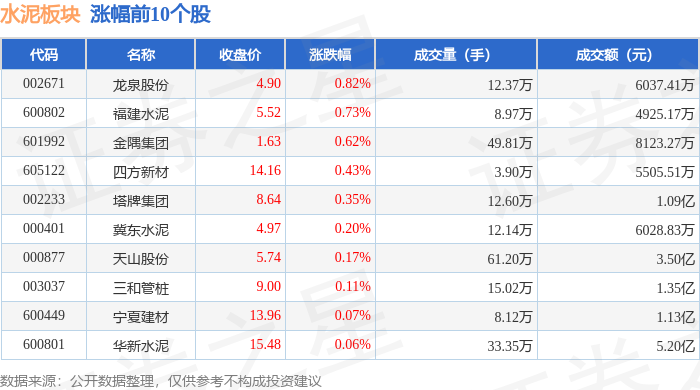
Market Overview - The cement sector experienced a decline of 0.72% on August 19, with Tibet Tianlu leading the drop [1] - The Shanghai Composite Index closed at 3727.29, down 0.02%, while the Shenzhen Component Index closed at 11821.63, down 0.12% [1] Individual Stock Performance - Notable gainers included Longquan Co. (+0.82%), Fujian Cement (+0.73%), and Metal Group (+0.62%) [1] - Major decliners included Tibet Tianlu (-2.64%), Sichuan Jinding (-1.94%), and Conch Cement (-1.45%) [2] Trading Volume and Value - Longquan Co. had a trading volume of 123,700 shares and a transaction value of 60.37 million yuan [1] - Tibet Tianlu recorded a trading volume of 2,758,000 shares with a transaction value of 467.3 million yuan [2] Capital Flow Analysis - The cement sector saw a net outflow of 682 million yuan from institutional investors and 123 million yuan from speculative funds, while retail investors contributed a net inflow of 805 million yuan [2] - The capital flow data indicates that retail investors were more active in the market compared to institutional and speculative investors [3] Net Capital Inflow by Stock - Jinou Group had a net inflow of 6.2856 million yuan from institutional investors, while Longquan Co. saw a net outflow of 1.9952 million yuan [3] - The data shows that retail investors were net buyers in several stocks, including Longquan Co. and Fujian Cement, despite overall net outflows from institutional and speculative funds [3]


为保8%增长,越南掀起“基建狂潮”,一口气上马250个项目
Hua Er Jie Jian Wen· 2025-08-19 07:52
Core Viewpoint - Vietnam is launching an unprecedented wave of infrastructure construction to boost its economy and achieve its annual GDP growth target of at least 8.3%-8.5% [1][3] Group 1: Infrastructure Projects - Approximately 250 large-scale projects are being inaugurated across Vietnam, including key developments like the Rach Mieu 2 Bridge and the Saigon Coastal International Financial Center, with a total investment of about 1,280 trillion VND (approximately 50 billion USD) [1][2] - Of the total investment, 63% is driven by private and foreign direct investment, while state funding accounts for only 37%, indicating a shift towards mobilizing private and international capital [2][4] Group 2: Economic Impact - These projects are expected to contribute over 18% to the national GDP by 2025, with contributions exceeding 20% in subsequent years, highlighting their importance as a long-term economic engine [2] - The government aims to accelerate public investment funding, which is projected to contribute more than 2 percentage points to national GDP growth if the annual public investment disbursement targets are met [3][4] Group 3: Policy Reforms - The new Public Investment Law, effective from January 1, 2025, aims to enhance the efficiency of fund disbursement through decentralization and streamlined project approval processes [4] - The coordinated launch of projects across 34 provinces reflects unprecedented collaboration among various government departments, making public investment disbursement progress a key performance indicator for government leadership [4] Group 4: Long-term Benefits - The infrastructure improvements are expected to lower logistics costs, accelerate the flow of goods and services, and enhance overall economic efficiency, thereby attracting more foreign direct investment in high-tech sectors [5][6] - The plan emphasizes social inclusivity, covering projects related to affordable housing, smart cities, and upgrades to healthcare and education facilities, which will stimulate demand for materials like cement, steel, and machinery [6]
水泥行业反内卷:过去,现在和未来
Tianfeng Securities· 2025-08-19 07:46
Investment Rating - The industry rating is "Outperform the Market" (maintained rating) [5] Core Insights - The necessity for "anti-involution" in the cement industry remains, with a competitive landscape characterized by high concentration and state-owned enterprise dominance [1][12] - The cement industry is experiencing a significant oversupply, with a projected capacity utilization rate of only 53% in 2024, indicating a need for supply-side reforms to reduce actual capacity [3][22] - Short-term measures such as peak-shifting production will continue to support the industry, while medium-term strategies will focus on administrative measures to limit overproduction [4][30] Summary by Sections Supply Structure - The cement industry is primarily led by state-owned enterprises, with a concentration ratio (CR10) of 57% and an expected state-owned enterprise capacity share of around 45% in 2024 [1][12] - The top ten cement companies include four state-owned enterprises, which collectively hold about 71% of the capacity, facilitating coordinated efforts to stabilize prices and enhance efficiency [12][1] Industry Profitability - The industry is projected to achieve a total profit of 260 billion yuan in 2024, with a profit margin of approximately 4.1%, although this represents an 86% decline from the peak levels seen in previous years [16][20] - The worst period in early 2024 saw over 55% of companies reporting losses, but a recovery is anticipated in the fourth quarter, with profits expected to reach 150-160 billion yuan in the first half of 2025 [20][16] Supply and Demand Dynamics - The total cement supply has peaked at around 1.81 billion tons, but demand continues to decline, leading to a significant oversupply issue [22][3] - The expected demand bottom is estimated to be between 1.2 to 1.5 billion tons, indicating a potential decline of 18% to 34% from 2024 levels [22][3] Review of Previous Supply-Side Reforms - Previous reforms included a ban on new capacity and the promotion of peak-shifting production, which successfully reduced new clinker capacity additions from a billion-ton level to a few million tons [2][26] - The industry's profit recovery from 518 billion yuan in 2016 to a historical high of 1867 billion yuan in 2019 was largely due to these reforms [2][29] Future Anti-Involution Strategies - The future governance of "anti-involution" will involve a combination of market, administrative, and legal measures, with a strong emphasis on reducing excess capacity through administrative controls [4][30] - The carbon trading policy expected to be implemented by 2027 will further pressure high-emission capacities to exit the market, promoting a shift towards more efficient production methods [33][35]


水泥行业产能治理提速 天山股份上半年减亏
Zheng Quan Shi Bao Wang· 2025-08-19 07:10
Company Performance - In the first half of 2025, Tianshan Co. reported operating revenue of 35.98 billion, a year-on-year decrease of 9.4% [1] - The company experienced a net loss of 0.922 billion, which represents a reduction in losses compared to the previous year [1] - Cement sales reached 80.62 million tons, down 14.63% year-on-year, while clinker sales were 9.9 million tons, down 14.59% [1] Cost Management - Tianshan Co. implemented significant cost control measures, benefiting from a decrease in coal prices, which led to a substantial reduction in production costs for cement and commercial concrete [1] - The company reported improvements in cement sales prices and gross profit margins year-on-year due to price recovery and cost optimization efforts [1] Industry Context - The national cement market demand continued to shrink in the first half of the year, primarily due to a deep adjustment in the real estate market [2] - The commercial concrete industry saw a total profit decline of 26.4% compared to the previous year, although the decline rate narrowed compared to earlier months [2] - Tianshan Co. acknowledged the complex competitive landscape and the impact of declining water demand on operational performance [2] Strategic Initiatives - The company plans to deepen supply-side structural reforms and promote healthy development within the industry [2] - Tianshan Co. aims to enhance its e-commerce platform "Jucaitong" and develop special cement products to seek new growth opportunities [2] - The company will optimize procurement strategies and strengthen supply chain management to address challenges related to raw material price fluctuations and fixed cost increases [3] Market Outlook - The industry is expected to face continued downward pressure on demand, with profitability largely dependent on supply changes and the execution of supply-side policies [3] - If companies adhere to production capacity regulations, there is potential for a significant reduction in supply and an increase in capacity utilization rates from 53% to around 70% [3]
摸清“碳家底” 算好“减碳账” 商业银行多维“碳”路绿色可持续发展
Jin Rong Shi Bao· 2025-08-19 02:36
Core Insights - The concept of "green mountains and clear waters are as valuable as mountains of gold and silver" has been proposed for 20 years, and the "dual carbon" goals have been set for 5 years, highlighting the importance of green finance in promoting high-quality economic development [1] - Carbon finance is emerging as a crucial tool for banks to implement the "dual carbon" goals, with commercial banks gradually building climate-adaptive financial service systems to assist high-carbon industries in reducing emissions [1] Group 1: Financial Support for High-Carbon Industries - Postal Savings Bank provided a 30 million yuan loan to Chizhou Conch Cement Co., Ltd. to facilitate the green upgrade of the cement industry [2] - Industrial Bank issued a 200 million yuan loan to an aluminum company in Shandong, helping to lower financing costs and incentivize self-reduction of carbon emissions [2] - The existing green finance system does not fully meet the financing needs of high-carbon industries like steel, cement, and chemicals, which require a gradual reduction in carbon emissions [2] Group 2: Innovative Financial Tools and Services - Industrial Bank's Huizhou branch issued over 8 billion yuan in credit support for a leading petrochemical group's core project, effectively reducing financing costs by 1.5% [3] - Shanghai Bank provided a 40 million yuan loan to Juneyao Airlines, linking the loan interest rate to the airline's carbon emission reduction performance [3] Group 3: Carbon Accounts and Financial Services - Carbon accounts are becoming essential for banks to provide financial services based on carbon emission data, helping companies manage their carbon footprint [4] - Banks like Industrial Bank and China Everbright Bank have initiated personal carbon credit and corporate carbon account services since 2010, enhancing green financial services [4] Group 4: Development of Carbon Financial Market - The reopening of the voluntary greenhouse gas emission reduction trading market (CCER) presents significant opportunities for the carbon financial market [6] - Several banks have launched innovative products linked to CCER, increasing liquidity in the carbon market and providing low-cost financing options for companies [6] - Industrial Bank has pioneered several market-leading carbon financial products, including the first CHUEE product and carbon-neutral bonds [6] Group 5: Future Directions for Carbon Finance - Financial institutions need to establish mature carbon finance operational models, focusing on strategic development and external collaborations with various stakeholders [7] - Banks should enhance their research on carbon reduction and trading policies and consider forming dedicated carbon finance departments [7]

830亿元超长期特别国债将招标发行
Zheng Quan Ri Bao· 2025-08-18 16:12
Group 1 - The Ministry of Finance plans to issue 30-year fixed-rate special government bonds with a total competitive bidding amount of 83 billion yuan on August 22, completing the issuance plan for August [1] - The total issuance scale of special government bonds in August will reach 235 billion yuan, making it the second highest monthly issuance this year, following May's 242 billion yuan [1] - The overall issuance plan for special government bonds this year is 1.3 trillion yuan, an increase of 300 billion yuan from last year, with 996 billion yuan already issued, achieving a progress rate of 76.6% [1] Group 2 - Of the 1.3 trillion yuan special government bonds to be issued this year, 800 billion yuan will support "two major" projects, and 500 billion yuan will be allocated for "two new" policies [2] - As of August 13, 188 billion yuan in investment subsidy funds for equipment updates has been allocated, supporting approximately 8,400 projects across various sectors, driving total investment exceeding 1 trillion yuan [2] - The issuance and utilization of special government bonds are seen as having multiple positive implications for stabilizing growth, adjusting structure, and benefiting people's livelihoods [2] Group 3 - From January to July, infrastructure investment grew by 3.2% year-on-year, contributing 43% to overall investment growth, which is 1.6 percentage points higher than the total investment growth rate [3] - Special government bonds play a crucial role in accelerating project progress and promoting industrial upgrades, providing solid financial support for infrastructure investment [3] - The injection of funds from special government bonds can leverage social capital, attracting more investment into the infrastructure sector and further promoting economic growth and employment [3]
天山股份(000877.SZ):上半年净亏损9.22亿元
Ge Long Hui A P P· 2025-08-18 12:17
Group 1 - The core viewpoint of the article is that Tianshan Co., Ltd. (000877.SZ) reported a decline in sales and revenue for the first half of 2025, aligning with industry trends [1] - The company sold 80.62 million tons of cement, a year-on-year decrease of 14.63% [1] - The sales of clinker reached 9.90 million tons, down 14.59% year-on-year [1] - The sales of ready-mixed concrete were 34.16 million cubic meters, showing a slight decline of 0.29% [1] - The sales of aggregates totaled 57.68 million tons, down 2.86% year-on-year [1] Group 2 - The company achieved an operating revenue of 35.98 billion yuan, a year-on-year decrease of 9.40% [1] - The net profit attributable to shareholders of the listed company was -0.922 billion yuan, which represents a year-on-year increase of 72.99% [1]
天山股份(000877.SZ)发布上半年业绩,归母净亏损9.22亿元
智通财经网· 2025-08-18 12:11
Group 1 - The core viewpoint of the article is that Tianshan Co., Ltd. reported a decline in revenue and a significant net loss for the first half of 2025 [1] Group 2 - The company achieved an operating income of 35.98 billion yuan, representing a year-on-year decrease of 9.40% [1] - The net loss attributable to shareholders of the listed company was 922 million yuan [1] - The net loss attributable to shareholders after deducting non-recurring gains and losses was 1.083 billion yuan, with a basic loss per share of 0.1296 yuan [1]
中经资料:巴基斯坦证券市场一周回顾(2025.08.11 - 2025.08.15)
Zhong Guo Jing Ji Wang· 2025-08-18 12:00
Group 1 - Moody's upgraded Pakistan's local and foreign currency issuer ratings and senior unsecured debt rating from Caa2 to Caa1, changing the outlook from "positive" to "stable" [9] - The IMF delegation is expected to visit Pakistan at the end of September for an economic review, with the anticipation of receiving a third loan tranche of $1 billion after the review [9] - As of August 8, the State Bank of Pakistan reported an increase of $11 million in foreign exchange reserves, reaching $14.2432 billion, while commercial banks' net foreign exchange reserves decreased by $10 million to $5.2535 billion [9] Group 2 - The Pakistan Bureau of Statistics reported a 0.31% increase in short-term inflation week-on-week and a year-on-year increase of 2.21%, with 17 out of 51 surveyed items experiencing price increases [9] - The Pakistan Securities and Exchange Commission announced the final revision of the public offering system, effective from August 6, 2025, aimed at enhancing IPO efficiency through competition, technology, and transparent pricing mechanisms [10] - The latest report from the Pakistan Bureau of Statistics indicated a 0.74% contraction in the large-scale manufacturing (LSM) sector for the fiscal year 2024-2025, despite a 4.14% year-on-year growth in June, with significant declines in sectors such as tobacco, textiles, and automotive [11]
降本节支与绿色转型驱动 天山股份2025年上半年减亏72.99%
Zheng Quan Shi Bao Wang· 2025-08-18 11:39
Core Viewpoint - Tianshan Co., Ltd. reported a significant reduction in losses for the first half of 2025, achieving a net profit of -0.922 billion yuan, a 72.99% improvement year-on-year, despite ongoing challenges in the cement industry due to declining demand and cost pressures [1] Financial Performance - The company achieved operating revenue of 35.98 billion yuan, with a year-on-year decrease of 9.40% [1] - Operating costs decreased by 16.71%, indicating effective cost management strategies [2] - The net cash flow from operating activities was 1.943 billion yuan, a 27.30% increase year-on-year, providing a buffer for strategic adjustments [3] Cost Management - The cost of cement clinker decreased by 20.14%, while the cost of ready-mixed concrete fell by 9.96% [2] - The company implemented various procurement strategies, including centralized purchasing and direct sourcing, to drive down costs [2] - The company reported a reduction in sales, management, and financial expenses by 3.39%, 8.63%, and 7.90% respectively [3] International Expansion - Tianshan Co., Ltd. accelerated its internationalization, with overseas revenue increasing by 72.49% year-on-year [3] - The gross margin for overseas business reached 39.90%, significantly higher than domestic operations, highlighting the profitability of its international strategy [3] Green Transformation - The company is focusing on a comprehensive carbon reduction system, achieving a reduction of 122.94 million tons of CO2 through raw material substitution and 153.43 million tons through fuel substitution [4] - Tianshan Co., Ltd. has launched 58 solar projects with a total installed capacity of 176,320 kW, contributing to its green energy initiatives [4] - The company has established a full-chain carbon reduction system, positioning itself advantageously in the low-carbon economy [5] Technological Innovation - The company’s Akesu Tianshan Cement facility has implemented a biomass fuel production line, significantly reducing coal consumption and achieving a CO2 reduction of 44,800 tons annually [5] - Tianshan Co., Ltd. received the first carbon management system certification in the cement industry, indicating its advanced capabilities in carbon asset management [5] Strategic Focus - The company is committed to supply-side reform, emphasizing lean management and cost control while pursuing opportunities in digital transformation and green development [5]