健康养老

Search documents
宿迁加快构建现代服务业高质量发展新体系
Xin Hua Ri Bao· 2025-11-06 21:56
Core Insights - The establishment of the Suqian Bonded Logistics Center (Type B) marks a significant step in supporting local enterprises to expand into international markets and reduce logistics costs, reflecting the city's commitment to high-quality service industry development since the 14th Five-Year Plan [1] Group 1: Service Industry Development - Suqian has prioritized service industry development as a key driver for economic transformation, implementing a three-year action plan for high-quality modern service industry development [2] - The service industry added value surpassed 200 billion yuan for the first time in 2023, reaching 206.66 billion yuan, with projections for 2024 to achieve 235.22 billion yuan, ahead of the 14th Five-Year Plan targets [2] - By the first half of 2025, the service industry's added value accounted for 51.9% of GDP, solidifying its role as a critical force in promoting synchronized development [2] Group 2: Market Vitality and Business Growth - Suqian focuses on cultivating business entities to enhance market vitality, with a significant increase in the number of scale service enterprises, reaching 756 by August 2025, a 2.6-fold increase from the end of the 13th Five-Year Plan [3] - In the first nine months of 2025, 123 new scale service enterprises were added, a year-on-year increase of 25.5%, indicating robust market activity [3] Group 3: Project Development and Investment - The city emphasizes the "project first" philosophy, attracting high-quality service industry projects that drive effective investment and enhance development momentum [4] - Notable projects include the Suqian Digital Economy Center, expected to generate annual revenues of 20 billion yuan and create 20,000 jobs upon full completion [5] - By September 2025, 47 major service industry projects had completed investments of 12.58 billion yuan, achieving 73.2% of the annual plan [5] Group 4: Policy Support and Future Outlook - Suqian's modern service industry development is supported by comprehensive policy measures and financial incentives, contributing to a 3.96-fold increase in revenue for scale service enterprises by 2024 [7] - The city aims to continue enhancing the service industry's supply-side structural reforms, focusing on improving the industrial system, expanding business entities, advancing project construction, and optimizing the development environment [7]


南京新百前三季度营收47.73亿元 聚焦大健康韧性凸显
Zhong Zheng Wang· 2025-10-30 14:40
Core Insights - Nanjing Xinbai reported a slight year-on-year decline of 3.67% in Q3 2025 revenue, totaling 1.561 billion yuan, but demonstrated resilience in core business operations [1] - The company achieved a net profit of 45.9142 million yuan for the quarter, with cumulative revenue of 4.773 billion yuan and a net profit of 212 million yuan year-to-date [1] - Strong cash flow from operating activities, amounting to 526 million yuan, supports the company's transformation into a health-oriented enterprise [1] Business Strategy - Nanjing Xinbai is advancing its strategic transformation from traditional commerce to a "life and health service provider," focusing on three main sectors: health care, biomedicine, and modern commerce [1][2] - The company is enhancing its medical service facilities and increasing investment in core medical operations while pursuing a dual focus on "cell therapy and health management" [2] - The health industry is expected to grow due to aging populations and rising health awareness, positioning Nanjing Xinbai to capitalize on its previous investments in cord blood storage and medical services [2] Future Outlook - The company aims to maintain performance stability, foster innovation, and promote transformation to unlock value in the health industry, ultimately creating long-term returns for shareholders and investors [2]

南京新百2025年前三季度营收47.73亿元 大健康转型提速
Zheng Quan Shi Bao Wang· 2025-10-30 09:53
Core Viewpoint - Nanjing Xinbai (stock code: 600682) is accelerating its transformation into a "health service provider," with a focus on the health and wellness industry, despite a slight decline in revenue due to industry challenges [1][2] Financial Performance - In Q3 2025, the company achieved revenue of 1.56 billion yuan, a year-on-year decrease of 3.67% - Cumulative revenue for the year reached 4.773 billion yuan, with a net profit attributable to shareholders of 212 million yuan and a net cash flow from operating activities of 526 million yuan [1] Strategic Transformation - The company is transitioning from traditional commerce to a focus on "healthcare + biomedicine + modern commerce," with the health sector becoming the main driver of performance growth - The strategic focus includes enhancing medical service facilities and increasing investment in core medical businesses [1][2] Industry Trends - The health industry is expected to grow due to an aging population and increasing health awareness, providing opportunities for Nanjing Xinbai to capture market share in niche segments such as cord blood storage and medical services [2] Future Outlook - The company aims to continue its dual focus on "cell therapy + health management," leveraging policy support for the biomedicine sector and deepening collaborations with quality medical resources domestically and internationally - The core strategy moving forward will be to stabilize performance, strengthen innovation, and promote transformation to create long-term value for shareholders and investors [2]
【晶采观察·解码“十四五”】老有所养、老有所乐!三个关键词解码健康养老“新图景”
Yang Guang Wang· 2025-10-13 02:17
Core Insights - The article discusses the achievements in the development of civil affairs during the "14th Five-Year Plan" period, focusing on life expectancy, meal assistance points, and the active participation of the elderly in society [2][3]. Group 1: Life Expectancy - The average life expectancy in China has increased to 79 years by 2024, which is 1.07 years higher than in 2020 and 5 years above the global average [2]. - The nursing bed ratio has improved significantly, with professional care beds increasing from 48% in 2020 to 65.7% by the end of 2024, indicating a more precise and refined elderly care service [2]. Group 2: Meal Assistance Points - A total of 86,000 elderly meal assistance points have been established nationwide during the "14th Five-Year Plan," serving over 3 million elderly individuals daily [3]. - The operation of these meal assistance services is primarily through a model of "government guidance + enterprise participation + social donations," with increasing integration into urban convenience service networks [3]. Group 3: Active Participation of the Elderly - The government aims to broaden channels for elderly social participation, encouraging them to contribute to society and create value, thus achieving both "old-age security" and "old-age enjoyment" [3]. - The initiative seeks to awaken the "silver-haired value" and enhance the active engagement of the elderly in contributing to China's modernization efforts [3].
消费活力激发就业新空间
Yang Shi Wang· 2025-09-07 12:27
Group 1 - The demand for new employment opportunities is increasing as consumer preferences shift towards higher quality and more diverse experiences [1][3] - The rise of drone performances is becoming a new growth point for consumption, leading to the emergence of roles such as drone flight planners [3][5] - New professions and job types are being created in sectors like health care, cultural creativity, and modern services, reflecting the evolving job market [5][7] Group 2 - The introduction of 17 new professions and 42 new job types by the Ministry of Human Resources and Social Security indicates a significant expansion in employment capacity [7] - There are new requirements for knowledge and skills in traditional jobs, such as the need for barbecue chefs to understand fire control and ingredient pairing [5][7] - The Ministry is working on establishing professional standards and evaluation criteria for these new occupations to enhance training and talent development [7]

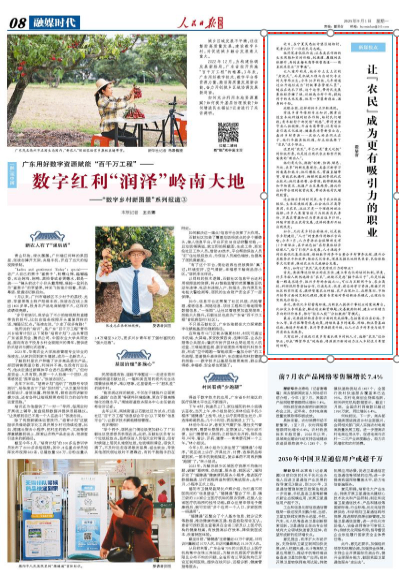
让“农民”成为更有吸引力的职业(新媒视点)
Ren Min Ri Bao Hai Wai Ban· 2025-08-31 22:47
Core Viewpoint - The article highlights the emergence of a new generation of farmers in China, characterized by their educational background, innovative approaches, and the ability to leverage modern technology for agricultural development [1][2][3]. Group 1: New Generation of Farmers - The new farmers are not traditional figures relying solely on natural conditions; they are educated individuals who embrace modern agricultural practices and technologies [3]. - These farmers possess skills in areas such as live-streaming sales, smart machinery operation, and IoT monitoring, enabling them to respond to market demands effectively [3]. - The shift in perception of farming as a profession is evident, with more young people choosing to return to agriculture, driven by the potential for economic growth and community development [2][3]. Group 2: Importance of Talent in Rural Development - The role of talent in rural revitalization and digital village construction is increasingly recognized, with new job titles like "Rural Collective Economic Manager" being introduced [3]. - The influx of skilled individuals into rural areas not only drives industrial development but also enhances grassroots governance and cultural heritage [3][4]. Group 3: Strategies for Attracting Talent - Establishing regular training mechanisms is essential to ensure the growth of the farming profession, providing customized courses based on regional needs [4]. - Optimizing the rural business environment is crucial, including setting up special funds to address financing challenges and creating performance-based incentive systems [4]. - Providing material support, such as housing subsidies and improved infrastructure, is necessary to make rural living conditions comparable to urban areas [4].
潍坊以标准助企强链,引领经济社会高质量发展
Sou Hu Cai Jing· 2025-08-27 13:29
Core Viewpoint - The Weifang Municipal Government is actively promoting a standardization strategy to enhance high-quality industrial development, focusing on innovation and transformation through established standards [3][4][8]. Group 1: Policy and Support - The Weifang government has issued implementation opinions to deepen the standardization strategy, fostering interaction between standardization and technological innovation [4]. - A total of 2,434 provincial and above standards have been formulated or revised, with financial support of 16.32 million yuan provided [4]. - The establishment of a standard innovation award has incentivized enterprises, with a total of 18.65 million yuan awarded over eight years [4]. Group 2: Service and Financing - The introduction of standard financing services has facilitated credit issuance of 14.5 billion yuan to 92 enterprises, addressing financing challenges [5]. - A standard technical service platform has been created, providing 1.36 million standard queries to the public [5]. Group 3: Enterprise Development - Weifang has initiated the cultivation of standard innovation enterprises, establishing five provincial technical standard innovation centers and three common technology standard innovation platforms [6]. - A total of 3,986 standards have been improved through targeted assistance programs for enterprises [6]. Group 4: Industry Enhancement - The manufacturing sector has seen the establishment of a comprehensive standard system with 3,335 standards, including 63 international and national standards [7]. - In agriculture, 51 national-level pilot projects have been approved, enhancing the branding of "Weifang Agricultural Products" [7]. - The service industry has benefited from the release of various industry standards, promoting quality improvement and consumer safety [7]. Group 5: Future Directions - The Weifang government plans to continue implementing the standardization strategy, focusing on integrating standards with enterprise development and industrial upgrades [8].
破除消费堵点,释放内需潜能
2 1 Shi Ji Jing Ji Bao Dao· 2025-08-20 22:31
Group 1 - The State Council's ninth plenary session emphasizes strengthening domestic circulation by removing restrictive measures in the consumption sector to stimulate consumer potential and promote high-quality economic development [1][2] - Systematic removal of restrictions will empower consumers with more autonomy, enhance their quality of life, and stimulate demand [1][3] - Optimizing policies in the automotive sector is crucial as it is a pillar industry that supports various supply chain segments, leading to overall industry development and transformation [1][2] Group 2 - Adjusting real estate market policies is essential to release potential demand for improved housing, which is interconnected with multiple industries such as construction and furniture [2][3] - Accelerating the growth of service consumption and new consumption models, such as online education and shared economy, is necessary to meet the evolving needs of consumers [2][4] - The execution of removing consumption restrictions should follow a scientific and orderly approach, avoiding a one-size-fits-all strategy while optimizing the business environment [3][4] Group 3 - In the automotive sector, transitioning from purchase management to usage management can alleviate traffic pressure and meet consumer needs more effectively [3][4] - The real estate sector requires a comprehensive cancellation of purchase, sale, and price restrictions to promote healthy market development [3][4] - In the service consumption area, breaking down invisible market entry barriers and enhancing the supply of high-quality services can create job opportunities and drive economic growth [4]
经济日报:培育服务消费新增长点丨做好下半年经济工作
Jing Ji Ri Bao· 2025-08-18 08:07
Core Viewpoint - The recent Central Political Bureau meeting emphasized the importance of implementing special actions to boost consumption, particularly focusing on cultivating new growth points in service consumption, which is seen as a key driver for expanding domestic demand [1] Group 1: Service Consumption Growth - Service retail sales in the first half of the year increased by 5.3% year-on-year, outpacing the growth rate of goods retail sales by 0.2 percentage points [2] - Per capita service consumption expenditure rose by 4.9% year-on-year, accounting for 45.5% of total per capita consumption expenditure [2] - The service sector's value added accounted for 59.1% of GDP, contributing over 60% to GDP growth, indicating strong support for high-quality economic development [2] Group 2: Policy and Market Environment - The government is focusing on service consumption as a primary tool for expanding domestic demand, with measures to enrich supply, expand consumption scenarios, and optimize the consumption environment [2][3] - Continuous policy optimization is creating a favorable market atmosphere for service consumption, with various differentiated consumption stimulation plans being implemented [3] Group 3: Integration of Consumption Scenarios - The Ministry of Commerce has launched the "Service Consumption Season" initiative for 2025, promoting the integration of travel, culture, sports, and health [4] - Experts suggest that integrating consumption scenarios is crucial for cultivating new growth points in service consumption, emphasizing the need for diverse, personalized, and interactive service offerings [4] Group 4: Digital Empowerment and Financial Support - The use of modern information technologies like the internet and big data is enhancing service production efficiency and upgrading service consumption [5] - The People's Bank of China and other departments have issued guidelines to increase credit support for key areas of service consumption, promoting personalized financial products [5] Group 5: Quality Supply and Market Competition - Despite the vast market for service consumption, challenges such as insufficient quality supply and a non-optimally competitive environment exist [7][8] - Experts advocate for policies that enhance market access for private and foreign enterprises, stimulate competition, and support the development of high-standard service providers [8]
服务业贷款贴息方案发布,苏州公积金可支付物业费 | 财经日日评
吴晓波频道· 2025-08-13 00:29
Group 1: US-China Trade Relations - The US and China have agreed to suspend the implementation of a 24% tariff for 90 days, which temporarily stabilizes trade relations and delays uncertainty [2] - Both countries have made efforts to restore normal trade relations, with China agreeing to resume rare earth exports and the US easing semiconductor export controls [2] - The ongoing trade tensions and tariff measures highlight the complexities and uncertainties in US-China trade relations, which are seen as detrimental to both sides [2] Group 2: New Business Entities in China - In the first half of the year, over 13.27 million new business entities were established in China, including 4.62 million new enterprises and 8.63 million individual businesses [3] - The growth of new private and foreign enterprises indicates a positive trend, with private enterprises increasing by 4.6% year-on-year [3] - The service sector, particularly in cultural industries, has shown significant growth, contributing to job creation and economic resilience [3] Group 3: VAT Law Implementation - The Ministry of Finance and the State Taxation Administration have released a draft for the implementation of the VAT Law, which clarifies tax regulations and enhances transparency [4] - The VAT is a major tax source in China, projected to generate approximately 6.57 trillion yuan in 2024, accounting for 38% of total tax revenue [4] - The new regulations aim to provide clearer guidelines for tax rates and improve the accessibility of VAT benefits for various market participants [4] Group 4: Loan Subsidy Policy for Service Industry - A new loan subsidy policy has been introduced to support service industry entities, allowing for a 1% interest subsidy on loans up to 1 million yuan [6] - The policy targets small and micro enterprises in sectors such as hospitality, health, and culture, aiming to enhance their financial support [6] - The initiative is expected to stimulate the service sector, although its overall impact remains to be seen [7] Group 5: Robotics Industry Development in Hangzhou - Hangzhou is drafting regulations to promote the development of the embodied intelligent robotics industry, focusing on a regulatory framework that encourages innovation [8] - The city has over 200 robotics companies and aims to establish a supportive policy environment for high-quality industry growth [8] - The initiative reflects a broader trend of local governments actively fostering technological advancements and economic transformation [9] Group 6: Housing Fund Policy in Suzhou - Suzhou has announced measures to expand the use of housing provident fund loans, including lowering down payment ratios and allowing for more flexible withdrawals [10] - These changes aim to support the local real estate market and alleviate financial pressure on residents [10] - The adjustments are part of a wider trend among cities to enhance the utility of housing funds and stimulate housing demand [10] Group 7: Nvidia's Revenue Sharing Agreement - Nvidia has reportedly agreed to pay 15% of its revenue from H20 chip sales in China to the US government in exchange for export licenses [11] - This unprecedented arrangement raises questions about the implications for market dynamics and the perception of US-China trade policies [11] - The move reflects a shift in the US government's approach to regulating technology exports while seeking to increase government revenue [11] Group 8: Stock Market Performance - The stock market has shown a positive trend, with the Shanghai Composite Index rising by 0.5% and reaching new highs [12] - Despite the overall market growth, there is caution regarding potential corrections and shifts in market focus, particularly in speculative sectors [12] - The performance of semiconductor stocks has been influenced by developments in US-China trade relations, particularly regarding chip exports [12]