
医美材料

Search documents
新氧打响价格战第一枪:“童颜针”跌破3千元
Hua Er Jie Jian Wen· 2025-09-23 09:16
Core Viewpoint - The price war in the "童颜针" (youthful injection) market is intensifying, with New Oxygen (SY.O) launching its 奇迹童颜3.0 at a record low price of 2999 yuan, significantly undercutting competitors whose prices range from 13,000 to 24,000 yuan [1] Group 1: Product Launch and Pricing Strategy - New Oxygen's 奇迹童颜3.0 utilizes a formulation called "塑缇妍," which is a combination of hyaluronic acid produced by Jiangsu Xihong Biological Pharmaceutical Co., Ltd. [2] - The product is part of a broader strategy where New Oxygen has previously launched versions 1.0 and 2.0, but faced disputes with upstream suppliers over pricing [3] - The upstream suppliers, including 普丽妍 and 圣博玛, demanded retail prices of 16,800 yuan and 18,800 yuan respectively, while New Oxygen priced its earlier versions at 4,999 yuan and 5,999 yuan [3][4] Group 2: Market Dynamics and Competitive Pressure - The increasing number of approved injection products has diminished the pricing control that upstream suppliers have over downstream distributors, exacerbated by aggressive pricing strategies from internet platforms [5] - Competitors like 美团 and 京东 are also engaging in significant price reductions, with 美团's subsidies bringing the price of certain products down from 6,000 yuan to around 900 yuan, and 京东 offering substantial discounts [5] - The trend indicates that downstream players are gaining more pricing power, putting additional pressure on upstream suppliers [6]
胶原蛋白:医美技术升级,场景拓宽
2025-09-07 16:19
Summary of Key Points from the Conference Call Industry Overview - The Chinese medical aesthetics market has a penetration rate significantly lower than developed countries like the US, Japan, and South Korea, indicating substantial growth potential, especially in the light medical aesthetics sector [1][3] - The medical aesthetics industry is transitioning from chaotic growth to steady expansion, with an expected annual compound growth rate of 15% over the next few years [1][5] - The market for hyaluronic acid has seen a notable shift, with domestic brands rapidly increasing their market share, surpassing foreign brands, and driving the popularization of light medical aesthetics through competitive pricing [1][9] - The botulinum toxin market is projected to maintain a nearly 20% year-on-year growth rate, with market size expected to continue expanding [1][10] Market Dynamics - The regenerative materials market is competitive, with companies vying for market share through technological differentiation and customer segmentation, impacting the high-end hyaluronic acid market [1][12] - Recombinant humanized collagen is gaining traction in the light medical aesthetics market due to its structural advantages and safety, likely to further increase its market share [1][24] Market Size and Comparison - The Chinese medical aesthetics market has reached a scale of over 100 billion RMB, but still has significant room for growth compared to developed countries, with treatment rates per thousand people being only 1/4 of South Korea, 1/3 of the US, and 80% of Japan [3][4] - The light medical aesthetics market in 2021 was dominated by hyaluronic acid (51%) and botulinum toxin (33%), with recombinant humanized collagen accounting for approximately 6.5% of the market [23] Competitive Landscape - The competition in the hyaluronic acid market has shifted, with domestic brands capturing a significant share by offering lower prices compared to international brands [9][8] - The botulinum toxin market features products from various companies, with the core of market share differentiation relying on the capabilities of sales teams [10][11] Technological Innovations - The development of recombinant humanized collagen is seen as a key driver for the growth of the light medical aesthetics market, with expectations of increasing penetration rates from 6.5% in 2024 to 10% by 2027 [23] - Companies like Jinbo Biotechnology are leading in recombinant humanized preparation technology, having developed innovative injection-grade implants and continuously working on new products [29][30] Consumer Preferences - Consumer preferences vary by region, with American and Brazilian consumers favoring shaping procedures, while Asian consumers prioritize skin improvement and anti-aging effects [4] - The demand for regenerative materials reflects changing aesthetic values and a strong desire for natural and long-lasting anti-aging effects [12][13] Challenges and Opportunities - The collagen market in China is still developing, with a relatively limited range of products available, primarily dominated by imported products [25] - The historical challenges faced by collagen injectables, such as safety concerns and cost-effectiveness, have hindered rapid market growth compared to alternatives like hyaluronic acid [26] Conclusion - The medical aesthetics industry in China is poised for significant growth, driven by technological advancements, changing consumer preferences, and increasing market penetration of domestic brands. The focus on safety and efficacy in new product development will be crucial for sustaining this growth trajectory [1][24][29]
SILKROSE® 丝玫瑰北京发布会圆满落幕 国内首款自主PEG交联凝胶正式上市
Zheng Quan Shi Bao Wang· 2025-08-16 10:45
Core Insights - The launch event of SILKROSE® in Beijing highlighted the innovative advancements in light medical beauty technology, featuring key industry experts and marking the introduction of the first domestically produced PEG cross-linked hyaluronic acid gel with complete independent intellectual property rights [1][8] Group 1: Product Innovation - The PEG cross-linking technology of SILKROSE® was a focal point, offering a more complex three-dimensional network structure compared to traditional products, which enhances flexibility and prevents displacement and deformation [2] - The safety design of the product is noteworthy, as the PEG fragments released after hyaluronic acid degradation can be completely metabolized in the body, eliminating accumulation risks and addressing traditional cross-linking agents' metabolic concerns [4] - Clinical data indicates that the effects of SILKROSE® can last over 9 months, achieving a balance between "natural dynamism" and "long-lasting safety" [4] Group 2: Industry Perspectives - Experts emphasized the broad application prospects of PEG cross-linking technology in the medical beauty field, with a commitment from the company to pursue technological innovation and product quality [5] - A roundtable discussion among leading medical beauty experts focused on the comprehensive evaluation system for new technologies and materials in facial rejuvenation injection treatments, highlighting a shift in the market from "incremental competition" to "quality competition" [7] Group 3: Strategic Partnerships - A strategic cooperation agreement was signed between the company and China Resources Shanghai, aiming to leverage channel advantages for accelerated market coverage of the new product [8] - Since its listing in 2020, the company has supported the development and production of various PEG-modified drugs and medical devices, both domestically and internationally [8] Group 4: Future Outlook - With the official launch of SILKROSE® and subsequent market promotion, the company aims to empower medical beauty institutions through material innovation, providing safer and higher-quality options for consumers [10]


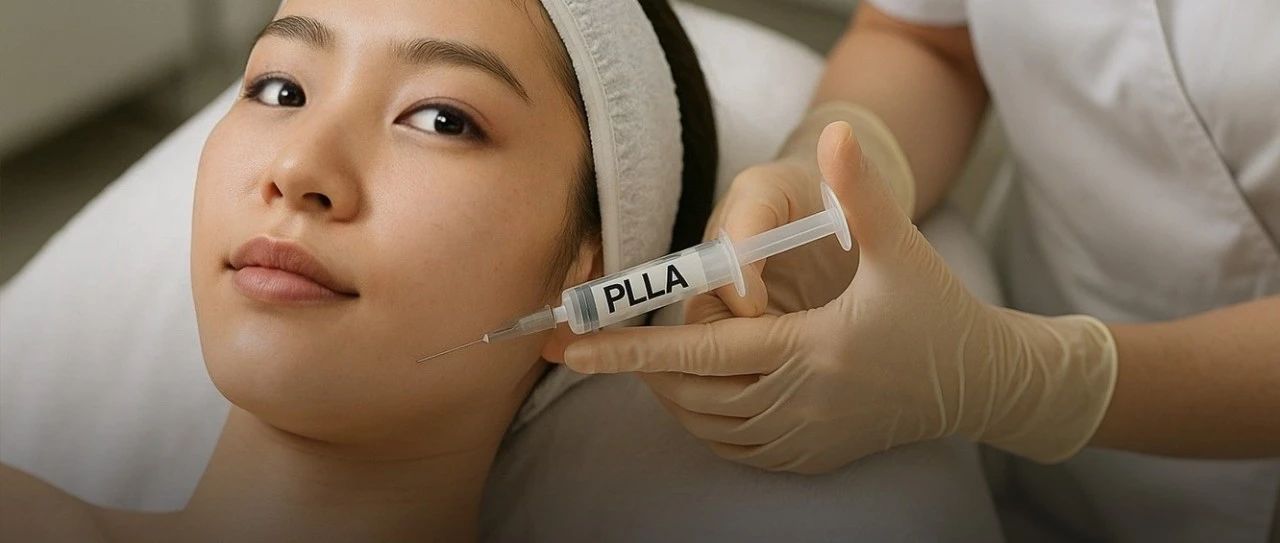
打一针返老还童?童颜针卖了30亿
盐财经· 2025-07-14 09:33
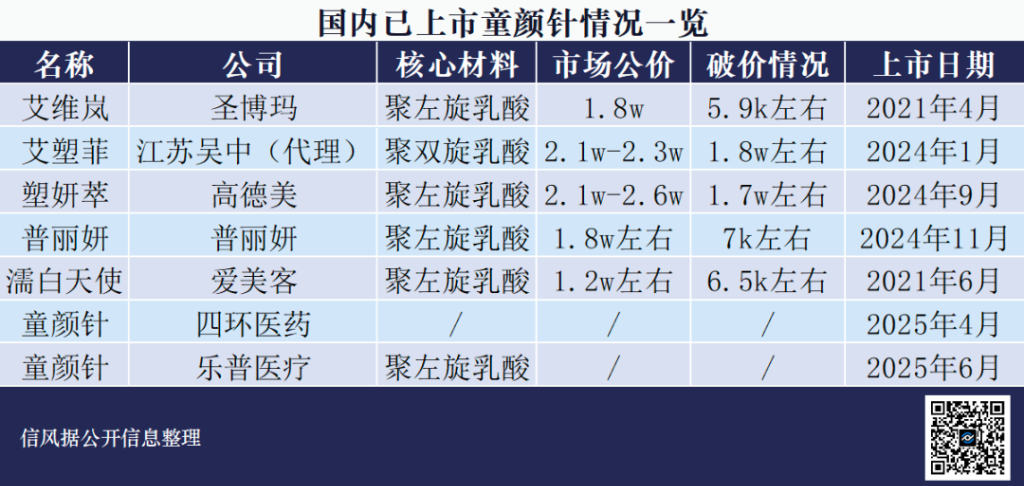
Core Viewpoint - The article discusses the rapid growth and popularity of "童颜针" (youthful face injection) in the Chinese medical aesthetics market, highlighting its mechanism, market dynamics, and the competitive landscape among companies involved in this sector [6][8][22]. Market Growth - The market size of youthful face injections in China grew from approximately 100 million yuan in 2021 to over 3 billion yuan by 2024, representing a 30-fold increase in three years [6]. - Major companies like 长春圣博玛 and 爱美客 reported significant revenues from their youthful face injection products, with 长春圣博玛's "艾维岚" expected to generate over 4 billion yuan in revenue [6][24]. Product Dynamics - The core ingredient of most youthful face injections is 聚左旋乳酸 (PLLA), which stimulates collagen production in the skin [4][15]. - Different brands of youthful face injections vary in composition and pricing, with products like "濡白天使" priced around 10,000 yuan, while others like "艾塑菲" exceed 20,000 yuan [12][24]. Competitive Landscape - The entry of numerous pharmaceutical companies into the youthful face injection market has intensified competition, with over 20 companies currently registering products [30]. - The high profit margins associated with these products, with 爱美客 reporting a gross margin of 93.76% for gel-based injections, have attracted more players to the market [24][25]. Regulatory Environment - The approval of several youthful face injection products by the National Medical Products Administration (NMPA) has legitimized the market, with five products approved by 2024 [22][27]. Consumer Behavior - The article notes a growing trend among urban women to seek youthful face injections, driven by aggressive marketing and social media promotions [10][11]. - Despite the high costs, the demand for youthful face injections remains strong, with companies like 江苏吴中 achieving significant sales shortly after product launches [24][26]. Future Outlook - The global market for youthful face injections is projected to reach $1.545 billion by 2025, with a compound annual growth rate of approximately 3.8% from 2025 to 2033 [26]. - The competitive landscape is expected to evolve further, with potential price wars as more products enter the market [30].


“童颜针”的好日子要到头了
华尔街见闻· 2025-06-23 09:15
Core Viewpoint - The article discusses the price war in the cosmetic injectables market, particularly focusing on the "童颜针" (youthful needle) products, highlighting the conflict between upstream material suppliers and downstream medical institutions over pricing strategies [1][3][34]. Group 1: Market Dynamics - New Oxygen's self-operated clinic is selling the "艾维岚" product at 5,999 yuan, which is one-third of the market price, leading to dissatisfaction from the brand owner, 圣博玛 [1][2]. - The price war is intensifying as more competitors enter the market, with several new products expected to launch soon [3][30][32]. - The market for "童颜针" is projected to grow from $1.488 billion in 2024 to $2.082 billion by 2033, indicating significant growth potential [25]. Group 2: Company Strategies - New Oxygen has established a strategic partnership with 东方妍美, securing exclusive rights to commercialize several upcoming products, including the XH301 [4][19]. - 东方妍美's XH301 is expected to complete domestic listing reviews in the second half of the year, with the potential to reverse its current financial losses [6][17]. - The company plans to adopt an agency sales model rather than direct sales, which is seen as a safer approach given its current financial situation [18][22]. Group 3: Product Insights - XH301, a key product from 东方妍美, utilizes a combination of 聚左旋乳酸 (PLLA) and 羧甲基纤维素 (CMC) to stimulate collagen regeneration, similar to the materials used in 艾维岚 [12][14]. - The product's unique manufacturing process aims to enhance safety and reduce adverse reactions, with clinical trials showing a 95.5% effectiveness rate in wrinkle correction [15][16]. - The competitive landscape is challenging, as the pricing of "童颜针" products is under pressure, with some institutions offering prices as low as 5,900 yuan [37][38].
联手新氧,东方妍美“童颜针”要卷入价格战了?
Hua Er Jie Jian Wen· 2025-06-23 05:51
Core Viewpoint - The price war in the "童颜针" (youthful needle) market is intensifying, sparked by New Oxygen's significantly lower pricing for its product, which has led to disputes with upstream suppliers like 圣博玛 (Shengboma) [1][27][32]. Group 1: Market Dynamics - New Oxygen's self-operated clinic is selling the "艾维岚" (Aivilan) product at 5,999 yuan, which is one-third of the market price of 18,000 yuan [1][18]. - The competitive landscape is changing rapidly, with at least seven "童颜针" products approved for sale in China, leading to concerns about the sustainability of high prices [24][26]. - The market for "童颜针" is projected to grow from $1.488 billion in 2024 to $2.082 billion by 2033 [17]. Group 2: Company Strategies - 东方妍美 (Dongfang Yanmei) has formed a strategic partnership with New Oxygen to exclusively authorize the commercialization of its products, including the upcoming XH301 [3][11]. - XH301, a key product for 东方妍美, is expected to complete its domestic listing review in the second half of this year, which could help reverse its current financial losses [9][4]. - 东方妍美 plans to explore overseas markets for its products, which may provide additional growth opportunities [36][37]. Group 3: Product Comparisons - XH301 and 艾维岚 share similar core materials, but differences in manufacturing processes may affect their efficacy [8]. - XH301 has shown a significantly higher effectiveness rate of 95.5% in wrinkle correction compared to 59.83% for imported hyaluronic acid in trials [7]. - The competitive pricing of XH301 may challenge the established products in the market, as New Oxygen's CEO indicated that upcoming products will be priced more reasonably [32].
医美材料大战正式打响,谁能胜出?
3 6 Ke· 2025-06-09 01:04
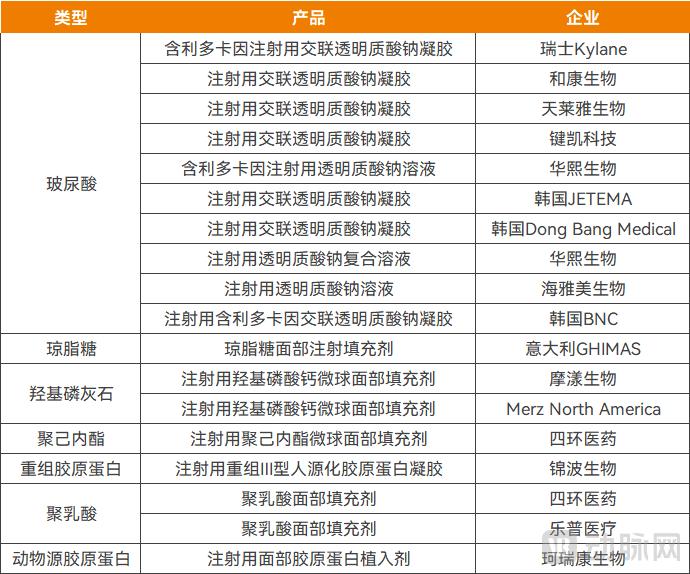
Core Insights - The medical beauty materials market is entering a competitive phase in 2025, with significant approvals for new materials such as agarose and hydroxyapatite, indicating a growing diversity of products [1][10] - The approval of various injection fillers, including recombinant collagen and animal-derived collagen, highlights the rapid development and commercialization of medical beauty materials [1][4] - Investment in medical beauty materials companies has surged, with 12 companies securing funding in the first five months of 2025, reflecting strong interest from investors [4][5] Regulatory Approvals - Hydroxyapatite received two approvals in 2025, with the first compliant product for medical beauty injections approved in February [10] - Agarose also saw its first approval in January 2025, marking a significant milestone for this material in the domestic market [10] - Over 110 products for medical beauty injections have been approved in China, primarily classified as Class III medical devices [2][4] Market Dynamics - The competition for the first regulatory approval (Class III certificate) is intense, as it provides a significant market advantage [10][12] - Companies are increasingly focusing on developing new materials and applications, with many aiming to secure the first approval in various new material categories [11][12] - The market is characterized by a mix of established companies and startups, all vying for a share of the growing medical beauty sector [15][16] Investment Trends - Notable investments in medical beauty materials companies include significant funding rounds for firms like 聚源生物 and 未名拾光, indicating robust investor confidence [5][6] - The trend of startups receiving funding is expected to continue, as the demand for innovative medical beauty solutions grows [4][5] Product Development - Companies are exploring the combination of different materials to enhance product competitiveness, with a focus on safety and efficacy [14][15] - New materials such as PDRN, silk protein, and chitosan are being investigated for their applications in medical beauty and functional skincare [16][17] - The development of multi-indication products is becoming a strategic focus, with companies aiming to address various aesthetic needs [13][15] Future Outlook - The medical beauty market is anticipated to expand, driven by the introduction of new materials and innovative applications [16][17] - The interplay between medical beauty and skincare sectors is expected to create a positive feedback loop, enhancing market growth [16][17] - Ultimately, the success of new materials will depend on their clinical validation and real-world application, as safety and effectiveness remain paramount [16][17]


赵燕的券商反击战:谁在谋杀中国玻尿酸?
Guan Cha Zhe Wang· 2025-05-21 12:16
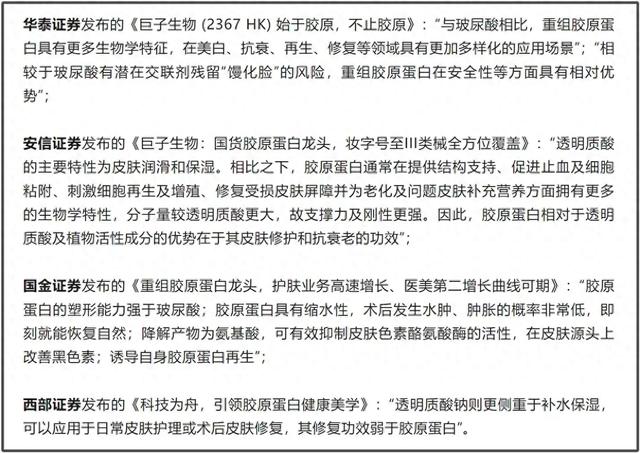
Group 1: Industry Dynamics - The medical beauty industry is experiencing a shift from technology competition to capital narrative, as highlighted by Huaxi Biological's recent criticism of major brokerages for downplaying hyaluronic acid in favor of collagen products [2][7] - The market for hyaluronic acid is becoming increasingly competitive, with over 50 approved Class III medical devices and more than 400 circulating brands in China by 2024, leading to a saturation of supply [8][9] - Emerging alternative materials, such as hydroxyapatite and recombinant collagen, are reshaping the market landscape, with predictions that the collagen market in China will reach 173.8 billion yuan by 2027, with recombinant collagen accounting for over 60% [9][6] Group 2: Company Performance - Huaxi Biological's revenue declined from 6.359 billion yuan in 2022 to 5.371 billion yuan in 2024, with net profit dropping from 961 million yuan to 174 million yuan, and a further 58.13% decrease in Q1 2025 net profit year-on-year [7][10] - Aimei Ke's revenue growth slowed to a historical low of 5% in 2024, with its flagship product "Hi Body" achieving 314 million yuan in sales, but injection product growth rates fell to single digits [7] - Haohai Biological's revenue for 2024 was 2.698 billion yuan, a slight increase of 1.64%, but its ophthalmology and orthopedics businesses faced significant declines due to centralized procurement policies [7] Group 3: Marketing Strategies - The marketing strategies in the medical beauty sector are evolving, with institutions leveraging consumer psychology to shift focus from hyaluronic acid to collagen products, promoting the latter as safer and more effective [5][4] - Social media plays a crucial role in shaping consumer perceptions, with narratives around collagen's benefits and the risks associated with hyaluronic acid injections driving consumer behavior [5][4] - The pricing dynamics show that while hyaluronic acid injections are becoming more affordable, collagen injections remain significantly more expensive, creating a new revenue opportunity for institutions [4][6]
报名!皮肤管理-胶原蛋白专题活动
思宇MedTech· 2025-05-19 07:59
Core Viewpoint - The article emphasizes the transition of "skin management" from traditional beauty care to a new stage of precise anti-aging supported by material science and bioengineering, focusing on collagen as a key material in skin health and tissue regeneration [1]. Group 1: Event Information - The event is scheduled for May 23, 2025, from 14:00 to 16:30 at Langcheng Building, Beijing, and is limited to on-site communication without online streaming [2]. - The event is organized by the Baidachu Plastic Surgery Medical Concept Verification Center, targeting researchers, corporate representatives, and investors involved in skin management, biomaterials, and medical aesthetics product development [2]. - Participation is free but subject to a limited review process [2]. Group 2: Key Speakers and Topics - The opening introduction will be conducted by Yao Guijin, the Deputy General Manager of Baidachu Plastic Surgery Group and head of the verification center [3]. - Zhang Guifeng, Deputy Director of the Biological Technology Working Committee of the China Anti-Aging Promotion Association, will present on the scientific basis and innovative pathways of collagen in skin management, discussing the synergistic effects of collagen, elastin, and peptides [5]. - The event will include a free discussion segment focusing on various topics, including the application scenarios of collagen in skin management and the design logic of cross-border products from skincare to medical materials [6].

专家访谈汇总:医美新材料从“灰色地带”走进阳光
阿尔法工场研究院· 2025-04-15 11:44
1 、 《 国内第三款"少女针"获批 》摘要 ■ 继伊妍仕(进口)和塑妍(国产)获得批准后,四环医药旗下渼颜空间科技(吉林)也获批注射用 聚己内酯微球面部填充剂("少女针")。 ■ 羟基磷灰石材料早前在市场上以"打擦边球"的方式存在,而今年两款相关产品相继获得批准,标志 着这一材料从灰色地带迈向合规发展。 ■ 新材料如PDRN复合溶液和丝素蛋白凝胶也进入临床阶段,预计未来会成为国内医美市场的新兴竞 争者。 ■ 医美材料品类不断丰富,从传统的玻尿酸、肉毒素到新兴的PLA、PCL、羟基磷灰石、琼脂糖等, 国内注射医美市场正朝着多元化、精细化方向发展。 ■ 随着新材料的普及,消费者对医美效果的需求更加注重"自然"和"长效",例如羟基磷灰石可维持1-2 年,比玻尿酸的短期效果更符合现代消费者的需求。 ■ 中游机构和企业应注重技术品牌化和场景化品牌输出,结合精准的产品定位和服务,逐步提升消费 者对品牌的信任和认知。 2、 《 固态电池量产"提前" 》摘要 ■ 上汽集团 近日透露,新一代固态电池将于2025年底在全新MG4车型上量产应用,并在2027年实现 全固态电池"光启电池"落地。 ■ 上汽发布的 智己L6 车型将搭 ...
