外汇市场

Search documents
前三季度河南省金融运行总体稳健
Sou Hu Cai Jing· 2025-10-24 00:25
Core Viewpoint - The financial operation in Henan Province is overall stable in the first three quarters of 2025, with a focus on expanding total volume, optimizing structure, and reducing costs to create a favorable monetary and financial environment for high-quality economic development [1] Financial Operation Overview - As of the end of September, the total balance of deposits in both domestic and foreign currencies reached 11.7 trillion yuan, with household deposits at 8.3 trillion yuan and non-financial enterprise deposits at 1.8 trillion yuan [2] - The total balance of loans in both domestic and foreign currencies was 9.3 trillion yuan, with household loans at 3.5 trillion yuan and loans to enterprises at 5.8 trillion yuan; new loans added in the first three quarters amounted to 408.16 billion yuan [2] - The incremental social financing scale for the first three quarters was 726.95 billion yuan [2] Structural Monetary Policy - Under the guidance of structural monetary policy tools, financial resources are increasingly directed towards key sectors, with agricultural loans growing steadily to a balance of 2.6 trillion yuan, an increase of 77.13 billion yuan since the beginning of the year [3] - Loans to the manufacturing sector increased to 664.88 billion yuan, up by 79.46 billion yuan since the start of the year [3] - Infrastructure loans reached a balance of 1.7 trillion yuan, with an increase of 52.46 billion yuan; medium and long-term loans for infrastructure stood at 1.5 trillion yuan, up by 67.13 billion yuan [3] - General consumer loans grew rapidly, reaching a balance of 724.1 billion yuan, an increase of 36.57 billion yuan since the beginning of the year [3] Cost Reduction and Interest Rates - The People's Bank of China in Henan has effectively promoted a decline in policy interest rates, leading to a decrease in comprehensive financing costs; the weighted average interest rate for new loans in September was 3.83%, down by 0.61 percentage points year-on-year [3] - The weighted average interest rate for new corporate loans was 3.31%, also down by 0.61 percentage points; for new personal housing loans, it was 3.19%, down by 0.27 percentage points [3] Policy Implementation and Financial Services - The People's Bank of China in Henan has intensified the implementation of financial policies, enhancing services for enterprises and supporting high-quality economic development [4] - The balance of technology loans reached 1.07916 trillion yuan, a year-on-year increase of 15.9% [4] - The balance of green loans was 1.03809 trillion yuan, growing by 27% year-on-year [4] Inclusive Finance and Elderly Care Finance - The number of inclusive small and micro enterprise credit accounts reached 2.427 million, a year-on-year increase of 2.0%; the balance of inclusive small and micro loans was 1.30709 trillion yuan, up by 12.6% [5] - Loans for the elderly care industry reached 7.754 billion yuan, with over 17 billion yuan in loans for consumption and elderly care projects issued [5] Digital Finance - The balance of loans for the digital economy reached 110.18 billion yuan, a year-on-year increase of 18.9% [6] Bond Financing - The balance of corporate debt financing tools reached 448.87 billion yuan, an increase of 8.6% year-on-year; 73 enterprises issued bonds in the interbank market, raising 144.02 billion yuan [7] - The balance of innovative debt financing tools reached 46.23 billion yuan, up by 64.9% year-on-year [7] Foreign Exchange Market - The foreign exchange market in Henan has shown resilience, with nearly 70 billion USD in facilitation business processed in the first three quarters [9] - The number of quality enterprises reached 462, with 12 pilot banks involved [9] Trade and New Business Models - The new international trade settlement scale reached 408 million USD, with 801 market procurement trade registered merchants [10] - The total service trade revenue was 7.893 billion USD, a year-on-year increase of 43.63% [10]
韩国计划很快启动24小时外汇市场 完善离岸韩元市场
Di Yi Cai Jing· 2025-09-26 06:33
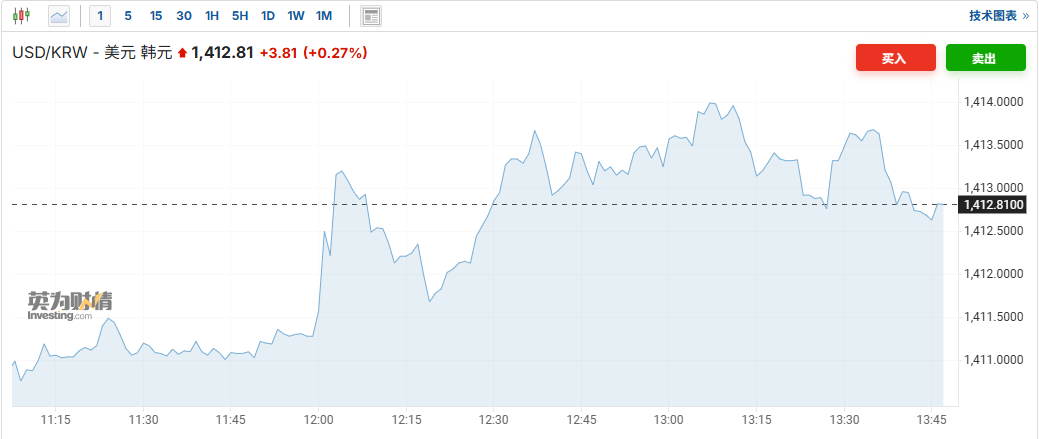
Core Viewpoint - The South Korean government is preparing to transition to a 24-hour trading system for its foreign exchange market, aiming to enhance market accessibility for foreign investors and address the lack of an offshore won market [1][2]. Group 1: Market Opening and Regulatory Changes - South Korea plans to open its foreign exchange market 24 hours a day and relax restrictions on won trading among non-residents, with a roadmap expected by the end of the year [2]. - The current trading hours are from 9 AM to 2 AM the next day, and the government aims to implement these changes sometime next year [2]. - A new settlement system will be established to facilitate 24-hour processing of won payments [2]. Group 2: MSCI and FTSE Russell Inclusion Efforts - The lack of an offshore won market has been a key factor in MSCI classifying South Korea as an emerging market, and the government is making reforms to meet the criteria for inclusion in the MSCI developed markets index [3]. - MSCI has indicated that full currency convertibility and the removal of capital controls are necessary for South Korea to be recognized as a developed market [3]. - The South Korean government is also working towards inclusion in the FTSE Russell Global Government Bond Index, with the timeline for inclusion pushed to April 2026 [5]. Group 3: Market Reactions - Following the announcement, the won depreciated against the dollar, reaching its lowest level since mid-May at 1410.8, with further declines observed [4].

中国人民银行行长潘功胜:截至6月末我国融资平台数量已较2023年初下降超60%
Xin Hua Cai Jing· 2025-09-22 14:58
Core Insights - The number of financing platforms in China has decreased by over 60% compared to the beginning of 2023, and the scale of financial debt has dropped by over 50% as of June 2023 [1] - The People's Bank of China (PBOC) has implemented various policies to support risk resolution in the real estate sector, including optimizing down payment ratios and mortgage rates, which could reduce interest expenses by approximately 300 billion yuan for over 50 million households annually [1] - The PBOC emphasizes that during the 14th Five-Year Plan period, financial risks are generally controllable, and the financial system is operating steadily, providing strong support for high-quality economic development [1] Group 1 - The PBOC is focused on balancing economic growth and financial risk prevention, recognizing the interconnection between economic issues and financial risks [2] - The PBOC is actively working to resolve key area risks, including the debt risks of financing platforms, by promoting local governments to manage funds and assets effectively [2] - The PBOC has achieved significant progress in reducing the number of high-risk small and medium-sized banks through various measures such as online repairs and mergers [2] Group 2 - The PBOC is committed to maintaining stable financial markets, ensuring the basic stability of the RMB exchange rate amid changing external environments [2] - The bond market is being closely monitored by the PBOC, which has implemented measures to mitigate risk accumulation and maintain a low default rate [2] - The PBOC is exploring monetary policy tools to stabilize the capital market, collaborating with the China Securities Regulatory Commission to create mechanisms that support market stability [2][3] Group 3 - The PBOC is enhancing the financial stability guarantee system through legislative efforts and the establishment of a financial stability guarantee fund [3] - Continuous improvement of financial risk monitoring, assessment, and early warning systems is a priority for the PBOC [3]
央行、外汇局:构建全链条市场监管制度
Zheng Quan Ri Bao· 2025-08-22 16:18
Core Viewpoint - The People's Bank of China (PBOC) and the State Administration of Foreign Exchange (SAFE) have revised the interim regulations on the interbank foreign exchange market to enhance regulation and support the real economy, with a draft open for public consultation until September 21, 2025 [1][2]. Group 1: Regulatory Enhancements - Strengthening regulation of the interbank foreign exchange market, with comprehensive oversight by the PBOC and SAFE over various participating institutions [1]. - Establishing a full-chain market regulation system that includes requirements for operational management, trader management, legal agreements, market maker management, information exchange, disclosure, data services, and self-regulation [1]. Group 2: Infrastructure and Service Improvements - Improving the management and service capabilities of foreign exchange market infrastructure, detailing responsibilities, collaboration mechanisms, abnormal handling, and information reporting requirements [1]. - Specifying that infrastructure is responsible for managing trading and clearing qualifications and fulfilling supervisory duties [1]. Group 3: Clarification of Institutional Roles - Clarifying the business boundaries for participating institutions, including the entry scope, basic conditions, and business principles for financial institutions [2]. - Emphasizing that financial institutions can independently decide on risk mitigation services such as trade offsetting and synchronous settlement [2]. Group 4: Forward-looking Management - Enhancing the forward-looking nature of foreign exchange market management by continuously enriching trading varieties and currencies based on market demand [2]. - Providing data services according to market principles and regulating the data distribution behavior of financial information service providers [2].
中银晨会聚焦-20250728
Bank of China Securities· 2025-07-28 01:09
Key Points - The report highlights a selection of stocks for July, including companies such as 滨江集团 (Binjiang Group) and 顺丰控股 (SF Holding) as part of the recommended investment portfolio [1] - The macroeconomic analysis indicates a gradual appreciation of the RMB against the backdrop of easing trade policy uncertainties between the US and China, which enhances the competitiveness of Chinese exports [2][6] - The report notes a slight decrease in the overall activity of mergers and acquisitions in the A-share market, with a total of 66 disclosed transactions amounting to 5233.44 billion RMB, indicating a trend towards structural reorganization despite a decrease in the number of major deals [12] - In the nuclear fusion sector, significant advancements have been made in China's nuclear fusion technology, which is expected to benefit from ongoing investments and the development of related industrial chains [13][15] - The report discusses the emergence of a new market for AI Infra catalyzed quartz fiber cloth, with the company 菲利华 (Philips) leveraging its full industry chain advantages to gain a first-mover advantage in the electronics fabric sector [17][18]




5月16日电,韩国财政部称,正密切关注金融市场和外汇市场,市场目前总体稳。
news flash· 2025-05-16 00:15
Group 1 - The South Korean Ministry of Finance is closely monitoring the financial and foreign exchange markets, indicating a proactive approach to market stability [1] - The overall assessment of the market is stable at present, suggesting no immediate concerns regarding volatility or significant fluctuations [1]
韩国称将密切关注金融和外汇市场的波动。贸易谈判和政策风险带来很多不确定性。
news flash· 2025-05-08 00:04
Group 1 - South Korea will closely monitor fluctuations in financial and foreign exchange markets [1] - Trade negotiations and policy risks are creating significant uncertainty [1]
“第二次广场协议”不得不防
日经中文网· 2025-03-20 03:14
Core Viewpoint - The article discusses the potential restructuring of the global trading system, focusing on the implications of the U.S. dollar's strength and the possibility of a new international monetary framework, particularly in light of recent comments from President Trump regarding currency devaluation by trade partners [1][2][4]. Group 1: U.S. Dollar and Currency Valuation - The U.S. dollar is considered overvalued due to its status as the world's primary reserve currency, which imposes costs on U.S. manufacturers and exporters [2][5]. - President Trump has criticized the devaluation of currencies like the Japanese yen and Chinese yuan, asserting that such actions create an unfair disadvantage for the U.S. [2][5]. - The actual exchange rate of the dollar has strengthened, with the International Bank for Settlements indicating that the dollar's real exchange rate is at a high level compared to the pre-Plaza Accord period [4][6]. Group 2: Historical Context and Comparisons - The article draws parallels between the current situation and the Plaza Accord of 1985, which aimed to induce a depreciation of the dollar through coordinated intervention by major economies [5][6]. - The scale of the foreign exchange market has significantly increased since the Plaza Accord, complicating any potential coordinated intervention today [6][7]. - The historical context highlights that the intervention during the Plaza Accord involved approximately $10 billion, while recent interventions, such as Japan's, have reached much higher amounts, indicating a shift in market dynamics [6][7]. Group 3: Challenges and Future Implications - Achieving a new agreement similar to the Plaza Accord would require participation from emerging economies, which presents significant challenges compared to the past [6][7]. - There is speculation that Trump may push for a weaker dollar through tariffs, which could lead to increased pressure on countries like Japan to adjust their monetary policies [7]. - The potential for a new monetary agreement, referred to as the "Mar-a-Lago Accord," remains uncertain, but if realized, it could have profound implications for the foreign exchange market and the global economy [1][7].