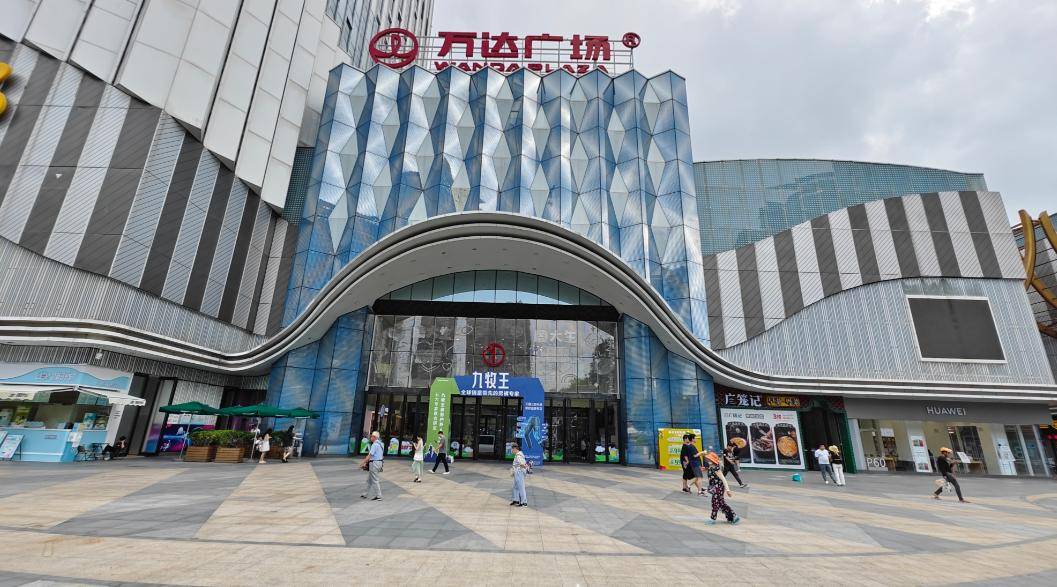
影院

Search documents
行业首张战略投资门票,万达电影定义影像社交的千亿生态闭环
3 6 Ke· 2025-12-15 02:15
Core Insights - Wanda Film has made a strategic investment in the interactive photo brand "Paili Cube," aiming to enhance the cinema experience by integrating social media and immersive entertainment [3][13][19] - The collaboration is expected to transform cinemas into multi-functional social spaces, moving beyond traditional viewing experiences to include interactive and shareable moments [4][5][20] Investment and Strategic Moves - On December 12, Wanda Film announced the completion of its investment in Paili Cube, with plans to install the first batch of smart selfie devices in Wanda cinemas by early 2026 [3][15] - The investment is part of Wanda Film's broader strategy to create a "super entertainment space," enhancing the cinema experience with interactive elements and social sharing opportunities [20][21] Market Trends and Consumer Behavior - The current consumer market is shifting towards experiential consumption, particularly among the younger generation (Z Generation), who prioritize emotional experiences and social sharing [8][9] - Data indicates that over 90% of users born after 2000 have a high willingness to spend on experiences they love, highlighting the potential for cinema to cater to this demographic [8][9] Innovative Experiences and Engagement - Wanda Film is actively creating new consumption experiences by integrating IP derivatives and scene-based activities, such as themed pop-up stores and interactive events [4][9] - Recent collaborations with popular IPs have resulted in significant increases in foot traffic and engagement, with average visitor growth of about 50% during promotional events [9][10] Future Prospects and Expansion - The partnership with Paili Cube is expected to expand beyond cinemas, with plans to introduce interactive photo booths in urban centers and transportation hubs, enhancing the social experience in various settings [22] - Wanda Film aims to leverage its extensive film IP resources to create unique, immersive social experiences that resonate with younger audiences, establishing a comprehensive entertainment ecosystem [22]



中信证券:人民币的升值压力可能会带来超预期的货币宽松,这可能是超预期变化的来源
Xin Lang Cai Jing· 2025-12-07 05:40
Core Viewpoint - The continuous improvement of China's manufacturing industry's global pricing power and economic profit share is expected to lead to a sustained appreciation of the Renminbi, with predictions of reaching 6.8 against the US dollar by 2026. To mitigate the potential negative impact of rapid Renminbi appreciation on export-oriented manufacturing, proactive monetary easing is deemed necessary [1]. Group 1: Economic Outlook - The anticipated monetary easing may lower real interest rates and stimulate domestic demand, which is essential for breaking the current market stagnation and achieving further growth by 2026 [1]. - Prior to this, market fluctuations and structural opportunities are expected to be the norm in the A-share market, with a focus on sectors that have global exposure and profit growth potential [1]. Group 2: Sector Recommendations - In the resources and traditional manufacturing sectors, there is optimism for leading companies in industries where China holds a competitive advantage, particularly in non-ferrous metals, chemicals, and new energy, emphasizing the narrative of "supply internalization and external demand for profit" [1]. - Companies expanding overseas remain a crucial avenue for profit and market capitalization growth, as A-shares transition from a domestic emerging market focus to a global mature market perspective, despite the increased resonance with overseas risk assets and economic environments [1]. - From a high-to-low perspective, less crowded sectors such as cinema, securities, aviation, liquor, and hotels, along with direct increment stocks like banks, thermal power, and oil & petrochemicals, are also viable options [1]. - Close attention is advised for policy changes during the upcoming Political Bureau meeting and economic work conference at the end of the year [1].

奈飞买下华纳,反对的人太多了
Jin Rong Jie· 2025-12-07 05:33
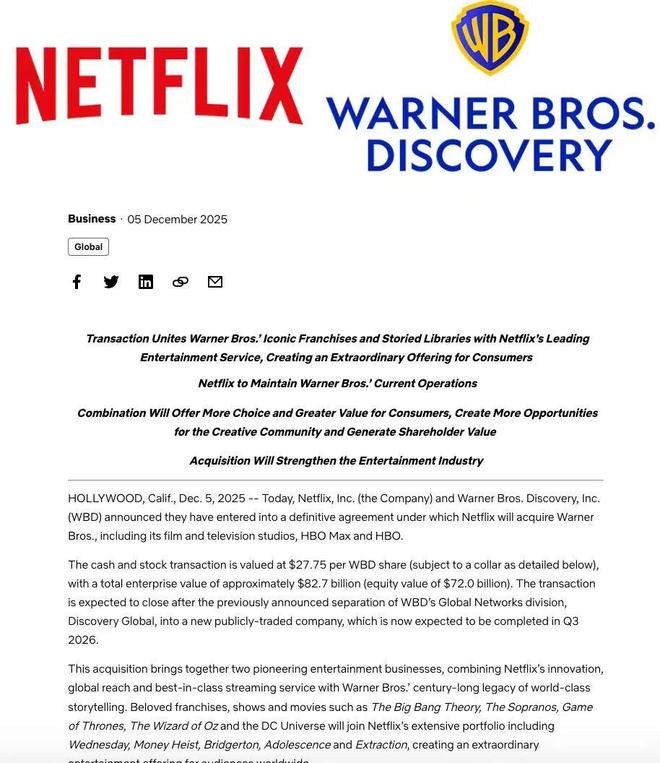
Core Viewpoint - Netflix announced plans to acquire Warner Bros. Discovery's film production and streaming business for approximately $82.7 billion, which has raised concerns in the market about the implications for the entertainment industry and traditional cinema [1][2]. Group 1: Acquisition Details - The acquisition involves a payment of about $72 billion in equity and the assumption of Warner Bros. Discovery's debt, with completion expected within 12 to 18 months [1]. - If successful, this acquisition would merge Netflix's popular IPs like "Stranger Things" and "Squid Game" with Warner Bros.' classics such as "Friends" and the "Harry Potter" series, along with HBO Max streaming services [1]. Group 2: Market Reaction - Following the announcement, Netflix's stock fell by 2.89% to $100.24 per share, while Warner Bros. Discovery's stock rose by 6.28% to $26.08 per share, reflecting a total market capitalization of approximately $64.6 billion for Warner Bros. [2][7]. - Despite receiving debt financing support from major banks, the acquisition is viewed as expensive, especially considering Netflix's cumulative net profit of about $32.1 billion from 2018 to Q3 2025 [2]. Group 3: Industry Concerns - Hollywood unions and cinema owners have expressed concerns that the acquisition could threaten the traditional cinema business model, potentially leading to reduced film production budgets and impacting industry professionals' incomes [5][6]. - There are fears that Netflix may push more Warner Bros. films to premiere on streaming platforms rather than in theaters, which could result in a 25% decrease in box office revenues in the U.S. and Canada [5]. - The acquisition has been criticized as a potential violation of antitrust laws, with warnings about job losses, wage reductions, and a decline in content diversity [6][8].
中信证券:A股市场配置上建议延续资源/传统制造业定价权的重估、企业出海两个方向
智通财经网· 2025-11-30 09:36
Core Viewpoint - The report from CITIC Securities emphasizes the importance of focusing on opportunities in resource and traditional manufacturing industries, highlighting the advantages of leading companies in sectors where China has a global market share [1] Group 1: Market Characteristics - The market is characterized by low volatility and a slow bull trend, with a notable decrease in the volatility of major broad-based indices [1] - The maximum drawdown of the Shanghai Composite Index this year is -9.7%, which is significantly lower than previous years, indicating a relatively stable market environment [1] - The Sharpe ratios for major indices have improved, with the Shanghai Composite Index and Shenzhen Component Index exceeding 1, indicating favorable risk-adjusted returns [1] Group 2: Performance of Investment Strategies - Subjective long-only products have slightly outperformed the Wind All A index but continue to lag behind quantitative strategies, with average returns of 23.3% compared to 26.4% for Wind All A and 35.2% for quantitative products [2] - The gap between private and public subjective long strategies has reached a peak, with private strategies underperforming public ones by 7.6 percentage points [3] - The performance of balanced market selection products remains mediocre, indicating limited excess returns from stock selection despite significant index gains [2][3] Group 3: Capital Flow and Investment Behavior - There is a notable increase in allocation-type capital and quantitative pricing power, while the growth of active stock-picking funds is limited [4] - The influx of capital from insurance funds and "fixed income plus" products has contributed to market stability, but these funds are less sensitive to individual stock fundamentals [4] - The main source of active capital driving rapid increases in high-growth sectors has been margin financing, which has seen a net increase of approximately 700 billion yuan over two months [5] Group 4: Market Strategy and Outlook - The prevailing strategy among subjective long investors has become cautious, characterized by a "squat, hit, and withdraw" approach due to the lack of pricing power in individual stocks [6] - The report suggests that breaking the current market deadlock will require significant positive changes in fundamentals, particularly in domestic demand [7] - Without unexpected changes in fundamentals, the anticipated market movements may only reflect existing structural logic, limiting potential upside [7]
上海正从“潮流首发地”升级为“价值定义地”
Sou Hu Cai Jing· 2025-11-28 11:23
Core Insights - Shanghai has transitioned from being a "trendsetter" to a "value-defining" city, where brand success is measured by excellence rather than novelty [11] - New consumer brands often undergo a process of "training in other cities" before entering Shanghai, allowing them to refine their offerings [3][4] - The competitive landscape in Shanghai demands brands to adapt and innovate to meet the high expectations of discerning consumers [5][6] Group 1: Brand Strategies - Emerging brands are increasingly using other cities as testing grounds before launching in Shanghai, which is seen as a challenging market due to high costs and consumer expectations [3][4] - Brands like "阿嬷手作" and "蜀宴赋" have successfully entered Shanghai after establishing themselves in other regions, demonstrating the effectiveness of this strategy [3][5] - The "异地练兵" approach allows brands to build a loyal customer base and refine their business models before facing the rigorous Shanghai market [3][4] Group 2: Market Dynamics - Shanghai is viewed as a critical market for brands aiming for national and international recognition, often seen as a "crowning" location for brand expansion [4][5] - The city serves as both a testing ground and a platform for brands to connect with global resources, enhancing their market presence [7][8] - The evolving consumer preferences in Shanghai emphasize the need for brands to provide unique and refined experiences rather than just new offerings [11] Group 3: Consumer Expectations - Shanghai consumers are known for their high standards, which require brands to not only innovate but also ensure that their offerings are well-executed [4][6] - The shift from "people finding goods" to "goods finding people" highlights the importance of creating engaging experiences that resonate with consumers [6][10] - Brands must adapt their products and services to align with local tastes and preferences, as seen in the modifications made by "蜀宴赋" to cater to Shanghai's consumer base [6][8]
演艺新空间、飞行影院、好特卖超级仓|北京远洋乐堤港打造消费体验新空间
Xin Lang Zheng Quan· 2025-11-11 02:26
Core Insights - Beijing Yuanyang Letipark integrates cultural elements with commercial real estate, creating a new consumer experience space that supports Beijing's development as an international consumption center [1][12]. Group 1: Cultural Integration - The complex is rooted in the Grand Canal culture, offering a multifaceted consumption space that combines cultural depth, commercial vitality, and consumer enthusiasm [3]. - The "Mumu Theater," located on the third floor, is one of the first 25 city-level "performing arts new spaces" in Beijing, featuring a mix of theater, bookstore, cultural creativity, exhibitions, and arts education [3]. - The theater employs a time-sharing operation strategy, catering to different demographics such as families on weekends and urban professionals during weekdays [3]. Group 2: Commercial Innovation - The shopping center hosts nearly 50 flagship and upgraded stores, significantly enhancing the regional commercial capacity, with notable brands like Huawei and NIO House [10]. - The opening of the first "Hao Te Mai Super Warehouse" in Tongzhou attracted over 100,000 visitors within three days, showcasing strong consumer appeal [10]. - Letipark is recognized as a flagship brand of the Yuanyang Group's commercial product line, focusing on "fashion, art, and lifestyle" to create diverse consumption scenarios [12].

澳门知名娱乐场,停止运营
Nan Fang Du Shi Bao· 2025-11-07 03:18
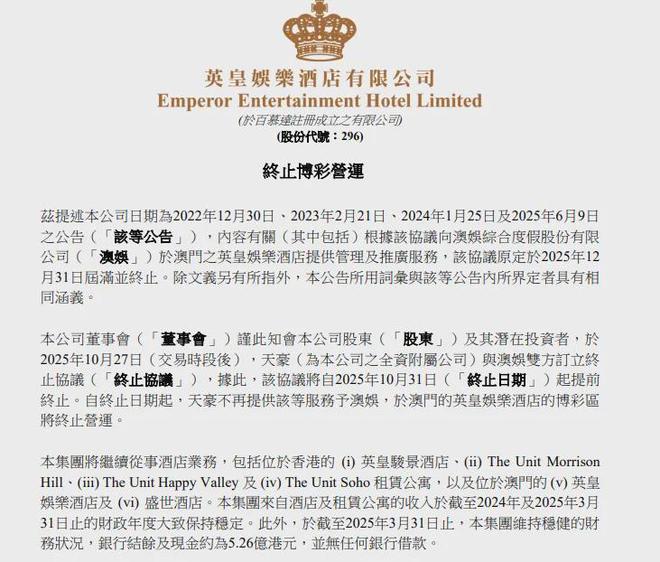
Core Viewpoint - Emperor Entertainment Hotel (00296.HK) announced the termination of its gaming operations at the Emperor Palace Casino, effective October 30, 2023, following an agreement with SJM Holdings [1][6][8]. Group 1: Termination of Operations - The Emperor Palace Casino ceased operations at 23:59 on October 30, 2023, as part of a mutual agreement between Emperor Entertainment's subsidiary, Tianhao, and SJM Holdings [6][8]. - This decision follows SJM Holdings' earlier announcement on June 9, 2023, regarding the discontinuation of gaming operations at several satellite casinos, including the Emperor Palace Casino [5][6]. Group 2: Financial Performance and Debt Issues - Emperor Entertainment Hotel reported a revenue of approximately HKD 1.2 billion for the fiscal year ending March 31, 2007, indicating strong initial performance [8]. - The company is currently facing significant financial challenges, with HKD 16.6 billion in overdue loans, raising concerns about its ongoing viability [15]. - Emperor International (00163.HK) reported total revenue of HKD 1.376 billion for the fiscal year 2024-2025, a 41.5% increase year-on-year, but also saw losses increase from HKD 20.28 billion to HKD 48.4 billion, a 138% rise [12][14]. Group 3: Future Business Direction - Despite the termination of gaming operations, Emperor Entertainment Hotel will continue its hotel business, including properties like the Emperor Scenic Hotel in Hong Kong [8]. - The company aims to maintain stable income from hotel and rental apartment operations for the fiscal years ending March 31, 2024, and 2025 [8].

超1.7万家实体店,倒在2025上半年
商业洞察· 2025-10-15 09:24
Core Viewpoint - The retail industry in China is undergoing significant adjustments, with a notable increase in store closures across various sectors, including supermarkets, department stores, tea and coffee shops, and apparel brands, driven by changing consumer habits and market dynamics [2][3][7][9][12][19][24]. Supermarket Sector - In the first half of 2025, at least 720 supermarkets closed, including major brands like Yonghui and Walmart, due to factors such as operational strategy adjustments and lease expirations [4][6]. - The online retail growth rate of 8.5% significantly outpaces the 3.75% growth in offline retail, indicating a shift in consumer shopping habits towards online platforms [7]. - Traditional supermarkets face challenges from aging infrastructure and expiring leases, prompting a shift towards closing underperforming stores and enhancing online operations [8]. Department Store Sector - The department store retail total saw a 1.2% year-on-year increase in the first half of 2024, recovering from a 3% decline the previous year, but still lagging behind overall retail growth [9]. - At least 23 department stores and shopping centers closed in the first half of 2025, with closures attributed to outdated business models and lease expirations [10][11]. Tea and Coffee Sector - A total of 6,673 tea and coffee shops closed in the first half of 2025, reflecting a market reshuffle [12][15]. - Major brands like Xinyue and Nayuki saw significant store reductions, with Nayuki closing 159 stores, marking an 18.32% decrease in its total store count [15][18]. Apparel Sector - The apparel retail sector experienced a 3.1% year-on-year growth, which is below the overall retail growth rate of 5.0% [19]. - At least 4,563 apparel stores closed in the first half of 2025, with brands like Semir and H&M leading in closures due to high inventory levels and outdated brand appeal [20][23]. Cinema Sector - The cinema industry faced a high vacancy rate of 30-40%, leading to the closure of at least 38 cinemas in the first half of 2025 [25][26]. - Factors contributing to the cinema industry's struggles include high fixed costs, reliance on film content for revenue, and competition from streaming platforms [26]. Other Industries - Other sectors, such as the pet industry and home improvement, also experienced closures, indicating a broader trend of contraction across various retail formats [28].

万达电影近亿资金加码三地影城,哈尔滨获2500万增资升级多元娱乐
Xin Lang Cai Jing· 2025-09-30 05:34
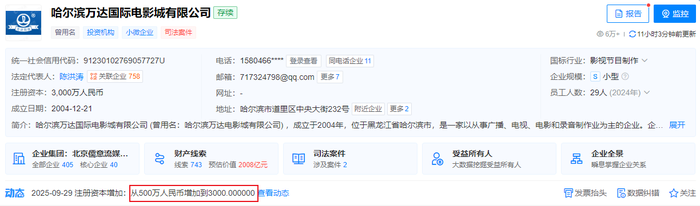
Core Insights - Wanda Film is undergoing significant capital increases across multiple subsidiaries, indicating a strategic shift towards transforming cinemas into diversified entertainment spaces [1][6][8] - The company reported strong financial performance in the first half of 2025, with revenue of 6.689 billion yuan, a year-on-year increase of 7.57%, and a net profit of 536 million yuan, reflecting a substantial growth of 372.55% [2][6] - Wanda Film maintains its leading position in the domestic cinema industry, with a market share of 14.4% and a network of 705 cinemas across 350 cities, holding 51 seats in the top 100 cinemas by box office [3][6] Capital Increase and Strategic Shift - Multiple subsidiaries, including Harbin Wanda International Movie City, have increased their registered capital significantly, with Harbin's capital rising from 5 million yuan to 30 million yuan, totaling an increase of 25 million yuan [1][5] - The total capital increase across three locations amounts to 9.2 million yuan, with the highest increase in Wuxi, followed by Harbin and Taiyuan, reflecting regional market potential [1][5] Market Performance and Consumer Engagement - Harbin's cinema market showed strong performance during the summer of 2025, with total box office revenue reaching 74.097 million yuan and an average ticket price of 36.6 yuan [4][5] - The integration of film and tourism through initiatives like "Follow the Movie to Travel" has enhanced local consumer engagement and contributed to the cinema's success [5][6] Future Development Plans - Wanda Film plans to open 20 to 25 new cinemas in 2025, focusing on high-tier cities and untapped markets with high box office potential [6][7] - The company aims to transform traditional cinemas into "super entertainment spaces," incorporating social and consumption elements, which requires substantial investment in hardware upgrades [6][7] Non-Ticket Revenue Growth - The company is actively developing new consumption models, leveraging its cinema spaces for themed events and collaborations, which have attracted significant audience participation [7][8] - The gross margin for Wanda's food and beverage business is reported at 73.42%, highlighting the profitability of its non-ticket revenue streams [7][8] Hardware and Experience Enhancement - Wanda Film is focusing on enhancing its special effects theaters, which currently represent only 12.6% of total theaters but contribute 24.8% of box office revenue [10] - Plans are in place to complete the deployment of fully laser-equipped theaters by the end of 2026, promising improved viewing experiences for audiences [10]
又一万达被卖后,王思聪再传2大坏消息,王健林可能已没有回头路
Sou Hu Cai Jing· 2025-08-20 00:41
Core Viewpoint - The article discusses the decline of Wang Jianlin's Wanda Group, highlighting its transition from a leading commercial empire to a company struggling with debt and asset sales, reflecting the volatile nature of the business environment [6][10][50]. Company Overview - Wang Jianlin's Wanda Group was once a dominant player in China's commercial real estate sector and expanded globally, but has faced significant challenges since 2017 due to tightened real estate regulations [9][14]. - The company has been forced into a "sell-off" strategy, divesting multiple assets including cultural tourism projects and hotels to survive financially [14][16]. Recent Developments - In 2024, Wanda faced a severe debt crisis, leading to large-scale asset sales, including several Wanda Plazas and the Wanda Hotel Management Company [16][18]. - In May 2024, Wanda sold multiple Wanda Plazas in major cities like Beijing and Shanghai to Tencent and JD.com, indicating ongoing financial distress [18][50]. Financial Challenges - The sale of the Chuzhou Wanda Plaza marked a significant move for Wanda, as it completely exited the shareholder structure, reflecting the severe financial pressures the company is under [37][40]. - Despite these asset sales providing temporary relief, the core business's divestiture raises concerns about Wanda's long-term competitiveness and future prospects [50]. Family Dynamics - Wang Jianlin's son, Wang Sicong, has also been in the media spotlight due to personal controversies, which may further complicate the family's public image amidst the company's struggles [44][46]. - The article suggests that Wang Jianlin's ability to influence his son's decisions is diminishing as Wang Sicong matures and makes his own choices [49].