有色冶炼加工

Search documents
国际金价暴涨!现货黄金首次突破5200美元,有色应声大涨,有色ETF汇添富(159652)强势拉升涨超5%,盘中价格创新高,资金顺势增仓
Sou Hu Cai Jing· 2026-01-28 03:26
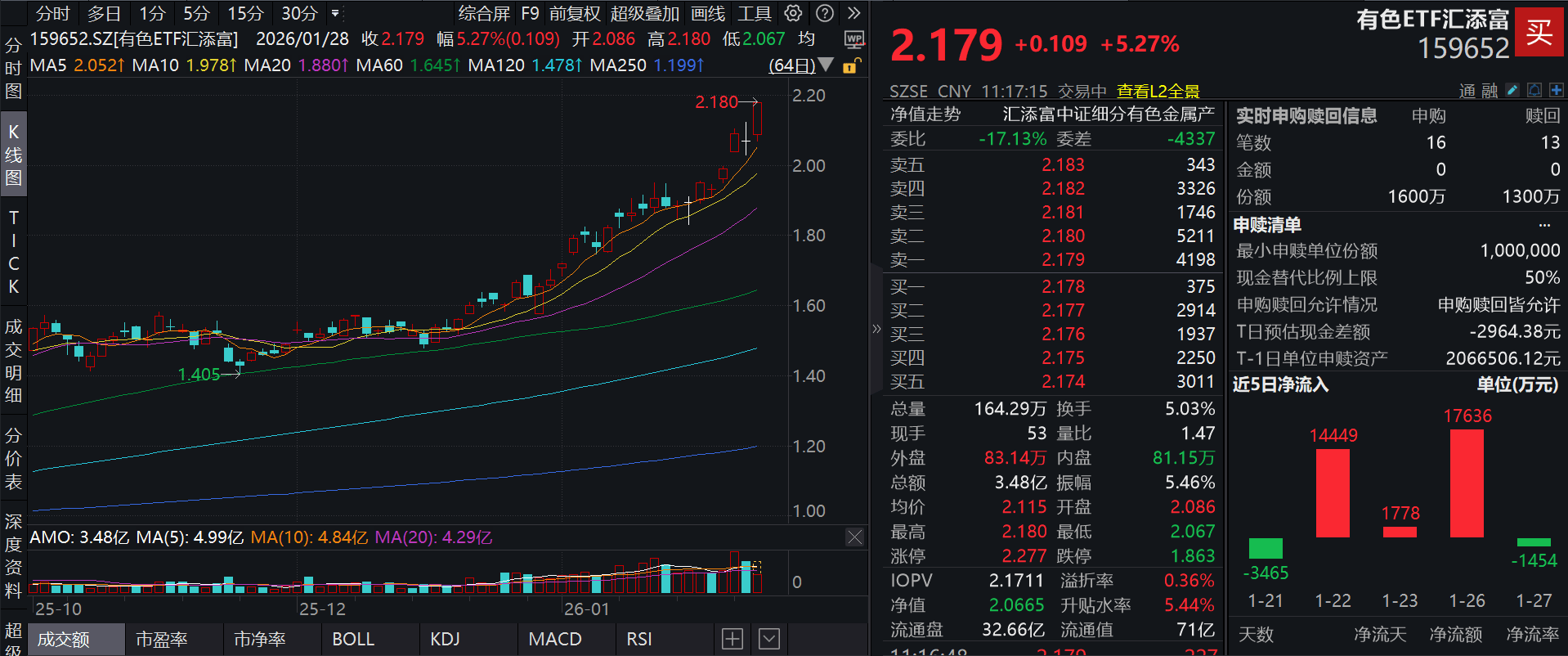
Core Viewpoint - The non-ferrous metal sector is experiencing a strong upward trend, driven by rising prices of precious and industrial metals, with significant interest in the ETF Huatai-PineBridge Nonferrous Metals (159652) and its constituent stocks [1][4][6]. Market Performance - As of January 28, 2026, the CSI Nonferrous Metals Industry Theme Index (000811) rose by 5.06%, with constituent stocks such as silver and aluminum companies seeing increases of over 10% [1]. - The Huatai-PineBridge Nonferrous Metals ETF (159652) recorded a 5.27% increase, with a recent price of 2.18 yuan, and a weekly increase of 9.23% [1]. - The ETF had a turnover of 5% during trading, with a transaction volume of 348 million yuan, and an average daily transaction volume of 108 million yuan over the past year [1]. Fund Flows - The Huatai-PineBridge Nonferrous Metals ETF saw a net subscription of 3 million units, indicating strong investor interest [2]. - The fund's latest scale reached 6.75 billion yuan, with a net outflow of 14.54 million yuan recently, but it had a net inflow of 289 million yuan over the last five trading days [4]. - Leveraged funds are increasingly investing in the ETF, with a net purchase of 2.31 million yuan in financing this month [4]. Gold Market Outlook - International gold prices surged, with spot gold exceeding 5,200 USD per ounce, marking an increase of over 880 USD this month, or more than 20% [4]. - Wall Street analysts, including Jefferies Group, predict gold prices could reach 6,600 USD per ounce this year, while Morgan Stanley anticipates prices may hit 5,700 USD in the second half of the year due to geopolitical uncertainties and strong demand from central banks and ETFs [5]. Company Updates - Zhongjin Gold announced an expected net profit of 4.8 to 5.4 billion yuan for 2025, representing a year-on-year increase of 41.76% to 59.48% due to improved profitability in its gold mining operations [5]. - Luoyang Molybdenum's cobalt products have begun exporting from the Democratic Republic of the Congo, with an export quota of 6,650 tons for Q4 2025 [5]. - Luoyang Molybdenum completed the acquisition of 100% equity in several gold mines in Canada, expected to contribute 6-8 tons of gold annually starting in 2026 [6]. Sector Trends - The non-ferrous metal sector is benefiting from a combination of global monetary easing, rigid supply, and new demand dynamics, with a strong performance expected in the coming periods [6][8]. - The market anticipates a shift to a rate-cutting cycle starting in September 2024, which could further support the performance of gold and other metals [7][8]. - The demand for industrial metals, particularly copper, is expected to rise due to a recovery in manufacturing inventory cycles and increased capital expenditure in AI and infrastructure [9]. Historical Context - Historical trends indicate that the non-ferrous metal sector often performs well during the second phase of major market cycles, supported by improving economic fundamentals [10][12]. - The current environment of monetary easing and supply constraints is expected to enhance the investment appeal of non-ferrous metals [12].

广发期货《有色》日报-20260119
Guang Fa Qi Huo· 2026-01-19 07:45
1. Report Industry Investment Ratings No industry investment ratings are provided in the reports. 2. Core Views of the Reports Tin - Short - term tin prices are highly volatile due to market sentiment. Friday night saw a sharp decline, erasing the previous week's gains. It is recommended to be cautious in the short - term and consider a low - buying strategy after the sentiment stabilizes. The new energy vehicle and AI server sectors offer long - term demand support, while traditional electronics and white - goods sectors are weak [1]. Copper - In the long - term, the price bottom of copper is expected to rise due to capital expenditure constraints on the supply side. Short - term price strength is due to global inventory imbalances and supply concerns. However, real - terminal demand is weak, and prices may return to fundamental pricing. Attention should be paid to CL premium and LME inventory changes, with support at 97500 - 98500 [3]. Nickel - The nickel market is mainly affected by macro factors and Indonesian ore quota news. Although ore - end news provides some support, most of it has been digested. The market is expected to fluctuate widely, with the main contract reference range of 135000 - 145000 [5]. Zinc - Zinc prices are expected to oscillate. The lower support comes from tight domestic zinc ore supply, and the upper pressure comes from expected imported ore supply and negative demand feedback. Attention should be paid to zinc ore TC and refined zinc inventory changes, with support around 23800 [8]. Lithium Carbonate - The lithium carbonate market shows some resilience in the off - season. However, with high valuations, there is resistance to further price increases. The short - term market may adjust widely, with the main contract running between 140,000 - 150,000. Short - term unilateral trading within the range is recommended [11]. Aluminum - Alumina prices are expected to oscillate widely around the industry's cash - cost line, with the main contract in the range of 2600 - 2950 yuan/ton. Aluminum prices are expected to maintain a high - level wide - range oscillation, with the main contract running between 23000 - 25000 yuan/ton. Key factors to watch include domestic inventory accumulation speed, downstream consumption resilience, and overseas monetary policies and geopolitical events [13]. Aluminum Alloy - Aluminum alloy prices are expected to continue a high - level oscillation, with the ADC12 price in the range of 22000 - 24000 yuan/ton. Attention should be paid to raw material price changes, imported supply, and downstream pre - holiday stockpiling [15]. Stainless Steel - Stainless steel prices are expected to oscillate in the short - term, with the main contract in the range of 13800 - 14500. Attention should be paid to ore - end news and downstream inventory building [18]. Polysilicon - In the polysilicon market, demand is expected to improve due to export - rush demand, and there is an expectation of supply reduction. The price may be supported at 48,000 yuan/ton. It is recommended to wait and see during the cooling period and monitor production cuts and downstream demand recovery [20]. Industrial Silicon - The industrial silicon market remains in a state of weak supply and demand, with prices oscillating at a low level. The price is expected to fluctuate between 8000 - 9000 yuan/ton. Attention should be paid to supply - side production changes and potential further polysilicon production cuts [21]. 3. Summaries by Relevant Catalogs Tin - **Price and Basis**: SMM 1 tin price decreased by 2.81% to 414050 yuan/ton, and SMM 1 tin premium decreased by 78.57% [1]. - **Fundamental Data**: November tin ore imports increased by 29.81%, and December SMM refined tin production decreased slightly by 0.06% [1]. - **Inventory Changes**: SHEF inventory increased by 37.69%, and social inventory increased by 36.07% [1]. Copper - **Price and Basis**: SMM 1 electrolytic copper price decreased by 0.70% to 101855 yuan/ton, and the premium decreased significantly [3]. - **Fundamental Data**: December electrolytic copper production increased by 6.80% to 117.81 million tons, and November imports decreased by 3.90% [3]. - **Inventory Changes**: Domestic social inventory increased by 17.20%, and SHFE inventory increased by 18.26% [3]. Nickel - **Price and Basis**: SMM 1 electrolytic nickel price decreased by 0.47% to 149350 yuan/ton, and the premium of 1 Jinchuan nickel decreased by 18.75% [5]. - **Cost of Electrolytic Nickel Production**: The cost of integrated MHP - produced electrolytic nickel increased by 1.09% to 112237 yuan/ton [5]. - **Supply, Demand and Inventory**: China's refined nickel imports decreased by 9.38%, and SHFE inventory increased by 3.28% [5]. Zinc - **Price and Basis**: SMM 0 zinc ingot price decreased by 2.40% to 24800 yuan/ton, and the premium decreased [8]. - **Fundamental Data**: December refined zinc production decreased by 7.24% to 55.21 million tons, and November exports increased by 402.59% [8]. - **Inventory Changes**: Global visible inventory decreased slightly, and China's seven - region zinc ingot social inventory decreased by 0.08% [8]. Lithium Carbonate - **Price and Basis**: SMM battery - grade lithium carbonate average price decreased by 0.63% to 158000 yuan/ton, and the basis increased significantly [11]. - **Fundamental Data**: December lithium carbonate production increased by 4.04% to 99200 tons, and demand decreased by 2.50% [11]. - **Inventory Changes**: December lithium carbonate total inventory decreased by 12.23% [11]. Aluminum - **Price and Spread**: SMM A00 aluminum price decreased by 0.66% to 24030 yuan/ton, and the premium decreased [13]. - **Fundamental Data**: December alumina production increased by 1.08% to 751.96 million tons, and domestic electrolytic aluminum production increased by 3.97% [13]. - **Inventory Changes**: China's electrolytic aluminum social inventory increased by 3.08%, and LME inventory decreased by 0.41% [13]. Aluminum Alloy - **Price and Spread**: SMM aluminum alloy ADC12 price decreased by 0.42% to 23900 yuan/ton, and the price difference between refined and scrap aluminum decreased [15]. - **Fundamental Data**: December recycled aluminum alloy ingot production decreased by 6.16% to 64.00 million tons, and the industry's operating rate decreased [15]. - **Inventory Changes**: Recycled aluminum alloy social inventory decreased slightly to 4.89 million tons [15]. Stainless Steel - **Price and Basis**: The price of 304/2B (Wuxi Hongwang 2.0 coil) decreased by 0.35% to 14350 yuan/ton, and the basis increased [18]. - **Fundamental Data**: December 300 - series stainless steel crude steel production in China decreased by 2.50% to 171.93 million tons, and exports increased by 13.18% [18]. - **Inventory Changes**: 300 - series social inventory (Wuxi + Foshan) decreased by 1.47% [18]. Polysilicon - **Spot Price and Basis**: N - type polysilicon feedstock average price increased by 0.18% to 54850 yuan/ton, and the basis decreased [20]. - **Fundamental Data**: Weekly polysilicon production decreased by 9.66% to 2.15 million tons, and imports decreased by 27.05% [20]. - **Inventory Changes**: Polysilicon inventory increased by 6.29% to 32.10 million tons [20]. Industrial Silicon - **Spot Price and Basis**: East China oxygen - containing SI5530 industrial silicon price remained unchanged at 9250 yuan/ton, and the basis increased [21]. - **Fundamental Data**: December national industrial silicon production decreased by 1.15% to 39.71 million tons, and exports increased by 21.78% [21]. - **Inventory Changes**: Social inventory increased by 0.54% to 55.50 million tons [21].
有色早报-20260116
Yong An Qi Huo· 2026-01-16 01:50
Group 1: Copper - The copper price has significantly increased recently, driven by the expected potential refined copper tariff in the US, which causes a phased inventory transfer to the US, and the inflow of investment funds. The market remains optimistic about copper due to low inventories in non - US regions and continuous restocking in the US. In the future, the copper price will depend on the terminal demand's ability to accept high prices, the continuation of US restocking, and the recovery of Chinese demand. It is expected to accumulate inventory steeply before the Spring Festival and de - stock quickly after the Spring Festival [1]. Group 2: Aluminum - The expected trading dominates the changes in the futures and spot prices, with amplified price fluctuations. The import of primary aluminum decreased significantly in November, while the export of primary aluminum, aluminum products, and related items increased. The actual domestic apparent demand is weaker than previously expected. The automobile sales are poor and are expected to decline further after the subsidy withdrawal in 2026, but the PV installation volume has rebounded better than expected, boosting short - term demand. The inventory of aluminum ingots and products has accumulated, the apparent demand has decreased, and the basis has rebounded but remains at a low level. The strong expectation supports the current high price [1][2]. Group 3: Zinc - On the supply side, domestic and imported TC are accelerating their decline. Domestic zinc ore will be in short supply from the fourth quarter to the first quarter of next year. In November, the Huoshaoyun zinc ingot was officially put into production, and other smelters have limited increments. In December, many smelters had maintenance, and it is expected that they will resume production in mid - January. On the demand side, domestic demand is seasonally weak, and overseas, European demand is average while US zinc ingot imports have increased recently. For strategies, it is recommended to wait and see for unilateral trading, pay attention to reverse arbitrage opportunities between domestic and foreign markets, and positive arbitrage opportunities for the monthly spread [5]. Group 4: Nickel - On the supply side, the production of pure nickel has slightly declined. On the demand side, it is generally weak, but the premium of Jinchuan nickel is relatively strong. In terms of inventory, the domestic inventory accumulation has slowed down, and about 30,000 tons were delivered to LME warehouses this week, mainly in Asian warehouses. In the short term, the fundamental situation is weak. The Indonesian energy and mining minister did not disclose the nickel production quota for 2026 but said it would be adjusted according to industry demand, so the short - term policy and fundamentals will continue to compete [6][7]. Group 5: Stainless Steel - On the supply side, steel mill production schedules remain at a high level. On the demand side, it is mainly for rigid needs. In terms of cost, the price of nickel iron has slightly stabilized, and the price of chromium iron has remained unchanged. In terms of inventory, the high - level inventory has slightly decreased, and the warehouse receipts have remained the same. The fundamentals are generally weak, and the news of the Indonesian quota is the main driver of recent prices, following the nickel price in the short term [10]. Group 6: Lead - This week, the lead price has fluctuated at a high level following the macro trend. On the supply side, primary production is driven by profits, with an expected production recovery of 1 - 1.5 tons in January. The concentrate production has decreased seasonally, and the concentrate has become tight with no hope of a TC rebound. The recycling plants have resumed production after the environmental inspection at the beginning of the month, and recyclers are starting to hold up prices. On the demand side, the battery production rate is high this week, but the monthly battery finished - product inventory has accumulated, and demand is expected to weaken. The lead ingot market has been tight since the end of September, and although the supply - demand mismatch has been alleviated by the recovery of recycling production, it is difficult to accumulate inventory due to the high - rate production of battery factories. The downstream's low - price restocking provides support. The refined - scrap price difference has returned to - 150. The new national standard has suppressed the consumption of two - wheeled vehicle batteries, and the year - end inventory counting has led to a dull trading environment. It is expected that the domestic and foreign lead prices will remain volatile next week, and attention should be paid to the risk of low warehouse receipts [11]. Group 7: Tin - This week, the tin price has increased. On the supply side, domestic tin production has remained the same. Overseas, production in Wa State may be affected in the first quarter due to equipment problems in local mines, and the export quota issue in Indonesia is still under negotiation. The war in the DRC and Rwanda has not affected local mining production, but border risks still exist. On the demand side, downstream restocking willingness is strong due to rigid orders and the expectation of pre - installation before the cancellation of PV tax rebates, leading to a significant decline in domestic inventory, while overseas LME inventory has fluctuated. In the short term, there are supply risks in major global suppliers, and it is difficult to accumulate large - scale inventory under the expectation of domestic export rush. Before the macro sentiment weakens, the upward driving force is stronger. The risk of going long on the fundamental side lies in whether the overseas LME inventory will accumulate on a large scale. In the long term, demand determines the upper price limit. Tin can be a multi - allocation in non - ferrous metals in the first quarter, but if the macro situation falls short of expectations, the price may decline significantly in the second half of the year [11][12]. Group 8: Industrial Silicon - This week, some factories in Shaanxi and Xinjiang have increased production, while some in Xinjiang Yili and Qinghai have decreased production again. As large factories are gradually entering the maintenance period, the supply and demand of industrial silicon are approaching balance. In the short term, the supply - demand balance is expected to keep the price fluctuating with the cost. In the long term, the over - capacity of industrial silicon is still high, and the low operating rate is expected to keep the price oscillating at the bottom of the cycle, anchored by the seasonal marginal cost [15]. Group 9: Lithium Carbonate - Recently, potential disturbances in domestic and foreign resource - ends, the increase in iron - lithium processing fees, and the macro sentiment have jointly driven up the lithium price. On the raw material side, the available supply is still tight, and the price is relatively firm. The auction of Albemarle's concentrate has further boosted market sentiment. On the lithium salt side, the sales strategy of upstream lithium salt factories is changing, with a decrease in the proportion of long - term contracts and an increase in the proportion and willingness to sell spot orders. Downstream, material factories are cautious about high prices and tend to replenish inventory rigidly after the price drops to a relatively low level. In the second half of the week, the trading volume of orders below 140,000 has slightly increased. Currently, some mid - stream inventories have become visible, with the quotes of first - tier spodumene - based electric carbon at - 1500~ - 1000 and second - and third - tier at - 1800~ - 1500 [18].
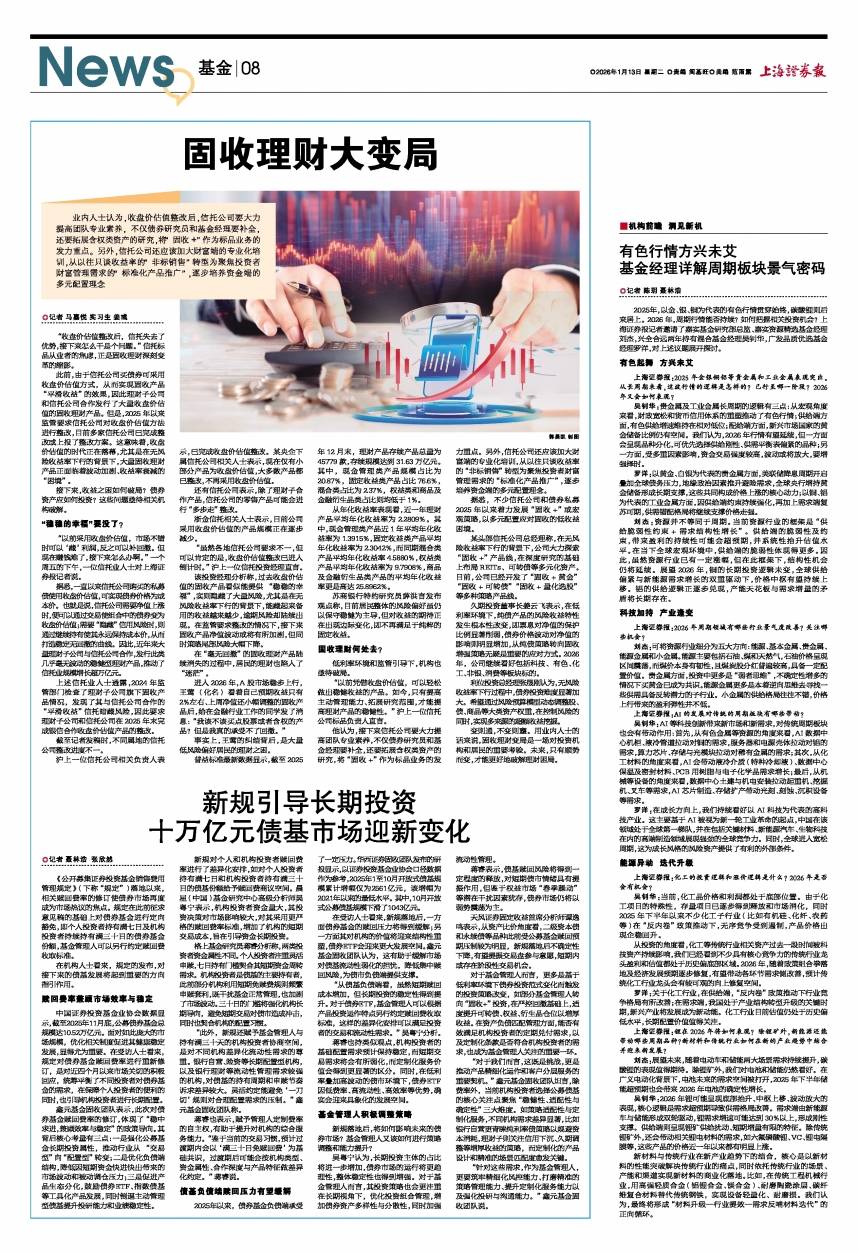
机构前瞻 洞见新机 | 有色行情方兴未艾 基金经理详解周期板块景气密码
Sou Hu Cai Jing· 2026-01-13 00:13
Group 1 - The core viewpoint is that the market for non-ferrous metals, represented by gold, silver, and copper, will continue to thrive in 2025, with lithium carbonate emerging as a strong contender in 2026. The sustainability of the cyclical market and investment opportunities will be discussed [14][15][20] - The long-term logic behind the performance of precious and industrial metals includes three main factors: fiscal easing and the restructuring of the monetary credit system, relatively low growth rates in supply, and the potential for increased gold reserves in emerging markets. The market is expected to continue in 2026, albeit with some differentiation among products [15][16] - The demand for lithium is projected to increase significantly due to the dual drivers of electric vehicles and energy storage, with demand growth potentially reaching over 30%. This will create a rigid support for prices, while supply may face disruptions [20] Group 2 - The investment landscape for traditional industries, particularly in the chemical sector, is currently characterized by low prices and profits. However, with the implementation of policies aimed at reducing disorderly competition, there is potential for price stabilization and recovery in 2026 [19] - The integration of AI technology is expected to drive demand in traditional cyclical sectors, particularly in the context of resource industries. This includes increased demand for copper and aluminum due to the needs of data centers and other technological advancements [18] - The cyclical market is anticipated to experience structural opportunities due to the constraints on supply and the growth in demand, particularly in the context of the global macroeconomic environment [16][17]
ETF盘中资讯|黄金,历史新纪录!有色ETF华宝(159876)量价齐升,续刷上市新高!近10日狂揽3.31亿元!
Sou Hu Cai Jing· 2026-01-12 06:22
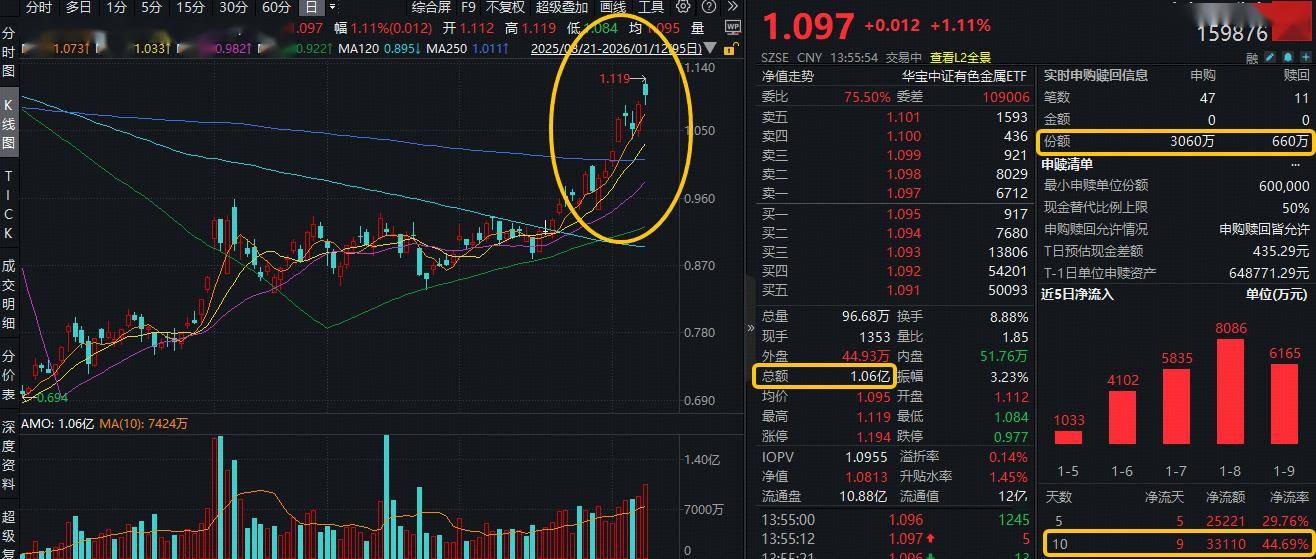
Group 1 - The core viewpoint of the news highlights the strong performance of the Huabao Nonferrous ETF (159876), which reached a historical high with a trading volume of 1.06 billion yuan, indicating a bullish market sentiment [1] - The Huabao Nonferrous ETF has seen a net subscription of 24 million units, accumulating 331 million yuan over the past 10 days, suggesting significant investor interest [1] - Key constituent stocks such as Zhong Rare Earth and Western Superconducting have shown substantial gains, with Zhong Rare Earth hitting the daily limit, indicating strong sector performance [1] Group 2 - On January 12, spot gold prices surged, breaking the historical record set on December 29, 2025, reaching 4601.38 USD/oz, reflecting heightened demand for safe-haven assets amid geopolitical tensions [3] - Global geopolitical risks are escalating, particularly between Iran and the U.S., contributing to increased market uncertainty and driving demand for precious metals like gold [3] - The World Gold Council anticipates that ongoing geopolitical uncertainties will continue to influence the gold market, with potential for moderate price increases or strong rallies depending on economic conditions [3] Group 3 - Xiangcai Securities notes that the U.S. faces recession pressures, with high sovereign debt and trade deficits undermining the dollar's credibility, leading to a renewed focus on gold as a universal asset [4] - As gold prices rise, the supply-demand dynamics for commodities like copper may tighten, suggesting a potential revaluation of these assets [4] Group 4 - The Huabao Nonferrous ETF and its linked funds cover a wide range of sectors including copper, aluminum, gold, rare earths, and lithium, positioning them to capitalize on various market cycles [5] - The ETF's comprehensive coverage allows for better exposure to the overall sector's beta performance, indicating a favorable investment environment for nonferrous metals [5]
中信建投:铜的行情仍未结束,看好2026年铜价赔率
Xin Lang Cai Jing· 2026-01-11 13:07
Group 1 - The core viewpoint of the article is that the non-ferrous metals market, particularly copper and aluminum, is experiencing a strong year-end performance driven by strategic resource pricing and unexpected monetary easing in the U.S. [1] - The essence of the non-ferrous market is tied to the pricing of the global transition between old and new orders, indicating that copper will take over from gold and silver in terms of market momentum [1] - The report suggests that the current copper price of $13,000 is not the peak for this cycle, and there is optimism for copper price performance through 2026 [1]

中信建投:铜必将接力金银,行情仍未结束
Xin Lang Cai Jing· 2026-01-11 11:48
Core Viewpoint - The report from CITIC Securities indicates a strong performance in the non-ferrous metals sector, particularly copper and aluminum, driven by strategic resource pricing and unexpected monetary easing in the U.S. [1] Group 1: Market Analysis - CITIC Securities believes that the non-ferrous market reflects the transition between the old and new global order, suggesting that copper will take over from gold and silver in terms of market performance [1] - The report asserts that the copper market is not at its end, with a price target of $13,000 not being the peak for this cycle, and anticipates favorable odds for copper prices by 2026 [1] Group 2: Price Dynamics - Following historical highs, copper prices are currently undergoing a technical correction phase, influenced by profit-taking and weak market realities in the short term [1] - Despite these short-term pressures, structural demand is expected to provide strong support for copper prices moving forward [1]
沪指突破4100点,AI应用概念爆发,多只牛股连板
Zheng Quan Shi Bao· 2026-01-09 09:13
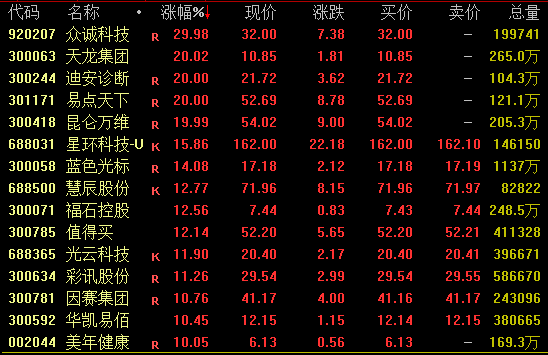
Market Overview - The A-share market rose again on January 9, with the Shanghai Composite Index breaking through 4100 points, marking a continuous 16-day increase [1] - The total trading volume of the A-share market exceeded 3 trillion yuan, the first time since October 2025 [1] - The Shanghai Composite Index closed up 0.92% at 4120.43 points, while the Shenzhen Component Index rose 1.15% and the ChiNext Index increased by 0.77% [1] AI Application Sector - The AI application concept saw a significant surge, with stocks like Yidian Tianxia and Kunlun Wanwei hitting the 20% limit up, and Xinghuan Technology reaching a historical high [3][4] - The Ministry of Industry and Information Technology and other departments issued an implementation opinion for the "AI + Manufacturing" initiative, aiming for significant advancements in AI technology and applications by 2027 [4][5] - The proportion of industrial enterprises in China applying large models and intelligent agents increased from 9.6% in September 2024 to 47.5% in 2025, with further rapid growth expected [5] Aerospace and Military Sector - The aerospace and military sectors showed strong performance, with stocks like Qian Zhao Guangdian and Zhenyou Technology hitting the 20% limit up [7][8] - The military industry is expected to enter a long-term prosperous phase, driven by both domestic demand and foreign trade, with significant improvements in revenue and profitability anticipated [8] Notable Stocks - Fenglong Co. continued its impressive performance with an 11-day limit up streak, reaching a historical high [10] - Lushin Investment also saw a strong performance with 9 limit up days in 11 trading sessions [10] - Zhizhi New Materials achieved a 20% limit up for five consecutive days, with a cumulative increase of nearly 150% [11]



有色商品日报-20260107
Guang Da Qi Huo· 2026-01-07 02:55
有色商品日报 有色商品日报(2026 年 1 月 7 日) 一、研究观点 | 品 种 | 点评 | | --- | --- | | | 隔夜内外铜价联袂走高,LME 铜收盘价再创历史新高,国内精炼铜进口维系亏损。宏 | | | 观方面,美联储内部就降息路径继续产生较大分歧,里士满联储主席巴尔金称利率已 | | | 至中性水平,而理事米兰表示数据支持进一步降息,今年幅度或超 100 个基点。国内方 | | | 面,央行工作会议上明确 2026 年重点工作,加大逆周期和跨周期调节力度,灵活高效 | | | 运用降准降息等多种货币政策工具。库存方面,LME 库存增加 3525 吨至 146075 吨; | | 铜 | Comex 库存增加 4996 吨至 461654 吨;SHFE 铜仓单增加 2989 吨至 93271 吨,BC 铜维 | | | 持 1053 吨。需求方面,因铜价持续高位,终端订单有所放缓,市场维系刚性采购需求。 | | | 贵金属表现持续乐观下,做多情绪正在传导,尽管当下铜基本面表现并不乐观,但市场 | | | 对 26 年经济复苏仍存较强预期,资金成为短线铜价的主要推手,调整节奏被延后,操 ...
相关部门释放绿色消费强信号,自由现金流ETF(159233)备受关注
Sou Hu Cai Jing· 2026-01-07 02:01
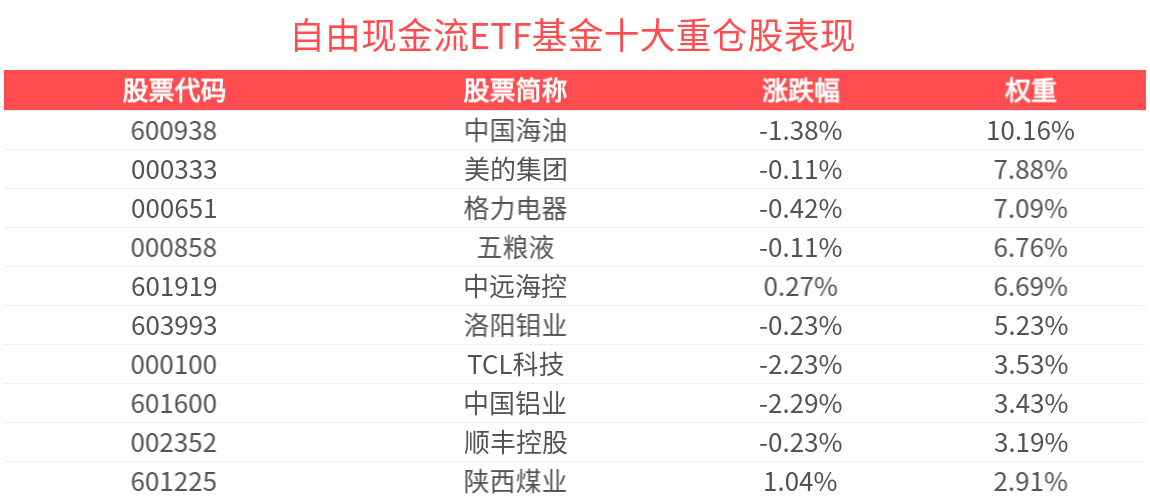
Group 1 - The core viewpoint of the news is the introduction of a policy by nine departments to promote green consumption, which is expected to inject strong momentum into sectors like non-ferrous metals, home appliances, and automobiles due to their cash flow strength [1] - The policy focuses on enhancing the green consumption incentive mechanism, emphasizing seven dimensions including the supply of green products and the recycling of waste items [1] - The Free Cash Flow ETF (159233) targets high free cash flow companies in the non-ferrous and home appliance sectors, which are better positioned to benefit from policy incentives and advance their green transformation and capacity expansion [1] Group 2 - The non-ferrous metals sector is generally viewed positively by authoritative institutions, with expectations of a bull market driven by monetary, demand, and supply factors by 2026, particularly for copper, aluminum, and tin [1] - Copper is highlighted as the "oil of the electrification era," with demand significantly benefiting from multiple factors such as new energy, AI computing power, and grid upgrades [1] - The home appliance sector is expected to see sustained demand improvement due to policies promoting green upgrades and trade-in programs, with a projected subsidy scale of 250 billion yuan by 2026 [2] Group 3 - The CSI Free Cash Flow Index (932365) includes top-weighted stocks such as China National Offshore Oil Corporation, SAIC Motor, Gree Electric Appliances, and others, with the top ten stocks accounting for 53.78% of the index [3] - The index reflects the overall performance of companies with strong cash flow creation capabilities, selecting 100 high free cash flow rate listed companies as sample securities [2][3]