
高技术

Search documents
6月制造业PMI边际改善
HTSC· 2025-06-30 12:25
Manufacturing PMI Insights - June manufacturing PMI improved slightly from 49.5% in May to 49.7%, slightly above Bloomberg consensus of 49.6% but still below seasonal levels[1] - Production index rose by 0.3 percentage points to 51.0%, while new orders index increased from 49.8% to 50.2%[3] - New export orders index saw a minor increase from 47.5% to 47.7%, remaining below seasonal averages[5] Non-Manufacturing Sector Performance - Non-manufacturing business activity index rose by 0.2 percentage points to 50.5%, with the construction sector showing significant recovery[6] - Service sector index slightly declined to 50.1%, indicating mixed performance across industries[6] Price Trends and Economic Outlook - Both purchasing prices and factory prices showed signs of recovery, with raw material prices index rising by 1.5 percentage points to 48.4%[7] - The uncertainty surrounding tariff policies post July 9 may disrupt future export and production activities, necessitating stronger monetary and fiscal policies[2] Employment and Business Expectations - Employment index in manufacturing fell by 0.2 percentage points to 47.9%, indicating ongoing challenges in labor market stability[3] - Business activity expectations index decreased by 0.5 percentage points to 52%, reflecting cautious outlook among manufacturers[3]
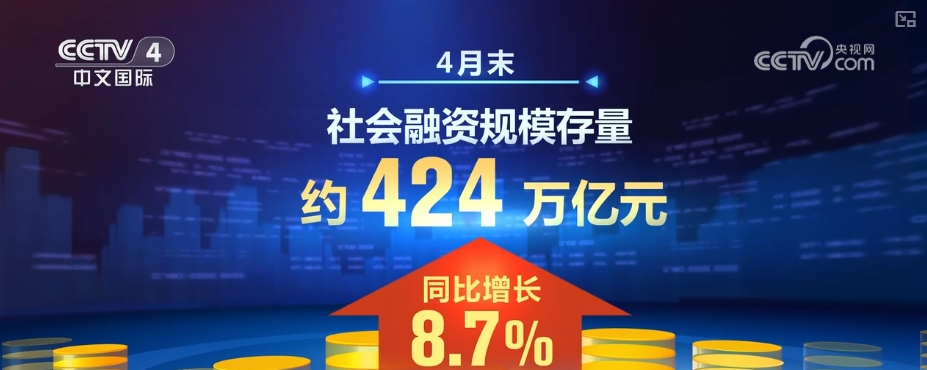
424万亿、10.06万亿、2.85万亿……“数”看经济稳步增长 持续回升向好
Yang Shi Wang· 2025-05-15 03:05
Economic Growth Indicators - China's economy is showing steady growth and continuous recovery as indicated by recent financial data released by multiple departments [1] - The total social financing scale at the end of April was approximately 424 trillion yuan, with a year-on-year growth of 8.7% [4] - The broad money supply (M2) balance was about 325 trillion yuan, also reflecting a year-on-year increase of 8.0%, maintaining a high level [4] Credit and Loan Growth - From January to April, the total increase in RMB loans was 10.06 trillion yuan, with an improving credit structure supporting economic transformation [6] - In April, inclusive small and micro loans and medium to long-term loans for the manufacturing sector grew by 11.9% and 8.5% year-on-year, respectively, both exceeding the overall loan growth rate [6] Corporate Sales Performance - National corporate sales revenue increased by 4.3% year-on-year in April [7] - The manufacturing sector's sales revenue grew by 4.4% year-on-year, driven by policies supporting "new and emerging" industries, with significant growth in sectors like electrical machinery, computer manufacturing, and instrumentation [9] Regional Economic Activity - In April, corporate sales revenue in the eastern region grew by 4.8% year-on-year, with provinces like Zhejiang, Guangdong, and Beijing showing growth rates significantly above the national average [11] - The development of innovative industries, particularly in artificial intelligence, has accelerated growth in equipment manufacturing and high-tech industries [11] Trade Performance in the Greater Bay Area - The import and export activities of the nine cities in the Guangdong-Hong Kong-Macao Greater Bay Area maintained growth, reaching 2.85 trillion yuan in the first four months of 2025, a growth of 5.4% [14] - Exports of "new three items" and motorcycles increased by over 40%, while imports of semiconductor manufacturing equipment, computers and components, and certain consumer goods also saw rapid growth [16]

社论丨扩大有效需求,畅通供需循环
2 1 Shi Ji Jing Ji Bao Dao· 2025-05-12 17:57
Group 1 - The core viewpoint of the articles emphasizes the importance of stabilizing prices and promoting reasonable price recovery through a combination of monetary and fiscal policies [1][2][3] - The April CPI showed a month-on-month increase of 0.1%, reversing a previous decline, driven by rising food and travel service prices, indicating the effectiveness of policies aimed at expanding domestic demand and consumption [1] - The central bank's report highlights that the key to boosting prices lies in expanding effective demand and ensuring smooth supply-demand cycles, while also addressing structural issues in the economy [2][3] Group 2 - The report indicates that total demand remains weak due to various uncertainties, including global growth slowdown and the ongoing transformation of China's economic structure, which requires time for new growth drivers to fill the gap left by traditional drivers [2] - There is a recognition of excessive competition in certain industries, which has exacerbated supply-demand imbalances due to a historical focus on investment-driven capacity expansion [2][3] - A coordinated approach involving fiscal, monetary, industrial, employment, and social policies is necessary to achieve a balance between supply and demand, and to promote reasonable price recovery [3]
社论丨中国出口结构持续优化,贸易“朋友圈”不断扩大
2 1 Shi Ji Jing Ji Bao Dao· 2025-05-09 17:53
Core Insights - China's foreign trade shows strong resilience and growth potential despite global economic challenges, with exports increasing by 8.1% year-on-year and imports decreasing by 0.2%, leading to a trade surplus of $96.18 billion, up 33.6% [1] Group 1: Export Performance - The export structure is continuously optimizing, with steady growth in electromechanical and high-tech product exports, while labor-intensive product exports remain weak [1] - In April, electromechanical product exports reached $190.58 billion, with significant growth in integrated circuits, audio-video equipment, general machinery, LCD modules, and ships [1] - The shift in export product structure indicates the effectiveness of China's manufacturing transformation and upgrade, enhancing the technical content and added value of exported products [1] Group 2: Trade Diversification - China's trade relationships are diversifying, with stable imports and exports to major economies except for the U.S., where trade has been negatively impacted by "reciprocal tariffs" [2] - Exports to ASEAN, Central Asia, Latin America, and Africa have seen rapid growth, with double-digit increases, while exports to the EU and Japan remain stable [2] - Strengthening trade ties with ASEAN, Latin America, and Central Asia promotes a more balanced trade market and enhances China's foreign trade's risk resistance [2] Group 3: New Trade Dynamics - New productive forces are rapidly developing, fostering competitive enterprises in high-end, intelligent, and green manufacturing, which supports the transformation and upgrade of foreign trade [2] - The equipment manufacturing sector has seen significant growth, representing a substantial portion of foreign trade, while domestic brand exports are increasing in scale and share [2] - The "cross-border e-commerce + industrial belt" model is thriving, providing a broad platform for SMEs to enter international markets, with digital technology reshaping competitive advantages in foreign trade [2] Group 4: Future Outlook - China's foreign trade faces external challenges, including global economic uncertainty and trade protectionism, which may impact trade dynamics [3] - The "reciprocal tariffs" from the U.S. have led to a "rush to export" effect, with a decline in new export orders and purchasing indices in April, indicating weaker export expectations [3] - To mitigate the impact of reduced external demand, China has implemented various supportive policies for foreign trade enterprises, including tax reductions and improved business environments [3] Group 5: Trade Development Trends - Future foreign trade is expected to show a differentiated trend, with stable and accelerating trade with closely linked economies, while others may experience slow growth due to global economic slowdown or trade protectionism [4] - High-tech products and key components are likely to maintain stable growth, while traditional low-value-added industrial and labor-intensive products are more susceptible to external influences [4] - Enterprises with strong technological reserves and international competitiveness may accelerate their globalization efforts, while SMEs reliant on external markets should actively seek transformation [4]
3月外贸数据点评:一季度出口仍强
LIANCHU SECURITIES· 2025-04-16 10:46
Export Performance - In Q1, export growth was 5.8% year-on-year, with March exports increasing by 12.4%, significantly exceeding the expected growth of 3.5%[1] - The strong export growth is attributed to a low base from the previous year and the delayed effects of Trump's tariff policies, leading to a "rush to export" phenomenon[1] - March exports showed a month-on-month growth that was higher than seasonal trends, indicating continued strength in exports[1] Regional Contributions - Major contributors to export growth include ASEAN, EU, and the US, with ASEAN's contribution rate rising significantly compared to last year[2] - In March, ASEAN contributed 2.2 percentage points to export growth, with a contribution rate of 17.7%, while the EU and the US contributed 1.5 and 1.2 percentage points, respectively[2] - Cumulatively in Q1, ASEAN, EU, and the US together contributed 0.9 percentage points to export growth, accounting for a total contribution rate of 46.4%[2] Product Categories - Labor-intensive products saw a decline in their contribution to export growth, while high-tech products maintained strong resilience[3] - In March, textile, clothing, and ceramic products showed improved export growth rates, but their overall contribution to export growth decreased significantly compared to last year[3] - High-tech products contributed 25% to export growth, while labor-intensive products contributed negatively, dragging down the overall export growth by 0.3 percentage points[3] Import Trends - Import growth was negatively impacted by low commodity prices, with Q1 imports declining by 7.1% year-on-year, below the annual target of 1.1%[4] - Agricultural products and certain resource commodities were the main contributors to the decline in import growth, with agricultural imports down by 15.8%[4] - The decline in imports was also driven by significant drops in metal resources and energy products, with iron ore imports down by 27.5%[4] Structural Changes and Risks - The fluctuating tariff policies are expected to create structural differentiation in exports, with potential short-term boosts in exports to ASEAN and certain consumer electronics due to tariff exemptions[5] - Domestic policy measures aimed at boosting internal demand may help offset external demand shocks, with expectations of potential interest rate cuts and increased issuance of government bonds[5] - Risks include unexpected changes in overseas policies and slower-than-expected recovery in foreign economies[6]
热点聚焦 | 刘伟等:2025年中国经济形势展望与政策预期
水皮More· 2025-04-10 07:39
刘伟等:2025年中国经济形势展望与政策预期 热点聚焦 内容摘要: 2024年中国GDP同比增长5.0%,经济运行"总体平稳、稳中有进",顺利 完成年初制定的5%左右增速目标。展望2025年,全国人口减少、市场预期偏弱、支 柱产业调整、地缘政治风险、能源格局变动等国内外因素仍将影响中国经济发展。中 国经济自然走势将是供给、需求双收缩的格局,且需求收缩大于供给,整体依然低于 潜在水平。房地产风险、地方债务风险、汇率及货币风险、贸易摩擦风险等将成为未 来中国经济发展的潜在风险点。鉴于此,2025年的政策目标仍需以需求端作为主要发 力点,同时,对供给端的稳定运行和市场环境的持续改善提供必要的支持,宏观调控 政策组合应该以需求、供给双扩张为主,以市场环境管理为辅。 全文字数 | 约13000字 2024年是实现"十四五"规划目标任务的关键一年,在以习近平同志为核心的党中央团结带领下, 沉着应变,综合施策,我国经济运行总体平稳,稳中有进。数据显示,2024年我国GDP同比增长 5.0%,顺利完成年初制定的增速目标。 展望2025年,中国宏观经济运行的自然走势将是供给、需求双 收缩的格局,且需求收缩大于供给,低于潜在水平 ...