
建材

Search documents
港股收评:恒指涨0.31%、科指涨0.9%,有色金属及稀土板块走高,科网股、汽车股活跃
Jin Rong Jie· 2026-02-11 08:20
Market Performance - The Hong Kong stock market showed a positive trend with the Hang Seng Index rising by 83.23 points, or 0.31%, closing at 27,266.38 points [1] - The Hang Seng Tech Index increased by 48.96 points, or 0.9%, to 5,499.99 points, while the National Enterprises Index rose by 25.43 points, or 0.28%, to 9,268.18 points [1] - Significant market divergence was observed, with new stocks surging and some older stocks experiencing sharp declines, supported by continuous inflow of southbound funds [1] Individual Stock Movements - Newly listed stock Lexin Outdoor surged by 48.51% on its second day of trading, reaching HKD 36.8, marking an increase of over 220% from its IPO price [2] - Bilibili-W saw a rise of 5.16% to HKD 252.8, with expectations of a nearly 60% year-on-year growth in game licenses by 2026, potentially boosting advertising revenue [2] - Kingsoft Cloud experienced a significant increase of 9.12%, benefiting from Xiaomi's projected AI investment of approximately HKD 10 billion in 2026 [2] Sector Performance - Resource stocks performed strongly, with Ganfeng Lithium rising over 4% due to an 8% increase in lithium carbonate futures [2] - Coal stocks continued their upward trend, with Mongolian Coal and Yancoal both rising over 4%, following Indonesia's announcement of significant production cuts [2] - Real estate stocks saw a late surge, with Vanke Enterprises and Country Garden rising by 3.76% and 3.57%, respectively, amid easing concerns over corporate debt risks [3] Market Sentiment and Outlook - Analysts noted that the recent market pullback was driven by three main pressures: hawkish Fed expectations, doubts about AI capital expenditure returns, and lower-than-expected manufacturing PMI [4] - Despite the inflow of southbound funds, overall trading volume in the Hong Kong market has decreased, indicating a cautious sentiment among investors [4] - The market is expected to see a potential short-term recovery, with a focus on essential retail and tech hardware sectors, while maintaining a defensive strategy due to high volatility risks [4]
跨越短周期扰动,拥抱长周期拐点!借道建材ETF(159745) 捕获"量增价稳"甜蜜期
Sou Hu Cai Jing· 2026-02-11 07:02
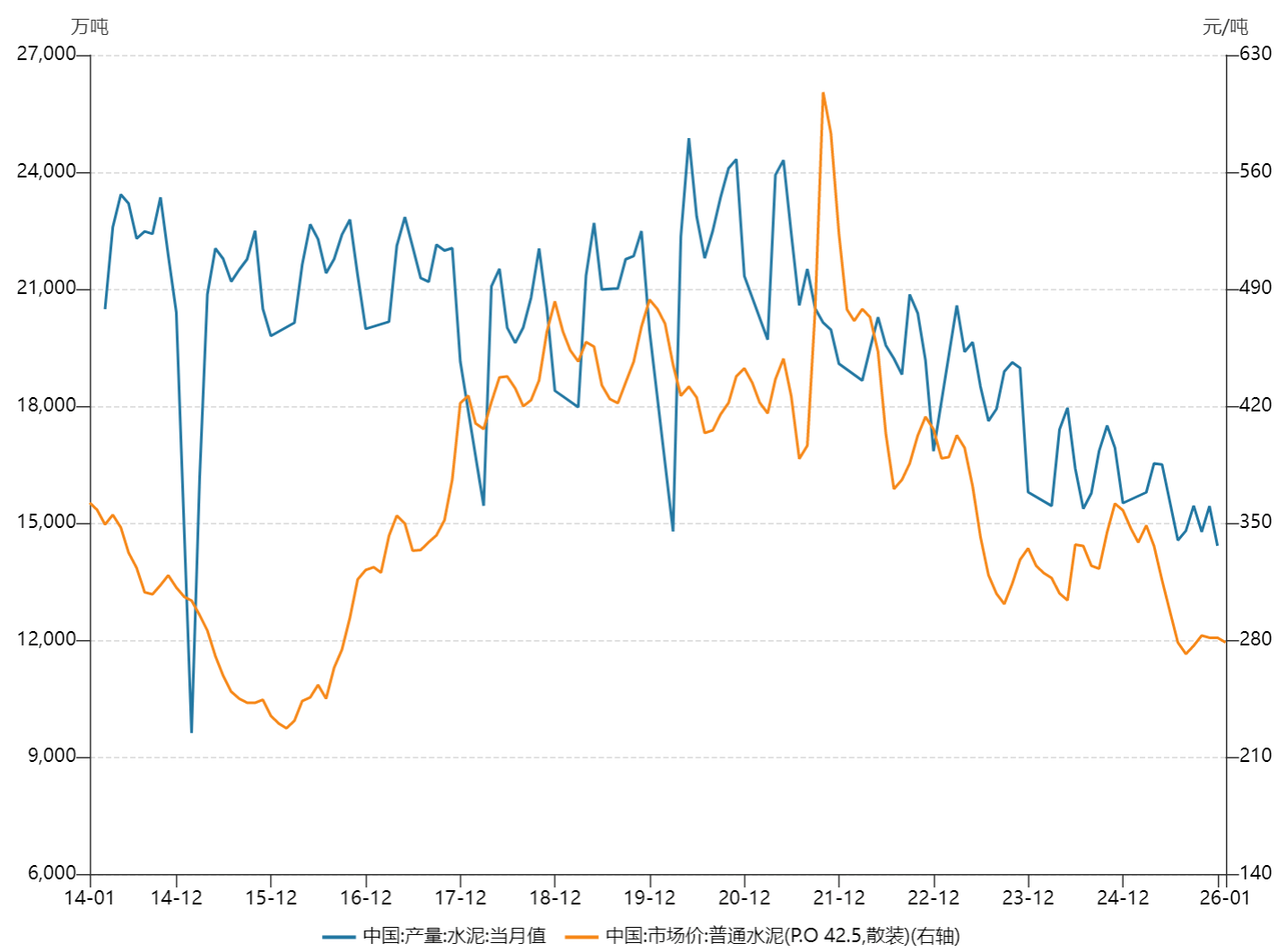
Group 1: Industry Overview - The building materials industry is a typical early-cycle sector, with its recovery often leading macroeconomic recovery confirmations. Current infrastructure investment and marginal improvements in real estate completions are driving demand, while raw material costs remain manageable, suggesting a potential "volume increase and price stability" period for the industry [1] - The cement industry is facing short-term challenges due to cold weather, which can lead to reduced production. Extreme low temperatures increase energy costs and affect equipment safety, while logistics are hindered by snow, leading to physical supply constraints [2][5] - The implementation of strict "peak-shifting production" policies in the cement industry, particularly in northern regions, results in production halts of 4-5 months during winter, with limits on production capacity exceeding 60% during the heating season [2][5] Group 2: Long-term Trends - The supply-side reform 2.0 and market restructuring are expected to benefit the building materials sector. The previous supply-side reforms from 2016-2018 reduced excess capacity, while the current market-driven clearing process is more thorough, leading to a significant increase in industry concentration [6] - The building materials industry is transitioning from "incremental competition" to "stock game," with capacity utilization rates recovering from lows, while capital expenditures remain restrained. This combination suggests stronger price elasticity and longer profit sustainability during the next upturn [6] - The inventory cycle has adjusted over three years, with both cement clinker inventory ratios and finished product inventories in the renovation and building materials sector at historically low levels, indicating that demand improvements will quickly translate to price increases [6] Group 3: Financial Metrics - The median debt-to-asset ratio for the renovation and building materials sector was 48.7% in Q3 2025, significantly lower than the real estate development sector's 72.3%, indicating stronger debt resilience and financial flexibility for building materials companies [7][10] - The financial structure of renovation and building materials companies is characterized by "light assets and low debt," providing a safety net and risk protection during economic cycles [10] Group 4: Investment Opportunities - The building materials sector has numerous sub-sectors (cement, glass, fiberglass, pipes, waterproofing, coatings), making individual stock research complex. Investing in the Building Materials ETF (159745) allows for effective risk diversification and captures overall valuation recovery in the sector [10][12] - The ETF tracks the CSI All Share Building Materials Index, covering leading companies across the entire industry chain, reflecting both cyclical elasticity and growth attributes of renovation materials, making it a convenient tool for investors looking to capitalize on cyclical trends [12] - The top ten holdings in the ETF include leading companies across various segments, indicating a concentrated representation of the industry [12]

县域发展上台阶 重要瓶颈待突破
Xin Lang Cai Jing· 2026-02-10 21:07
Core Insights - The announcement of the first "billion-yuan county" in Guangdong, specifically in Boro County, marks a significant milestone in the region's economic development, with a GDP of 1005.45 billion yuan projected for 2025, reflecting a 5.5% year-on-year growth [2][4] - Experts highlight that while the achievement is commendable, challenges such as regional economic imbalances and structural weaknesses in the county economies persist, necessitating long-term efforts for sustainable development [1][3][4] Economic Development - Boro County's economic growth is supported by a stable manufacturing sector, with five major industrial clusters in electronics, intelligent equipment, new materials, new energy, and modern food, each exceeding 10 billion yuan [2] - The "Hundred Million Project" in Guangdong is expected to accelerate county economic growth, with projections indicating an increase in the number of billion-yuan counties to 62 by 2024 [2][4] Regional Disparities - Despite Guangdong's overall GDP ranking first in the country, county-level GDP accounts for only 12.4% of the provincial total, significantly lower than the national average of 38.3% [3] - The economic development of Guangdong's counties is uneven, with the Pearl River Delta region outperforming other areas, while counties in the eastern and western parts of Guangdong lag behind [5][6] Structural Challenges - Experts point out that many counties in Guangdong face issues such as low industrial bases, homogeneous industrial structures, and a lack of leading enterprises, which hampers their economic competitiveness [6][7] - The reliance on traditional agriculture and low-value manufacturing limits the counties' ability to attract investment and create jobs, further complicating the push for new urbanization [6][9] Recommendations for Improvement - To enhance county economic vitality, experts suggest a focus on tailored development strategies that leverage local resources and strengths, rather than a one-size-fits-all approach [9] - There is a call for reforms to empower counties through decentralization and improved resource allocation, which could stimulate local economies and align them more closely with the Greater Bay Area's economic dynamics [8][9]
20cm速递|科技+顺周期主线价值凸显,科创创业ETF国泰(588360)盘中涨超1%
Mei Ri Jing Ji Xin Wen· 2026-02-10 17:30
Group 1 - The core viewpoint emphasizes that the combination of technology and cyclical sectors remains a key investment theme, with expectations of PPI turning positive driving EPS growth and liquidity support [1] - The article highlights the importance of focusing on stable growth in end-user sectors and the commercialization of ToB applications, particularly in areas such as computing hardware, energy storage, AI applications, and intelligent driving [1] - The Guotai Science and Innovation ETF (588360) tracks the Science and Innovation 50 Index (931643), which includes 50 large-cap emerging industry companies from the Sci-Tech and ChiNext boards, reflecting the overall performance of representative emerging industries [1] Group 2 - The index focuses on industries such as electronics, power equipment, communications, and biomedicine, emphasizing technological attributes and innovative growth, with a relatively balanced industry allocation [1] - The cyclical sectors are expected to show significant price and valuation elasticity during the phase of PPI turning positive, with reduced competition potentially leading to improved performance in sectors like non-ferrous metals, chemicals, machinery, steel, and building materials [1]

中国建材取得微通道板氢定向还原设备与方法专利
Jin Rong Jie· 2026-02-10 08:53
Group 1 - The State Intellectual Property Office of China has granted a patent for "Microchannel Plate Hydrogen Directional Reduction Equipment and Method" to China Building Materials Science Research Institute Co., Ltd. and China National Building Material Group Corporation, with the announcement number CN119742217B and application date of November 2024 [1] - China Building Materials Science Research Institute Co., Ltd., established in 2000 and located in Beijing, focuses on technology promotion and application services, with a registered capital of 2,717.0456 million RMB. The company has invested in 36 enterprises, participated in 1,316 bidding projects, holds 21 trademark records, 2,186 patent records, and has 77 administrative licenses [1] - China National Building Material Group Corporation, founded in 1981 and also based in Beijing, primarily engages in wholesale activities, with a registered capital of 17,136.14628692 million RMB. The company has invested in 20 enterprises, participated in 5,000 bidding projects, holds 236 trademark records, 793 patent records, and has 5 administrative licenses [1]
周期底部已现,政策东风劲吹!借道建材ETF(159745)把握顺周期修复红利
Sou Hu Cai Jing· 2026-02-10 07:09
Core Viewpoint - The current macroeconomic environment is showing signs of stabilization and recovery, creating an important window for valuation repair in cyclical sectors, particularly in the building materials sector, which is closely linked to infrastructure investment, real estate completion cycles, and manufacturing capital expenditure [1] Group 1: Macroeconomic Policy and Industry Trends - Since 2025, growth-stabilizing policies have been increasingly emphasized, with a notable acceleration in the issuance of special bonds, leading to a significant increase in infrastructure work [1] - The real estate policy has shifted from "risk prevention" to "stability promotion," with ongoing optimization of purchase and loan restrictions, which is expected to boost demand for building materials, particularly as about 60% of demand is related to the real estate sector [1][2] - The "Three Major Projects" (affordable housing construction, urban village renovation, and public infrastructure construction) are entering substantial implementation phases, providing incremental demand for specific segments like construction pipes and waterproof materials [1] Group 2: Market Dynamics and Investment Opportunities - As of early 2025, the scale of special loans for ensuring housing delivery has exceeded 4 trillion yuan, with over 3 million overdue projects delivered, resulting in a delivery rate improvement of over 40 percentage points since the policy's inception [2] - The construction industry is showing signs of recovery from a three-year downturn, with first-quarter new contract amounts increasing by 4.2% year-on-year, indicating a positive shift in industry indicators [5][6] - The building materials sector is currently valued at historical lows, with leading companies like Conch Cement and Beixin Building Materials trading at price-to-earnings ratios of 14-16 times, suggesting significant valuation repair potential [7][9] Group 3: Investment Tools and Strategies - The Building Materials ETF (159745) tracks the CSI All-Share Building Materials Index, covering leading companies across the entire industry chain, providing an efficient tool for investors to gain exposure to the building materials sector [7] - The current market environment, characterized by a pullback in technology stocks, presents a good opportunity for allocation to cyclical sectors, with the building materials industry offering low valuations and high dividend yields [9]
商品叙事的反转?在基础研究束手无策的时刻
对冲研投· 2026-02-10 07:05
Core Viewpoint - The article emphasizes the importance of breaking away from traditional narratives and focusing on market signals and technical indicators to navigate volatile market conditions, particularly in the context of commodity trading [4][6]. Group 1: Market Dynamics - Recent geopolitical tensions, particularly between the U.S. and Iran, have created a complex environment characterized by simultaneous negotiation and confrontation, leading to heightened risks in the short term [9][10]. - The global competition for critical minerals has intensified, driven by energy transition needs, supply chain security concerns, and geopolitical tensions, making these resources crucial for national security and economic development [11][12]. Group 2: Commodity Trends - Different commodity sectors are experiencing divergent trends due to varying underlying drivers, with precious metals and certain industrial metals being influenced by global risk sentiment and structural demand, while sectors like black metals and traditional chemicals reflect domestic economic weaknesses [13]. - The article suggests that the market is no longer unified in its bullish or bearish narratives, as each commodity is priced based on its unique supply-demand dynamics, with macro factors serving as a backdrop [13]. Group 3: Investment Strategies - For investment strategies, the focus should be on right-side trading in resource-oriented metals and left-side positioning in commodities that are currently in a downtrend but are sensitive to macroeconomic policies, particularly in sectors like real estate and chemicals [14]. - Specific insights into the pig market indicate a potential price ceiling due to a large supply base, despite rising prices for piglets, suggesting caution in future price expectations [16]. - The article highlights that the recent performance of caustic soda is closely tied to liquid chlorine prices, which have not declined as expected, indicating ongoing supply pressures that may affect pricing dynamics [19][20].

1月行业信息思考:春节错期对1月数据及3月开工旺季影响
SINOLINK SECURITIES· 2026-02-10 06:38
Group 1 - The core disturbance in January industry data is attributed to the timing of the Spring Festival, which significantly affects production, consumption, and export data compared to the previous lunar year [1][5][12] - The production sector shows an overall weakness compared to the same lunar period last year, with notable contraction in construction-related segments, while manufacturing exhibits divergence in performance [1][12] - Consumption patterns reveal significant declines in real estate transaction areas, while overall commodity consumption remains relatively stable, with variations in service consumption [1][13] Group 2 - The impact of the Spring Festival timing extends beyond January, potentially suppressing March production and investment data during the peak season [2][20] - The construction sector's new project initiation is expected to continue its downward trend due to ongoing inventory reduction policies, which will affect the overall recovery pace post-holiday [3][20] - Despite a more proactive fiscal policy and faster issuance of special bonds, the recovery in production and investment post-holiday is anticipated to be limited compared to previous years [3][20] Group 3 - In the energy and resources sector, coal supply constraints due to production cuts and holiday shutdowns have led to price fluctuations, while metal demand shows improvement [4][25] - The real estate sector remains under pressure with low transaction volumes and investment levels, impacting demand for construction materials [4][34] - The financial sector shows high activity in the A-share market, with insurance premium income experiencing a year-on-year decline, while new credit issuance exceeds expectations [4][34] Group 4 - The manufacturing sector continues to show strong growth in machinery and heavy truck sales, benefiting from domestic equipment renewal policies and demand from emerging markets [4][34] - Consumer spending remains stable overall, but demand for durable goods is under pressure due to high base effects and policy rollbacks [4][34] - The TMT sector is experiencing multiple catalysts from both industry and policy perspectives, while the new energy sector sees a decline in domestic sales but strong export growth [4][34]
廖市无双:马年春节,持币还是持股?
2026-02-10 03:24
Summary of Conference Call Notes Company/Industry Involved - The conference call primarily discusses the Chinese stock market and investment strategies, with a focus on various sectors including consumer goods, technology, and financial services. Core Points and Arguments 1. **Market Sentiment and Predictions** - The market is expected to experience a "small red envelope" rally before the Spring Festival, indicating a bullish sentiment for holding stocks [3][4][5] - The Shanghai Composite Index has shown signs of weakness, breaking below the 20-day and 5-week moving averages, suggesting a potential end to the previous upward trend [4][5][10] 2. **Market Structure and Adjustments** - The market is undergoing a significant adjustment phase, with a possible three-part correction structure (A-B-C) anticipated [5][9][14] - The recent market volatility has led to a shift in investment style, favoring large-cap stocks over small-cap growth stocks [6][7][21] 3. **Sector Performance** - Consumer sectors, particularly food and beverage, have shown strong performance, while resource and technology sectors have underperformed [11][12][28] - The financial sector, particularly brokerage firms, is expected to enter a bullish phase starting February 4, 2024, although immediate large gains are not anticipated [8][24] 4. **Investment Strategy Recommendations** - Investors are advised to maintain positions but reduce exposure to high-volatility sectors, focusing instead on sectors with lower risk and higher potential for recovery [21][22][23] - Specific sectors to watch include securities, consumer services, and building materials, which are expected to perform well in the current market environment [23][24][28] 5. **Market Dynamics and Future Outlook** - The market is likely to remain in a volatile but upward-trending phase leading up to the Spring Festival, with potential for a rebound after the holiday if no significant negative events occur [15][16][20] - The overall market sentiment remains cautiously optimistic, with expectations of continued sector rotation and a focus on value-oriented investments [19][21][28] Other Important but Possibly Overlooked Content 1. **Historical Context** - The market has experienced significant growth over the past two years, with a rise of over 2500 points, leading to concerns about sustainability and potential corrections [25][26] 2. **Sector Rotation and Investment Behavior** - There is a clear trend of funds reallocating from previously high-performing sectors (like technology and resources) to more stable sectors as investors seek to mitigate risk [22][28] 3. **Technical Analysis Insights** - The analysis indicates that the current market structure is not conducive to a straightforward upward trend, suggesting that investors should be prepared for fluctuations and adjust their strategies accordingly [10][12][25] 4. **Emerging Themes and Indices** - New themes in the market include traditional industries and sectors like electric equipment and consumer services, which are gaining traction as investors seek stability [28][30][31] 5. **Investor Sentiment and Behavior** - There is a noted disconnect between past market performance and current investor expectations, with many still expecting continuous growth despite recent volatility [25][26]
未知机构:中信证券海外策略12026年1月29日至2月4日EPFR跟踪的全-20260210
未知机构· 2026-02-10 02:05
【中信证券海外策略】 12026年1月29日至2月4日EPFR跟踪的全球资金整体流入发达市场及新兴市场分别为251.65/88.27亿美元。 全球主动资金流入中国市场约7.03亿美元。 全球主动资金流入中国市场约7.03亿美元。 分不同区域主动资金情况看,本周欧洲区域资金流入规模最大,为0.7亿美元。 分行业看,本周中国资产各板块均呈流入趋势,其中信息技术、金融和可选消费板块流入规模最大,分别为 0.94/0.79/0.63亿美元。 2我们测算,2026年1月26日至1月30日,港股通/外资中介/内资中介分别净流入18/113/-118亿港元。 南向资金边际流入游戏、电池、医疗器械等板块;而外资增持黄金、半导体、造纸等板块。 互联网、保险、地产、多元金融、建材获南向及外资的共同青睐。 分不同区域主动资金情况看,本周欧洲区域资金流入规模最大,为0.7亿美元。 分行业看,本周中国资产各板块均呈流入趋势,其中信息技术、金融和可选消费板块流入规模最大,分别为 0.94/0.79/0 【中信证券海外策略】 12026年1月29日至2月4日EPFR跟踪的全球资金整体流入发达市场及新兴市场分别为251.65/88.27亿美 ...