数码

Search documents
元旦假期广西消费市场活力十足
Guang Xi Ri Bao· 2026-01-04 02:38
Core Insights - The consumption market in Guangxi is showing strong vitality and stability during the 2026 New Year holiday, driven by coordinated efforts among various sectors and innovative consumption scenarios [1] Group 1: Consumption Activities - The "old for new" consumption initiative launched on January 1, 2026, has effectively released consumer potential, with over 10,000 applications and subsidies exceeding 5.87 million yuan, leading to sales of over 41.25 million yuan within two days [1] - Key cities like Liuzhou and Guigang have reported significant sales increases, with Liuzhou's sales growing by 29.5% for home appliances and 200% for communication equipment [1] Group 2: Promotional Activities - Various promotional activities have been organized across the region, resulting in a 21% increase in daily foot traffic and a 16% increase in sales in 30 monitored pedestrian streets and commercial areas during the holiday [2] - Online promotional activities have also been robust, with over 400 live-streaming events promoting local products and expanding consumption channels [2] Group 3: Service Consumption Growth - Service consumption has shown strong growth, with a 20.1% increase overall, including a 5.8% rise in dining and a remarkable 185.4% increase in accommodation compared to the previous year [2] - Notable increases in restaurant attendance have been observed, with some areas reporting a 30% to 60% rise in customer volume [2] Group 4: Tourism and Entertainment - Tourism-related consumption in Guangxi has surged by 39.4% compared to the previous year, with a 35.2% increase in the number of visitors from outside the region [3] - The "performing arts economy" has gained traction, with significant increases in hotel bookings around concert events, and the number of tickets sold for New Year's events has seen exponential growth [3] - Data indicates a 270% increase in car rental bookings and over 230% growth in tour package reservations during the holiday period [3]
元旦假期各地消费市场暖意升腾、活力迸发
Yang Guang Wang· 2026-01-04 01:48
Group 1: Consumer Activity and Trends - During the New Year's holiday, the total cross-regional movement of people is expected to reach 590 million, averaging 198 million per day, representing a year-on-year increase of 19.5% [1] - In Changchun, the daily customer flow and transaction volume at a fruit market significantly increased, with sales of certain fruits rising from 300 boxes to 900-1000 boxes per day [2] - In Dezhou, a consumption voucher program worth 50 million yuan was launched, offering up to 15% discounts on digital products, attracting many customers to purchase electronics [3][4] - In Nanchang, foot traffic at automotive dealerships surged by 40% to 50%, driven by attractive promotions and discounts on vehicles [5] - In Wuhan, a jewelry store experienced long queues, with a notable increase in demand for investment gold products, which rose by approximately 60% compared to the previous year [6] Group 2: Retail and E-commerce Performance - The Hainan Free Trade Port's first holiday since full operation saw a significant increase in duty-free shopping, with sales of 307,000 items and a 121.5% year-on-year increase in shopping amounts to 505 million yuan [6]
视频丨2026“国补”来了 有哪些新变化新趋势
Yang Shi Xin Wen Ke Hu Duan· 2026-01-03 23:22
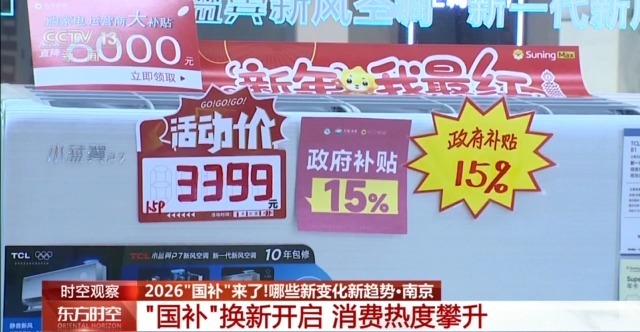
Core Viewpoint - The National Development and Reform Commission and the Ministry of Finance have issued a notice regarding the implementation of a large-scale equipment update and consumer goods replacement policy in 2026, clarifying and optimizing the support scope, subsidy standards, and implementation mechanisms for the "two new" policies [1] Group 1: Policy Overview - The new round of "national subsidies" officially begins on January 1, 2026, with significant changes and trends in the subsidy policy [1] - The policy covers four major areas, including six categories of home appliances and four categories of digital and smart products, with a subsidy of 15% of the transaction price for eligible purchases [5][10][12] Group 2: Subsidy Details - For home appliances, consumers can receive a subsidy of up to 1,500 yuan for each eligible item purchased, limited to one item per category [12] - In the digital and smart products category, consumers can receive a subsidy of up to 500 yuan for each eligible item, also limited to one item per category [10] - The automotive sector continues to support vehicle scrapping and replacement, with subsidies of up to 20,000 yuan for new energy vehicles and 15,000 yuan for fuel vehicles under specific conditions [14] Group 3: New Trends - The new subsidy policy emphasizes improving people's livelihoods and supporting urban development, with a focus on precision in policy implementation [19] - The inclusion of smart glasses in the subsidy scope reflects the growing importance of digital consumption as a new growth point [19] Group 4: Implementation Mechanisms - The new policy enhances standard guidance, increasing support for high-efficiency products while emphasizing the importance of standards for policy effectiveness [22][24] - The implementation mechanism includes optimizing fund allocation and improving the overall implementation process to enhance policy precision and effectiveness [24][26] - The policy also combines uniformity and specificity, allowing local authorities to set specific subsidy standards for smart home products based on local conditions [26]

“国补”继续!买家电、手机等,2026年补贴标准来了
Xin Lang Cai Jing· 2026-01-03 20:20
Core Viewpoint - The National Development and Reform Commission and the Ministry of Finance have released a notice regarding the implementation of large-scale equipment updates and consumer goods replacement policies in 2026, optimizing support scope, subsidy standards, and implementation mechanisms [1] Group 1: Optimization of Support Scope - The support scope for equipment updates will generally continue from 2025, focusing on key consumer goods with strong coverage and driving effects for the consumer goods replacement policy [2] - The policy will enhance support for the installation of elevators in old residential areas, equipment updates in elderly care institutions, and updates for fire rescue and inspection equipment [3] Group 2: Optimization of Subsidy Standards - The subsidy for updating old residential elevators will shift from a fixed amount to a tiered subsidy based on the number of elevator floors [2] - The subsidy for scrapping and updating old operational trucks will prioritize the replacement with electric trucks [3] - The subsidy for household appliances will focus on products with a 1st-level energy efficiency or water efficiency rating, providing 15% of the product price with a maximum subsidy of 1,500 yuan per item [3] Group 3: Optimization of Implementation Mechanism - The project application mechanism and review process for equipment updates will be optimized to lower the investment threshold for applications, increasing support for small and medium-sized enterprises [2] - The notice emphasizes the need for strict enforcement against fraudulent subsidy claims and illegal practices [4] - Local governments are required to organize and implement the policies effectively, enhancing the efficacy of the "Two New" policies [5]
2026年四川消费品以旧换新补贴政策公布
Xin Lang Cai Jing· 2026-01-03 19:18
Core Viewpoint - The Sichuan Provincial Department of Commerce announced new subsidy policies for the replacement of old vehicles and the purchase of new household appliances, digital, and smart products starting January 1, 2026, aimed at boosting consumer spending and promoting energy-efficient products [1]. Automotive Trade-In Subsidies - The automotive trade-in subsidy allows individuals to receive a one-time subsidy for scrapping eligible vehicles registered before specific dates, with a maximum subsidy of 20,000 yuan for new energy vehicles and 15,000 yuan for fuel vehicles with an engine size of 2.0 liters or less [2][3]. - Consumers can apply for the subsidy through designated online platforms, and each individual can only claim either the scrapping or trade-in subsidy once [3]. Household Appliances and Digital Products Subsidies - The subsidy for household appliances and digital products will also start on January 1, 2026, with a 15% subsidy on the sales price for energy-efficient appliances, capped at 1,500 yuan per item, and similar terms for digital products with a cap of 500 yuan [4]. - The subsidy applies to personal consumers, including foreign nationals and residents from Hong Kong, Macau, and Taiwan, with specific conditions regarding the shipping address [4]. Subsidy Distribution Method - The subsidies will be distributed using a "subsidy deduction" model, with "Cloud Flash Payment" serving as the coupon service platform, allowing consumers to claim subsidies daily from 9:00 AM to 11:00 PM [5].
视频丨新一轮“国补”政策落地 各地消费市场热度攀升
Yang Shi Xin Wen Ke Hu Duan· 2026-01-03 12:27
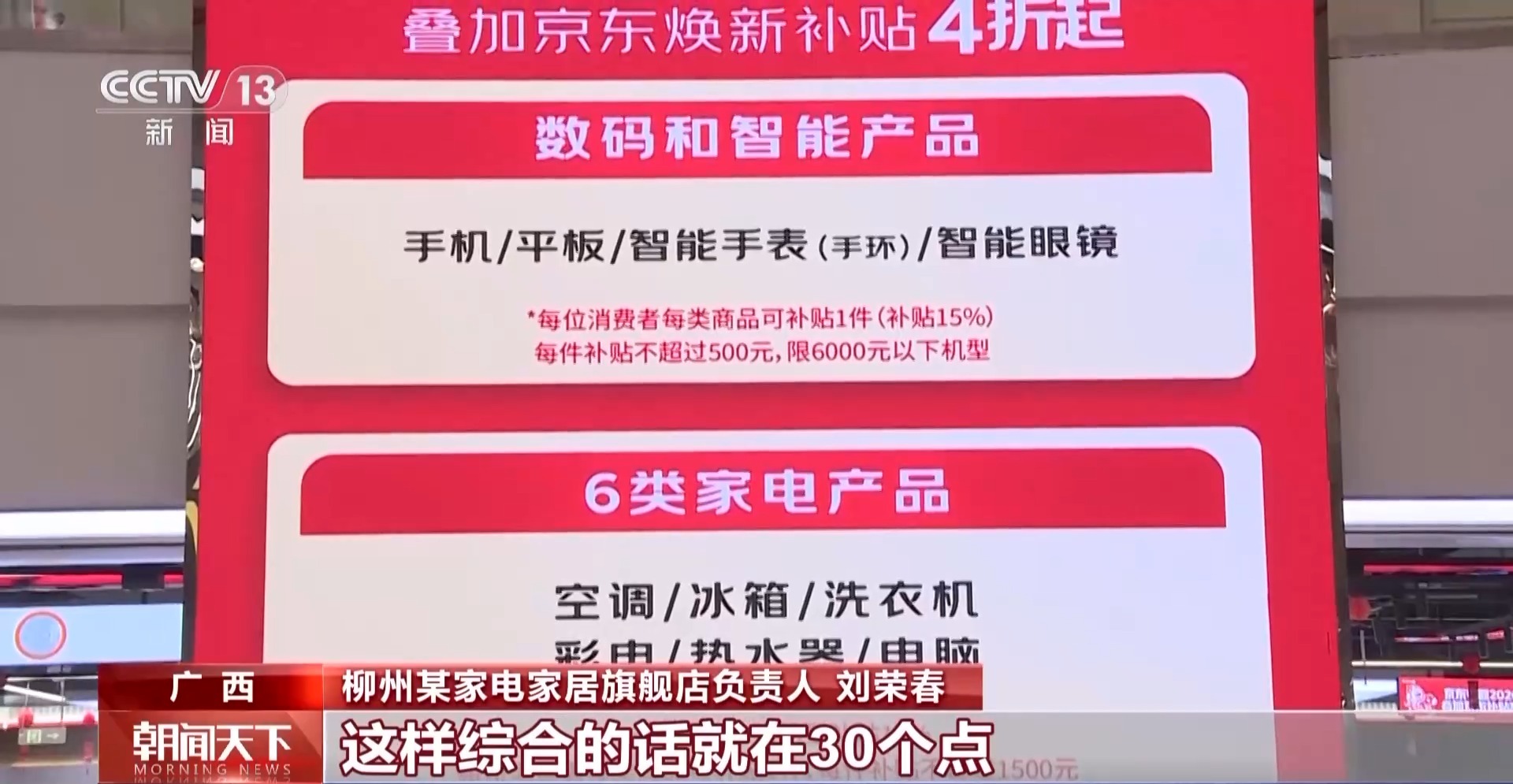
Core Insights - A new round of national subsidies ("Guo Bu") has officially begun, with the first batch of 62.5 billion yuan allocated for 2026, continuing the "trade-in" program for consumer goods and increasing support for equipment upgrades [1] Group 1: National Subsidy Program - The subsidy program covers four major areas: vehicle scrapping and replacement, six categories of home appliances, and four categories of digital and smart products [4] - Consumers purchasing energy-efficient appliances and certain digital products can receive a 15% subsidy on the transaction price, with limits on the number of items and maximum subsidy amounts [4] - For home appliances, the maximum subsidy is 1,500 yuan per item, while for digital and smart products, it is capped at 500 yuan [4] Group 2: Regional Implementation and Consumer Response - In Guangxi, cities like Liuzhou and Guigang have initiated the trade-in subsidy program, leading to increased consumer activity and engagement with the policy [2] - In Sichuan, the new subsidy policy has sparked a surge in consumer interest, particularly during the New Year holiday, with many consumers upgrading their home appliances [7][9] - The Sichuan provincial government has adopted a "subsidy deduction" model, which has been well-received by consumers, leading to a noticeable increase in sales of energy-efficient products [9] Group 3: Market Trends and Consumer Preferences - The new subsidy policy emphasizes the purchase of first-level energy-efficient appliances, effectively phasing out subsidies for lower efficiency products [9] - Retailers report a significant shift in consumer preferences towards high-efficiency products, with a notable increase in sales of first-level energy-efficient air conditioners and refrigerators [11]
新一轮“国补”政策落地 各地消费市场热度攀升
Yang Shi Wang· 2026-01-03 02:34
Group 1 - The core viewpoint of the articles highlights the launch of national subsidy programs in Guangxi and Sichuan, aimed at stimulating consumer spending through "trade-in" initiatives for various products [1][2] - In Guangxi, the subsidy program covers four major areas, including the replacement of old cars, six categories of home appliances, and four types of digital and smart products, offering a 15% subsidy on the purchase price for eligible items [1] - The subsidy for home appliances is capped at 1,500 yuan per item, while for digital and smart products, it is limited to 500 yuan, with each consumer allowed to claim one subsidy per category [1] Group 2 - In Sichuan, the new subsidy policy has been implemented, which also provides a 15% subsidy for six categories of home appliances and four types of digital and smart products, utilizing a "subsidy deduction" model [2] - The policy has led to increased consumer enthusiasm, particularly during the New Year holiday, with many consumers taking advantage of the subsidies to upgrade their home appliances [2] - The new policy emphasizes energy efficiency by focusing on first-level energy efficiency or water efficiency products, effectively phasing out subsidies for lower efficiency appliances, which has resulted in a noticeable preference for high-efficiency products among consumers [2]
2025年以旧换新相关商品 销售额超2.6万亿元
Xin Lang Cai Jing· 2026-01-02 23:43
Core Insights - The sales of products related to the "trade-in for new" policy are expected to exceed 2.6 trillion yuan by 2025, benefiting over 360 million people [1][2] Group 1: Sales Projections - By 2025, the trade-in for new policy is projected to result in the following sales: over 11.5 million cars, 129 million home appliances, 9.1 million digital products, 120 million home renovation items, and 1.25 million electric bicycles [1] - The retail sales of consumer goods from January to November increased by 4.0% year-on-year, with the trade-in policy contributing over 1 percentage point to this growth [1] Group 2: Industry Upgrades - In the automotive sector, nearly 60% of trade-ins involve new energy vehicles, leading to a retail market share for new energy passenger cars exceeding 50% for nine consecutive months, reaching 59.4% in November [1] - In the home appliance sector, over 90% of traded-in products are first-class energy efficiency (water efficiency) products [1] - Sales of communication equipment have shown continuous growth for 11 months [1] Group 3: Economic and Environmental Impact - By 2025, the volume of scrapped cars is expected to increase by 24.5%, resulting in the recycling of approximately 9.6 million tons of steel and 1.3 million tons of non-ferrous metals, thereby reducing carbon emissions by about 24.5 million tons [1] - Since the full implementation of the policy in September 2024, over 480 million direct subsidies have been issued to consumers, facilitating the entry of numerous green, low-carbon, and smart products into daily life [2] - For every two new household cars sold, one will benefit from the trade-in subsidy, and the number of old electric bicycles being replaced has exceeded nine times that of 2024 [2]
从消费提质到投资优化:2026年扩大内需路径明晰
Xin Lang Cai Jing· 2026-01-02 18:29
Core Insights - The Chinese government emphasizes the importance of domestic demand as a key driver for economic growth, with a focus on boosting consumption and expanding domestic markets as primary tasks for 2026 [3][4]. Group 1: Domestic Demand and Consumption - The contribution of domestic demand to economic growth reached 71% in the first three quarters of 2025, highlighting its role as a stabilizing force [3]. - A series of policies aimed at stimulating consumption, particularly through "trade-in" programs, have led to significant sales increases, with over 2.5 trillion yuan in sales generated from these initiatives from January to November 2025 [4]. - Service consumption has seen a notable increase, with per capita spending on services rising to 46.8% in the first three quarters of 2025, indicating a shift towards sectors like tourism and elderly care [5]. Group 2: Investment Trends - Fixed asset investment (excluding rural households) decreased by 2.6% year-on-year in the first 11 months of 2025, but investment in key sectors remains robust, with project investment growing by 0.8% when excluding real estate [7]. - The government plans to stabilize investment by increasing central budget investments and optimizing the use of local government bonds, focusing on urban renewal and public infrastructure [8]. - Investment policies in 2026 are expected to target four main areas: "two重" project construction, new productivity sectors, urban renewal, and enhancing the environment for private investment [8].
买家电、手机等,2026年“国补”标准来了
Xin Lang Cai Jing· 2026-01-02 16:23
Core Viewpoint - The Ministry of Commerce and other departments have announced a subsidy program for the replacement of old home appliances and the purchase of new digital and smart products starting January 1, 2026, aimed at promoting energy efficiency and consumer spending [2] Group 1: Subsidy Program Details - The subsidy will apply to six categories of home appliances: refrigerators, washing machines, televisions, air conditioners, water heaters, and computers, as well as four categories of digital and smart products: mobile phones, tablets, smartwatches (bands), and smart glasses [2] - The subsidy standard is set at 15% of the final sales price after discounts for the specified products, with a cap of 1,500 yuan for home appliances and 500 yuan for digital and smart products per item [2] - Each individual consumer is eligible for one subsidy per category of product, with a maximum subsidy amount for home appliances not exceeding 1,500 yuan and for digital and smart products not exceeding 500 yuan [2]