
有色金属采选

Search documents
矿业ETF(561330)午后涨超1.2%,稀土景气度有望持续回升
Mei Ri Jing Ji Xin Wen· 2025-08-07 06:49
Group 1 - The mining ETF (561330) rose over 1.2% in the afternoon, indicating a potential sustained recovery in the rare earth sector [1] - The mining ETF tracks the non-ferrous metal index (931892), which is compiled by China Securities Index Co., Ltd., reflecting the overall performance of listed companies in the non-ferrous metal industry in China [1] - The index exhibits strong cyclical characteristics, with industry allocation primarily concentrated in sub-sectors such as base metals and precious metals [1] Group 2 - Investors without stock accounts can consider the Guotai CSI Non-Ferrous Metal Mining Theme ETF Initiated Link C (018168) and Link A (018167) [1]
国城矿业:8月5日召开董事会会议
Mei Ri Jing Ji Xin Wen· 2025-08-05 10:45
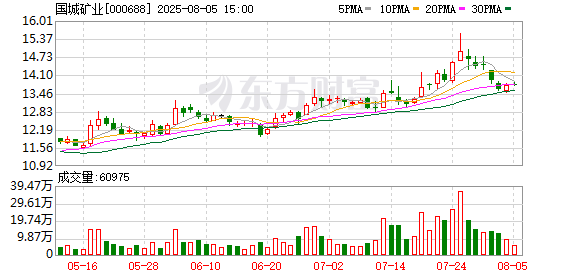
Group 1 - The company Guocheng Mining (SZ 000688) announced a board meeting on August 5, 2025, to discuss a proposal regarding capital increase in an associated company and related transactions [2] - For the year 2024, Guocheng Mining's revenue composition is as follows: non-ferrous metal mining and selection accounted for 72.46%, chemical manufacturing accounted for 26.57%, and trade and others accounted for 0.96% [2]


今日国内有色金属市场最新价格!有色金属普跌,锰硅领跌4.95%
Sou Hu Cai Jing· 2025-08-03 14:14
Core Viewpoint - The recent plunge in the domestic non-ferrous metal market reflects deep-seated challenges faced by the industry, driven by multiple long-term factors [1] Group 1: Small Metals Sector - The small metals sector, particularly manganese silicon, experienced a significant drop, with futures contracts plummeting 4.95%, a daily decline of 308 yuan, reaching a new low of 5910 yuan/ton [3] - Tungsten and cobalt indices also fell by 3.55% and 2.51% respectively, indicating accelerated capital outflow from the small metals sector [3] - The previous rise in manganese silicon prices by 15% due to steel production cuts was reversed due to lower-than-expected actual demand, leading to concentrated profit-taking and subsequent market collapse [3] Group 2: Industrial Metals Sector - The industrial metals sector saw widespread declines, with copper futures breaking the psychological barrier of 78,000 yuan/ton, closing at 78,110 yuan/ton, down 960 yuan or 1.21% [5] - Aluminum prices fell to 20,525 yuan/ton, a decrease of 0.46%, while zinc and nickel also experienced significant drops [5] - The overall performance of the industrial metals sector has been notably weaker than the industrial product index, with supply-demand imbalances particularly pronounced in the aluminum market [5] Group 3: Precious Metals Sector - The precious metals sector was not spared, with silver prices dropping significantly more than gold, with silver futures falling 2.04% compared to a 0.36% decline in gold [5] - The disparity in price movements between gold and silver highlights increasing internal differentiation within the precious metals market [5] Group 4: Market Sentiment and External Pressures - The market sentiment is low due to multiple pressures, including a 50% tariff on imported copper products from the U.S., weak downstream demand, and accelerated capital withdrawal, with a net outflow of 19.6 billion yuan in a single day [6] - Although domestic copper inventories decreased by 13.17%, this was primarily due to reduced imports rather than a recovery in consumption [6] - The manufacturing PMI slightly rebounded to 49.7 but remains below the expansion threshold, indicating ongoing challenges in traditional industries [6] Group 5: Structural Issues and External Shocks - The non-ferrous metal export value increased by 29.1% in the first half of the year, mainly driven by gold, while the trade volume between China and the U.S. fell by 11% due to trade frictions [7] - Profits in the mining sector grew by 41.7%, while processing sector profits declined by 0.4%, indicating a concentration of profits in upstream resources [7] - The government's stringent carbon reduction targets for the electrolytic aluminum industry further squeeze profit margins, particularly for small smelting enterprises [7] - Short-term demand expectations are negatively impacted by the decline in photovoltaic installations and reduced subsidies for home appliance replacements, despite long-term demand prospects in the new energy sector [7]
A股早评:创业板指高开0.65% CPO概念盘初活跃
Ge Long Hui A P P· 2025-07-31 01:37
Market Overview - The A-share market opened with the Shanghai Composite Index down by 0.3%, while the Shenzhen Component Index increased by 0.05%, and the ChiNext Index rose by 0.65% [1] Sector Performance - The CPO (Consumer Packaged Goods) concept saw a strong opening, with companies like Dongshan Precision, Zhongji Xuchuang, and Shengyi Electronics rising over 5% [1] - The assisted reproductive technology sector was active, with Lide Man and Hanshang Group hitting the daily limit, as all 31 provinces in China included assisted reproductive technology in medical insurance [1] - The non-ferrous metals sector experienced a broad decline, with Hunan Silver and Northern Copper falling over 3% [1] - The military equipment sector opened lower, with Guorui Technology dropping over 8% and Construction Industry falling nearly 6% [1]

华锡有色: 广西华锡有色金属股份有限公司关于间接控股股东股权结构拟发生变动的提示性公告
Zheng Quan Zhi Xing· 2025-07-28 16:14
证券代码:600301 股票简称:华锡有色 编号:2025-046 本公司董事会及全体董事保证本公告内容不存在任何虚假记载、误导性陈 述或者重大遗漏,并对其内容的真实性、准确性和完整性承担法律责任。 重要内容提示: ? 广西华锡有色金属股份有限公司(以下简称"公司")实际控制人广西壮 族自治区国有资产监督管理委员会(以下简称"广西国资委")拟将其所持有的 公司间接控股股东广西北部湾国际港务集团有限公司(以下简称"北部湾港集团") 集团")。 ? 本次股权结构变动完成后,公司控股股东仍为广西华锡集团股份有限公 司(以下简称"华锡集团"),间接控股股东仍为北部湾港集团,实际控制人仍为 广西国资委,公司的控股股东、间接控股股东及实际控制人均未发生变化。 近日,公司接到间接控股股东北部湾港集团通知,获悉其股权结构拟发生变 动。现将相关情况公告如下: 一、公司间接控股股东股权结构变动基本情况 根据广西国资委通知要求,以 2024 年 12 月 31 日为基准日,其将所持有的 北部湾港集团 33%股权无偿划转至广西国控集团。 本次变动完成后,广西国资委仍为公司实际控制人,北部湾港集团仍为公司 间接控股股东,华锡集团仍为公 ...

矿业ETF(561330)、有色60ETF(159881)均涨超1.5%,稀土景气度有望持续回升
Mei Ri Jing Ji Xin Wen· 2025-07-22 04:17
Group 1 - China has implemented export controls on key minerals such as gallium, germanium, antimony, tungsten, and rare earths in response to U.S. restrictions on high-tech exports to China, significantly impacting U.S.-China trade policies [1] - The export control on rare earths is particularly influential, as it has become a critical negotiation point in U.S.-China trade talks, leading to the U.S. lifting some export restrictions on products like H20 and AMD after China eased rare earth export controls [1] - If China continues to strengthen its rare earth controls, overseas rare earth prices, especially for medium and heavy rare earths, are likely to remain high, while domestic rare earth prices are expected to rise, indicating a positive outlook for the rare earth industry [1] Group 2 - The Mining ETF (561330) tracks the non-ferrous metal index (931892), which reflects the overall performance of listed companies in China's non-ferrous metal industry, focusing on sectors such as mining, smelting, and processing [1] - The Non-ferrous Metal 60 ETF (159881) tracks the China Non-ferrous Metal Index (930708), providing investors with a tool to measure the development status of the non-ferrous metal industry, characterized by its cyclical nature [2] - Investors without stock accounts can consider various linked ETFs related to non-ferrous metals, which offer exposure to the industry while reflecting its cyclical characteristics [2]
7300亿南下资金重构港股生态:2025上半年高股息与硬科技双主线深度解析
智通财经网· 2025-07-15 13:18
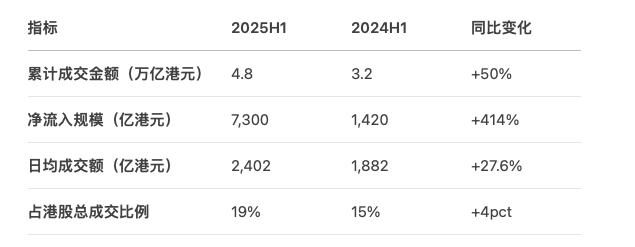
Core Insights - The Hong Kong stock market experienced a significant rebound in the first half of 2025, with the Hang Seng Index rising by 20%, leading among major global indices [1] - The primary driver of this rebound was the substantial inflow of mainland funds through the "Hong Kong Stock Connect" channel, coupled with a global reassessment of the value of "cheap Chinese assets" [1] - The net inflow of southbound funds reached over 730 billion HKD, marking a 414% increase year-on-year and setting a historical record for the same period [3][5] Market Dynamics - The total trading volume through the Hong Kong Stock Connect reached 4.8 trillion HKD, a 50% increase compared to the previous year, accounting for 19% of the total trading volume in the Hong Kong market [2][3] - Southbound funds have significantly reshaped the investor structure in the Hong Kong market, with their proportion of total trading volume rising from less than 10% in 2020 to nearly 20% [4] - The inflow of southbound funds has enhanced the correlation between the Hong Kong and A-share markets, while also increasing the independence of the Hong Kong market from global trends [4] Sector Preferences - The southbound funds showed a clear preference for high-dividend and innovative pharmaceutical sectors, with energy, telecommunications, and banking being the top three sectors for net buying [6][7] - The energy sector attracted a net buying of 620 million HKD, while telecommunications and banking received 410 million HKD and 380 million HKD, respectively [6][7] - The innovative pharmaceutical index saw significant gains, with some stocks experiencing over 60% increases, reflecting a strong recovery after a prolonged downturn [6][8] Investment Trends - The current market environment is characterized by a "barbell strategy," where investors are seeking both stable cash flow from high-dividend assets and growth potential from innovative sectors [10][16] - The anticipated interest rate cuts by the Federal Reserve are expected to further highlight the defensive value of high-dividend sectors, while the commercialization capabilities of innovative pharmaceutical companies will be crucial for growth stocks [16] - The semiconductor, innovative pharmaceuticals, and energy security sectors are expected to benefit from policy support and sustained inflows from mainland funds [17] Notable Stocks - The top-performing stocks in the Hong Kong Stock Connect included Lao Pu Gold, which saw a staggering increase of 330.18%, followed by Sangfor Technologies and Rongchang Biopharmaceuticals with increases of 288.98% and 278.12%, respectively [11][12] - The presence of diverse sectors among the top gainers indicates a broad market interest, with biotechnology leading the way [11][12] - Stocks like Rongchang Biopharmaceuticals have gained significant institutional recognition, with over 50% of holdings through the Hong Kong Stock Connect [13]
LME铜与沪铜的回调或存机会,有色60ETF(159881)当日涨超1%
Mei Ri Jing Ji Xin Wen· 2025-07-10 07:38
Group 1 - The core point of the article is the announcement by Trump on August 8 to impose a 50% tariff on copper, which has led to a significant widening of the price difference between COMEX copper and LME copper, reaching a premium of approximately 25% [1] - The widening price difference is attributed to the U.S. having stockpiled a large amount of copper inventory through "import grabbing," which may lead to a substantial reduction in copper imports in the future [1] - The article suggests that the disconnect between the U.S. market and the global market diminishes the attractiveness of this price difference, but a potential opportunity may arise from the correction between LME copper and Shanghai copper due to long-term supply-demand mismatches [1] Group 2 - The article highlights that the non-ferrous 60 ETF tracks the Zhongzheng Non-Ferrous Index, which is compiled by Zhongzheng Index Co., and reflects the overall performance of listed companies in the non-ferrous metal industry [1] - The index includes stocks from various sub-sectors such as precious metals and rare metals, exhibiting strong cyclical and commodity characteristics [1] - Investors without stock accounts are advised to consider the Guotai Zhongzheng Non-Ferrous Metal ETF Initiated Link A (013218) and Guotai Zhongzheng Non-Ferrous Metal ETF Initiated Link C (013219) [1]
中金岭南: 深圳市中金岭南有色金属股份有限公司2025年度跟踪评级报告
Zheng Quan Zhi Xing· 2025-06-13 08:32
Core Viewpoint - Shenzhen Zhongjin Lingnan Nonfemet Company maintains a stable credit rating of AA+ based on its strong resource reserves, operational advantages, and improved debt repayment indicators, despite facing challenges from fluctuating metal prices and rising inventory costs [2][4][9]. Financial Overview - Total assets increased from 326.57 billion in 2022 to 484.78 billion in 2025 [7]. - Owner's equity rose from 152.95 billion in 2022 to 178.73 billion in 2025 [7]. - Total liabilities increased from 173.62 billion in 2022 to 306.06 billion in 2025 [7]. - Total revenue decreased from 656.47 billion in 2023 to 598.62 billion in 2024, with a net profit of 13.21 billion in 2024 [7][31]. - The operating cash flow showed a decline, with a net cash flow of -2.82 billion in the first quarter of 2025 [7]. Industry Context - The nonferrous metal industry is cyclical and closely tied to global economic conditions, with significant price volatility impacting profitability [11]. - The lead and zinc market is expected to face supply pressures in 2025, with potential price declines due to increased production and changing consumption patterns [12][13]. - Copper prices are projected to rise in 2025, supported by domestic demand, although processing fees are under pressure [15][31]. Company Strengths - The company has rich lead and zinc resource reserves and a complete industrial chain, with significant scale and technical advantages in smelting operations [9][11]. - The company benefits from strong external support from its state-owned parent company, enhancing its operational stability [11][16]. - The company is actively expanding its new materials segment, which is expected to contribute to future growth [19][31]. Risks and Challenges - The company faces challenges from declining processing fees and rising inventory costs, which could pressure profit margins [4][9][26]. - The ongoing construction of new projects may require significant capital expenditures, impacting liquidity [30][31]. - The company must navigate the uncertainties in global economic conditions and commodity prices, which could affect its financial performance [11][12].

有色金属-海外季报:嘉能可2025Q1公司自有铜产量同比减少30%至16.79万吨,自有金产量同比减少28%至4.51吨
HUAXI Securities· 2025-06-11 07:48
Investment Rating - Industry rating: Recommended [5] Core Insights - In Q1 2025, the company's own copper production decreased by 30% year-on-year to 167,900 tons, and by 32% quarter-on-quarter, primarily due to lower ore extraction rates and overall recovery rates at Collahuasi, Antapaccay, and KCC [1][2] - The company's own cobalt production increased by 44% year-on-year to 9,500 tons, reflecting improved grades and output at Mutanda, despite a 19% quarter-on-quarter decrease [1][2] - Zinc production in Q1 2025 was 213,600 tons, a 4% year-on-year increase, but a decrease of 18% quarter-on-quarter, driven by higher grades at Antamina and increased output from Australia [1][2] Production Summary - Q1 2025 production figures include: - Lead: 49,900 tons, a 14% year-on-year increase [2] - Nickel: 18,800 tons, a 21% year-on-year decrease [2] - Gold: 145,000 ounces (4.51 tons), a 28% year-on-year decrease [2] - Silver: 4,230,000 ounces (131.57 tons), a 6% year-on-year decrease [2] - Ferrochrome: 277,000 tons, a 7% year-on-year decrease [2] - Steelmaking coal: 8.3 million tons, a 493% year-on-year increase [2] - Energy coal: 23.4 million tons, a 7% year-on-year decrease [2] - Oil entitlement interest: 883,000 barrels of oil equivalent, a 23% year-on-year decrease [2] 2025 Guidance - The company expects 2025 production to be: - Copper: 850,000 to 910,000 tons [3] - Cobalt: 40,000 to 45,000 tons [3] - Zinc: 930,000 to 990,000 tons [3] - Nickel: 74,000 to 86,000 tons [3] - Steelmaking coal: 30 million to 35 million tons [3] - Energy coal: 87 million to 95 million tons [3]
