
消费

Search documents
大类资产配置月报第54期:2026年1月:下一任美联储主席即将敲定,宽松预期下降-20260106
Huaan Securities· 2026-01-06 07:10
Group 1: Federal Reserve and Interest Rate Expectations - The next Federal Reserve chair is expected to lower interest rate cut expectations, impacting market sentiment positively[2] - The market anticipates a pause in rate cuts during the January FOMC meeting, with a focus on maintaining the current target rate[11] - The 1-year Treasury yield decreased from 1.402% to 1.337%, a drop of 6 basis points, indicating a shift in short-term interest rate expectations[2] Group 2: Domestic Market Trends - The Shanghai Composite Index rose from 3888.6 to 3968.84, a 2.06% increase, driven by improved macro policies and a significant rise in the construction PMI[2] - The growth style index increased from 8331.69 to 8741.04, reflecting a 4.91% rise, supported by favorable liquidity conditions[2] - The construction PMI improved significantly, indicating a potential stabilization in investment and economic recovery[17] Group 3: Commodity and Currency Insights - Brent crude oil prices fell from $58.55 to $57.42 per barrel, a decrease of 1.93%, suggesting a bearish outlook on oil due to supply dynamics[2] - The US dollar index decreased from 99.44 to 98.27, a drop of 1.18%, reflecting a slight weakening of the dollar amid lower rate cut expectations[2] - The COMEX copper price increased from $5.19 to $5.649 per pound, an 8.84% rise, indicating strong demand amid supply constraints[2]
沪指重回4000点!春季行情继续?券商分析师最新发声
券商中国· 2026-01-05 15:08
Core Viewpoint - The A-share market experienced a strong start in 2026, with over 4,100 stocks rising and the Shanghai Composite Index surpassing 4,000 points for the first time in 34 trading days, driven by fundamental improvements, policy benefits, and liquidity recovery [1][2]. Market Performance - On January 5, the A-share market opened high and closed higher, with a total trading volume of 2.57 trillion yuan, an increase of over 500 billion yuan compared to the previous trading day, marking a recent high [2]. - The brain-computer interface, insurance, healthcare, memory storage, and technology sectors led the gains, influenced by Elon Musk's announcement regarding large-scale production of brain-computer interface devices in 2026 [2]. Economic Indicators - The manufacturing PMI returned to the expansion zone in 2025, providing a solid foundation for economic stability and improvement [2]. - The "14th Five-Year Plan" policy expectations, combined with the Federal Reserve's interest rate cuts and a strong yuan, have created a favorable liquidity environment [2]. Investor Sentiment - The strong performance on the first trading day reflects a restoration of investor confidence [3]. - Analysts believe that the spring market rally has begun, with the potential for widespread profit-making effects due to improved fundamentals and liquidity [2]. Future Market Outlook - Analysts predict that the spring market will continue to deepen, supported by multiple favorable factors such as yuan appreciation, concentrated benefits in the technology sector, and positive macroeconomic expectations [4]. - The market is expected to maintain a healthy upward trend, transitioning from "valuation repair" to "earnings realization" [4]. Sector Focus - Emerging fields such as commercial aerospace, brain-computer interfaces, and AI hardware are anticipated to become new focal points for investment, driving activity in the broader technology sector [5]. - The recovery of domestic demand, alongside stabilization in the real estate market, is expected to enhance consumer confidence and lead to a revaluation of consumption and cyclical industries [5]. Capital Inflow - The economic recovery and yuan appreciation are likely to accelerate the conversion of household savings into capital market investments, providing substantial incremental capital for insurance, bank wealth management, and public funds [5]. - Unlike previous market trends dominated by retail investors, the capital structure in 2026 is expected to be more institutional and long-term oriented, supporting a healthier and more sustainable "slow bull" market [5]. Foreign Investment Perspective - Goldman Sachs has recommended maintaining a high allocation to Chinese stocks in 2026, projecting annual increases of 15%-20% in the Chinese stock market for 2026 and 2027, supported by earnings growth and valuation re-rating [5].


[1月5日]指数估值数据(A股大涨,迎来开门红;免费领好书福利)
银行螺丝钉· 2026-01-05 14:15
Core Viewpoint - The A-share and Hong Kong stock markets experienced significant gains at the beginning of 2026, indicating a positive market sentiment and potential investment opportunities [1][17]. Group 1: Market Performance - The A-share market overall rose, achieving a rating around 4.0 stars, with all market caps (large, medium, and small) showing upward movement [2][3]. - Growth style stocks saw a more substantial increase compared to value style stocks, which experienced slight gains [4]. - The Hong Kong stock market, including indices like the Hang Seng Index and Hang Seng Tech Index, also rose, returning to normal valuation levels [5][11]. Group 2: Valuation Trends - As the markets rose, the green rate of the valuation table gradually decreased, indicating a shift in market sentiment [6]. - The AH share premium index, which measures the price difference between A-shares and H-shares of the same companies, has fluctuated between 120-140 in recent years, suggesting that A-shares are typically priced higher due to various costs associated with H-shares [27][28]. Group 3: Future Outlook - The recovery in A-share company earnings is expected to continue, with a slight decline in 2024 followed by a recovery in 2025, which could positively impact both A-shares and Hong Kong stocks [40][41]. - The anticipated continuation of the US Federal Reserve's interest rate cuts and the recovery of A-share earnings could further support the upward trend in both markets [43]. Group 4: Investment Strategies - The article emphasizes a strategy of buying during market dips and selling during peaks, while maintaining patience during stable periods [45]. - The importance of continuous learning and reading in investment practices is highlighted, suggesting that knowledge can translate into better investment decisions [54].

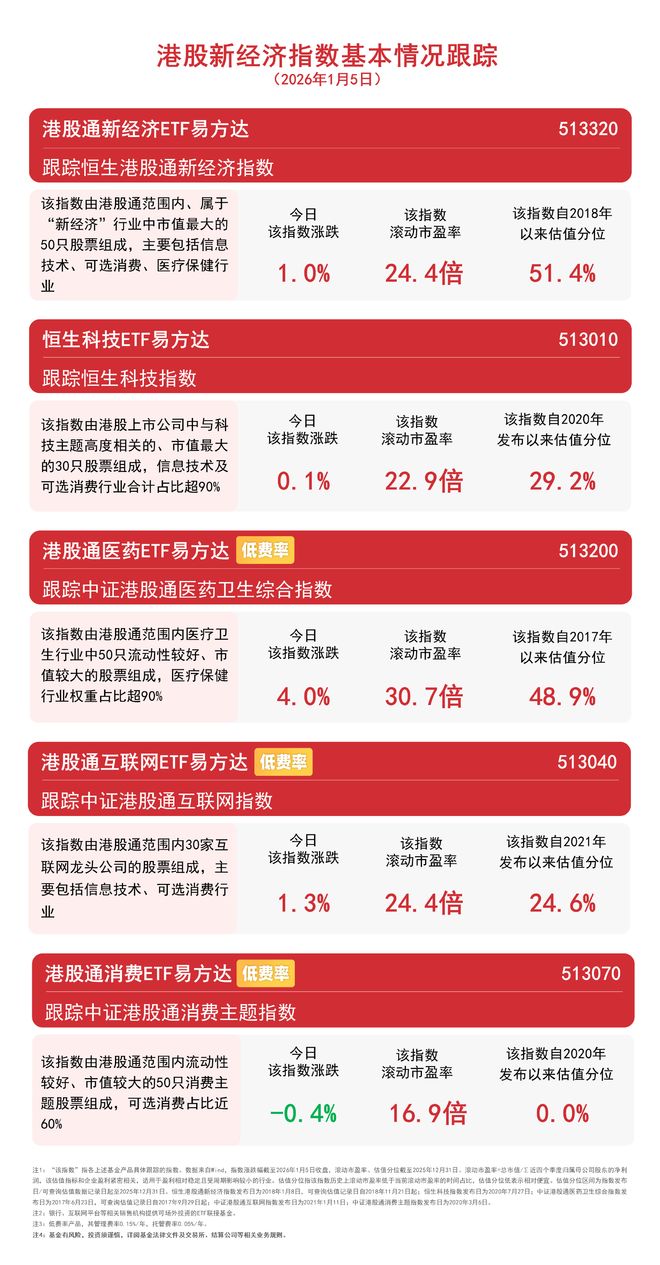
港股板块走势分化,医药、互联网股涨幅居前,港股通医药ETF易方达(513200)标的指数上涨4%
Mei Ri Jing Ji Xin Wen· 2026-01-05 11:35
Group 1 - The core viewpoint of the news is that the Hong Kong stock market showed a mixed performance, with significant gains in the pharmaceutical sector and active performance in large internet stocks, as evidenced by the rise in various indices [1] - The CSI Hong Kong Stock Connect Pharmaceutical and Health Comprehensive Index increased by 4.0%, while the CSI Hong Kong Stock Connect Internet Index rose by 1.3%, and the Hang Seng New Economy Index increased by 1.0% [1] - The market sentiment and liquidity environment are currently better than in November, leading to an increased probability of successful investments in Hong Kong stocks [1] Group 2 - Huatai Securities suggests continuing to allocate investments in technology chains with performance expectations, as the liquidity environment may catalyze significant growth in the next quarter [1] - The report emphasizes the need for balanced allocation in cash flow assets considering changes in driving factors and funding attributes [1]
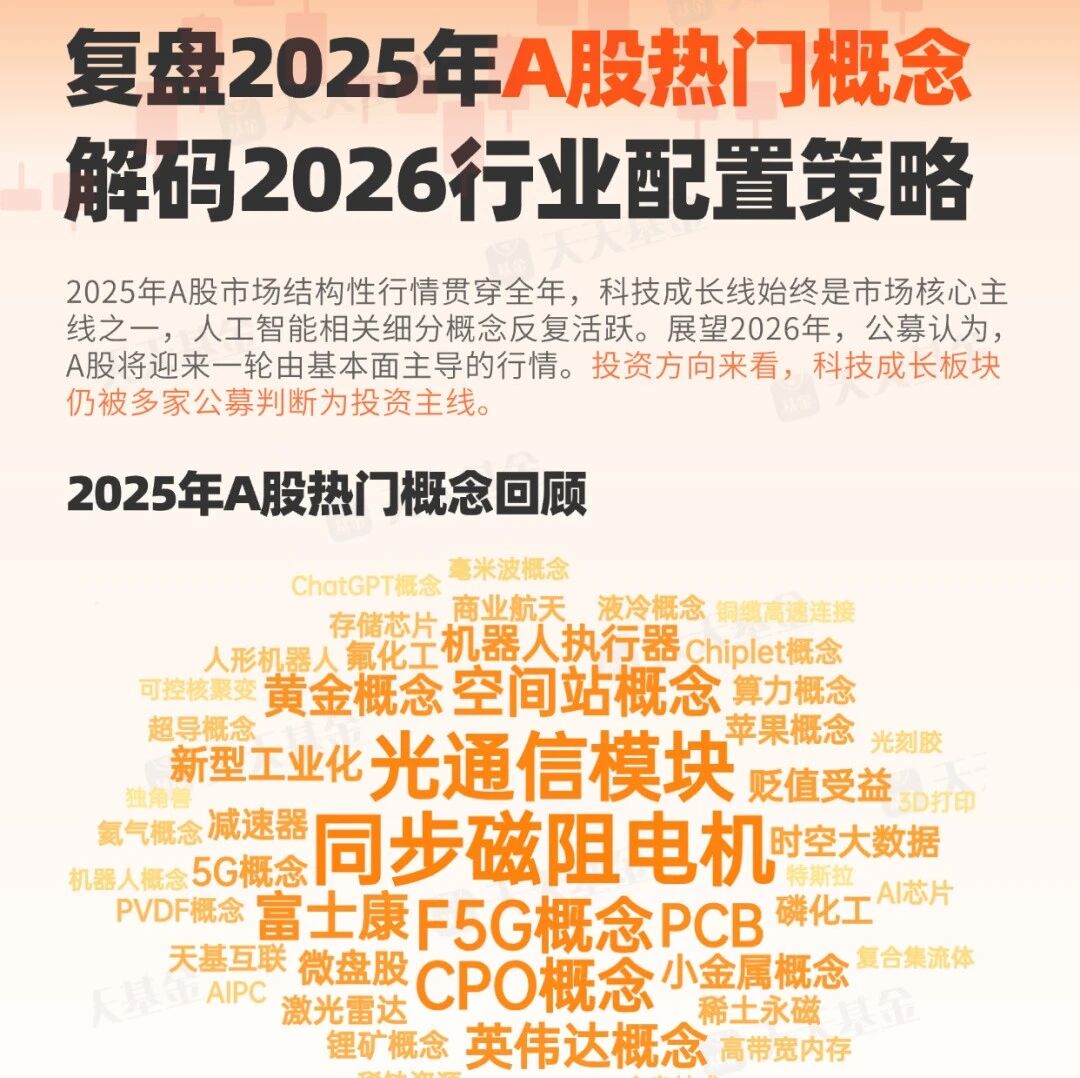
布局2026年 科技成长仍是主角?公募最新投资策略来了
天天基金网· 2026-01-05 08:41
Core Viewpoint - The A-share market in 2025 experienced a structural trend with technology growth as a core theme, particularly in artificial intelligence-related sectors. Looking ahead to 2026, public funds anticipate a market driven by fundamentals, with technology growth remaining a key investment focus [1][8]. Summary by Sections 2025 A-share Market Overview - The A-share market in 2025 was characterized by a clear rotation of concept sectors, with major themes alternating and a rapid iteration of hotspots. Over 90% of concept indices saw an increase, with the synchronous reluctance motor achieving the highest growth at 165.05%, followed by optical communication modules at 156.02% [11]. 2026 Investment Outlook - Public funds predict a fundamental-driven market in 2026, with technology growth sectors still viewed as the main investment line. HSBC Jintrust Fund suggests a potential market rebalancing, shifting from TMT to lower-positioned industries with profit recovery potential. Investors focusing on safety margins should consider midstream manufacturing, consumption, and cyclical sectors [9][11]. Sector-Specific Insights - CITIC Prudential Fund indicates that a solid growth style may persist throughout the year, but broad market rallies may end. Companies with genuine technological barriers and commercialization capabilities in AI applications, domestic substitution, and overseas expansion are expected to attract market attention due to their high growth potential [12]. - Zhongjia Fund emphasizes that technology, particularly AI, remains a focus for aggressive sectors in 2026, combining short-term performance with long-term narratives. Other sectors of interest include event-driven stocks and stable, defensive attributes in Hong Kong dividends, finance, agriculture, and precious metals [12].
385只港股2025年涨幅超100% “红底股”显著增加
Cai Jing Wang· 2026-01-05 02:16
Group 1 - The Hong Kong stock market experienced a strong start in 2026, with 385 stocks rising over 100% in 2025, including 14 stocks that increased more than tenfold [1][2] - Notable high-performing stocks included Base Champion Group with a 41.64 times increase, Beihai Kangcheng with over 18 times increase, and Zhu Feng Gold benefiting from rising gold prices with over 12 times increase [1] - The number of "red bottom stocks," defined as stocks trading above 100 HKD, increased significantly from 22 at the beginning of 2025 to 45 by the end of the year, indicating a growing recognition of quality leading enterprises [2] Group 2 - The increase in "red bottom stocks" reflects a shift in market sentiment towards high market capitalization and high liquidity assets, with major companies like Tencent, Ctrip, and NIO trading above 500 HKD [2] - The concentration of "red bottom stocks" in leading industries such as internet technology, finance, healthcare, and consumer sectors signifies a re-evaluation of their long-term value by the market [2] - Analysts from various institutions are optimistic about the Hong Kong stock market in 2026, particularly in the technology sector, driven by factors such as price increases in the supply chain and domestic replacements [3]

市场脱离低回报区域可布局四条主线
Zheng Quan Shi Bao· 2026-01-04 23:52
Group 1 - The core viewpoint is that the ROE of the non-financial real estate sector in A-shares is expected to rise from 7.2% to 7.9% by 2026, indicating a shift from a "low return" phase to a more favorable profitability trend [1] - The investment strategy suggests focusing on four main lines: industrial resource products, equipment exports, consumer recovery, and non-bank financials, with a particular emphasis on tracking the demand for aluminum, copper, steel, and coal driven by power system construction [1] - In overseas markets, the characteristics of "investment stronger than consumption," profit differentiation among large and small enterprises, declining employment, and slowing wage growth are observed, which provide a foundation for a sustained interest rate cut cycle [1] Group 2 - On the domestic consumption front, the drag of housing prices on household spending has diminished, and the recovery of trade settlement rates along with visa-free entry for foreign tourists has led to improved sales net profit margins in sectors such as aviation, hotels, duty-free, and food and beverage [2] - The financial landscape shows a shift of household savings towards "fixed income+" products, with pension and insurance funds continuously increasing their allocation to equities; policy adjustments to lower insurance risk factors and relax brokerage leverage are expected to resonate with the non-bank sector and the recovery of ROE [2]
投资策略专题:掘金1月春季躁动的机会
KAIYUAN SECURITIES· 2026-01-04 13:43
Group 1 - The report indicates that the "spring market excitement" has begun early, characterized by a clear "structural lead and opportunity rotation" feature, with technology remaining dominant [2][3][16] - The current market adjustment was primarily driven by three factors: overseas liquidity disturbances, concerns over AI bubble risks during the US earnings window, and relatively mild economic data, all of which are now diminishing [14][15][16] - The A-share market is entering a pre-heating and layout window for the "spring market excitement" of 2026, with structural opportunities emerging in sectors such as commercial aerospace, robotics, petrochemicals, and non-ferrous metals [3][16] Group 2 - The report highlights that the rise in non-ferrous metals is driven by multiple factors, including macroeconomic conditions, industry fundamentals, capital allocation, and geopolitical issues, rather than a single cause [4][29] - The report notes that the current Chinese consumer market shows a clear characteristic of "total pressure but structural recovery," with structural highlights in both traditional and emerging consumption sectors [5][31][32] - The investment strategy suggests a dual focus on technology and cyclical sectors, emphasizing the importance of PPI improvements and the benefits of "anti-involution" policies in sectors like non-ferrous metals, photovoltaics, chemicals, steel, and machinery [6][34][35]
港股IPO放量的影响与高效打新策略
Sou Hu Cai Jing· 2026-01-04 02:06
Group 1 - The Hong Kong IPO market has significantly rebounded in 2025, with 99 companies listed as of December 12, raising over 250 billion HKD, accounting for 67% of the total fundraising for Chinese companies this year, marking a 10-year high [1][17][21] - The IPO success rate has increased to 73% with an apparent return rate of 34%, both significantly higher than previous years, although the average winning rate has dropped to 20%, the lowest in a decade [1][21] - The characteristics of the Hong Kong IPO market include a registration system with a low listing success rate of 37% since 2016, no market capitalization requirements for participation, and a higher first-day failure rate compared to A-shares, averaging 45% since 2016 [1][6][50] Group 2 - There is a weak positive correlation between the primary market financing and the secondary market performance, driven by common macroeconomic factors such as a weak US dollar and low Hibor rates [2][7][62] - Large IPOs do not significantly impact the overall secondary market but can boost specific sectors like consumer goods and technology [2][8] - A selection model for IPOs can enhance returns by evaluating market sentiment, company fundamentals, and issuance characteristics, with a scoring system that can increase returns by approximately 15 percentage points for selected stocks [2][9] Group 3 - The outlook for 2026 suggests continued activity in the Hong Kong IPO market, with 314 companies currently in the listing application process, estimating a central fundraising scale of around 330 billion HKD [3][24][28] - The historical data indicates that the performance of the secondary market in the previous year influences the IPO application decisions of companies [3][25] - The average fundraising scale in 2026 is expected to be over 20% higher than in 2025, reflecting a robust pipeline of IPOs [3][28]

定期报告:节后春季行情进行中聚焦成长
Huajin Securities· 2026-01-04 02:01
1. Report Industry Investment Rating No relevant content provided. 2. Core Viewpoints of the Report - This year after the New Year's Day, the A - share spring market is underway and may be volatile and bullish, affected by factors such as policy implementation, liquidity, and the performance of the Hong Kong stock market [1][4][7]. - After the holiday, technology growth and some cyclical industries may be relatively dominant, with continuous upward industrial trends and policy support [1][26]. - After the holiday, it is recommended to continue to allocate industries such as technology, some cyclical and consumer sectors on dips [1][38][46]. 3. Summary by Relevant Catalogs 3.1 Post - holiday Spring Market is Underway 3.1.1 Factors Affecting Post - holiday A - share Movement - Since 2010, in 11 out of 16 years, the Shanghai Composite Index showed the same upward or downward trend in the 10 trading days before and after the holiday. The post - holiday short - term market performance is affected by policies, external events, liquidity, and the performance of the Hong Kong stock market [1][4]. - Positive policies and external events may lead to a short - term rise in the post - holiday A - shares, while tight policies or negative external events may result in weak performance. Liquidity also plays a key role, and the performance of the Hong Kong stock market during the holiday has a certain impact on the post - holiday A - shares [4]. 3.1.2 This Year's A - share Spring Market is Underway and May be Volatile and Bullish - Positive policies may continue to be implemented after the holiday, and external risks may be limited. The "two new" policies are accelerating implementation, local two - sessions may be held intensively, and consumption - stimulating policies may be introduced. Externally, the Fed may cut interest rates in January, Sino - US relations may remain stable, and geopolitical conflicts may ease [7][8]. - Post - holiday short - term liquidity may be further relaxed. Overseas, the Fed is likely to cut interest rates, and the RMB exchange rate may be strong. Domestically, the central bank may cut interest rates and reserve requirements. Also, stock market funds may accelerate inflow [9]. - The Hong Kong stock market performed strongly during the New Year's Day holiday, which may boost the post - holiday A - shares. The correlation coefficient between the Hong Kong stock market's rise and fall during the New Year's Day holiday and the Shanghai Composite Index's rise and fall in the 10 trading days after the holiday is about 0.5 [18][19]. - The post - holiday economy and corporate profits are still in weak recovery. The economy is in a weak recovery state, and corporate profits may continue to recover, although the industrial enterprise profits in November continued to decline [21]. 3.2 Industry Allocation: Focus on Growth after the Holiday 3.2.1 Technology Growth and Some Cyclical Industries May be Relatively Dominant after New Year's Day - Historically, policy and industrial trends drive pre - holiday strong industries to maintain their strength after the holiday. Pre - holiday leading industries may switch due to high sentiment or market adjustments. Industries with continuous strength around the New Year's Day usually have a relatively low historical quantile of trading volume [26]. - This year, the industrial trends of technology growth and some cyclical industries may continue to rise after the holiday. The pre - holiday leading cyclical industries have neutral - low sentiment, while the technology growth industries have high sentiment [26]. 3.2.2 Currently, the PEG of Electric Power, Media, and Automobile is Low - Among the primary growth industries, the predicted PEG of electric power equipment, media, and automobile is relatively low, at 0.64, 0.86, and 1.13 respectively. The historical quantiles of trading volume of medicine, computer, media, and automobile are low [40]. - Among the secondary growth industries, the sentiment of traditional Chinese medicine, biological products, automobile services, and chemical pharmaceuticals is low. The predicted PEG of nautical equipment, games, commercial vehicles, and wind power equipment is relatively low [44]. 3.2.3 After the Holiday, it is Recommended to Continue to Allocate Industries such as Technology, Some Cyclical and Consumer Sectors on Dips - It is recommended to allocate industries with upward policy and industrial trends, such as machinery (robotics), military (commercial aerospace), electric power (nuclear fusion, energy storage), media (AI applications, games), computer (AI applications, satellite Internet), electronics (semiconductors, AI hardware), communication (AI hardware), and medicine (innovative drugs) on dips [46]. - In the short term, it is recommended to allocate sectors that may make up for lost ground and have potentially improved fundamentals, such as securities and consumer sectors (food, retail, social services) on dips [56].