
科技硬件

Search documents
伯克希尔一季度大幅减持银行股 全面清仓花旗,苹果仍为第一大持仓
Hua Er Jie Jian Wen· 2025-05-15 21:54
Core Viewpoint - Berkshire Hathaway, led by Warren Buffett, has made significant changes to its investment portfolio in the first quarter, including selling its entire stake in Citigroup and reducing holdings in Bank of America and Capital One Financial, while maintaining its major positions in Apple, American Express, Coca-Cola, and Chevron [2][3]. Group 1: Portfolio Changes - Berkshire sold 14,639,502 shares of Citigroup and reduced its stake in Bank of America by over 7%, selling 48,660,056 shares, while still holding over 631.5 million shares [2]. - The company also reduced its holdings in Capital One Financial by approximately 4%, selling 300,000 shares [2]. - Additionally, Berkshire completely exited its position in Nu Holdings, selling 40 million shares, and cut its investment in Liberty Formula One by about half to 3.5 million shares [2]. Group 2: Major Holdings - Apple remains Berkshire's largest single investment, with 300 million shares representing about 25% of its total stock portfolio, valued at $66.6 billion as of March 31 [3]. - Other significant holdings include American Express, Coca-Cola, Bank of America, and Chevron [3]. Group 3: Management and Strategy - The trading activity in the first quarter was relatively low, with Todd Combs and Ted Weschler managing about 10% of Berkshire's stock portfolio independently from Buffett [3][4]. - Buffett announced plans to step down as CEO by the end of the year, passing leadership to Greg Abel while continuing as chairman [4]. Group 4: Regulatory Filings and Market Insights - Berkshire is required to file Form 13F with the SEC within 45 days after the end of each quarter, disclosing its long-term holdings, which are closely monitored by market observers [4]. - The company has requested confidentiality for certain stock investments in its 13F report, likely to avoid market attention while accumulating positions [4][5]. - In the first quarter, Berkshire had a net stock sell of $3.2 billion, with total purchases of $3.2 billion and sales of $4.7 billion, while cash and U.S. Treasury holdings reached a record $333 billion [5].


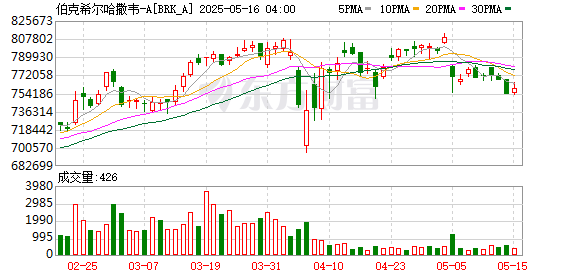
巴菲特Q1大笔卖出银行股 维持苹果持仓不变
news flash· 2025-05-15 20:34
Group 1 - Berkshire Hathaway, led by Warren Buffett, sold significant positions in bank stocks during Q1, including liquidating 14.63 million shares of Citigroup and reducing its stake in Bank of America by 4.866 million shares [1] - The company maintained its position in Apple, holding 300 million shares unchanged [1] - Berkshire increased its investment in Constellation Brands by 6.38 million shares, representing a 113.5% increase, and also added 760,000 shares of Occidental Petroleum and 860,000 shares of Pool Corporation [1] Group 2 - Notably, Berkshire did not establish any new positions in stocks during the first quarter [1]

贸易紧张局势缓解,今年美股的“大输家”要变“大赢家”?
Hua Er Jie Jian Wen· 2025-05-14 12:47
Group 1 - Major investment banks Citigroup and JPMorgan have made bold predictions that the worst-performing sectors of the U.S. stock market are expected to rebound in the short term [1] - Citigroup's U.S. equity trading strategy head Stuart Kaiser and JPMorgan's trading team are particularly optimistic about small-cap stocks, technology hardware, and homebuilders, which have lagged behind the S&P 500 in the recent market rally [1] - Kaiser noted that stocks of companies with weaker financial conditions are also worth attention in the current environment [1] Group 2 - The phenomenon of "catch-up" is driving traders and speculative buyers who missed the recent rebound to seek opportunities in lagging sectors before potential new tariffs [2] - Kaiser indicated that systematic traders and discretionary investors will flood into the market as they have not fully captured the current rebound, leading to significant buying in underperforming sectors [3] - Commodity trading advisors (CTAs) have significantly reduced their exposure to stocks in recent weeks, creating conditions for their return to the market following the S&P 500's rise [3] Group 3 - There is an opportunity for short-squeeze as traders close their short positions in the Russell 2000 index, which may further drive up small-cap stocks in the coming weeks [4] - JPMorgan's global market intelligence head Andrew Tyler pointed out that buying into battered sectors like retailers or discretionary consumer goods through derivatives could trigger a short squeeze in the short term [4] - Any short squeeze could lead to mid-cap and small-cap companies outperforming the broader market [4] Group 4 - Long-term investors remain cautious about small-cap stocks and financially weaker companies due to high interest rates and slowing economic growth [5] - The global trade situation remains uncertain due to the unpredictable nature of Trump's policies, leading to a reluctance to invest in small-cap stocks or hold high-risk market positions [5] - The tightening of immigration policies by the Trump administration may increase labor costs, putting pressure on domestic U.S. companies [5]
花旗、小摩齐喊话:押注今年“最惨”美股可获短期回报
智通财经网· 2025-05-14 10:56
Group 1 - Major Wall Street banks, Citigroup and JPMorgan, predict a significant buying opportunity in the U.S. stock market, particularly in the stocks that have seen the largest declines this year, as trade tensions ease [1] - Both banks are particularly optimistic about small-cap stocks, technology hardware, and residential builders, which have lagged behind the S&P 500 in recent rallies [1] - Citigroup's U.S. equity trading strategist, Stuart Kaiser, notes that systematic traders and discretionary investors are likely to make substantial purchases of underperforming stocks due to their low current positions and available capital [1][3] Group 2 - JPMorgan's Andrew Tyler highlights the potential for a short squeeze in sectors like retail and consumer discretionary, which could lead to a sharp increase in stock prices as short sellers are forced to cover their positions [3] - Despite the short-term optimism, long-term fund managers remain cautious about small-cap stocks and financially weak companies due to high interest rates and slowing economic growth [3] - The "weak balance sheet index" tracked by Goldman Sachs, which monitors 50 heavily indebted companies, has outperformed the S&P 500 in 7 out of the last 8 trading days, indicating a shift towards cheaper stocks [4] Group 3 - Kaiser suggests increasing long positions in sectors that have underperformed since the announcement of "reciprocal tariffs" by Trump, including technology hardware and durable goods [4] - Dennis Debusschere from 22V Research points out that the valuation gap between riskier, economically sensitive companies and high-quality firms is significant, suggesting greater short-term upside for the former [4]


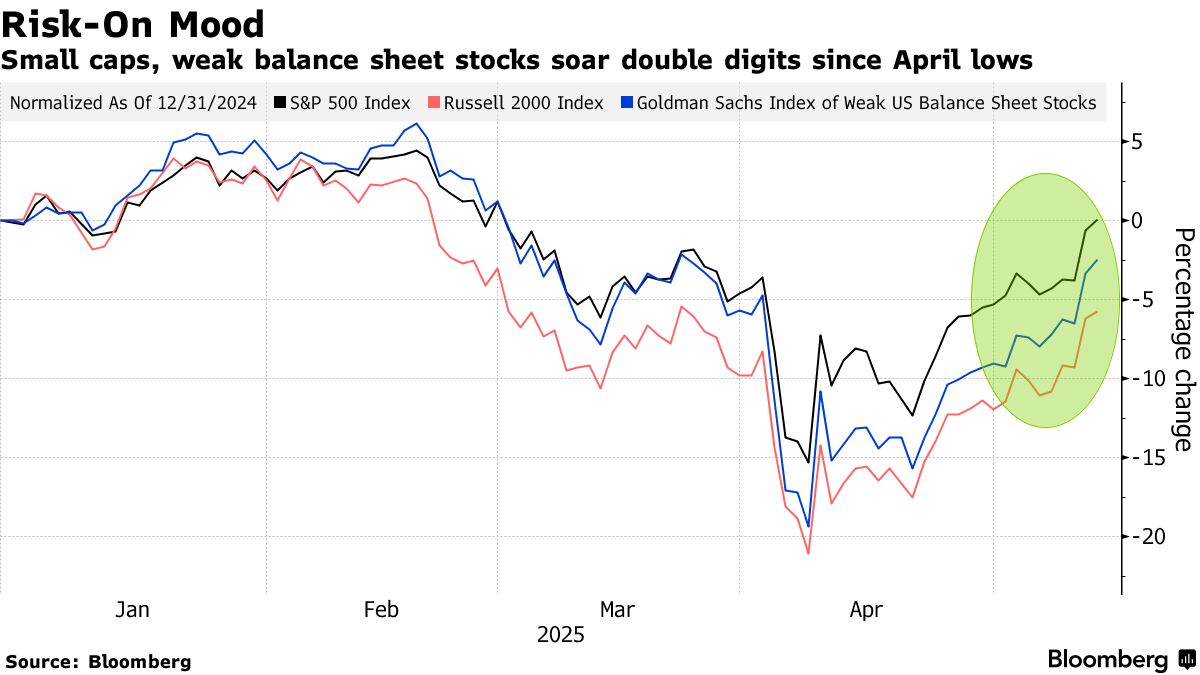
花旗和摩根大通对美股做出大胆预测:落后股后来居上 短期逆袭成赢家
news flash· 2025-05-14 10:24
随着贸易紧张局势缓和,华尔街两大主要交易部门对美国股市做出同样大胆的预测:大量买入今年表现 最差的股票,可快速获取短期利润。花旗集团和摩根大通的股票交易部门负责人表示,他们对未来几周 的小盘股、科技硬件和住房建筑股尤其看好,这些板块在最近一轮上涨中均落后于标普500指数。花旗 美国股票交易策略主管Stuart Kaiser表示,在当前环境下,他也看好财务状况较弱的公司股票。 ...
中金:关税如何影响行业配置?
中金点睛· 2025-05-06 23:34
Core Viewpoint - The article discusses the impact of the recent "reciprocal tariffs" announced by Trump on the global market, particularly focusing on the Chinese market and its recovery trends following the initial shock [1][3]. Market Performance Summary - Following the announcement of tariffs on April 2, the Hong Kong stock market experienced significant volatility, with a notable drop on April 7 that erased all gains for the year. However, by May 2, the Hang Seng Tech Index rebounded by 19.1%, while MSCI China, Hang Seng Index, and Hang Seng China Enterprises Index saw rebounds of 13.6%, 13.5%, and 13.3% respectively. The Shanghai Composite Index and CSI 300 had smaller rebounds of 5.9% and 5.0% [1]. - Sector performance from April 8 to May 2 showed that Information Technology (+29.0%), Healthcare (+19.2%), and Consumer Discretionary (+14.3%) led the gains, while sectors like Banking (+4.9%), Utilities (+5.6%), and Energy (+5.9%) lagged behind [1]. Industry Analysis Framework - The article proposes an industry analysis framework based on demand sources, categorizing industries into three main types: 1. Industries primarily dependent on the U.S. market, which face significant challenges in finding alternative demand. 2. Industries with demand from markets outside the U.S., which are less directly affected by U.S. tariffs. 3. Industries with domestic demand, which are influenced by domestic policy support [4][6]. Impact of Tariffs on Different Industries - Industries with primary demand from the U.S. are categorized based on their ability to find alternative markets and their bargaining power. Sectors like Media, Software Services, and Textiles have shown resilience due to higher profit margins and U.S. import dependency, while smaller firms in shipping and medical supplies face greater challenges [6][10]. - Industries with demand from other markets, particularly those with established market shares and competitive advantages, are expected to perform better. Sectors such as Technology Hardware and Home Appliances have shown potential for growth in non-U.S. markets [11][14]. - Domestic demand-driven industries, particularly in consumption and infrastructure, are closely tied to government policy support. The article highlights the importance of fiscal measures to mitigate external shocks [18][20]. Historical Context and Future Outlook - The article draws parallels with the 2018-2019 trade tensions, noting that the current market dynamics reflect similar patterns of initial decline followed by recovery phases. The sectors that are less dependent on U.S. demand have shown more resilience, while those heavily reliant on U.S. markets have faced significant declines [21][25]. - The potential impact of tariffs on GDP and corporate profits is discussed, with estimates suggesting that a significant drop in exports to the U.S. could lead to a decline in GDP growth and a downward adjustment in profit forecasts for Hong Kong stocks [34][35]. - The article concludes with a projection of market indices under different scenarios, emphasizing the need for policy support to counterbalance the negative effects of tariffs and the importance of sector-specific strategies for investors [37].
就在今晚!伯克希尔史上最重要股东大会来了,市场最关心巴菲特说什么?
华尔街见闻· 2025-05-03 10:56
Core Viewpoint - The article discusses the significance of the upcoming Berkshire Hathaway annual meeting, particularly as it may be one of Warren Buffett's last full participations, highlighting the transition of leadership to Greg Abel and the potential implications for the company's future strategies and investment approaches [4][5][9]. Group 1: Meeting Details - The annual meeting will feature a Q&A session with Warren Buffett, Greg Abel, and Ajit Jain, starting earlier than usual and lasting approximately four and a half hours [1][2][4]. - This year marks the 60th anniversary of Buffett's acquisition of Berkshire Hathaway, and the meeting is expected to be pivotal due to Buffett's advancing age [4][5]. Group 2: Leadership Transition - Greg Abel is anticipated to take over as CEO soon, with Buffett indicating that Abel will write the annual letter in the near future [5][12]. - Investors are particularly interested in Abel's leadership style and investment philosophy, as well as any potential changes in management structure following Buffett's departure [12][13][14]. Group 3: Economic and Market Concerns - The ongoing trade war initiated by the Trump administration is a significant concern, with investors eager to hear Buffett's views on tariffs and their impact on Berkshire's diverse businesses [6][7][8]. - Analysts warn that the U.S. economy may be on the brink of recession, which could affect Berkshire's stock price and overall performance [7][11]. Group 4: Investment Strategy and Cash Reserves - Berkshire Hathaway currently holds a record cash reserve of $334.2 billion, raising questions about how Buffett and Abel will deploy these funds for future investments or acquisitions [15][16]. - There is speculation about potential acquisitions, including the remaining shares of Occidental Petroleum or other distressed assets, as well as the possibility of stock buybacks if Buffett's exit leads to a drop in share prices [20][21]. Group 5: Portfolio Adjustments - The article notes significant changes in Berkshire's investment portfolio, particularly regarding its stake in Apple, which has seen a dramatic reduction in percentage terms [21][22]. - Investors are curious about Buffett's stance on further reducing Apple holdings and how the company will navigate investments in international markets amidst trade tensions [23][24].
陆家嘴财经早餐2025年5月2日星期五
Wind万得· 2025-05-01 22:18
Group 1 - The US and Ukraine have jointly established a reconstruction investment fund aimed at attracting global investment into Ukraine, with a 50:50 management structure and no dominant voting rights for either party [3] - The Bank of Japan has unanimously decided to maintain its target interest rate at 0.5%, while lowering GDP growth forecasts for 2025 and 2026 to 0.5% and 0.7% respectively [3] - In April, several electric vehicle manufacturers reported significant year-on-year delivery increases, with XPeng delivering 35,000 vehicles (up 273%), Li Auto 33,900 vehicles (up 31.6%), and BYD achieving cumulative sales of 1.380893 million vehicles in the first four months (up 46.98%) [4] Group 2 - Apple reported Q2 earnings of $1.65 per share and revenue of $95.36 billion, exceeding expectations, but its stock fell over 2% in after-hours trading [4] - The Chinese representative at the WTO refuted claims of "overcapacity" against China and criticized the US's discriminatory subsidy policies [6] - The revised Plant Variety Protection Regulations in China will take effect on June 1, 2025, expanding the scope of protection [6] Group 3 - QFII's significant stock holdings and changes in the first quarter have been revealed, with 367 stocks seeing new QFII investments [8] - In April, the top-performing stocks recommended by brokers showed strong excess returns, with some stocks rising by 83% [8] - CICC's report indicates that the earnings downturn cycle may have reached its low point, but attention should be paid to the impact of tariff policies on corporate fundamentals [8] Group 4 - The "2025 International Consumption Season" was launched in Shanghai, focusing on promoting consumption and optimizing tax refund policies [10] - Nvidia's CEO stated that the US and China are closely matched in AI development [10] - In April, the average new home price in 100 cities in China was 16,764 yuan per square meter, with a month-on-month increase of 0.14% [10] Group 5 - The US stock market saw all three major indices rise, with the Dow Jones up 0.21% and the S&P 500 up 0.63%, driven by strong corporate earnings and favorable economic data [22] - Tesla's board is reportedly seeking a successor for CEO Elon Musk, although the chairman denied these claims [22] - Apple plans to appeal a court ruling regarding its App Store practices, while also stating it will procure 19 million chips from the US this year [23]
摩根士丹利:科技硬件-不确定性增加-关税影响情境分析
摩根· 2025-04-28 04:59
Investment Rating - The report maintains an "In-Line" investment rating for the Greater China technology hardware sector [6]. Core Insights - The uncertainty surrounding U.S. tariffs on electronic products has increased, leading to various risks in the technology hardware supply chain. The risk-reward profile remains unattractive even after recent stock adjustments [1][3]. - A scenario analysis indicates a significant downward revision risk for earnings forecasts in 2025-26, with an average earnings forecast decline of 17-18% [3][16]. - Consumer electronics are expected to be the most affected, particularly companies heavily reliant on consumer technology, facing greater profit pressure and rising end-product prices [3][8]. - The diversification of production capacity is necessary but may come at a high cost, with potential increases in overall production costs by at least 50% [4][21]. Summary by Sections Tariff Impact Analysis - The report outlines three scenarios regarding tariff impacts, assessing their effects on earnings based on product price increases and shipment volumes. The base case suggests a 10% average tariff on electronic products, leading to a 5% year-over-year price hike [15]. - The analysis shows that the technology hardware sector may experience a downturn lasting at least four quarters, with recovery in shipment volumes not expected until Q3 2026 [3][16]. Company-Specific Impacts - The report highlights that no technology hardware company is immune to the impacts of U.S. tariffs, with significant adjustments made to earnings forecasts for several companies, particularly within the Apple supply chain [25][27]. - Specific companies such as Hon Hai and Luxshare are rated as "Overweight," while others like Goertek and Lingyi are rated "Underweight" due to their exposure to tariff-related cost increases and demand slowdowns [25][27]. Market Outlook - The report suggests a cautious outlook for consumer electronics, with expected earnings growth of only 8% for the Apple supply chain and 16% for personal computers in the current year [17]. - In contrast, the data center infrastructure segment is projected to benefit from steady AI demand, with earnings growth expected to be 26% in 2025 and 13% in 2026 [17][31].
中金研究 | 本周精选:宏观、策略
中金点睛· 2025-04-25 23:38
中金点睛"本周精选"栏目将带您回顾本周深受读者欢迎的研究报告。 01 宏观 Macroeconomy 特朗普的两个目标均难实现 >>点击图片查看全文<< 特朗普政府试图通过加征关税促使美国贸易逆差收窄,制造业回流,我们认为这两个目标难以通过关税实现。首先,关税难以使得美国贸易逆差收 窄。从理论来看,提升关税并不一定能够缩减逆差(扩大顺差)。根据勒纳对称定理,对进口征税等同于对本国的出口征税。关税难以促使制造业回 流美国。全球供应链对中国的依赖度比较高,而且无论是从劳动者数量、质量,还是就业意愿来看,美国制造业回流都将面临着劳动力短缺的问题。 美国制造业成本高,也是其制造业回流的挑战。特朗普关税或对美国产生滞胀式影响,美国衰退风险加大。除了"滞胀"风险,特朗普的减税、削减支 出和关税组合或将损害美国大多数家庭,对低收入人群损害更大,加剧美国内部不平衡。实际上,从经济视角来看,美国没有非常突出的外部失衡问 题,但内部分配问题很严重。 资料来源:US Census Bureau,中金公司研究部 >>点击图片跳转报告原文<< 2025.04.23 | 张文朗 黄亚东等 02 宏观 Macroeconomy 从汇率、利 ...