
债券市场

Search documents
【财经分析】债市“科技板”百日成绩单:双市场输血超9200亿元 风险缓释工具激活科创融资生态
Xin Hua Cai Jing· 2025-08-15 00:39
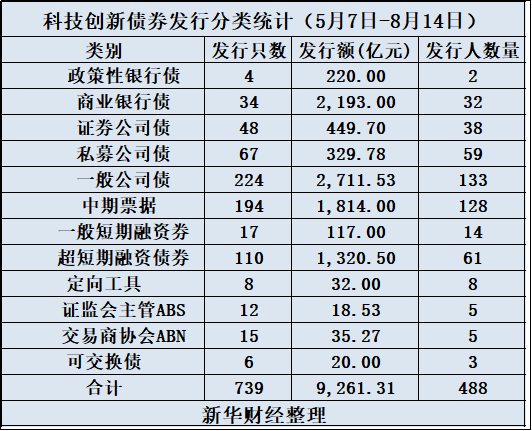
Core Viewpoint - The establishment of the "Technology Board" in the bond market has achieved significant milestones within its first hundred days, with a total issuance of 739 technology innovation bonds amounting to 926.13 billion yuan, reflecting a collaborative innovation effort among financial regulatory bodies, infrastructure, and market participants [1][2]. Group 1: Market Performance - The interbank market has dominated the issuance of technology innovation bonds, accounting for 62.14% of the total issuance, with 5,755.77 billion yuan issued [2]. - Commercial banks have been particularly active, with 32 commercial banks and 2 policy banks issuing a total of 2,413 billion yuan in technology innovation bonds [2]. - The Shanghai and Shenzhen stock exchanges have also contributed, with a total issuance of 3,467.01 billion yuan in technology innovation corporate bonds, primarily directed towards sectors like chip design, biomedicine, and artificial intelligence [2]. Group 2: Bond Issuance Characteristics - The issuance structure of technology innovation bonds has shown a significant lengthening of maturity, with over 75% of bonds having a maturity of more than 3 years, and over 30% exceeding 5 years [4][5]. - This maturity design addresses the long-cycle characteristics of technology research and development, providing stable funding for hard technology projects [5]. Group 3: Financial Innovation Tools - Over 300 of the issued bonds have special clauses, and nearly 60 have introduced innovative credit enhancement measures, such as credit risk mitigation certificates (CRMW) [6]. - These tools have been instrumental in reducing investor concerns by sharing 30%-50% of default risks, especially for technology companies with insufficient credit ratings [6]. - The use of blockchain technology has also been highlighted, with the issuance of the first blockchain-based technology board bond, ensuring traceability of funds [6][7]. Group 4: Evolving Investor Landscape - The investor structure for technology board bonds is changing, with insurance fund allocations increasing from 22% at the beginning of the year to 35% [8]. - The rapid growth of technology board bond ETFs indicates a strong interest from long-term funds, with the first ETF surpassing 100 billion yuan in just five trading days [8]. Group 5: Future Directions - The People's Bank of China has emphasized the need for optimizing the technology board mechanism and innovating risk-sharing tools [8][9]. - There are ongoing discussions about establishing a dual-track system for technology and credit ratings to better assess the value of technology companies [9]. - The development of innovative financing tools is expected to enhance the financing ecosystem for technology enterprises, addressing the historical imbalance between equity and debt financing [9].

中加基金权益周报︱央行呵护增值税新券发行,债市情绪不弱
Xin Lang Ji Jin· 2025-08-14 09:19
Market Overview and Analysis - The primary market saw the issuance of government bonds, local government bonds, and policy financial bonds amounting to 468.6 billion, 165.5 billion, and 174.5 billion respectively, with net financing of 338.6 billion, 82.8 billion, and 174.5 billion [1] - Financial bonds (excluding policy financial bonds) totaled an issuance of 132.0 billion with a net financing of 12.5 billion [1] - Non-financial credit bonds had an issuance of 357.9 billion and a net financing of 198.7 billion [1] - One new convertible bond was issued with an expected financing scale of 1.17 billion [1] Secondary Market Review - The bond market showed resilience amidst a strong stock market environment, influenced by factors such as the month-end liquidity, new VAT policies, and central bank's buyout operations [2] Liquidity Tracking - Post month-end, the liquidity naturally eased, and the central bank's announcement of buyout reverse repos further supported new bond issuance, leading to an overnight funding rate dropping below 1.3%, which pushed down funding prices [3] - The R001 and R007 rates decreased by 1.3 basis points and 3.3 basis points respectively compared to the previous week [3] Policy and Fundamentals - July economic data indicated resilient export growth, with core CPI rising for five consecutive months, although the anti-involution policy slightly hindered PPI transmission [4] - High-frequency data showed a slight decline in production and sustained low levels in consumption, with both food and commodity prices decreasing [4] Overseas Market - The easing of the Russia-Ukraine conflict improved market risk sentiment, while deviations in U.S. Treasury auctions put pressure on U.S. bonds, with the 10-year U.S. Treasury closing at 4.27%, up 4 basis points from the previous week [5] Equity Market - The market returned to an upward trend, with the Shanghai Composite Index reaching a new high for the year, while the overall A-share market rose by 1.94% with reduced trading volume, maintaining an average daily trading volume of 1.7 trillion [6] - As of August 7, 2025, the total financing balance for the entire A-share market was 1,998.9 billion, an increase of 27.9 billion from July 31 [6] Bond Market Strategy Outlook - In a low-interest-rate environment, traditional allocations of new funds by residents and institutions towards deposits and bonds are beginning to shift towards assets with rights, forming the basis for the stock market bull run this year [7] - This behavior will not change the downward trend of bond market interest rates but may delay the speed of decline and increase short-term volatility [7] - With the impact of the VAT recovery subsiding, the 10-year bond yield may return below 1.7%, potentially weakening market bullish sentiment [7] - The further downward space for interest rates depends on the central bank's continued support for new bond issuances affected by VAT and the pace of stock market increases [7] - For credit bonds, a relatively loose liquidity environment remains favorable, but attention should be paid to the issue of excessive narrowing of credit spreads [7] - In the convertible bond market, following the rollback of previous anti-involution expectations, there is renewed selection space for convertible bonds, with high-priced bonds not entering conversion periods and those not strongly redeemed gradually moving towards dual highs, maintaining a good overall profit effect [7] - It is important to note that the current risk-reward asymmetry has weakened, and some volatility is inevitable, making participation more challenging for low-volatility strategy investors [7]
7月金融数据点评:弱现实延续,债市阶段性脱敏
Shenwan Hongyuan Securities· 2025-08-14 08:43
Core Insights - The report highlights a continuation of weak economic conditions, with a notable decline in new RMB loans in July 2025, amounting to -0.05 billion compared to 2.24 billion in June 2025. New social financing (社融) was 1.16 billion, down from 4.20 billion in June 2025, while the year-on-year growth rate of social financing was 9%, slightly up from 8.9% in June 2025 [3][4][5]. Group 1: Social Financing and Government Debt - Government debt continues to support the growth of social financing in July, with net financing reaching 1.25 billion, although this is a decrease from 1.41 billion in June. This high level of government debt financing has effectively supported social financing growth despite weak credit demand from the real economy [3][5]. - The report indicates that corporate short-term loans were low, while bill financing saw significant growth. This is attributed to a rapid decline in bill rates, which created a substitution effect with short-term loans, and effective measures to clear overdue accounts [3][4][5]. Group 2: Household and Corporate Credit Demand - Both household and corporate credit demand in July were below seasonal levels, reflecting low consumer willingness to spend and weak housing demand. The implementation of personal consumption loan subsidies and childcare allowances may stimulate future household consumption, but improvements in housing demand remain uncertain due to inventory and pricing factors [3][4][5]. - The report notes that new non-bank deposits increased to a seasonal high in July, indicating a trend of residents moving deposits to equity markets, influenced by favorable performance in the equity market and a seasonal decline in wealth management products [3][4][5]. Group 3: Monetary Indicators - M1 and M2 growth rates both increased, with the M1-M2 spread narrowing, suggesting a marginal improvement in economic activity. The increase in M1 is attributed to several factors, including a low base effect from previous financial data adjustments and significant net fiscal spending [3][4][5]. - The report also mentions that the bond market's pricing of fundamentals and liquidity has weakened, with a flattening yield curve reflecting pessimistic expectations for the economy. The bond market has shown weakness following the release of financial data, indicating a potential shift of funds from bonds to equities [3][4][5]. Group 4: Future Outlook - The report anticipates that the bond market may face pressure in August, coinciding with a peak in government debt supply. The coordination of monetary policy with fiscal liquidity may be challenging, and if bond market adjustments intensify, there is a possibility that the central bank may restart bond purchases [3][4][5]. - The report concludes that the third and fourth quarters may present risk windows, as a decline in government debt supply could reduce liquidity support, while inflation risks may rise [3][4][5].
外资布局中国债市多偏向中长期配置
Zheng Quan Ri Bao· 2025-08-13 16:29
Core Insights - The trend of international investors increasingly allocating to RMB assets is gaining momentum, with foreign institutions holding a significant portion of China's bond market [1][2][3] Group 1: Foreign Investment in Chinese Bonds - As of June 2023, the custody balance of foreign institutions in China's bond market reached 4.3 trillion yuan, accounting for 2.3% of the total custody balance [1] - The foreign holdings in the interbank bond market amounted to 4.2 trillion yuan, with government bonds making up 2.1 trillion yuan (49.6%) and interbank certificates of deposit at 1.2 trillion yuan (27.2%) [1] - UBS reported that from 2018 to 2022, foreign institutional holdings in Chinese bonds increased from 200 billion USD to 600 billion USD (approximately 4.3 trillion yuan), with a rebound expected starting in the second half of 2024 [2] Group 2: Market Accessibility and Trends - The opening of the China Interbank Bond Market (CIBM) in 2016 and the Bond Connect program in 2017 have significantly improved the accessibility for foreign investors [2][3] - A recent UBS survey indicated that central banks globally are increasing their holdings of RMB and euro assets, suggesting a favorable outlook for Chinese bonds over the next 3 to 4 years [2] Group 3: Future Investment Directions - Currently, interest in Chinese bonds is primarily in interest rate bonds, which constitute about 62.3% of the market, while credit bonds make up approximately 37.7% [4] - Foreign investors are expected to gradually diversify into credit bonds and asset-backed securities (ABS), as they begin to explore these options due to their attractive yield characteristics [4][5] - The RMB bond market is characterized by its large scale, high openness, low correlation, and low volatility, making it an appealing choice for foreign investors [5] Group 4: Panda Bonds and Market Dynamics - The issuance of Panda bonds has surged since June 2023, driven by the internationalization of the RMB and the diverse financing needs of foreign issuers and investors [6] - As of August 3, 2023, the issuance scale of Panda bonds in the interbank market reached 116.65 billion yuan, with foreign government agencies and multinational corporations being active participants [6] - The increasing importance and influence of the RMB in the international monetary system are key factors attracting foreign investment into the RMB bond market [6]
方正富邦区德成:8月债市不应过分悲观的五大理由
Zhong Guo Jing Ji Wang· 2025-08-13 06:15
Group 1 - The bond market has experienced a correction from mid to late July, with the 10-year government bond yield rising from 1.66% to 1.72% and the 30-year bond yield increasing from 1.87% to 1.99% during the period from July 16 to August 11 [1] - In contrast to the bond market's decline, the stock market and commodities have shown strong performance, driven by supply reduction policies, economic recovery expectations, and global liquidity easing, leading to a significant rise in commodity prices and a rebound in the A-share market [1] - The adjustment in the bond market is attributed to three main factors: tight funding conditions, inflation expectations raised by "anti-involution" policies, and the impact of rising equity markets on the bond market [1] Group 2 - Recent PMI data indicates a marginal pressure scenario for the second half of the year, with production, domestic and external demand orders, and inventory indicators showing varying degrees of decline, suggesting that inflation expectations may not persist for long [2] - The commodity market is cooling down, which is favorable for the bond market, as the first phase of significant price increases in commodities may have passed, leading to a more rational market risk appetite [2] - Historically, August sees stable funding conditions, with funding rates typically rising before month-end; recent data shows overnight and 7-day funding rates declining to 1.35% and 1.49% respectively, indicating liquidity easing [2] Group 3 - The current adjustment in the bond market is driven more by sentiment and trading factors rather than a fundamental reversal of the bond market's core logic, suggesting that the long-term bullish outlook for the bond market remains unchanged [3] - The recent phase of decline in the bond market presents a more attractive opportunity for rational investors to position themselves [3]
信用利差周报2025年第28期:“股债跷跷板”效应下债市回调,政治局会议影响几何?-20250812
Zhong Cheng Xin Guo Ji· 2025-08-12 11:03
Report Industry Investment Rating - Not provided in the document Core Viewpoints - In the context of the "stock-bond seesaw" effect, the bond market adjusted due to the stock market's rise. However, the bond market still has support from fundamentals and capital, and the yield center may remain low. The Politburo meeting's policies may boost stock market activity, causing short-term disturbances to the bond market [4][11][12] - The Central Bank and the Ministry of Agriculture and Rural Affairs issued a document encouraging the issuance of rural revitalization bonds, which may lead to the expansion of such bonds [5][14][15] - Industrial enterprise profits declined in the first half of the year, with industrial product prices dragging down revenue and profits, while "volume" remained an important support factor for profit recovery [6][17] Summary by Directory Market Hotspots - **Stock-Bond Seesaw Effect and Bond Market Adjustment**: The stock market rose significantly last week, with the Shanghai Composite Index breaking through 3600 points, triggering the "stock-bond seesaw" effect. The bond market adjusted, with most major bond market indices falling and bond yields rising. The 10-year Treasury yield reached 1.73%. The Politburo meeting's policies may increase stock market activity, causing short-term disturbances to the bond market, but the bond market still has support [4][11][12] - **Policy Encouragement for Rural Revitalization Bonds**: The Central Bank and the Ministry of Agriculture and Rural Affairs jointly issued a document encouraging the issuance of rural revitalization bonds. This policy aims to provide comprehensive financial support for rural revitalization, and rural revitalization bonds may expand in the future [5][14][15] Macroeconomic Data - Industrial enterprise profits declined by 1.8% year-on-year from January to June, with the decline widening compared to the previous period. In June, the profit decline narrowed, indicating marginal improvement but overall weakness. Industrial product prices continued to drag down profits, while industrial production was supported by factors such as the "export rush" effect and the "618" shopping festival [6][17] Money Market - The central bank's net capital injection decreased last week, leading to a marginal tightening of liquidity. Most interbank repurchase rates rose, except for a slight decline in the DR1m rate. The spread between the 3-month and 1-year Shibor widened [20] Primary Market of Credit Bonds - The issuance scale of credit bonds increased last week, reaching 3243.17 billion yuan, an increase of 418.72 billion yuan from the previous period. Different bond types showed varying trends, with ultra-short-term financing bonds and corporate bonds increasing significantly. The infrastructure investment and financing industry had a net outflow of financing, while most industries in the industrial bond sector had a net inflow. The issuance cost of credit bonds mostly increased [23][25][31] Secondary Market of Credit Bonds - The trading volume in the secondary bond market increased last week, with the daily average trading volume reaching 19682.03 billion yuan. Bond yields generally rose, with interest rate bonds and credit bonds both showing significant increases. Most credit spreads widened, while rating spreads showed mixed trends with small changes [33][36][40]
鑫闻界丨419亿!上交所累计发行63只高成长产业债,争取年底达百只
Qi Lu Wan Bao· 2025-08-12 09:32
Group 1 - The core viewpoint is that the Shanghai Stock Exchange (SSE) has successfully issued 63 high-growth industrial bonds amounting to 41.905 billion yuan by July 31, 2025, involving 43 issuers [1] - As of the end of June, 53 high-growth industrial bonds had been issued with a total scale of 37.3 billion yuan, attracting over 80 non-bank institutions to participate in investment [1] - The SSE aims to reach a target of 100 high-growth industrial bonds issued by the end of the year to address long-standing structural issues in financing for small and medium-sized enterprises and private companies [1] Group 2 - High-growth industrial bonds are designed to alleviate the "financing difficulties and high costs" faced by industrial enterprises, with a focus on richer and more reliable information disclosure and clearer investor protection agreements [2] - The SSE is building a mechanism to enhance transparency and credibility among issuers, ensuring that both issuers and investors benefit from the high-growth industrial bond market [2] - The underlying principle of the high-growth industrial bonds is the concept of "credit equals return," aiming to strengthen the bond market's support for the real economy by excluding overly speculative junk bonds [2]

央行:2月债市共发行各类债券 超4.4万亿元
Xin Hua Wang· 2025-08-12 06:29
Group 1 - In February 2022, the bond market issued a total of 44,307.7 billion yuan in various types of bonds [1] - The issuance breakdown includes 4,800 billion yuan in government bonds, 5,071 billion yuan in local government bonds, 7,240.5 billion yuan in financial bonds, 7,518.4 billion yuan in corporate credit bonds, 45.0 billion yuan in credit asset-backed securities, and 19,366.1 billion yuan in interbank certificates of deposit [1] - By the end of February, the total custody balance of the bond market reached 136.3 trillion yuan, with government bonds at 22.4 trillion yuan, local government bonds at 31.3 trillion yuan, financial bonds at 31.9 trillion yuan, corporate credit bonds at 31.6 trillion yuan, credit asset-backed securities at 2.6 trillion yuan, and interbank certificates of deposit at 14.5 trillion yuan [1] Group 2 - In February, the interbank bond market saw a total transaction volume of 173 trillion yuan, with an average daily transaction of 10,825 billion yuan, marking a year-on-year increase of 69% and a month-on-month increase of 8.8% [1] - The average transaction size was primarily between 5 million to 50 million yuan, with an average transaction amount of 49.04 million yuan [1] - The exchange bond market recorded a transaction volume of 21 trillion yuan, with an average daily transaction of 1,281.9 billion yuan, reflecting a year-on-year increase of 54.3% and a month-on-month increase of 4.4% [1] Group 3 - As of the end of February 2022, the custody balance of foreign institutions in the Chinese bond market was 4.1 trillion yuan, accounting for 3% of the total custody balance [2] - Foreign institutions held 2.5 trillion yuan in government bonds, representing 62.3% of their total holdings, and 1.1 trillion yuan in policy financial bonds, accounting for 26.4% [2]
投资范围扩大程序简化 债市制度型开放更进一步
Xin Hua Wang· 2025-08-12 06:26
Core Viewpoint - The recent announcement by the People's Bank of China, the China Securities Regulatory Commission, and the State Administration of Foreign Exchange marks a significant step in the institutional opening of China's bond market, facilitating foreign institutional investors' access to both interbank and exchange bond markets [1][2]. Group 1: Market Access and Regulations - The announcement simplifies the entry procedures for foreign institutional investors while expanding their investment scope to include the exchange bond market [1][2]. - Foreign institutional investors are allowed to invest directly or through mutual connectivity in the exchange bond market, with the ability to choose their trading venues autonomously [2]. - The range of approved foreign institutional investors remains unchanged, but the process for entering the market has been streamlined, eliminating the need for individual product filings for new products from registered institutions [2]. Group 2: Market Growth and International Confidence - As of April 2022, the total balance of China's bond market reached 138.2 trillion yuan, making it the second largest in the world, with 1,035 foreign institutional investors holding a total of 3.9 trillion yuan in bonds, a 225% increase since the end of 2017 [3]. - Major international bond index providers, including Bloomberg, JPMorgan, and FTSE Russell, have included Chinese bonds in their primary indices, reflecting international investors' confidence in China's long-term economic health and financial openness [3]. - The continued deepening of bond market openness is expected to attract more foreign capital into China, enhancing the international competitiveness of its financial markets [3].
上交所发布实施细则 拓宽外资参与交易所债券市场渠道
Xin Hua Wang· 2025-08-12 06:25
Core Viewpoint - The implementation of the new rules for foreign institutional investors in the Shanghai Stock Exchange bond market is expected to enhance foreign investment scale and provide diverse funding sources for domestic bond issuers, promoting the long-term development of the bond market and accelerating the internationalization of the RMB [1][2]. Group 1: Implementation Details - The new rules require foreign institutional investors to appoint qualified commercial banks as custodians and domestic securities firms with membership in the Shanghai Stock Exchange as trading participants, with each securities account designated to only one trading participant [2]. - Foreign institutional investors are allowed to participate in various bond types, including exchangeable and convertible corporate bonds, asset-backed securities, bond lending, related derivatives for risk management, and bond funds, including exchange-traded bond index funds [2][3]. - Foreign institutional investors must also appoint domestic securities firms with qualifications as settlement participants to handle settlement operations [3]. Group 2: Market Impact - As of the end of May, the total custody balance of China's bond market was 139.1 trillion yuan, with foreign institutions holding 3.74 trillion yuan, accounting for 2.7% of the total [3]. - The new rules clarify the types of bonds that foreign institutional investors can engage with, particularly highlighting exchangeable and convertible corporate bonds, which are distinct from those in the interbank market, thus providing new asset allocation opportunities for foreign investors [3]. - The inclusion of bond funds in the investment scope for foreign investors is seen as a potential entry point, with index bond funds aligning with foreign investors' preferences and presenting lower entry barriers [4]. Group 3: Future Outlook - The ongoing development of the bond market's openness and the introduction of new policies are expected to continuously enhance foreign participation in the domestic bond market [4][5]. - The Shanghai Stock Exchange aims to further refine bond trading regulations to create a more favorable investment environment for both domestic and foreign investors, thereby better serving the real economy and establishing a new framework for high-quality development in the bond market [5].