工业金属

Search documents
主力资金监控:沃尔核材净买入超13亿
Xin Lang Cai Jing· 2026-01-15 03:11
转自:智通财经 【主力资金监控:沃尔核材净买入超13亿】智通财经1月15日电,智通财经星矿数据显示,今日早盘主 力资金净流入有色金属、工业金属、能源金属等板块,净流出计算机、文化传媒、国防军工等板块,其 中计算机板块净流出超135亿元。个股方面,沃尔核材涨停,主力资金净买入超13.21亿元位居首位,航 天机电、华友钴业、N至信获主力资金净流入居前;蓝色光标遭净卖出超18亿元,山子高科、岩山科 技、金风科技资金净流出额居前。 ...

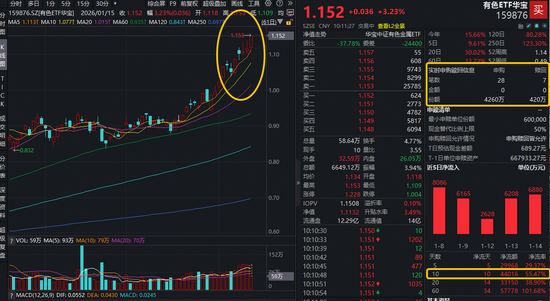
有色逆市狂飙!资金积极抢筹!有色ETF华宝(159876)盘中猛拉3%,冲击5连涨!此前10日狂揽4.4亿元!
Xin Lang Cai Jing· 2026-01-15 02:32
Core Viewpoint - The non-ferrous metal sector is experiencing significant growth, with the popular ETF, Huabao Non-ferrous ETF (159876), hitting a new historical high and attracting substantial capital inflow [1][9]. Group 1: Market Performance - The Huabao Non-ferrous ETF (159876) saw an increase of 3.23% and 2.69%, marking five consecutive days of gains and setting a new historical high [1][9]. - As of the report, the ETF received a net subscription of 38.4 million units, accumulating a total of 440 million yuan in the past ten days [1][9]. Group 2: Sector Analysis - In the gold sector, Xian Financial Securities suggests that the U.S. faces recession pressures, high sovereign debt, and trade deficits, which weaken the dollar's credibility, leading to increased focus on gold as a global asset [2][10]. - For copper, China Galaxy Securities indicates that there is still significant upward potential for copper prices, as historical data shows that current prices, adjusted for inflation, have not reached previous supercycle highs [3][11]. - Strategic metals like tungsten, molybdenum, titanium, and rare earths are expected to see increased demand due to technological revolutions and supply chain security concerns, as noted by CITIC Securities [3][11]. Group 3: Stock Performance - Key stocks in the non-ferrous metal sector include Huaxi Non-ferrous, Hunan Silver, and Huayou Cobalt, all of which have surged over 7% [4][12]. - Other notable performers include Ganfeng Lithium, which rose over 6%, and several other stocks that experienced significant gains [4][12]. Group 4: Future Outlook - The industry is expected to enter a supercycle driven by the convergence of AI advancements and global order restructuring, with historical parallels drawn to significant macroeconomic events [5][13]. - Institutions predict a bullish market for non-ferrous metals, with expectations of a synchronized upward trend in currency, demand, and supply by 2026 [5][13].





白银首破92美元,金铜锡拉升创新高,金属价格为何持续狂飙?
Bei Jing Ri Bao Ke Hu Duan· 2026-01-14 15:28
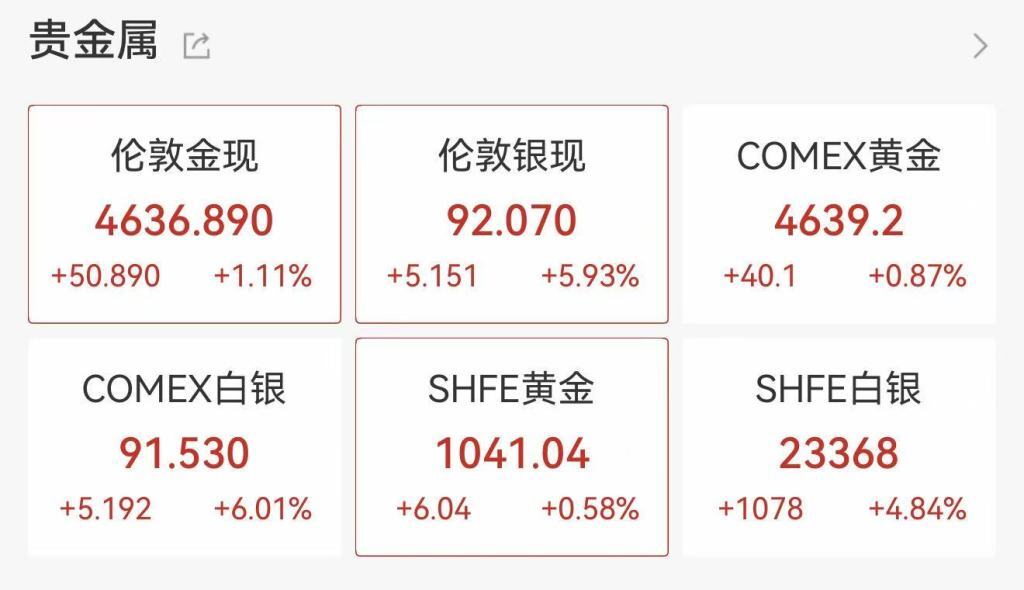
Group 1: Precious Metals Performance - Silver reached an all-time high of $92 per ounce on January 14, 2026, with a daily increase of nearly 6% and a year-to-date gain exceeding 28% [1] - Gold also hit a historical peak of $4641.853 per ounce, with a year-to-date increase of over 7% [1] - The strong performance of precious metals is attributed to rising geopolitical risks, persistent shortages in the physical market, and concerns regarding the independence of the Federal Reserve [4][6] Group 2: Market Dynamics and Predictions - Citigroup raised its three-month price target for gold to $5000 per ounce and for silver to $100 per ounce, citing factors such as geopolitical risks and market shortages [1][6] - Silver's market capitalization surpassed $5.045 trillion, making it the second-largest asset globally, just 14 days after it became the third-largest [5] - The demand for silver is driven by industrial needs, particularly in solar energy and green technology sectors, alongside investment demand due to uncertainties in the geopolitical and economic landscape [5][6] Group 3: Industrial Metals Performance - Industrial metals like copper and tin also saw significant price increases, with copper reaching a historical high of $13407 per ton and tin surpassing $54000 per ton [7][11] - The ongoing "super copper cycle" is driven by advancements in AI technology and shifts in global order, suggesting further upward potential for copper prices [9] - Tin prices have surged nearly 34% year-to-date, influenced by active trading and strategic investments in semiconductor technologies [11]
贵金属狂欢继续,白银史上首次站上90美元关口,铜、锡再创新高!
Hua Er Jie Jian Wen· 2026-01-14 11:53
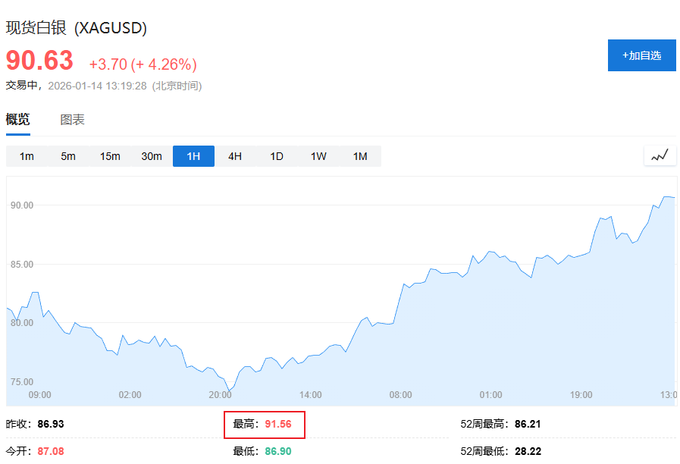
Group 1: Precious Metals Market Overview - Spot silver reached a historic high of $90.63 per ounce, marking a 4.26% increase on January 14, with a year-to-date rise of 25% [1] - Spot gold also increased, currently priced at $4637 per ounce, with ANZ Bank predicting gold prices will exceed $5000 per ounce in the second half of 2026 [3] Group 2: Price Forecasts and Influencing Factors - Citigroup raised its short-term precious metals price targets, increasing the silver price forecast from $62 to $100 per ounce, a rise of over 60%, citing geopolitical risks, physical shortages, and uncertainty regarding the Federal Reserve's independence as key drivers [4] - Following the release of the December CPI data, traders increased bets on an earlier rate cut by the Federal Reserve, raising the probability of a rate cut in April from 38% to 42%, which contributed to the surge in silver prices [7] Group 3: Industrial Metals Performance - Industrial metals, including copper and tin, have also seen significant gains, with LME copper reaching an all-time high and tin prices rising nearly 6% to $52,495, surpassing previous highs from 2022 [4] - Tin prices have surged nearly 40% last year and over 25% in 2026, driven by strong investments in artificial intelligence and data centers, indicating a bullish sentiment in the commodity market [8]

全球贵金属狂潮持续!白银史上首破90美元
第一财经· 2026-01-14 09:40
Core Viewpoint - The global precious metals market continues to surge, with silver prices surpassing $90 per ounce for the first time and gold prices hovering near historical highs, driven by geopolitical tensions and expectations of further interest rate cuts by the Federal Reserve [6][7][8]. Group 1: Precious Metals Performance - Silver prices soared by 5.3%, reaching a historical high of $91.5535 per ounce, while gold is just $10 away from its peak [7]. - Year-to-date, spot gold has increased by nearly 7%, and spot silver has surged by 23%, with platinum also rising by 15% [7]. - The price increases are built on last year's significant gains of 145% for gold and 65% for silver [7]. Group 2: Market Influences - The conflict between U.S. President Trump and Federal Reserve Chairman Powell has raised concerns about the independence of the Fed, contributing to the rise in precious metals [7][8]. - Geopolitical dynamics, including situations in Venezuela and Iran, have further fueled demand for safe-haven assets [8]. - Citi has raised its three-month price forecasts for gold and silver to $5,000 per ounce and $100 per ounce, respectively [8]. Group 3: Industrial Metals Trends - LME tin prices reached a historical high of $51,675 per ton, driven by increased demand from the electronics sector [11]. - Copper prices have also surged, hitting a record of $13,387.50 per ton, supported by global demand recovery and AI infrastructure needs [11]. - Goldman Sachs has significantly raised its copper price forecast for the first half of 2026 from $11,525 per ton to $12,750 per ton, citing a "scarcity premium" [12]. Group 4: Investment Strategies - Investors are advised to consider the cyclical nature of industrial metals compared to gold, which is primarily driven by safe-haven and investment demand [13]. - The relationship between these metals and equities is crucial; low correlation may encourage further investment in precious metals as a hedge against tail risks [13].

刚刚!A股突变!
天天基金网· 2026-01-14 08:40
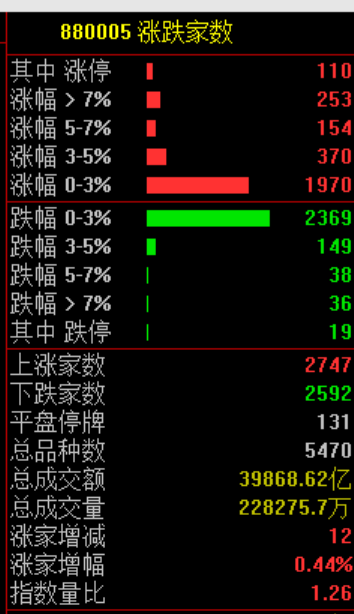
收盘了!今天的市场,无需多言,依旧火热, 全市场今日成交近4万亿元,再创历史新高。 一起看看发生了什么事情。 1月14日,市场全天冲高回落,三大指数涨跌互现。截至收盘, 沪指跌0.31%,深成指涨0.56%, 创业板指涨0.82%。 市场共 2747只个股上涨,110只个股涨停,2592只个股下跌。 | 880005 张跌家数 | | | | --- | --- | --- | | 日 | 涨停 | 110 | | 涨幅 | > 7% | 253 | | 涨幅 | 5-7% | 154 | | 涨幅 | 3-5% | 370 | | 涨幅 | 0-3% | 1970 | | 跌幅 | 0-3% | 2369 | | 跌幅 | 3-5% | 149 | | 跌幅 | 5-7% | 38 | | 跌幅 | > 7% | 36 | | 其中 跌停 | | 19 | | | | 2747 | | 上涨5秒 下载索数 新闻博报 总面帮助 | | 2592 | | | | 131 | | | | 5470 | | 总成交额 | | 39868.62亿 | | 总成交量 | | 228275.7万 | | 涨家增减 | | ...







A股突发,尾盘巨额压单
Zhong Guo Ji Jin Bao· 2026-01-14 08:33
Market Overview - The A-share market experienced a record trading volume of nearly 4 trillion yuan, setting a historical high [1] - The three major indices showed mixed results, with the Shanghai Composite Index down 0.31%, while the Shenzhen Component Index rose by 0.56% and the ChiNext Index increased by 0.82% [1] Stock Performance - A total of 2,747 stocks rose, with 110 hitting the daily limit up, while 2,592 stocks declined [1][2] - The trading statistics included 253 stocks with gains over 7%, 154 stocks gaining between 5-7%, and 370 stocks rising between 3-5% [2] Financing Margin Adjustment - The China Securities Regulatory Commission approved an adjustment to the financing margin ratio, increasing the minimum margin for buying securities on margin from 80% to 100% [3] - This adjustment is expected to reduce the leverage available for investors, potentially leading to a contraction in financing transactions and putting pressure on high-volatility sectors [6] Market Impact - The adjustment aims to prevent excessive leverage in financing transactions, thereby reducing market volatility risks and the potential for cascading declines due to margin calls [7] - The actual impact on the market is expected to be limited, as existing financing contracts will remain unchanged, and the overall financing balance in the A-share market is considered reasonable [8] End-of-Day Trading Activity - A notable occurrence was the appearance of large sell orders for several heavyweight stocks during the closing auction, with China Merchants Bank seeing sell orders exceeding 6.5 billion yuan [8] - Other stocks with significant sell orders included Zijin Mining, Yangtze Power, and China Aluminum, each with sell orders exceeding 1 billion yuan [8]
A股突发,尾盘巨额压单
中国基金报· 2026-01-14 08:27
Market Overview - The A-share market remains active with a total trading volume of nearly 4 trillion yuan, setting a new historical high [2] - On January 14, the market experienced fluctuations with the Shanghai Composite Index down by 0.31%, while the Shenzhen Component Index and the ChiNext Index rose by 0.56% and 0.82% respectively [2] Stock Performance - A total of 2,747 stocks rose, with 110 hitting the daily limit up, while 2,592 stocks declined [3] - The trading statistics show that 253 stocks increased by more than 7%, and 154 stocks rose between 5% to 7% [3] Financing Margin Adjustment - The China Securities Regulatory Commission approved an adjustment to the financing margin ratio, increasing the minimum margin for financing purchases from 80% to 100% [4] - This adjustment means investors can no longer leverage their purchases, which may lead to a short-term reduction in market liquidity, particularly affecting high-volatility sectors like small-cap stocks [5][6] Long-term Implications - The adjustment is seen as a measure to mitigate excessive leverage risks in the market, potentially stabilizing the stock market in the long run [5] - It is expected to enhance the A-share market's resilience against risks, laying a foundation for healthy long-term development [5] End-of-Day Trading Activity - Notable end-of-day trading activity included significant sell orders for several major stocks, with China Merchants Bank seeing a sell order amount exceeding 6.5 billion yuan [6][7] - Other companies with substantial sell orders included Zijin Mining, Yangtze Power, and China Aluminum, each with orders exceeding 1 billion yuan [6][7]

从银价波动看“变乱交织、动荡加剧”
工银国际· 2026-01-14 08:23
Group 1: Market Trends - Recent silver price fluctuations indicate increased volatility and a lack of single-factor explanations for price movements[1] - Major commodity prices are experiencing frequent adjustments, reflecting a transition from old equilibrium to a new, unstable state[1] - The price adjustment frequency has increased, suggesting that the market is still calibrating its long-term structure[1] Group 2: Structural Changes - Since 2016, the volatility of major commodity price indices has shown a synchronized increase, particularly around 2020 and 2022[2] - The global manufacturing system is undergoing restructuring, with new energy transitions and digital expansions affecting demand for industrial materials[3] - The cost structure is changing due to decreased elasticity in traditional energy supply and the sensitivity of energy prices to geopolitical and policy expectations[3] Group 3: Pricing Dynamics - Supply constraints and demand differentiation have led to more pronounced price jumps in the commodity market[7] - The relationship between inventory levels and price changes has shown instability, indicating that single supply-demand signals are insufficient for price explanations[7] - Financial participation in the market has intensified, altering pricing mechanisms and increasing sensitivity to marginal changes[8]
2026年有色金属的思考总结与展望
雪球· 2026-01-14 07:41
Core Viewpoint - The article discusses the significant changes in the pricing logic of non-ferrous metals, emphasizing the rise of strategic resource populism as a key factor influencing market pricing, particularly after the implementation of equal tariffs in the second half of 2025 [2][3]. Non-Ferrous Metals Market Analysis - The traditional pricing framework for non-ferrous metals has been driven by global macro liquidity, economic expectations, and the US dollar index, but recent years have shown a divergence between metal prices and global economic indicators [4][6]. - The current economic environment is characterized by low global PMI levels, yet non-ferrous metal prices have outperformed expectations, indicating a shift in market dynamics influenced by monetary attributes and strategic reserve demands [4][7]. Trading Framework and Historical Performance - The core trading framework focuses on the economic cycle, particularly inventory cycles, with liquidity as an important extension. However, this framework has faced challenges in the non-ferrous metals sector due to unique supply and demand dynamics [6][7]. - Historical trading experiences highlight the importance of adhering to a core framework while recognizing the evolving market conditions, leading to successful investments in precious metals and strategic small metals [9][10]. Sector-Specific Insights - Precious Metals (Gold, Silver): The article notes a strong performance in gold and silver due to anticipated changes in US monetary policy and geopolitical tensions, with significant gains observed over the past three years [9][10]. - Strategic Small Metals (Antimony, Tungsten, Rare Earths): The author emphasizes early positioning in strategic small metals, benefiting from export controls and geopolitical shifts, resulting in substantial price increases [11][12]. - Industrial Metals (Copper, Aluminum): Despite a generally positive long-term outlook, concerns remain regarding the sustainability of demand due to ongoing issues in the real estate sector and uncertainties in US economic growth [13][14]. 2026 Outlook for Non-Ferrous Metals - The market for non-ferrous metals is expected to remain active, but the author advocates for a cautious approach, focusing on identifying clear entry points rather than participating in the current market excitement [16][17]. - Industrial metals are viewed with caution due to unresolved concerns about the real estate market and the sustainability of AI-driven capital expenditures, with a recommendation to monitor these sectors closely [17][18]. - For strategic small metals, the long-term outlook remains positive, but current high prices necessitate waiting for favorable entry points [20][21]. - Precious metals continue to show long-term benefits, but short-term caution is advised due to market volatility and the need for clear buying signals [21][22]. Conclusion - The article concludes that while the non-ferrous metals market is currently vibrant, the focus should remain on waiting for definitive buying opportunities rather than engaging in all market trends, emphasizing the importance of patience and strategic decision-making in investment [22][24].