
水利

Search documents
【数据发布】2025年1—4月份全国固定资产投资增长4.0%
中汽协会数据· 2025-05-19 07:11
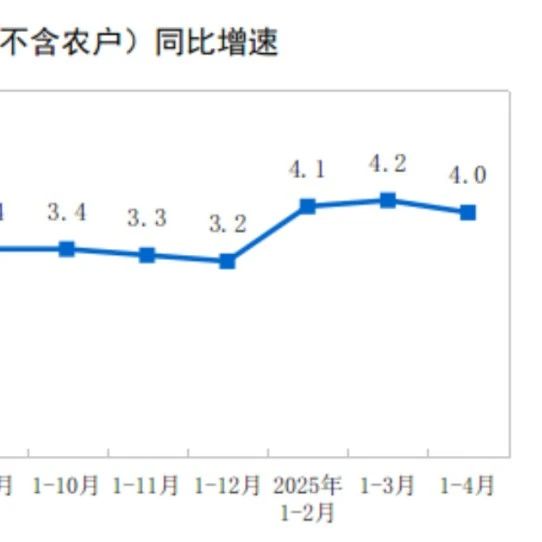
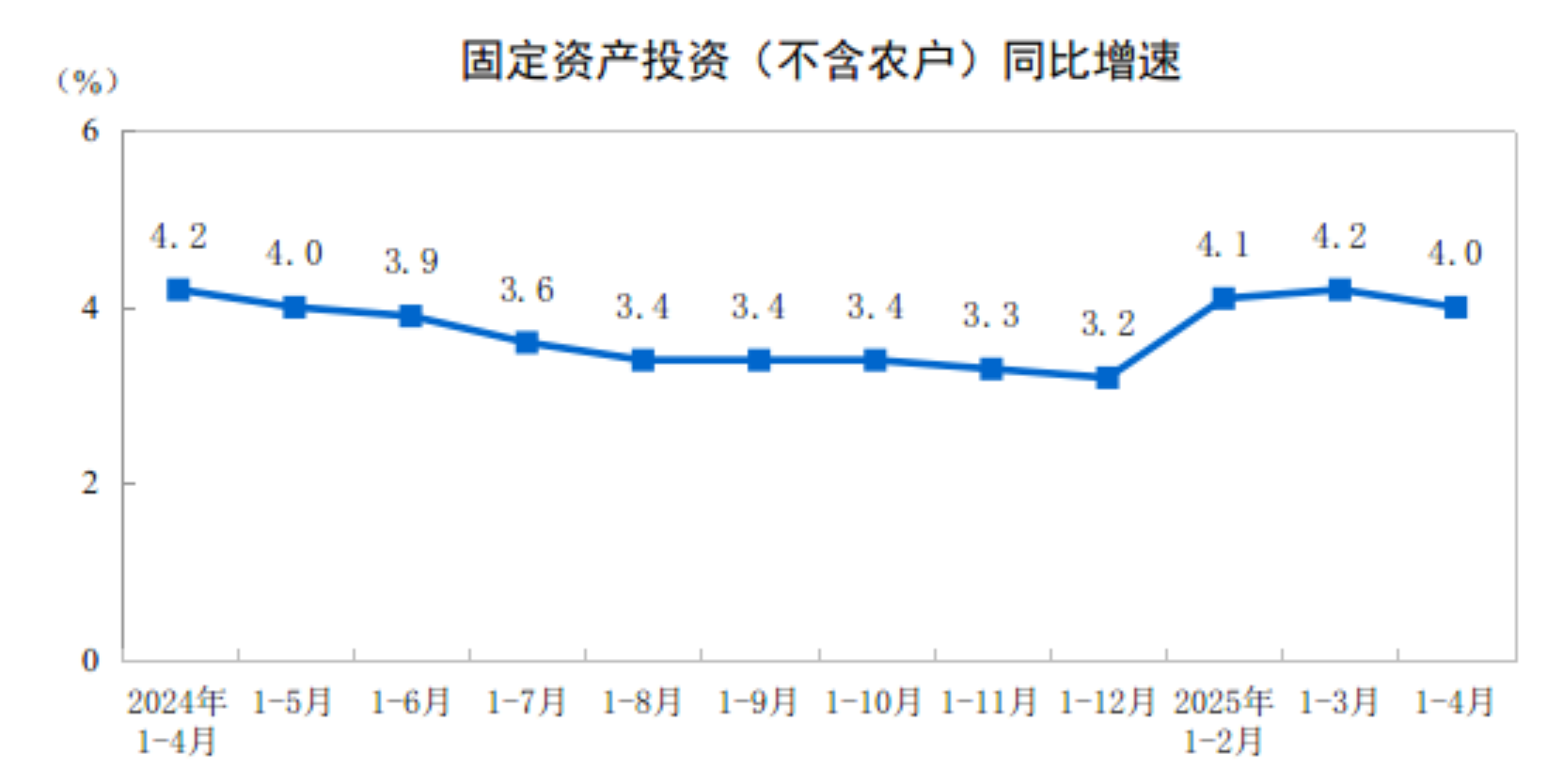
Core Viewpoint - The fixed asset investment in China for January to April 2025 shows a year-on-year growth of 4.0%, with private investment growing only 0.2%, indicating a mixed recovery in investment across different sectors and regions [1][2]. Investment Overview - Total fixed asset investment (excluding rural households) reached 14,702.4 billion yuan, with a year-on-year increase of 4.0% [1][2]. - The industrial investment grew by 11.7%, with mining investment increasing by 6.3% and manufacturing investment by 8.8% [1][2]. - The service sector experienced a decline of 0.2% in investment, highlighting challenges in this area [1][2]. Sector Analysis - First industry investment was 297.1 billion yuan, up 13.2% year-on-year [1][2]. - Second industry investment totaled 51,778 billion yuan, with notable growth in electricity, heat, gas, and water production and supply at 25.5% [1][2]. - Third industry infrastructure investment (excluding power, heat, gas, and water) grew by 5.8%, with water management investment surging by 30.7% [1][2]. Regional Investment Trends - Eastern region investment grew by 1.3%, while the central region saw a 4.8% increase, and the western region grew by 5.3% [1][2]. - The northeastern region had the highest growth at 7.6%, indicating a regional disparity in investment performance [1][2]. Investment by Registration Type - Domestic enterprises' fixed asset investment increased by 3.9%, while investment from Hong Kong, Macau, and Taiwan enterprises rose by 9.2% [1][2]. - Foreign enterprises, however, saw a significant decline in investment by 11.4%, reflecting potential challenges in attracting foreign capital [1][2].

2025年1—4月份全国固定资产投资增长4.0%
Guo Jia Tong Ji Ju· 2025-05-19 02:01
Core Insights - In the first four months of 2025, China's fixed asset investment (excluding rural households) reached 14,702.4 billion yuan, showing a year-on-year growth of 4.0% [2][4] - Private fixed asset investment grew by only 0.2% year-on-year, indicating a sluggish performance in this sector [2][4] Investment by Industry - Investment in the primary industry was 297.1 billion yuan, with a year-on-year increase of 13.2% [3][4] - The secondary industry saw an investment of 51,778 billion yuan, growing by 11.7% year-on-year, with notable growth in manufacturing and energy sectors [3][4] - The tertiary industry experienced a decline of 0.2% year-on-year, with infrastructure investment (excluding energy sectors) increasing by 5.8% [3][4] Investment by Region - Eastern regions reported a year-on-year investment growth of 1.3%, while central, western, and northeastern regions grew by 4.8%, 5.3%, and 7.6% respectively [3][4] Investment by Ownership Type - Domestic enterprises' fixed asset investment increased by 3.9%, while investment from Hong Kong, Macau, and Taiwan enterprises rose by 9.2%. In contrast, foreign enterprises saw a significant decline of 11.4% [3][4][5]
2024年平均工资数据出炉,平稳增长背后有啥新趋势?
Sou Hu Cai Jing· 2025-05-17 03:11
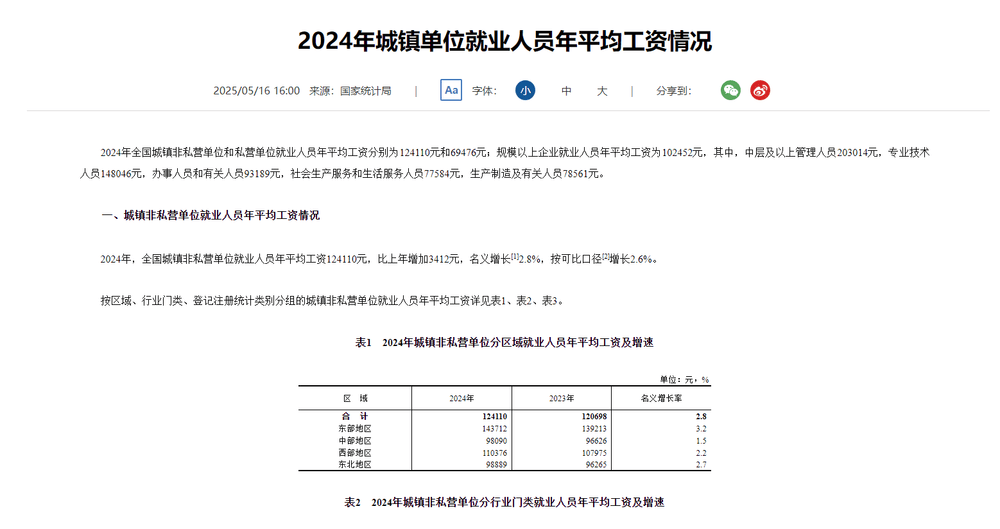
Group 1 - The average annual salary for urban non-private sector employees in 2024 is 124,110 yuan, reflecting a nominal growth of 2.8% and a comparable growth of 2.6% [4] - The average annual salary for urban private sector employees is 69,476 yuan, with a nominal growth of 1.7% and a comparable growth of 4.0% [4] - The average annual salary for employees in large-scale enterprises is 102,452 yuan, showing a nominal growth of 4.4% and a comparable growth of 4.2% [4] Group 2 - The highest average salary levels in urban non-private and private sectors are found in the information transmission, software and information technology services, financial services, and scientific research and technical services industries [5] - The lowest average salary levels are concentrated in agriculture, forestry, animal husbandry, fishery, accommodation and catering, water conservancy, environmental and public facilities management, and other service industries [5] Group 3 - The data indicates a trend of narrowing wage disparities across different industries, regions, and job positions [6][10] - The stability in wage levels across industries suggests a correlation with the overall stabilization of the macroeconomic environment [8] - The information transmission and software services industry has maintained the highest average salary for several years, attributed to the growth of the digital economy [8][10]
多部门权威解读民营经济促进法!更多配套制度机制将出
券商中国· 2025-05-08 12:37
Core Viewpoint - The introduction of the "Private Economy Promotion Law" marks a significant milestone in the development of the private economy in China, establishing a legal framework to support and protect private enterprises, ensuring fair competition and promoting high-quality development [5][6]. Group 1: Legislative Framework - The "Private Economy Promotion Law" consists of 9 chapters and 78 articles, focusing on fair competition, investment financing, technological innovation, operational regulation, service guarantees, and rights protection [5]. - This law is the first to explicitly state the legal status of the private economy and emphasizes the long-term commitment of the state to support its development [6]. Group 2: Implementation and Support Mechanisms - Various supporting systems are being accelerated, including investment financing promotion, technological innovation, service guarantees, and rights protection [2][9]. - The National Development and Reform Commission is working on a long-term mechanism for private enterprises to participate in major national projects, with an investment scale of approximately 3 trillion yuan in key areas such as transportation, energy, and urban infrastructure [4][10]. Group 3: Administrative Oversight - The Ministry of Justice is establishing a mechanism for handling complaints about administrative law violations, aiming to address issues such as arbitrary fees and inspections [4][8]. - The law includes provisions to regulate administrative enforcement behaviors, ensuring that enterprises can report violations effectively [7][8]. Group 4: Financial Support for Private Enterprises - Over the past five years, the average growth rate of loans to private enterprises has been 1.1 percentage points higher than that of other loans, with a loan balance of 76.07 trillion yuan as of Q1 2025, reflecting a year-on-year growth of 7.41% [12][13]. - The financial regulatory authority is focusing on targeted financial services for key sectors and is promoting innovative financing methods to support technology-driven enterprises [13][14]. Group 5: Future Directions - The government is committed to further enhancing the legal and institutional framework to support the private economy, with ongoing efforts to refine policies and regulations [9][11]. - The focus will also be on improving the business environment for private enterprises, ensuring their rights and interests are protected during the implementation of the law [11].

确保“双过半” 河南亮出经济发展新“底牌”
Zhong Guo Chan Ye Jing Ji Xin Xi Wang· 2025-05-06 08:24
Core Viewpoint - In the first quarter of this year, Henan Province's GDP grew by 5.9% year-on-year, outperforming both the same period last year and the entire previous year, indicating a strong economic start for the province [1] Economic Growth and Policy Measures - Henan Province has released a series of policy measures titled "1+7" to ensure economic growth in the second quarter, focusing on expanding demand, stabilizing enterprises, and promoting development [1][2] - The "1" in the "1+7" series refers to the overarching policy measures, while the "7" includes specific actions such as boosting consumption, infrastructure investment, foreign trade, and support for key enterprises [1][2] Consumption and Investment Strategies - The policy measures aim to stimulate consumption through various initiatives, including a special action plan for consumption and promotional activities to enhance consumer spending [2][3] - The province plans to implement a "circular economy" approach by promoting the replacement of old consumer goods, particularly in sectors like automotive and home appliances, to enhance consumption quality and quantity [3] Infrastructure Investment - Henan Province has experienced a decline in infrastructure investment, with a 10.5% year-on-year decrease in the first quarter, which is significantly lower than the national average [3] - In response, the provincial government has introduced 14 measures to boost infrastructure investment, focusing on major projects and enhancing coordination across different sectors [3]
重大基础设施投资力度加大
Jing Ji Ri Bao· 2025-05-05 22:10
Core Viewpoint - The national economy shows a positive start in the first quarter of this year, with significant growth in fixed asset investment and infrastructure investment, indicating a robust economic recovery and development strategy. Group 1: Economic Performance - In the first quarter, national fixed asset investment (excluding rural households) reached 10,317.4 billion yuan, a year-on-year increase of 4.2%, accelerating by 1.0 percentage points compared to the previous year [1] - Infrastructure investment grew by 5.8% year-on-year, which is an acceleration of 1.4 percentage points compared to the previous year [1] Group 2: Infrastructure Financing - The China Development Bank has issued 369.1 billion yuan in infrastructure loans in the first quarter, with the proportion of infrastructure loans in total loans steadily increasing [1] - The bank is focusing on supporting key areas such as transportation, energy, water conservancy, smart cities, and smart logistics, facilitating the advancement of 102 major projects outlined in the 14th Five-Year Plan [1] Group 3: Major Projects - Dalian Jinzhou Bay International Airport, part of the 102 major projects, is being constructed on an artificial island through offshore reclamation, with significant progress made in foundational work [2] - The project is expected to be completed by 2028 and will become the largest offshore airport globally, enhancing the transportation network by connecting sea, land, air, and rail [2] - The South-to-North Water Diversion Middle Line Xiong'an Regulation Reservoir is another major water conservancy project, with tailored financing solutions provided to support its construction [2] Group 4: Future Directions - The China Development Bank plans to strengthen its functional positioning, focusing on its main responsibilities and continuously improving its service and product system covering the entire lifecycle of infrastructure projects [3]
《郑州市重大基础设施建设专项行动方案》出台
Zheng Zhou Ri Bao· 2025-04-30 02:39
Group 1 - The core viewpoint of the article is the launch of the "Zhengzhou Major Infrastructure Construction Special Action Plan" aimed at accelerating the construction of 75 major infrastructure projects across various sectors including transportation, water conservancy, energy, municipal, and new infrastructure [1][2][3] Group 2 - The plan emphasizes the completion of ongoing projects and the initiation of new ones, creating a continuous and efficient construction momentum [1] - In the transportation sector, the focus is on expediting the construction of rail transit lines 6, 7, and 8, with all projects expected to be completed within the year [1] - The plan includes significant road and waterway projects, such as the completion of the Anlu Expressway and the construction of the G310 highway segment, with various projects set to commence within the year [1][2] Group 3 - In the water conservancy sector, the plan aims to accelerate the implementation of the Qili River flood diversion project and ensure the commencement of the Miaowan Reservoir project by the end of June [2] - The energy sector will see increased investment, particularly in the construction of the Houzihua Pumped Storage Power Station and related projects [2] - Municipal infrastructure projects will be prioritized, including the rapid construction of key roadways and drainage systems to address urban flooding [2] Group 4 - The plan also highlights the importance of new infrastructure, particularly the construction of 5G base stations to enhance network capacity [3]
一季度辽宁省固定资产投资同比增长7.8% 实现首季“开门红”
Sou Hu Cai Jing· 2025-04-21 08:24
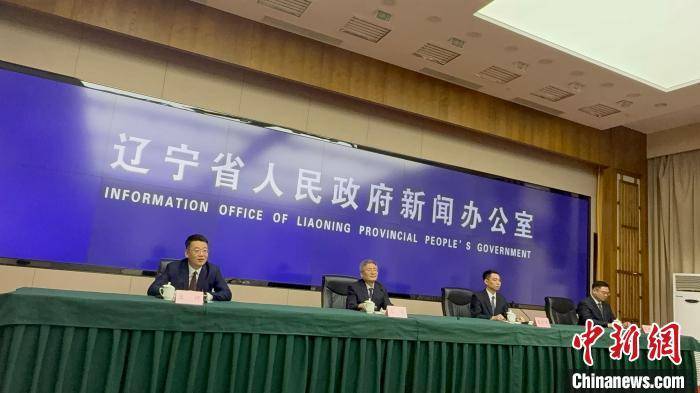
Group 1 - The core viewpoint of the news is that Liaoning Province achieved a significant year-on-year growth of 7.8% in fixed asset investment in the first quarter of 2025, surpassing the national average of 4.2% by 3.6 percentage points, marking a strong start to the year [1][2][4] Group 2 - Investment performance in Liaoning is improving, with 10 cities showing investment growth rates higher than the national average. Cities such as Huludao, Fushun, and Jinzhou experienced growth rates exceeding 20%, while Fuxin, Chaoyang, Tieling, and Panjin exceeded 10% [2][3] - The investment structure is optimizing, with manufacturing investment increasing by 13.2%, accounting for 26.7% of total investment, up by 1.2 percentage points from the previous year. Notably, investment in the aerospace and equipment manufacturing sector surged nearly 2.4 times, and investment in electronic and communication equipment rose by 32.7% [2][3] - Infrastructure investment grew by 13.8%, making up 34.5% of total investment, an increase of 1.8 percentage points year-on-year. Road transport investment alone increased by 46.7%, contributing to an 8.3 percentage point rise in infrastructure investment [2][3] Group 3 - In key sectors, public service levels are improving, with wholesale and retail investment soaring by 70.1%. The rental and business services sector grew by 54.7%, and transportation, storage, and postal services increased by 35.7%. Education investment rose by 61.9%, and investment in health and social work grew by 18.9% [3] - As of now, Liaoning has over 17,000 reserve projects with a total investment exceeding 9.6 trillion yuan. In the first quarter of 2025, the number of construction projects reached 7,850, with investment growth of 14.9%. Projects with over 100 million yuan saw a 22% increase in investment [3][4] Group 4 - The government aims to achieve a fixed asset investment growth target of around 8% in the next phase, focusing on expanding effective investment and stimulating private investment to support comprehensive revitalization efforts [4][5]
【招银研究|宏观点评】“开门红”超预期——中国经济数据点评(2025年一季度及3月)
招商银行研究· 2025-04-16 13:13
一是结构上产需同步向好。 一季度,外需增速高于生产和内需。"抢出口"效应下以人民币计价的出口同比增 速达6.9%。内需提振政策效果延续,社零和投资分别增长4.6%、4.2%。其中,基建(11.5%)和制造业投资 (9.1%)保持高增,房地产投资(-9.9%)拖累减弱。生产端工业增加值增长6.5%,增速为2022年以来的次高 值。值得注意的是,供给强于需求的格局仍在继续,一季度产能利用率(74.1%)和产销率(94.6%)均略超 季节性回落。 图1:3月内外需求增速均有提升 资料来源:Wind,招商银行研究院 图2:消费提振,投资分化 资料来源:Wind,招商银行研究院 二是节奏上前稳后高。 3月多数经济数据增速较1-2月改善。生产加快修复,3月规模以上工业增加值同比增速 上行1.8pct至7.7%。需求端以基建投资好转最为显著,3月增速大幅提升2.6pct至12.6%。社零增速表现亮眼,3 月增速提升1.9cpt至5.9%,达到2020年以来的最高值【注释1】。制造业投资增速微升,房地产投资增速微 降。 图3:房地产销售降幅略有收窄,投资降幅再度扩张 一、总览:供需两旺 一季度我国经济开局良好,实际GDP同比 ...
今年以来长江流域降水量偏少三成,三峡水库实施保春灌补水调度
Xin Jing Bao· 2025-04-09 07:34
今年以来,长江流域降水量偏少三成,其中长江中下游偏少近四成,流域约50%面积出现气象干旱,长 江中下游主要控制站水位较历史同期偏低2.3米至3.3米,沿线耕地春灌需求旺盛、灌溉供水保障压力 大。 会商研究决定,实施三峡水库保春灌补水调度,自4月8日起加大三峡水库下泄流量,按日均出库流量 10000立方米每秒控制,预计长江中下游沙市至湖口江段水位将抬升2.0米至0.7米,可明显提高沿江灌溉 取水水深、增加取水流量,有力保障长江中下游春灌用水需求,助力粮食生产安全。 新京报讯 据水利部消息,4月7日,水利部长江水利委员会召开专题防汛会商,决定自4月8日起,实施 三峡水库保春灌补水调度,保障长江中下游春灌用水需求。同时,开展三峡水库库尾减淤调度。 同时,本次保春灌补水调度期间相关条件基本满足三峡水库库尾河段走沙要求,为减轻三峡库尾河段淤 积、优化淤积分布、保障三峡水库防洪库容安全,会商决定同期实施三峡水库库尾减淤调度。在确定补 水调度流量时,充分考虑三峡库尾减淤调度需要,并会同三峡集团组织开展调度前后三峡水库库尾河段 水下地形监测,科学评估三峡库尾减淤调度效果。 会商强调,各部门各单位要全面进入汛期工作状态,坚持旱 ...