
制造业

Search documents
太原新春招聘月正月初八将启幕
Xin Lang Cai Jing· 2026-02-18 02:52
Core Viewpoint - The "New Spring Recruitment Month" series of events will commence on February 24, 2026, in Taiyuan, lasting for 23 days throughout the Spring Festival, aimed at providing job opportunities for graduates [1][2]. Group 1: Event Details - The first large-scale recruitment fair for graduates will take place on February 24 and 25, featuring nearly 100 employers with job openings for both recent and former graduates, offering over 5,000 job positions [1]. - The recruitment events will include various types of fairs, such as a comprehensive recruitment fair from February 26 to March 3, and a second graduate recruitment fair on March 4 and 5 [2]. Group 2: Participating Companies and Industries - The participating companies span multiple popular industries, including manufacturing, education, internet, mechanical and electrical, automotive trade, construction and environmental protection, modern services, and finance [1]. - Notable companies such as Foxconn, Liuweizhai, and Forbes Education will be present, alongside local high-quality growing enterprises, providing diverse job options for graduates of different majors and educational backgrounds [1].
经济总量破500亿元大关
Xin Lang Cai Jing· 2026-02-17 17:35
Economic Performance - The GDP of Geermu City is projected to reach 50.732 billion yuan in 2025, marking a year-on-year growth of 10.8% at constant prices, surpassing the 50 billion yuan milestone [1] - The secondary industry is identified as the core growth engine, achieving an added value of 37.574 billion yuan, with a year-on-year increase of 13.6% [1] - The industrial added value for large-scale enterprises grew by 18%, while the manufacturing sector saw a significant increase of 24.2% [1] Industrial Growth - The production of lithium carbonate reached 148,100 tons, reflecting a growth of 26.7%, alongside substantial increases in the output of gold, silver, and lead [1] - The three industrial sectors' structure has been optimized to 1.8:74.1:24.1 [1] Agricultural Development - The total output value of agriculture, forestry, animal husbandry, and fishery is reported at 1.358 billion yuan, with increases in goji berry planting area and output [1] - Livestock numbers and the planting area for vegetables and edible fungi have steadily increased, contributing to rural revitalization [1] Investment and Consumption - Fixed asset investment has slightly decreased, but private investment and infrastructure investment have increased by 62.1% and 170% year-on-year, respectively, with 90 new projects added [1] - The total retail sales of consumer goods reached 6.063 billion yuan, with a 4.7% growth in the catering industry, indicating a gradual activation of domestic demand [1] Income and Public Finance - The per capita disposable income for residents is reported at 44,561 yuan, with a year-on-year growth of 5.5%, and rural income growth outpacing urban income [2] - Local public finance budget revenue is 2.413 billion yuan, reflecting a growth of 2.5%, with health and wellness expenditures increasing by 11.9% [2] Transportation and Mobility - Passenger transport volume reached 4.6562 million, showing a year-on-year increase of 6.3%, with air passenger transport growth exceeding 10% [2]
九州同春启新程 万家灯火映山河
Xin Lang Cai Jing· 2026-02-17 17:34
Group 1 - The integration of traditional customs with modern elements is evident, showcasing a vibrant atmosphere during the Spring Festival across various regions in China [2][3][4] - The popularity of winter sports during the Spring Festival is highlighted, with ski resorts becoming key venues for celebrations, attracting numerous visitors [2][3] - The transportation infrastructure improvements, such as new high-speed rail connections, have significantly boosted tourism in areas like Yan'an and Chongqing, enhancing local economies [4][5] Group 2 - The festive market atmosphere is thriving, with a notable increase in demand for traditional New Year's Eve dinners, as evidenced by a 105% year-on-year increase in reservations [5][6] - Various local markets are bustling with activity, offering a wide range of products, from handmade crafts to fresh produce, reflecting the richness of local culture and consumer preferences [5][6] - The rise of experiential travel, particularly in nearby destinations, is becoming a preferred choice for families during the holiday season, indicating a shift in consumer behavior [7] Group 3 - The overall economic vitality is reflected in the bustling activities across different sectors, including tourism, retail, and local businesses, contributing to a positive outlook for the new year [8][9] - Innovations in technology and consumer engagement are evident, with increased foot traffic in stores and attractions, showcasing a blend of tradition and modernity [9][10] - The commitment to productivity and progress is underscored by ongoing research and development efforts in various scientific fields, emphasizing the importance of continuous innovation [10]
美国关税制裁一年,中国经济不降反增,美国民众扛下所有
Sou Hu Cai Jing· 2026-02-17 13:19
Core Viewpoint - The U.S. tariffs imposed on China have not achieved their intended goals of suppressing the Chinese economy or forcing a global supply chain shift, as China continues to show robust economic growth despite the pressures [2][21][27]. Economic and Trade Changes - Despite the ongoing tariff pressures, China's manufacturing sector remains active, with factories working hard to meet orders, indicating a stable growth in export orders [5][11]. - The core advantages of Chinese manufacturing, such as complete industrial support, efficient production, and stable supply capabilities, make it difficult for global companies to abandon the Chinese market [7][9]. Supply Chain Dynamics - Many companies have only partially relocated their production capacities rather than completely withdrawing from China, as doing so would require rebuilding supply chains and incur higher operational costs [9]. - U.S. buyers have gradually accepted the reality of the tariffs, choosing to continue cooperation with Chinese suppliers rather than forgoing high-quality products [11]. Impact of Tariffs on the U.S. - The tariffs have led to increased costs for U.S. consumers and businesses, with a significant portion of the tariff burden falling on American enterprises and the general public, contrary to initial claims that foreign companies would bear the costs [13][15]. - The rising prices of various goods, from clothing to electronics, have resulted in higher living costs for American families, putting pressure on the domestic economy [15][17]. Shift in U.S. Policy - The failure of the tariff policy and the economic pressure on the U.S. have prompted a softening of the U.S. stance towards China, with efforts to engage in dialogue and technical discussions [21][23]. - The realization that tariffs cannot sever the deep economic ties between the U.S. and China has led to a more pragmatic approach in U.S.-China relations, focusing on cooperation rather than unilateral sanctions [25][29]. Conclusion - China's economy has demonstrated resilience and growth despite external pressures, while the costs of the U.S. tariffs have primarily impacted American businesses and consumers, highlighting the drawbacks of unilateral trade protectionism [27][29][31].

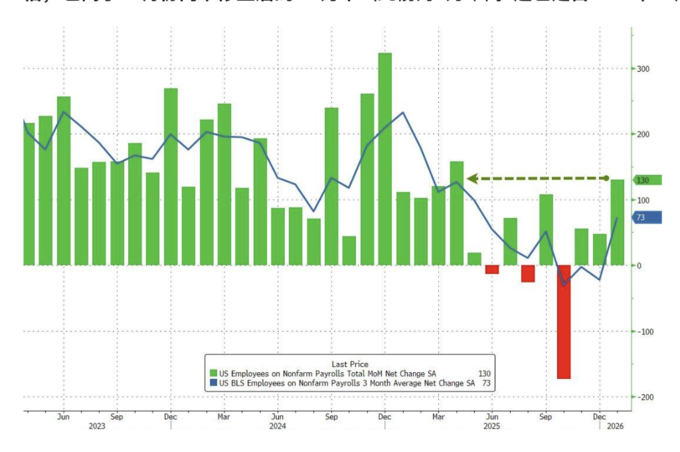
美国1月非农新增就业13万人,创去年4月以来最大增幅,失业率降至4.3%,年度下修86.2万!
Hua Er Jie Jian Wen· 2026-02-16 12:30
Core Viewpoint - The U.S. labor market shows resilience with January employment growth reaching a new high since December 2024, despite a surprising drop in the unemployment rate to 4.3%. However, significant downward revisions to previous employment data reveal a more substantial weakness in the labor market than previously understood [1][4]. Employment Growth and Revisions - In January, non-farm employment increased by 130,000, significantly exceeding market expectations of 65,000, marking the largest increase since April 2025 [1][7]. - The annual benchmark revision drastically lowered the total employment growth for 2025 from an initial report of 584,000 to 181,000, indicating a substantial correction in the understanding of last year's labor market performance [3][7]. - Monthly data revisions showed that the average monthly job growth last year was only 15,000, far below the initial estimate of 49,000 [7]. Sector Performance - The healthcare sector was the primary driver of employment growth in January, continuing to be a key engine for job expansion throughout 2025. Other sectors such as construction and professional services also saw job increases, while manufacturing recorded its first monthly growth of the year [8]. - Temporary help services continued to decline, with a reduction of 42,000 jobs in January, marking the fifth month of decline in the past six months [8]. Labor Market Stability - The January employment report indicates a gradual stabilization of the labor market after a year of cooling and low hiring activity. Despite expectations of overall weak job growth in 2026, clearer economic policy expectations and easing labor cost pressures may lead some employers to reconsider hiring plans [10]. - Job quality improved, with full-time positions increasing by 582,000 and part-time positions by 31,000. The unemployment rates for major demographic groups showed slight declines, with youth unemployment at 13.6% and adult male and female rates at 3.8% and 4.0%, respectively [11]. Market Reactions and Future Outlook - Following the data release, U.S. stock futures and Treasury yields rose, with traders reducing bets on a rate cut in June, now expecting the first cut to be delayed until July. The strong January data, despite the annual revisions, presents a complex picture for the Federal Reserve in assessing future rate cuts [6][12]. - The labor market's underlying fragility revealed by the revisions may provide the Federal Reserve with more room for policy adjustments [6].
2026年中美经济差距有望逆转,差距逐步收敛,市场表现可期
Sou Hu Cai Jing· 2026-02-16 10:26
Group 1 - The value of gold in global central banks is projected to exceed the value of US Treasury bonds for the first time by mid-2025, marking a significant shift in the financial landscape [1] - Central banks are increasingly investing in gold, indicating a move away from the dominance of the US dollar, which has been a longstanding trend in global finance [3][9] - The Chinese economy is expected to reach a GDP of 140.2 trillion yuan in 2025, with a stable growth rate of 5.0%, driven by a transformation in production capabilities known as "new quality productivity" [3][5] Group 2 - The rise of AI, exemplified by the launch of the domestic model DeepSeek, showcases China's advancements in technology and its competitive position in the global tech landscape [3][5] - In 2025, Chinese manufacturers are projected to dominate the global humanoid robot market, reflecting the country's strength in hard technology [5] - The manufacturing sector, particularly high-tech manufacturing, is expected to outpace overall industrial growth, indicating a shift towards innovation-driven economic growth [5] Group 3 - The US CPI rose by 2.4% year-on-year in January 2026, lower than market expectations, providing the Federal Reserve with room to consider interest rate cuts [7] - The US dollar index fell by approximately 10% in 2025, marking one of the largest annual fluctuations since 1973, while the Chinese yuan has shown a strengthening trend [7][9] - The shift in foreign investment attitudes towards Chinese assets is moving from cautious observation to planned allocation, as indicated by the performance of Asian tech stocks compared to US tech stocks [9] Group 4 - The anticipated performance of Chinese indices, with MSCI China expected to rise by 20% and the CSI 300 by 12% in 2026, is supported by a projected acceleration in corporate profit growth from 4% in 2025 to 14% in 2026 [9] - The transition in economic dynamics is characterized by China's focus on quality improvement and technological advancement, contrasting with the US's challenges in normalizing monetary policy amid inflation and employment pressures [11] - The surpassing value of gold over US Treasury bonds may signal a significant shift in the global asset valuation framework, prompting market participants to prepare for a restructured investment landscape [11]

对等关税失控,特朗普必须辞职,85岁佩洛西出山,美国人民已站队
Sou Hu Cai Jing· 2026-02-16 06:57
Group 1 - Trump's tariff policy is reshaping global trade rules, demanding other countries to accept increased import tariffs to weaken competitors and secure a favorable position for the U.S. in global trade [1] - The tariff war has spiraled out of control, with the White House unable to manage the fallout, leading to public protests and political pressure on Trump [3][5] - The rising prices of imported goods are significantly increasing the cost of living for American citizens, leading to widespread protests and potential political repercussions for the Republican Party [5][9] Group 2 - The Democratic Party is seizing the opportunity to criticize Trump's policies, with figures like Pelosi drawing historical parallels to the Great Depression and advocating for impeachment [7][9] - Trump's tariff policy is seen as a self-destructive path that could lead to a vicious cycle in global trade, with his approval ratings dropping to 43% and only 37% support for his economic policies [9] - The global supply chain is under severe strain, with many developing countries facing halted infrastructure projects and multinational companies forced to rethink production strategies [16][18] Group 3 - The EU, traditionally an ally of the U.S., is responding to Trump's tariffs with countermeasures, leading to a deterioration of relations and a shift towards new market partnerships [17] - The expectation that the U.S. could benefit from the tariff policy has backfired, resulting in trade barriers and escalating tensions in global markets [18] - The only viable path for the U.S. is to engage in equal dialogue with China to resolve trade issues, as previous attempts to suppress China through tariffs have led to economic crises domestically [20]
成都双流:硬核“拜年”把政策“兑”进企业心坎里
Xin Lang Cai Jing· 2026-02-16 06:48
Group 1 - The article highlights the efforts of Chengdu Shuangliu District to enhance government-enterprise communication and support industrial economic growth through initiatives like the "Sending Spring Festival Couplets, Policies, and Services" campaign [1][2] - A total of over 100 million yuan in subsidies related to industrial policies and equipment upgrades were distributed to enterprises in the district before the Spring Festival [2] - The district aims to maintain its position as the top area in the city for the number of industrial enterprises and achieve a year-on-year industrial added value growth of 10.3%, marking the best performance in four years [2] Group 2 - By 2025, Shuangliu plans to have 485 industrial enterprises above designated size, with significant growth in specialized and innovative small and medium-sized enterprises [2] - The district is focused on creating a modern industrial system and enhancing its economic structure through targeted development strategies, including the "Smart Manufacturing Airport and Happy Park City" vision [3] - Key areas of focus include economic growth, industrial cultivation, and digital transformation to elevate the industrial economy from a large district to a strong district [3]
2025年12月韩国制造业PMI指数为50.1%,同比上升了1.1个百分点
Chan Ye Xin Xi Wang· 2026-02-16 01:42
2025年12月,韩国制造业PMI指数为50.1%,同比上升了1.1个百分点,环比上升了0.7个百分点;2025年 12月,亚洲制造业PMI指数为51.1%,环比上升了0.4个百分点。 相关报告:智研咨询发布的《2025-2031年中国制造业市场竞争格局分析及投资发展研究报告》 数据来源:中国物流与采购网 近一年韩国制造业PMI指数与亚洲制造业PMI指数走势图 ...

2025年12月加拿大制造业PMI指数为48.6%,同比下降了3.6个百分点
Chan Ye Xin Xi Wang· 2026-02-16 01:36
近一年加拿大制造业PMI指数与美洲制造业PMI指数走势图 数据来源:中国物流与采购网 2025年12月,加拿大制造业PMI指数为48.6%,同比下降了3.6个百分点,环比上升了0.2个百分点;2025 年12月,美洲制造业PMI指数为47.9%,同比下降了1.7个百分点,环比下降了0.4个百分点。 相关报告:智研咨询发布的《2025-2031年中国制造业市场竞争格局分析及投资发展研究报告》 ...
